
Your Brand Has a Doppelganger Problem in AI

Search for a company with a common name and Google usually sorts it out with local results, knowledge panels, and years of link signals. Ask an AI model the same question, and it doesn’t have that scaffolding. It has to guess which entity you mean from context alone, and sometimes it guesses wrong.
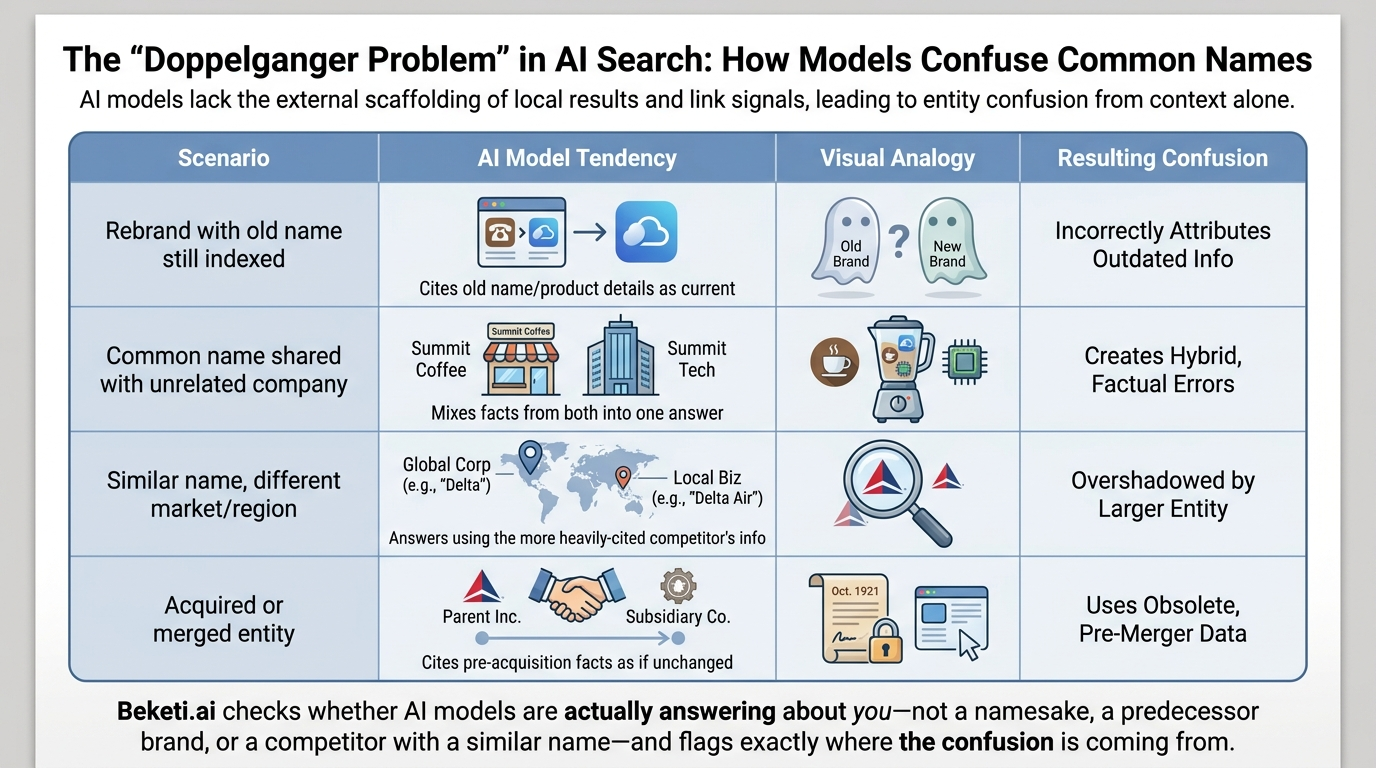
We call this the doppelganger problem: your brand gets blended with, or fully replaced by, a different company that shares your name, a similar name, or even just a similar description.
Where this actually bites
It shows up most with:
- Common single-word brand names that also exist as generic terms or other companies’ names
- Companies that recently rebranded, where old-name and new-name content both still exist online
- Regional businesses sharing a name with a larger company in another market
- Startups whose name is close to an established, more heavily-indexed competitor
| Scenario | What the model tends to do |
|---|---|
| Rebrand with old name still indexed | Cites old name/product details as current |
| Common name shared with unrelated company | Mixes facts from both into one answer |
| Similar name, different market/region | Answers using the more heavily-cited competitor’s info |
| Acquired or merged entity | Cites pre-acquisition facts as if unchanged |
Why this is hard to catch yourself
You won’t see this by searching your own name in the tool you use daily — you already know which company you mean, so you read past the confusion. It shows up when you ask a genuinely ambiguous, real-buyer-style question and check every detail in the answer against what’s actually true about your business.
Fixing it isn’t a content problem, it’s a clarity problem
The fix usually isn’t “publish more content.” It’s making the disambiguating facts (what you do, where you’re based, what you’re not) explicit and repeated in the pages a model is most likely to cite, so there’s less room for it to default to the wrong entity.
beket.ai checks whether AI models are actually answering about you — not a namesake, a predecessor brand, or a competitor with a similar name — and flags exactly where the confusion is coming from.
Related posts
Why Third-Party Signals Drive AI Mentions More Than Your Own Content
AI models don't just read your website. They read the web's conversation about you — and that's what shapes your citations.
Introduction to AI Presence Auditing by beket.ai
Why ensuring AI models accurately represent your business is the new frontier for brand trust, discoverability, and competitive advantage.
The AI Answer About Your Business Is Already Out of Date
AI search engines get facts about your brand wrong more often than you think, and the errors shift every week.