
Your AI Answer Is Not a Fact, It's a Weather Report

A one-time AI visibility check tells you what the model said on the day you asked. It doesn’t tell you whether that answer holds up next week, or whether a competitor’s new landing page just knocked you out of the response entirely.
That’s the gap most “AI SEO” advice skips over: answers aren’t static pages with a stable rank. They’re generated fresh, often influenced by whatever the model crawled most recently.
What actually changes between checks
Across the audits we run, the same query re-asked days or weeks later can come back with a different set of cited sources, a different top recommendation, or the same brand described with different (sometimes contradictory) details.
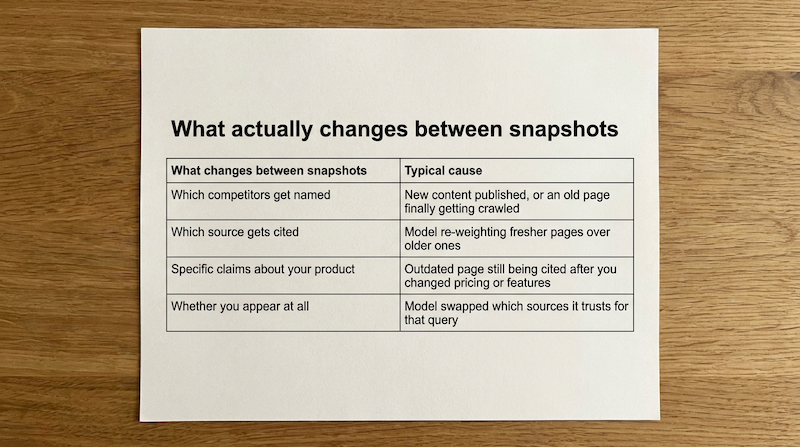
| What changes between snapshots | Typical cause |
|---|---|
| Which competitors get named | New content published, or an old page finally getting crawled |
| Which source gets cited | Model re-weighting fresher pages over older ones |
| Specific claims about your product | Outdated page still being cited after you changed pricing or features |
| Whether you appear at all | Model swapped which sources it trusts for that query |
Why a single snapshot is worse than no data
A single check creates false confidence. If the one time you looked, you were mentioned favorably, it’s easy to assume that’s steady state. It usually isn’t. The models are re-answering constantly, and the sources feeding those answers change underneath you without any notification.
Track it as a trend, not a fact
Treat AI visibility the way you’d treat rankings before AI search existed: as a line on a chart, not a single number. What matters is the direction — are you appearing more often, in more accurate framing, over time — not whether one snapshot looked good.
beket.ai re-runs your queries on a schedule and shows you the trend line, not just a one-time score, so a good result today doesn’t quietly erode without you noticing.
Related posts
The Most Dangerous Thing AI Can Say About You Is Almost Nice
A bad review you can fight. A lukewarm AI mention just quietly costs you customers.
Stop Optimizing the Things That Don't Move the Needle
The newest, most-hyped AI visibility tricks are usually the least important. The boring fundamentals are what get you cited.
Own the Words and AI Will Hand Them Back to You
Models learn to associate specific phrases with specific brands. Most companies waste that by being vague.