
Small Canadian Businesses Are Nearly Invisible in AI Search
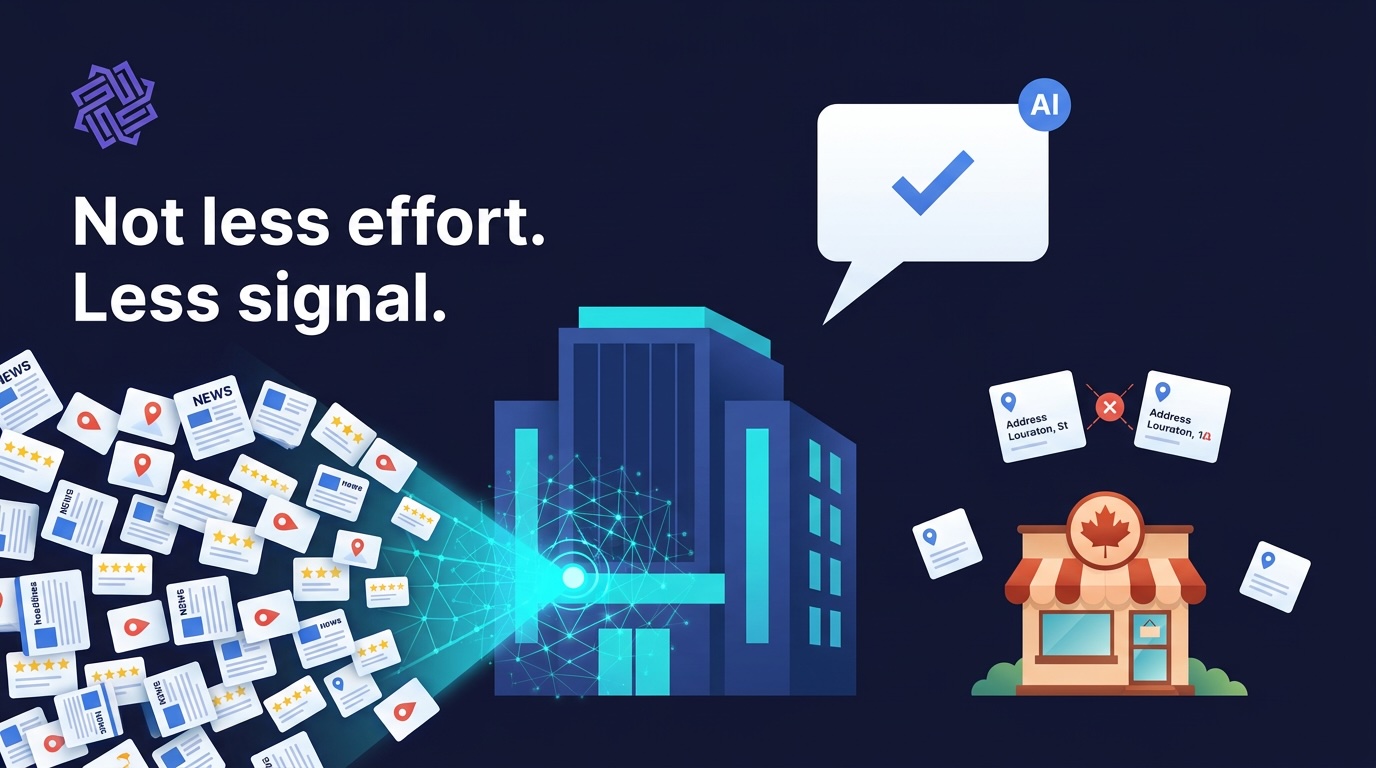 Most of the AI-search-visibility conversation in Canada so far has centered on larger, better-resourced brands — enterprise companies with marketing teams big enough to run an AI visibility audit as one more workstream. Local and small Canadian businesses face a different, harder version of the same problem, and it’s largely structural rather than a lack of effort.
Why small business visibility is a different problem
A large brand has years of press coverage, directory listings, and reviews for an AI model to draw on even if nobody’s optimized for it deliberately. A local business — a clinic, a contractor, a regional retailer — often has almost none of that. When a model can’t find enough third-party signal to answer confidently, it either stays generic or defaults to whichever competitor does have that signal, regardless of who’s actually better.
| Signal type | Typical enterprise brand | Typical local Canadian small business |
|---|---|---|
| Press/media mentions | Dozens to hundreds | Often zero to a handful |
| Review volume across platforms | High, multiple platforms | Low, usually one platform |
| Directory/citation consistency | Managed, consistent | Often inconsistent name/address/phone across listings |
| Dedicated FAQ/service pages | Common | Frequently absent |
What this means practically
For a small business, the fastest lever usually isn’t publishing more blog content — it’s fixing the basic signal gap: consistent business information across directories, encouraging and responding to reviews, and making sure service-area and offering details exist in clear, crawlable text rather than only on a Facebook page or a PDF menu.
Where to start if you’re behind
Confirm the basics are consistent everywhere your business is listed, then check whether an AI model can answer simple “does this business do X, in this area” questions correctly. That test alone reveals most of the gap.
beket.ai checks how much verifiable signal actually exists about your business online, and flags the specific gaps holding a local brand back from AI visibility that a bigger competitor doesn’t have to deal with.