
ChatGPT Now Flags Vendor-Written Rankings: What the Disclaimers Mean for Brands

Ask ChatGPT for the best tools in a software category and some answers now end with a short warning: be careful who wrote the rankings. One practitioner's tracking data suggests this is still a small share of answers. But the warnings point straight at a tactic many companies have used, the self-promotional listicle.
This is a news take on what has been reported, what the numbers do and do not show, and what a brand can do that does not depend on writing a list that ranks itself first.
What was reported
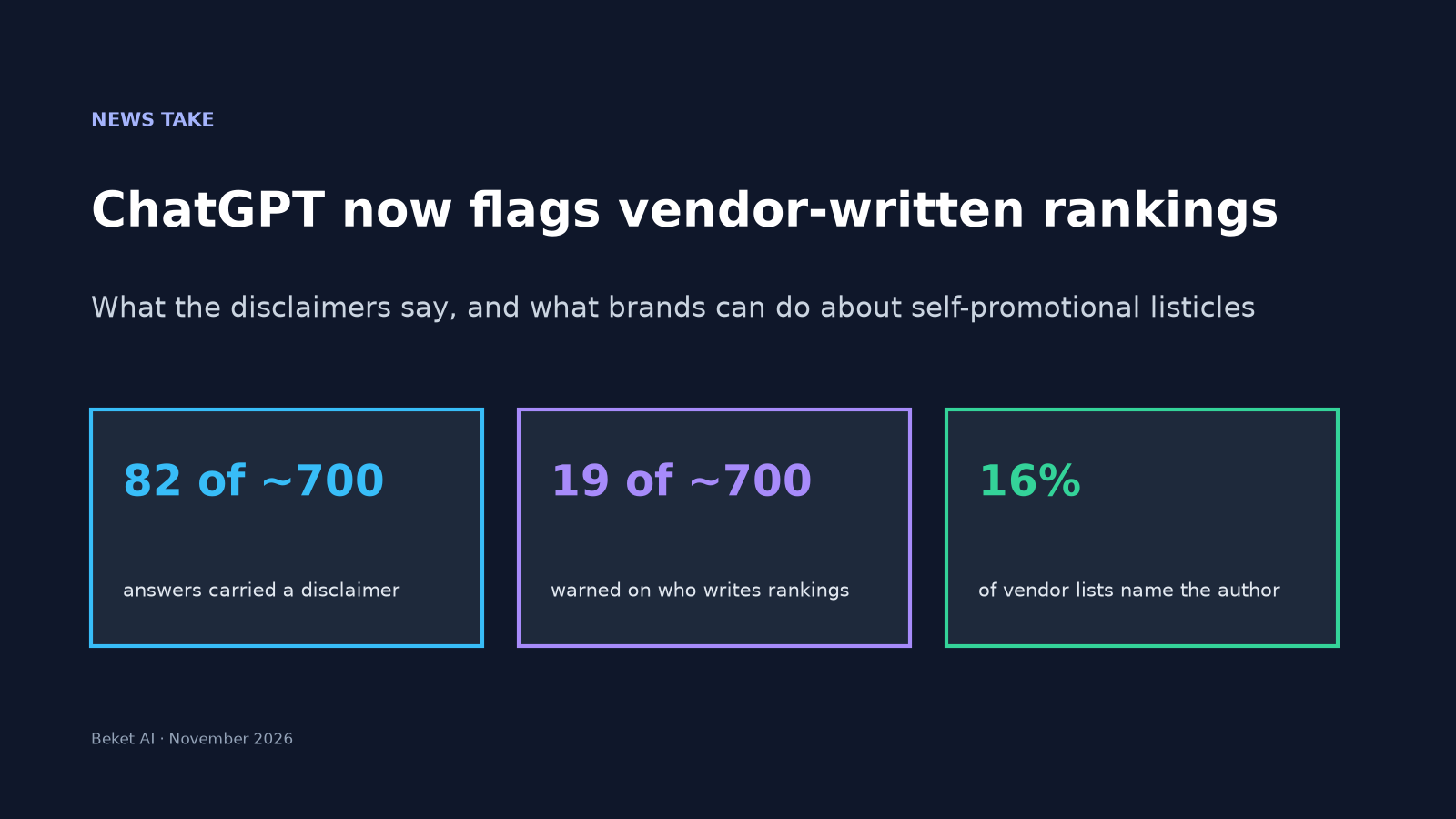
In mid-October 2026, SEO practitioner Lily Ray posted what she was seeing in her prompt tracking. She tracks a long list of B2B software prompts. Of about 700 ChatGPT answers in the past week, 82 included some kind of disclaimer, and 19 specifically warned users about who writes the rankings and reviews ChatGPT draws on.
According to her post, ChatGPT was cautioning about:
- vendors ranking themselves on their own comparison pages
- publishers affiliated with a brand they review
- whole categories where many comparison articles are written by companies selling those products
- sponsored placements and paid-for reviews on review sites
- recommendations that seem to exist mainly to promote affiliate links
- taking vendor claims at face value
- its own shortlist not being independently tested
She noted the disclaimers are usually "a sentence or two at the end of a list of recommended brands," and described them as a likely temporary band-aid while AI companies work out better ways to surface objective answers.
Read the numbers carefully. The denominator is answers, not brands or pages: 82 of about 700 is roughly 12%, and 19 of about 700 is roughly 3%. It is one practitioner's tracking of B2B software prompts over one week, not a controlled study, and it says nothing about local services, restaurants or retail.
Why those warnings target listicles
A self-promotional listicle is a software vendor's "best tools" list that includes its own product. The Self-Promotional Content Data Study by Minuttia and Convex Works measured how often AI answers cite them. It asked 18,084 software questions across Google Search, AI Overviews, ChatGPT, Gemini, Claude and Perplexity, with answers collected over two weeks in August 2026 (the X vs Y questions for ChatGPT were re-asked in October).
Per Minuttia's summary of the findings:
- 34% to 47% of cited listicles on "alternatives to X" questions were self-promotional, depending on the platform
- 93% of self-promotional listicles highlight the vendor's own product
- 87% rank the vendor's product first
- only 16% clearly disclose that the vendor created the list
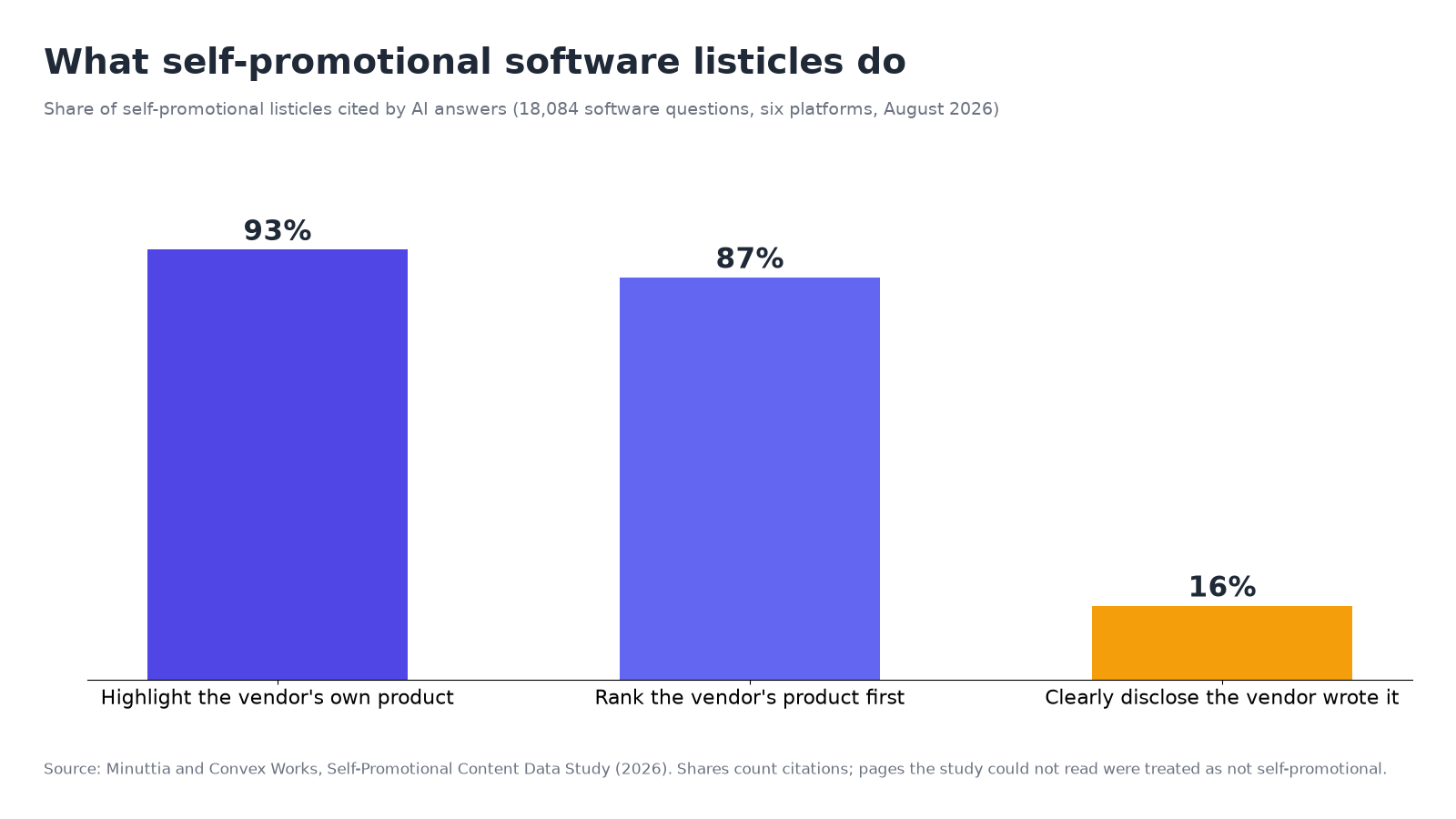
The study's own methodology notes that these shares are a floor, because pages it could not read were counted as not self-promotional, and that it is a snapshot of August 2026. It is also run by firms that work in AI search, so treat it as one dataset, not a verdict.
Put the two sources side by side and the disclaimers make sense: a large share of the lists AI cites in software are written by the companies on them, and few say so.
Citing a vendor list is not the same as recommending the vendor
There is a second, separate finding. In a June 2026 analysis, Lily Ray pulled Google AI Overview answers for 100 B2B "best [category] software" queries at three dates between April and June. Across the 80 queries that showed an AI Overview, a brand's own "best" listicle was cited as a source but the brand was left out of the recommendation on 224 of 323 cited self-promotional listicles (69%). Her read is that the recommended brands tended to be established category leaders that many third-party pages talk about.
That is Google AI Overviews, B2B software, April to June 2026, from one analyst. It is not a measurement of ChatGPT. But it fits the same pattern: a citation and a recommendation are different outcomes.
| What it measures | Number | Source | |
|---|---|---|---|
| ChatGPT disclaimers | Answers carrying any disclaimer (about 700 B2B software answers, one week) | 82 | Lily Ray, October 2026 |
| Rankings warning | Answers warning about who writes rankings and reviews | 19 | Lily Ray, October 2026 |
| Vendor lists disclose authorship | Self-promotional listicles that clearly say the vendor wrote them | 16% | Minuttia and Convex Works, 2026 |
| Cited but not recommended | Cited self-promotional listicles where the publisher was not recommended in the AI Overview | 224 of 323 (69%) | Lily Ray, June 2026 |
What this means if you sell software, or anything else
The reported disclaimers were on B2B software. Nothing here shows ChatGPT adds them for a plumber or a bakery. But the logic carries over to any category where businesses write their own "best of" pages: it is reasonable to expect what other people say about you to matter more than what you say about yourself (that is our inference, not a measured result).
- Do not rely on ranking yourself first. If you publish a comparison, say clearly at the top that you make one of the products, state how you tested, and link the public pages your claims come from. In the study, only 16% of self-promotional lists clearly disclosed the vendor wrote them.
- Earn mentions on pages you do not control. Independent reviews, trade publications, directories, customer write-ups and community threads are the kinds of sources those warnings point toward. Our post on why brand mentions are the new backlinks for AI search covers how those mentions show up in AI answers.
- Publish things only you can: your own data. Original numbers, pricing, specs and methods give independent sites something to cite. Where a comparison is warranted, cite sources for every claim, as in our GEO tools comparison, where prices come from each vendor's public page.
- Check what AI says about your category and about you. Ask the unbranded buyer questions yourself and read the end of the answer, where these caveats tend to sit. For the reputation side, see how to check ChatGPT brand sentiment.
- Keep a record over time. AI answers change, and a disclaimer that appears this week may not appear next month. Re-run the same questions on a schedule and compare. The free audit on the Beket AI homepage runs 25 prompts across ChatGPT, Perplexity and Google AI Overview so you can see whether you are named and which sources are cited; it does not look for disclaimers specifically.
A disclosure of our own: Beket AI is also a vendor in the AI visibility category. Our comparison posts use only public pages with links so you can check them, and we would rather you verify than trust us.
Where the evidence stops
- The disclaimer counts are one practitioner's tracking of B2B software prompts in one week; method, mode and how disclaimers were classified are not published in the post.
- The listicle study covers software, in August 2026; the platforms and their sources change fast.
- The 69% result is for Google AI Overviews in April to June 2026, not ChatGPT.
- None of this shows that a disclaimer changes what buyers do, or that ChatGPT demotes vendor pages. It shows the warnings exist and that vendor-written lists are common and rarely labelled.
Sources
- Lily Ray, LinkedIn post on ChatGPT disclaimers (October 2026)
- Lily Ray, Why Calling Yourself the Best Could Be Helping Your Competitors Win in AI Search (June 17, 2026)
- Minuttia and Convex Works, Self-Promotional Content Data Study and its methodology
- Minuttia, summary of findings
Figures are as published by each source. Checked November 8, 2026.
Related posts
ChatGPT API vs ChatGPT: Why AI Visibility Checks Don't Match What Users See
Is the OpenAI API the same as ChatGPT? A 2026 paper found Google plus the API recovered about half of cited sites but only 26–28% of cited pages.
Agent-Ready Website Checklist for 2026 (llms.txt, Schema, AIPREF, UCP, NLWeb)
A 2026 checklist for agent-ready sites: crawlable HTML, ReserveAction, llms.txt, AIPREF, UCP and NLWeb, plus where /ai-check fits.
Which SF Marketing Agencies Does AI Recommend? 2026 Study
Jives Media led 242 agency mentions in a Beket AI study of 25 San Francisco buyer prompts across ChatGPT, Perplexity and Google AI Overview.