
Google Is Reportedly Hiding AI Overview Source Cards: Why Being Named in the Answer Matters More Now

For a long time, the easiest way to see whose work fed a Google AI Overview was the row of source cards beside it: two or three websites, with logos and page titles. This week, SEO consultant Brodie Clark reported that those cards are showing up far less often on desktop.
If that holds, the credit a business gets inside an AI Overview moves toward the answer text itself, the part people actually read. So we checked our own data. On October 28, 2026, Beket AI reran 14 local questions about lawyers, realtors and mortgage brokers in Seattle and Vancouver through Google AI Overviews. In the 12 answers we got back, Google still attached sources to every answer, but the businesses it named and the business websites it linked were mostly different.
Here's what was reported, what our audit found, and what it means if you run a local business.
What was reported
Brodie Clark, who writes about Google Search, posted on X that Google's recent changes to AI Overviews are "brutal for websites." According to Clark:
- AI Overviews used to prominently show citations for two to three domains in visible cards. He's now seeing "a drastic reduction in their appearance."
- Hiding the cards has been the default on mobile for some time, and "it looks like the change is now here to stay" on desktop.
- Google has another AI Overview format that automatically opens the "show more" section, so the cards appear. But that version "seems to be rare at this point."
- If your site has seen impressions and visibility drop in recent days, this is likely a contributing factor.
- AI Overviews now appear for 83% of all US desktop searches, citing Semrush data.
The LabraSEO newsletter of October 28 led with the same story. It summarized it as a sharp drop in visible citation cards that now looks permanent on desktop. It also noted that sites "may see impressions and visibility fall even where their content is still being used."
Two caveats. This is one practitioner's observation, repeated by a newsletter. Google hasn't confirmed or explained any change in either source. And the 83% figure is Semrush's, as cited by Clark, for US desktop searches overall. Local searches vary a lot by trade, as we covered in what percentage of Google searches have AI Overviews.
Why the source cards mattered
An AI Overview gives a business two kinds of visibility:
- Being named in the answer. The text says your firm, agency or brokerage by name, often with a reason to pick you.
- Being linked as a source. Your page is one of the links Google attaches to the answer.
The source cards were the most visible form of the second. They showed a logo, a title and a domain in a box beside the answer, without the searcher doing anything. If they are folded behind "show more" by default, a link still exists, but fewer people will see it. The name in the text doesn't need a click to be seen.
That's why the question "How often are businesses named versus only linked?" matters more now. Our audit was set up to answer it.
What we found in 12 local AI Overviews
We ran two Beket AI market audits on October 28, 2026, one set to Seattle, Washington and one to Vancouver, British Columbia. Both used only Google AI Overviews. We picked 14 questions from our earlier Seattle lawyers and Vancouver realtors studies and their sister studies, all of which had triggered an AI Overview before. The full list is at the end.
12 of the 14 questions got an AI Overview this time: all 7 in Vancouver and 5 of 7 in Seattle. "Tenant rights lawyers in Seattle" and "Best mortgage brokers in Seattle for low rates" didn't get one, though both did on October 27.
Every answer still had sources
All 12 answers came with source links: 87 in total, from 3 to 14 per answer. So in our sample, Google was still attaching sources to every local answer. That fits Clark's description of cards being hidden rather than removed. But our data can't show how the links were displayed (more on that below).
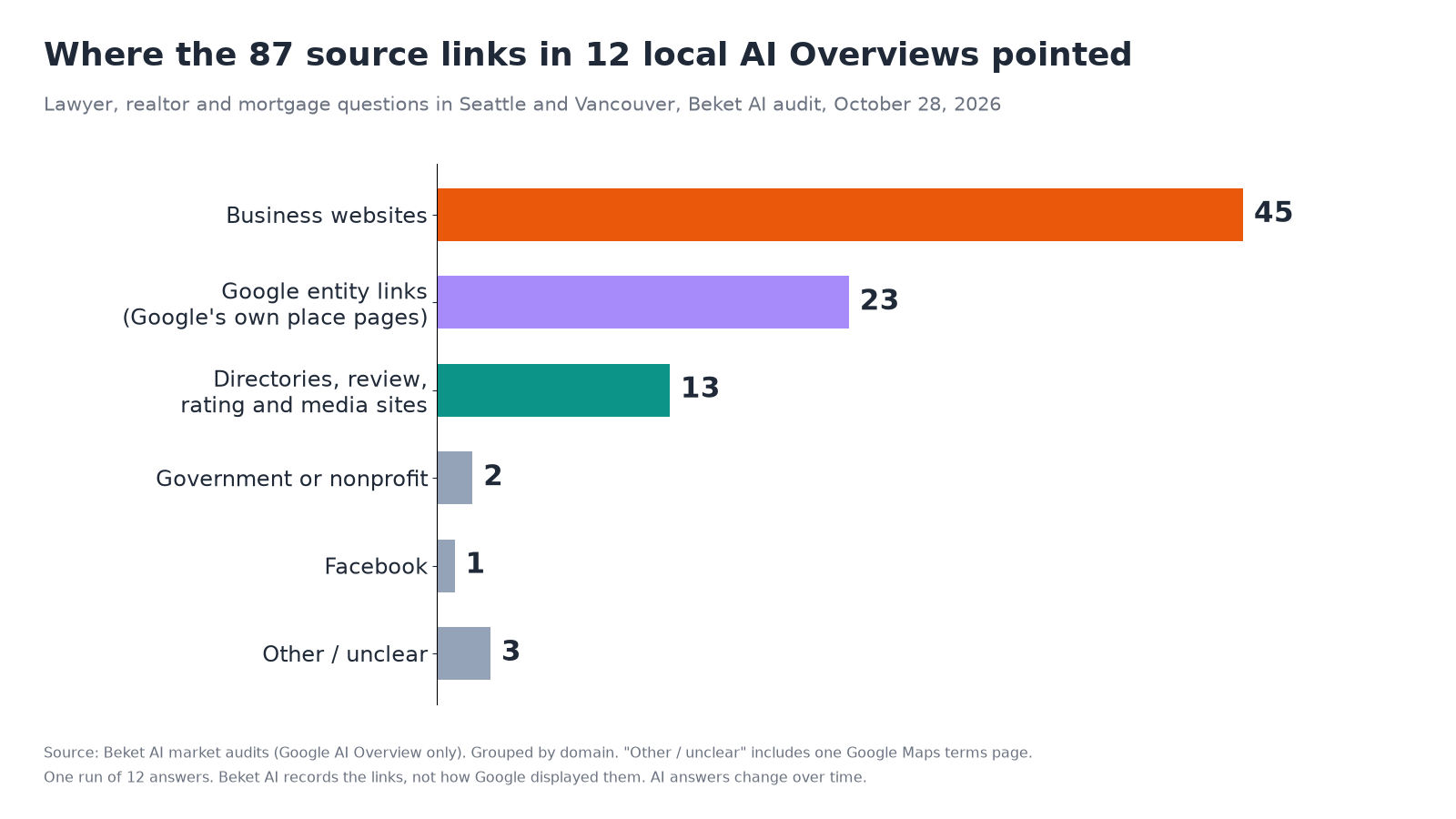
Here's where the 87 links pointed:
| Link type | Links | Share |
|---|---|---|
| Business websites | 45 | 52% |
| Google entity links (Google's own place and business pages) | 23 | 26% |
| Directories, review, rating and media sites | 13 | 15% |
| Government or nonprofit | 2 | 2% |
| 1 | 1% | |
| Other or unclear | 3 | 3% |
Two things stand out.
More than a quarter of the links went to Google itself. 23 links pointed to Google pages that open a business or place entity, not to the business's own website. They showed up in 7 of the 12 answers. "Family lawyers in Seattle" had 8 of them out of 14 links. "Luxury real estate agents in Vancouver" linked no realtor website at all, just 3 Google entity links and a rentals company. We can't tell from the links which businesses those entity pages belong to.
Business websites still made up about half. 11 of the 12 answers linked at least one business website, and 43 different businesses had their site linked.
| Industry | Answers | Links | Business website links | Google entity links |
|---|---|---|---|---|
| Lawyers | 4 | 36 | 20 | 11 |
| Realtors | 5 | 33 | 15 | 8 |
| Mortgage brokers and lenders | 3 | 18 | 10 | 4 |
With 3 to 5 answers per industry, we wouldn't read much into the differences between them.
Named businesses and linked businesses were mostly different
Beket AI counted 111 mentions of named organizations across the 12 answers: 48 in the 5 Seattle answers and 63 in the 7 Vancouver answers. In Seattle, that worked out to 37 different names. Beket AI shows the top 10 names per audit, and every Seattle name outside the top 10 appeared once. In Vancouver, we can only say it was between 29 and 48 names.
The names weren't all businesses. Seattle's most-mentioned name was HomeSight, a nonprofit homebuyer program, with 5 mentions. A state housing finance agency and a city homebuyer program also made its top 10. In Vancouver, ICBC, the province's public auto insurer, had 4 mentions, and a realtor rating site, a condo listing site and the regional real estate board also made the top 10.
Among businesses, the most-mentioned were:
- Seattle: Stoel Rives LLP (3 mentions) and Trelora Real Estate (3), then Davis Wright Tremaine and Real Residential (2 each). Amy Hyden Homes, Ashurst and Coldwell Banker Global Luxury had 1 each in the top 10, and 27 more names appeared once.
- Vancouver: Preszler Injury Lawyers (5 mentions, across two spellings of its name), then bcprivateloans.ca, Engel & Völkers, Kazlaw and Oakwyn Realty (2 each). The other 38 mentions went to names outside the top 10.
Then we compared those names with the linked websites.
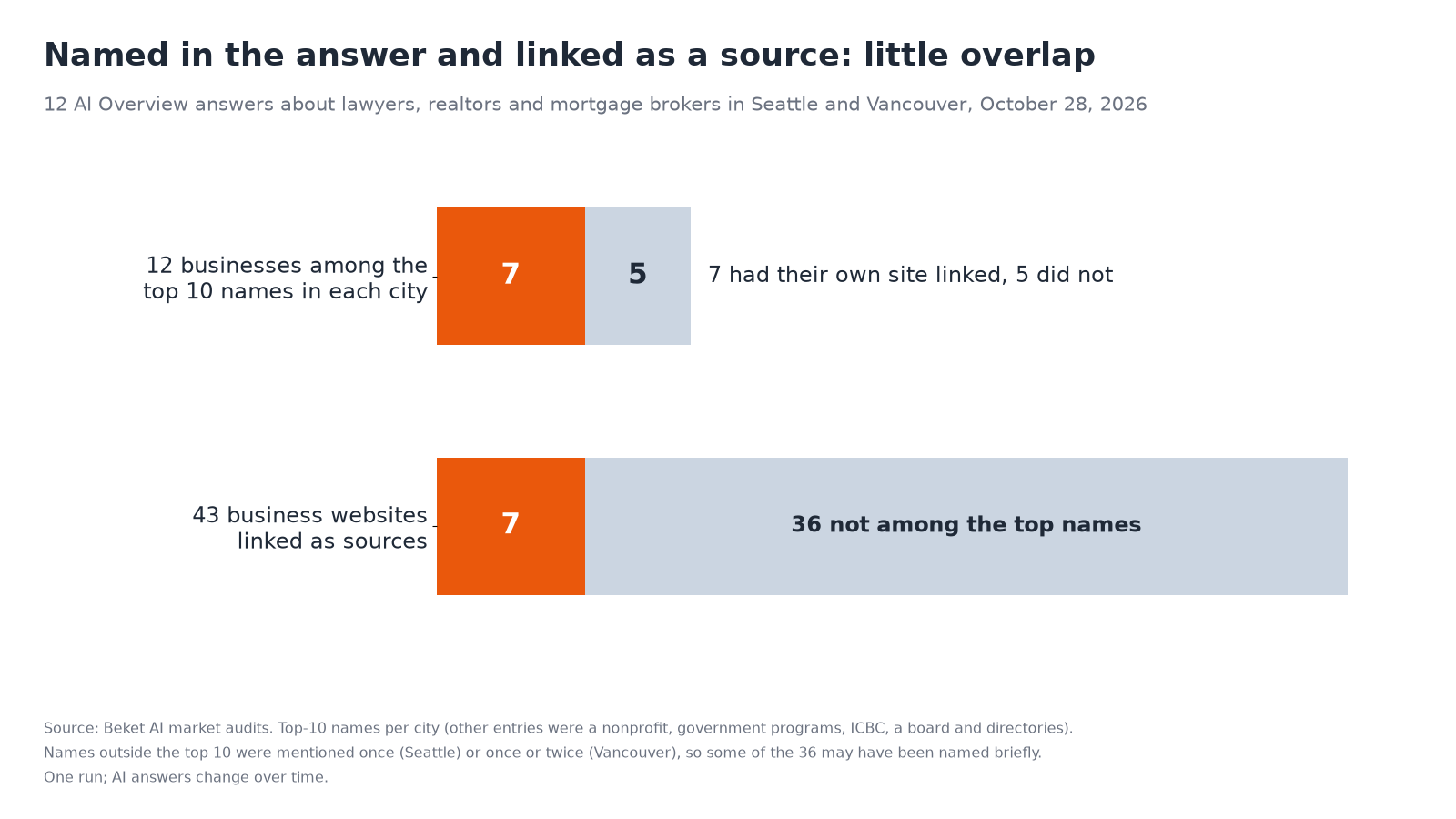
- Named, but not linked. Of the 12 businesses in the two top-10 lists, 5 had no link to their own website: Real Residential, Ashurst, Coldwell Banker Global Luxury, Engel & Völkers and Oakwyn Realty. Four of the five are large law firms or brokerage brands. Google named them in the answer and pointed the source links somewhere else.
- Named and linked. The other 7 had their own site among the sources. These include Stoel Rives, Davis Wright Tremaine, Trelora and Preszler.
- Linked, but not among the top names. 36 of the 43 linked business websites belonged to businesses outside the top-10 names. Some were probably named once or twice further down an answer. Others may not have been named at all. For example, Watson Goepel's website was linked in 2 Vancouver answers, but the firm wasn't among the top 10 names in those answers.
The takeaway: in these answers, Google treated naming a business and linking to it as two separate decisions. A big brand could be named without a link. A firm's page could be linked while the firm got a passing mention or none. If source cards are hidden by default, as Clark reports, the first kind of visibility is the one people still see without clicking.
What our audit can't tell you
- How links were displayed. Beket AI records the links attached to an AI Overview. It doesn't record whether Google showed them as cards, as small inline links, or behind "show more", or whether the page used a desktop or mobile layout. So this audit neither confirms nor refutes the reported desktop change.
- The full name list. We see each audit's top 10 names and the total mention count, not every name in every answer. That's why some numbers above are ranges.
- Sample size. This is 12 answers from one run on one day, with two location settings. AI answers change by the day, by the wording of the question and by the person searching.
- Our groupings. We sorted links by domain by hand, and matched named businesses to their own websites by hand.
For comparison, the same 12 questions had 99 source links in our October 23 (Vancouver) and October 27 (Seattle) runs, against 87 this time. That's one earlier run each, so it's not a trend.
What this means if you run a local business
Make it easy for Google to name you. Use the same business name everywhere, and make it clear what you do and where. An answer can only name you if Google is confident about who you are. Our guide to entity SEO covers how search engines connect your name, your services and your location.
Treat your Google Business Profile as a source too. About a quarter of the links in our sample went to Google's own entity pages for businesses and places, not to anyone's website. Keep your categories, services, hours and reviews current, because those pages may be what Google shows.
Keep earning the link. Sources were still attached to every answer we recorded, and 43 businesses had their site linked. A clear page for each service and each area you cover gives Google something specific to cite. Here's how to show up in Google AI Overviews.
Expect impressions to move. If cards are folded away, impressions and clicks from AI Overviews may drop even when your page is still cited, which is the point LabraSEO made. Before you blame your content, look at the dates. Our guide to tracking AI Overview traffic in Search Console and GA4 explains what those tools can and can't show.
Check AI Mode separately. AI Mode is a different surface with its own layout. Here's how AI Mode and AI Overviews differ.
What we're watching next
- Whether Google says anything. So far, this rests on Clark's observation.
- The auto-expanded version. Clark says an AI Overview type that opens "show more" automatically still exists but is rare. If it spreads, cards come back into view.
- Repeat runs. We plan to rerun these questions to see whether the share of Google entity links and the gap between named and linked businesses holds up.
Study details
- Date: October 28, 2026. Answers recorded between about 1:09 and 1:11 PM Pacific.
- Engine: Google AI Overviews only, in English, using two Beket AI market audits. One was set to Seattle, Washington, United States, and one to Vancouver, British Columbia, Canada.
- Seattle questions (7): best law firms in Seattle; family lawyers in Seattle; tenant rights lawyers in Seattle; luxury real estate agents in Seattle; realtors for first time home buyers in Seattle; Best mortgage brokers in Seattle for low rates; mortgage brokers for first time home buyers in Seattle.
- Vancouver questions (7): personal injury lawyers in Vancouver; startup lawyers in Vancouver; best realtors in Vancouver BC; presale condo realtors in Vancouver; luxury real estate agents in Vancouver; Best mortgage brokers in Vancouver for low rates; private mortgage lenders in Vancouver BC.
- Extra questions: Each audit also ran 4 longer questions of its own about real estate lawyers. 6 of those 8 got an AI Overview. They're excluded from every number above, but they appear in our raw data.
- What we counted: Source links come from the URLs Beket AI recorded for each answer, grouped by domain. Named counts come from Beket AI's mention counts for the 12 answers: the top 10 names per city plus the total number of mentions.
AI answers change over time, and a single run is a snapshot. If your business is in one of these markets and you think the picture has changed, you can ask Beket AI for another run of this study at beket.ai.
If you want to see whether AI answers name your business for the questions your customers ask, Beket AI's free audit runs 25 prompts across 3 AI engines. Beket AI Pro ($49/month) re-runs the audit daily, starting at 50 prompts across 3 engines, so you can see how answers change over time.
About the author: Nur Rysbek is the CEO of Beket AI.
Related posts
What Google's Connected Apps Platform Means for Getting Found in AI Mode
Google now lets developers submit apps to AI Mode and Gemini, but users must link them. Who it matters for, what to do now, and why AI mentions still count.
Best SEO Conferences 2026: Dates, Prices and AI Sessions
The SEO and AI search conferences left in 2026 and dated for 2027, with official prices, venues, and which agendas name GEO or AI search sessions.
Does Google AI Use Reddit as a Source? What New Data Means for Local Businesses
A 3.2M-page study finds Google AI Overviews cite user posts far more than ChatGPT or Perplexity. What our local audits show, and what to do about it.