
AI Search Sends Little Traffic. Here's Why Local Businesses Should Still Care

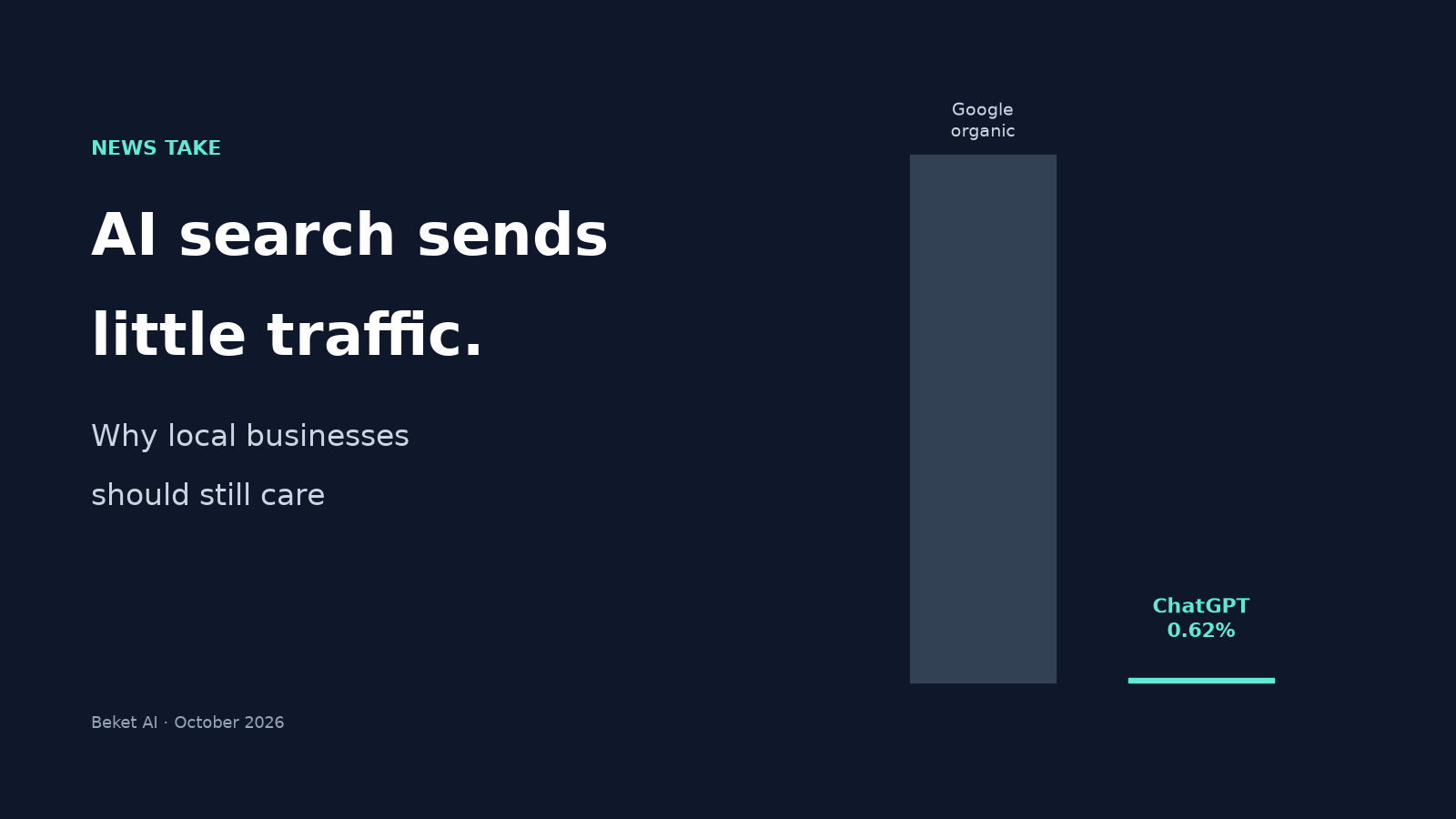
Three studies published in the past two weeks say the same thing: AI search sends a tiny amount of traffic compared with Google. If you run a local business and someone has been telling you to worry about ChatGPT, these numbers are a fair reason to push back.
They are also measuring one thing: clicks that analytics can see. That is a real number, but it is not the same as influence. This post goes through what the studies found, where they are right, and why the answer looks different when the question is "who should I hire?"
The three studies, in one table
| Study | Sample | AI traffic vs Google organic | Conversion rate |
|---|---|---|---|
| Marie Haynes, "GEO is a distraction" (Oct 21, 2026) | 12 months of GA4 data, 100 sites, over 145 million sessions | ChatGPT sessions = 0.62% of Google organic. All LLMs together = 0.73% | ChatGPT 13.8% vs Google organic 3.02% (55 sites tracking conversions) |
| The SEO Works (Sep 2025 to Aug 2026) | 95 sites; 63 for conversion comparisons | Organic sent 39x more traffic. AI = 2.6% of organic | AI 7.18% vs organic 6.08% (1.18x). AI converted worse on 23 of 63 sites |
| Kevin Indig, Growth Memo (Oct 19, 2026) | 12 GA4 properties; 632 tests on four brands | Direct sessions with identifiable AI traces = 0.003% of direct traffic | Not measured |
Search Engine Roundtable summed them up on October 22 under the headline "3 New Studies Suggest AI Visibility & Search Not Worth Investing In."
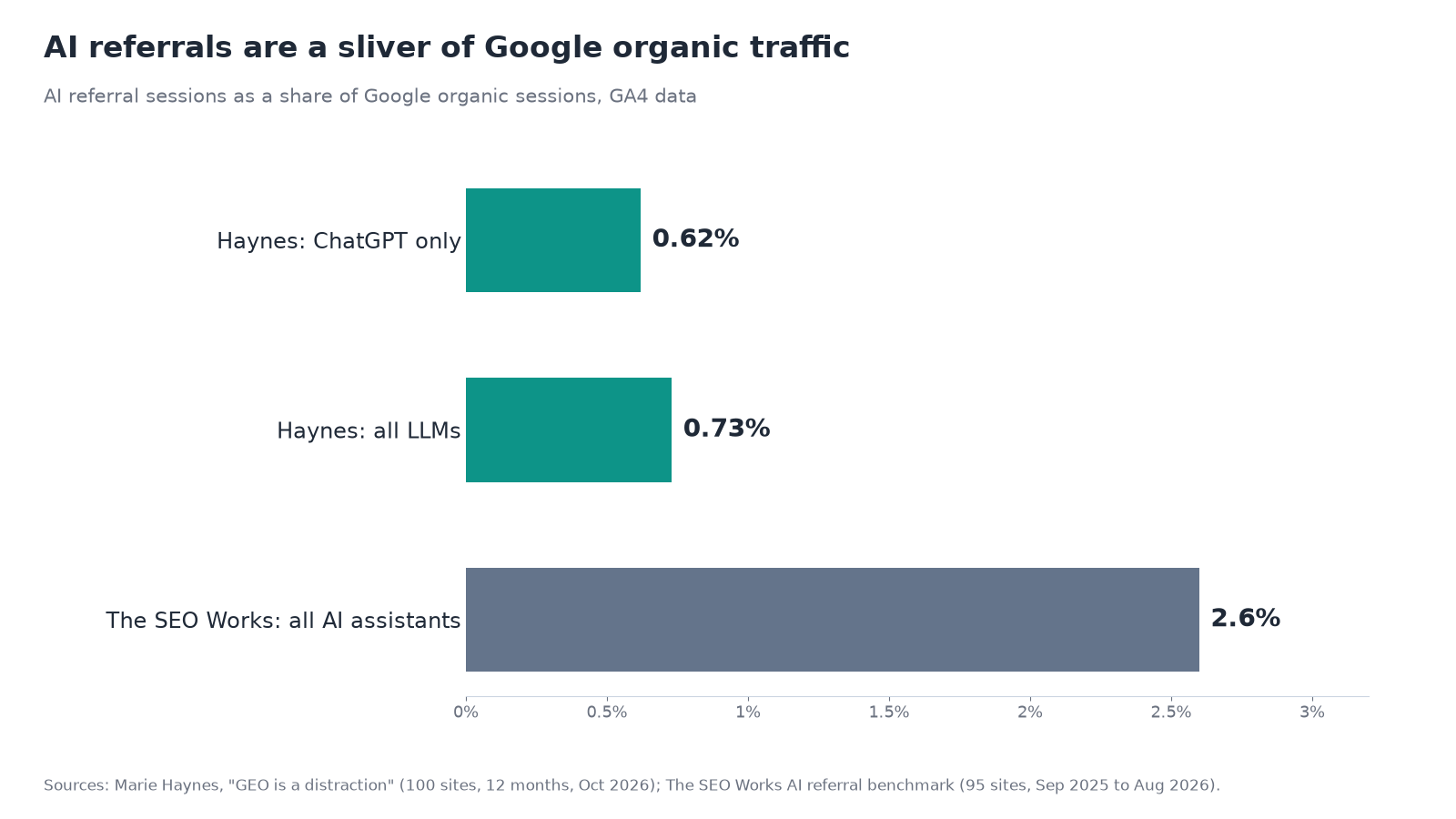
Sources: Marie Haynes (100 sites, 12 months); The SEO Works (95 sites, Sep 2025 to Aug 2026). Different samples and methods, so compare the scale, not the exact figures.
Where the studies are right
Start with what holds up, because it is most of it.
- Google is still where the visits come from. In Haynes's data, Google organic drove 96.5% of conversions across the channels she analyzed, and 27x more conversions than all LLMs combined. The SEO Works found AI referrals delivered 3.2 conversions for every 100 from organic search.
- Small organic gains beat big AI gains. The SEO Works calculated that a 5% lift in organic search would add 10.3 conversions per site per month, more than the 6.6 from doubling AI referral traffic.
- The "people see you in AI and come back later" theory is not showing up in analytics. Indig could not find a reliable link between AI visibility and later branded search or direct traffic. His words: "An effect could still exist. I just couldn't isolate it." The SEO Works ran a similar test and found no evidence that AI growth drives direct traffic.
- AI and organic move together. The SEO Works found that the sites gaining AI referral traffic were the ones whose organic search was improving.
If you were planning to drop your Google work for an "AI strategy," don't. The studies are a useful correction.
The conversion story is smaller than the headline
You will see "AI visitors convert 4.5x better" quoted from Haynes's study, and it is accurate for her data: 13.8% against 3.02%.
But The SEO Works, looking at 63 commercial sites, found AI referrals converted only about a fifth better than organic (7.18% vs 6.08%), and worse than organic on 23 of them. For B2B product sites, AI traffic converted at 0.62x the organic rate. They also point out that the multiple depends on what you compare against: 0.67x against paid search, 1.18x against organic, 2.48x against direct.
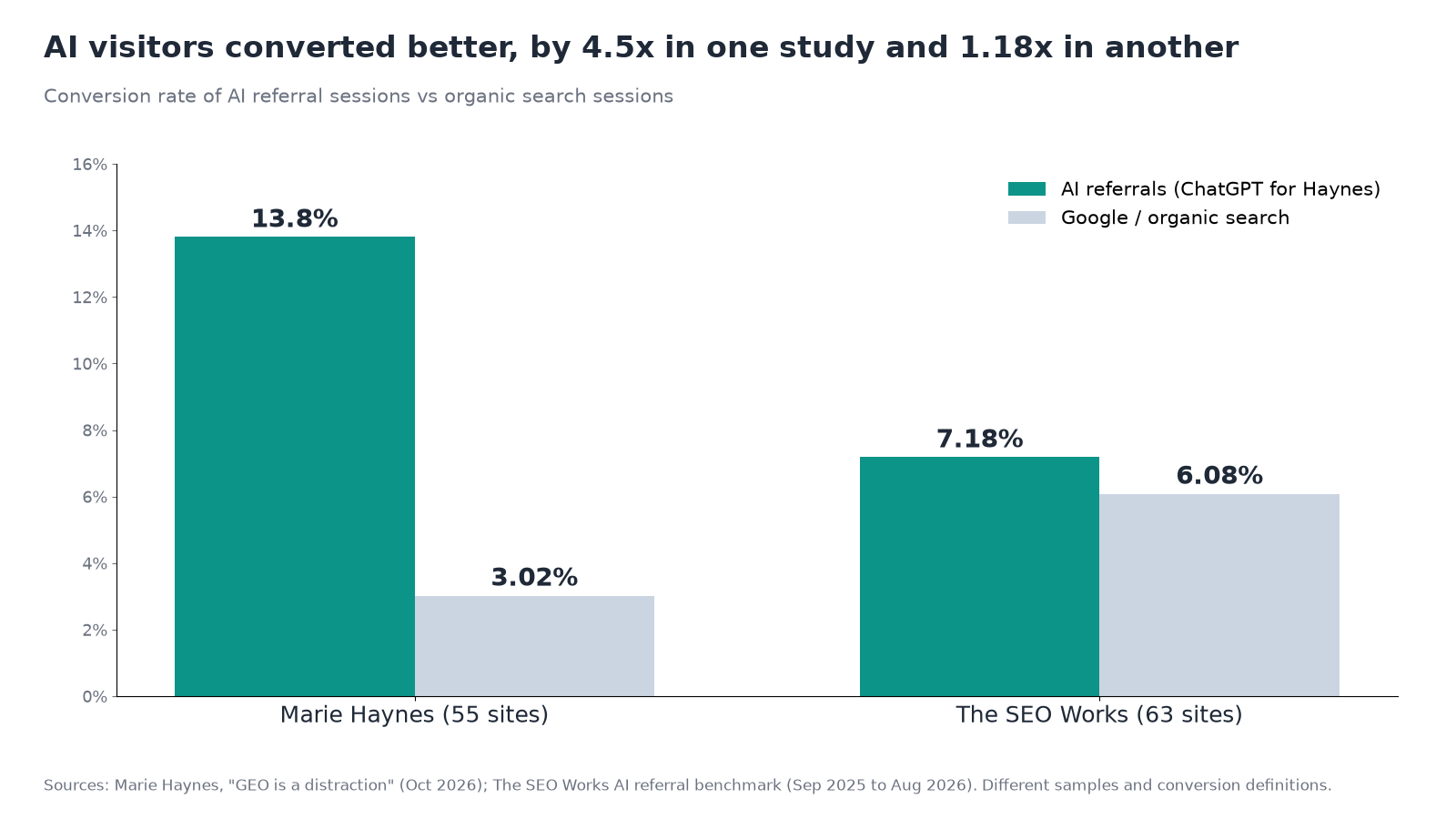
Sources: Marie Haynes (55 sites tracking conversions); The SEO Works (63 sites).
So the honest version is: AI visitors tend to convert at least as well as organic visitors, sometimes much better, but there are not many of them.
What a click count cannot see
All three studies measure sessions in Google Analytics. That leaves out three things, and the authors say so themselves.
1. Google's own AI answers count as organic. The SEO Works notes that clicks from Google AI Overviews "arrive as ordinary organic sessions and cannot be separated," so "the measured AI contribution should be read as a floor." Haynes makes a related point: "The AI search that is actually sending people to businesses today isn't ChatGPT. It's Google," through AI Overviews and AI Mode. In other words, a big share of the AI search that matters is inside the "Google organic" bar in the chart above.
2. Answers that end the search never show up. Pew Research Center found that when a Google AI summary appeared, people clicked a link inside it in just 1% of visits, and ended their browsing session on 26% of those pages, compared with 16% without a summary. A person who reads three plumbers' names in an answer and then phones one of them creates no session for anyone. We covered this gap in why being cited is not the same as being clicked.
3. Analytics misses some AI visits outright. The SEO Works lists in-app browsers, stripped referrers, and people who read an AI answer and then search for the brand by name as visits its method would not catch.
None of this proves AI influence is large. Indig tried to find it and could not. It does mean the traffic numbers are the wrong tool to rule it out. His own recommendation is to combine where your brand appears in AI answers, what customers say when you ask how they found you, and what happens commercially.
Why local "who should I hire" prompts are different
The 100-site and 95-site samples are mixed: publishers, ecommerce, B2B, services. A local service business has a different funnel. The decision is often a phone call, and the shortlist is often the whole decision.
People are asking. In BrightLocal's 2026 Local Consumer Review Survey of 1,002 US adults, 45% said they had used AI tools for local business recommendations in the past 12 months, up from 6% the year before. ChatGPT was used by 31% for business recommendations, and Google's AI Mode by 23%.
And the answers are narrow. When Beket AI ran unbranded local questions through the engines, the names spread across many businesses, and different engines often named different ones:
| Beket AI study | What the engines did |
|---|---|
| Which Vancouver electricians AI recommends (Oct 21, 2026) | 21 electricians named across Google AI Overview and Perplexity. Only 6 were named by both. Google AI Overview's most-mentioned name was BC Hydro, a utility, with 10 mentions |
| Which Seattle plumbers AI recommends (Oct 16, 2026) | 23 plumbing businesses across ChatGPT, Google AI Overview and Perplexity. No single plumber passed 12% of plumber mentions |
| Which Seattle dentists AI recommends (Oct 16, 2026) | 39 names, 205 mentions. The top five clinics took 61 of 165 clinic mentions (37%). The most-mentioned name was an insurer, Delta Dental |
If you are one of the six electricians both engines named, you are on the shortlist whether or not anyone clicks. If you are not on it, no amount of GA4 analysis will show you the call you did not get. That is the part of AI search the traffic studies cannot measure, and it is the part that matters most for a local business.
What to do with this
- Keep Google first. Every study agrees. Your Business Profile, reviews and website still drive most of your customers, and the same work tends to help you in AI answers.
- Track conversions at all. Haynes found 45 of her 100 sites were not tracking any key events. You cannot compare channels without that.
- Ask new customers how they found you, and write down their words, including which AI tool if they mention one. This is the only way to see the zero-click part.
- Check the shortlist, not the sessions. Ask ChatGPT, Google and Perplexity the questions your customers ask, without your name in them, and see who comes back. Beket AI's free audit runs 25 prompts across 3 engines and shows which businesses get named. Pro, at $49 a month, re-runs it daily so you can see when the list changes.
AI search sends little traffic. For a local business, that was never the main thing it does.
Related posts
Local Business Schema Markup: How to Add It, Test It, and What It Does for AI Search
A step-by-step guide to local business schema markup: pick the right type, write the JSON-LD, test it, and see what Google and Bing say it does for AI answers.
Google Business Home Beta: What It Changes for Local Businesses, and What It Doesn't
Google Business Home is a Gemini-powered beta dashboard for Business Profile, Ads, YouTube and Merchant Center. It changes where you manage, not how you rank.
Your AI Traffic Is Hiding in Direct
Gemini now tags some links with UTM codes. Most AI visits still land in Direct, and agent visits look human. Here is what you can and cannot count.