
Cited Is Not Clicked: What an 87% Drop in AI Click-Through Means for Your Brand

A court brief filed on September 17, 2026 put a hard number on a soft fear. Links shown inside AI chat get clicked far less than links in search.
The brief comes from news publishers suing OpenAI and Microsoft. It quotes a 2023 message from an OpenAI engineer: “no matter how prominently we show the links, users won’t click.”
The numbers
The brief cites Microsoft data. It compares click-through rate for the same sites in Bing Chat and in Bing web search.
| Publisher group | Click-through rate in chat vs. search |
|---|---|
| The New York Times sites | 87% to 93% lower |
| Daily News sites | 83% to 91% lower |
| Ziff Davis sites | 51% to 94% lower |
Read these numbers with care. They come from one side of a lawsuit. The court has not ruled. The brief does not say when the data was collected or how many queries it covered. OpenAI and Microsoft dispute the case.
The direction is still clear. The best case in the table is a 51% drop. The worst is 94%.
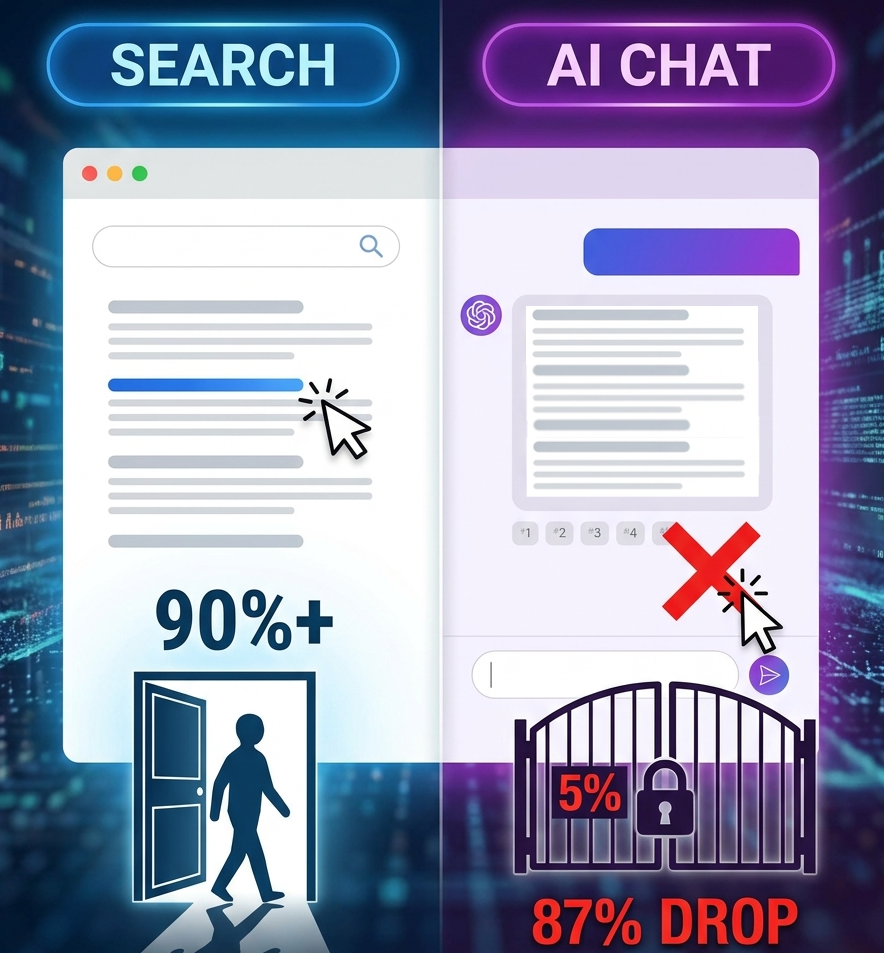
Citations and clicks are two metrics
The tools that measure AI search count citations. Bing Webmaster Tools reports citation share. Microsoft says that number is not traffic share. Google Search Console’s AI report shows impressions. It does not show clicks.
So a brand can be cited often and visited rarely. Both are true at once.
This changes what a citation is worth. In search, a ranking was a door. The user walked through it to your page. Your page told the story. In AI chat, the answer tells the story. The user reads it and moves on. Your page is a source, not a destination.
Google is moving the same way
On September 28, Google opened AI Mode’s monitoring feature to all users worldwide. A user tells AI Mode what to watch. Search keeps checking sites, forums, social posts, and a Shopping Graph of more than 60 billion products. It sends an update when something changes.
Every example Google gave was local or retail. New restaurants. Pop-up markets. Price drops. Back-in-stock alerts.
Google has not said if these updates carry links. It has not said how it picks sources. A local shop cannot yet tell how often an update will send a visit.
A user who gets a price alert may never open your site. They act on what the alert says. If the alert is wrong, they act on a wrong fact.
What to measure instead
If the click is going away, measure the answer.
- Accuracy. Does the answer state your price, hours, and features correctly?
- Completeness. Does it name the products you sell today? Does it leave out your newest one?
- Consistency. Do ChatGPT, Gemini, and Perplexity say the same thing about you? Or three different things?
A wrong answer is worse than a wrong page. With click rates 51% to 94% lower, few users will click through to find the fix.
Fix the sources the engines read
Engines build answers from pages they can parse. Start with your own site.
- Put key facts in plain text near the top of the page.
- Add structured data for prices, hours, and locations.
- Label every form field and button. On the top one million home pages, 51% have form inputs with no label. An AI agent cannot use a field it cannot name.
- Update third-party listings when your facts change.
Then ask the engines what they say. Write down every error. Repeat each month.
The click was the old proof that search worked. The answer is the new proof. beket.ai checks that answer across ChatGPT, Gemini, and Perplexity, scores it against your real data, and fixes what it can. See what AI says about your business at beket.ai.
Related posts
Your Donors Are Asking AI About You Before They Give
We checked 154,050 AI citations for accuracy. Here's what that means for the answer a donor sees before they click donate.
More Links in AI Answers Do Not Mean More Visits
AI answers now carry more links, yet search traffic keeps falling. What the answer says about you now matters more than the link.
The Thumbs-Down Button Won't Fix What AI Says About You
Every AI engine has a feedback button. None of them is a correction form. Here is what reporting a wrong answer really does, and what actually fixes it.