
Can an AI Agent Sign Up Your Monthly Donors?

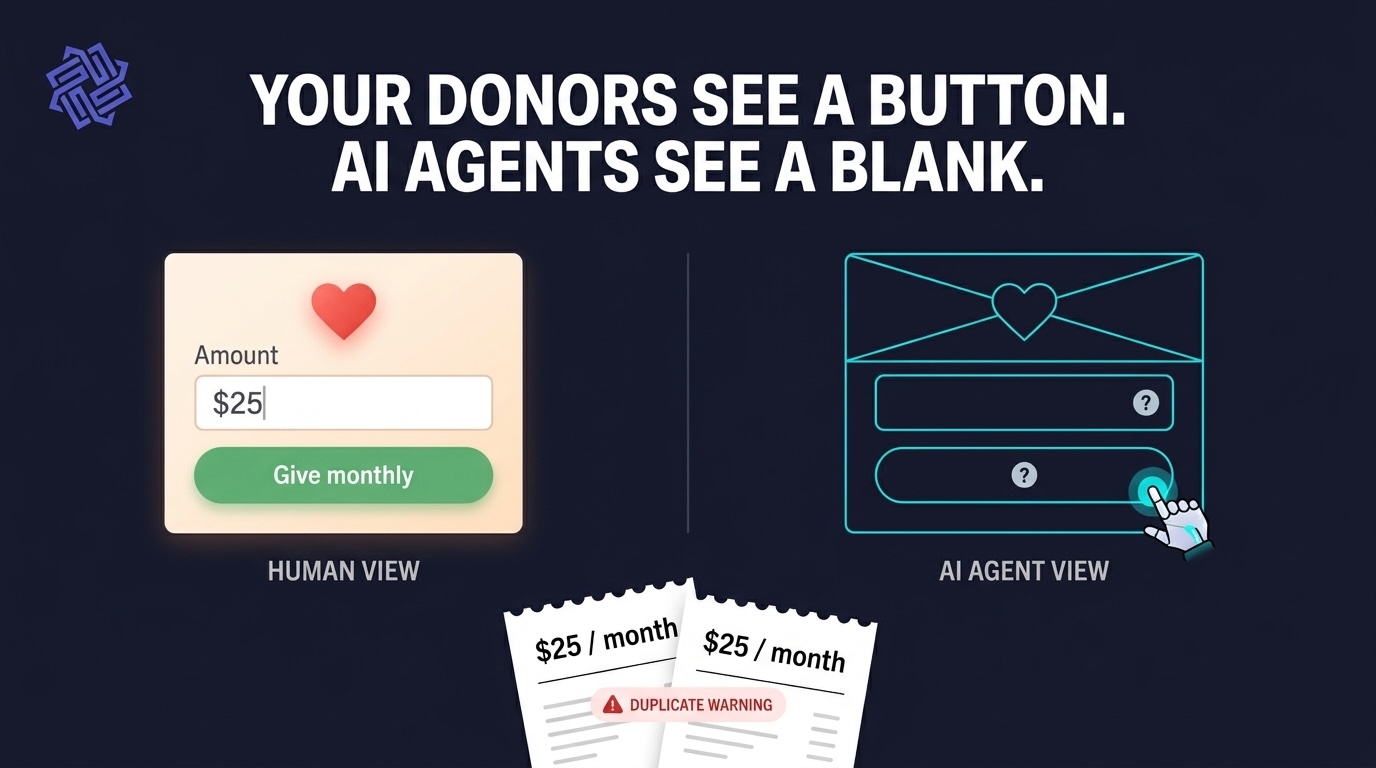 Monthly donors carry a nonprofit. They are worth five to seven times more than one-time donors, by the Center for Sustainable Giving’s estimate. One fundraising platform puts the figure at 10 times.
Donors now ask AI tools where to give. Soon they will ask the tool to set up the gift. Two things must work. The AI must know you take monthly gifts. And an AI agent must be able to use your form.
Step one: the answer
A donor types, “Which food banks near me take monthly donations?” The AI writes a short list. If your site never says “monthly giving” in plain words, you may not make that list.
Check these facts in each AI tool:
- Does it say you accept monthly gifts?
- Does it state your charity number and tax-receipt rules?
- Does it name the right minimum gift?
- Does it tell donors how to change or cancel a gift?
A wrong answer on cancellation costs trust. Donors fear gifts they cannot stop. If the AI says your gifts are hard to cancel, a careful donor walks away.
Step two: the form
AI agents work through a page’s structure, not its design. They read labels, buttons, and form fields. They cannot see a green box.
Most of the web fails this test. An annual review of the top one million home pages found 95.9% failed basic accessibility checks in 2026. That was up from 94.8% in 2025. Three failures hit forms hardest.
| Failure | Share of home pages | What an AI agent sees |
|---|---|---|
| Form inputs with no label | 51% | A blank field. It cannot tell “amount” from “phone.” |
| Empty links | 46.3% | A link with no name. It cannot tell where it goes. |
| Empty buttons | 30.6% | A button with no name. “Give monthly” looks like “Close.” |
Chart: common form failures on the top one million home pages. Data: WebAIM Million 2026.
A 2026 study tested an AI agent on 60 everyday web tasks. It succeeded 78.3% of the time under normal conditions. Limited to the keyboard, it succeeded 41.7% of the time. A donation form built only for the mouse and the eye loses donors this way.
The duplicate gift problem
One failure matters most for monthly giving. After a form is sent, many sites show a thank-you message built only for the eye. The page sends no signal a machine can read.
An agent that cannot tell whether it worked will try again. For a one-time gift, that means a refund request. For a monthly gift, it means two charges every month. The donor sees it on a statement. The donor cancels both.
The form worked. The feedback failed.
What to fix first
Start with the page that holds your monthly gift form.
- Label every field in the code, not only on screen.
- Give every button a clear name, such as “Start monthly gift.”
- Return a readable success or error message after each submission.
- State monthly giving, minimums, receipts, and cancellation terms in plain text.
- Ask three AI tools about your monthly program. Compare each answer to your real policy.
Failed payments show why this matters. One platform found automatic retries recover more than 30% of failed recurring gifts. Careful manual retries recover about 20 to 25%. Small mechanics move real money.
beket.ai asks ChatGPT, Gemini, and Perplexity the questions donors ask, scores each answer against your real data, and fixes what it can. Check how AI describes your monthly giving at beket.ai.
Related posts
Canadian Businesses Are Building SEO Plans for a Search Engine Losing Ground
Bilingual keywords, Google.ca rankings, six-step strategy guides. Almost none of it mentions what ChatGPT already says about you.
One Question Becomes Twenty Searches Before AI Answers
AI models break a single question into many smaller searches. A page built for one keyword misses most of them.
Ads Just Moved Into the Answer Box
ChatGPT ad penetration jumped from a rounding error to nearly half of US responses. Your citation now shares space with a paid slot.