
Local AI Visibility: How to Benchmark AI Answers by City and Country

Ask an AI engine the same question in two cities and you can get two different answers. That is not a glitch. ChatGPT, Claude and Google all say they use location to shape local results, and our own studies show how far apart the answers can drift. So if you sell in more than one place, one AI visibility score for “everywhere” hides most of what matters.
This guide explains why AI answers change by location, how to benchmark your local AI visibility city by city or country by country, and what to look for in a tool that claims to do regional benchmarking.
Why do AI answers differ by location?
There are two separate effects, and a good benchmark separates them.
1. The engine knows roughly where the user is. The engines document this themselves:
- ChatGPT. OpenAI says ChatGPT “may use an approximate location based on your IP address to provide relevant local results”, and that it may rewrite “good restaurants near me” into a search like “top restaurants San Francisco” (OpenAI Help Center). Sharing precise device location is optional and off by default.
- Claude. Anthropic says Claude “may use your location (inferred from your IP address) when responding to a request for localized results” (Claude Help Center).
- Google. Google says Search uses context such as location even with personalization turned off: “if you search [pizza near me] in a particular city, you could get results relevant to that location” (Google Search Help). AI Overviews appear on Google Search results, so it is reasonable to expect the same context to apply, though Google doesn’t spell that out for AI Overviews specifically.
2. The question names a place. “Best bike shop in Vancouver” and “best bike shop in Seattle” are different questions with different sources behind them: different local guides, directories, news sites and forums. Even with no IP location at all, the answers will differ because the web about each city differs.
For a business, both matter. The first decides what a person standing in Burnaby sees when they type “near me”. The second decides whether you show up when someone names your city.
What changes between cities: our study data
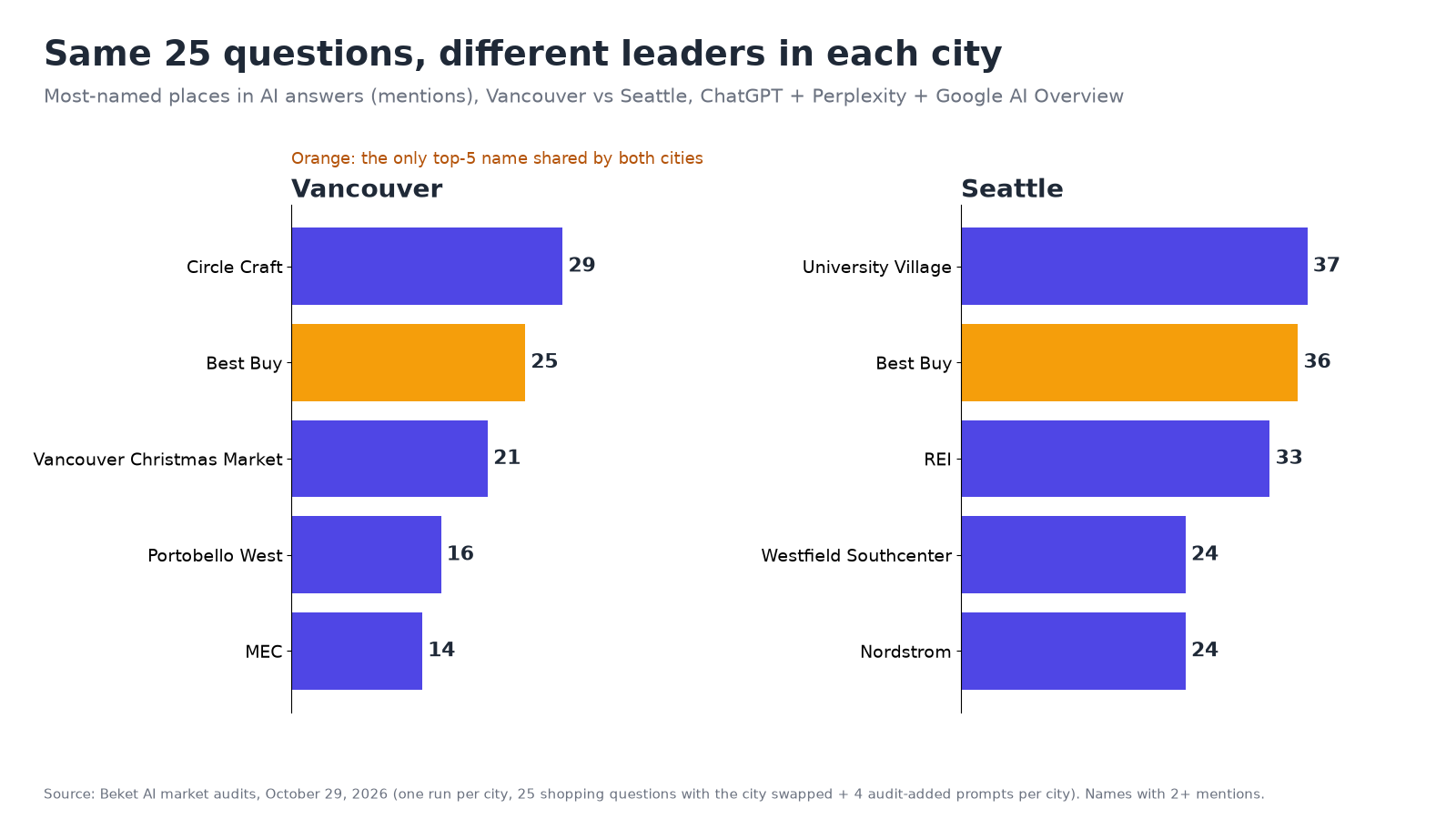
On October 29, 2026, we asked the same 25 shopping questions in Vancouver and Seattle, with only the city name swapped and Beket AI’s location setting matched to each city (one run per city, 145 answers across ChatGPT, Perplexity and Google AI Overview). The full results are in our Vancouver vs Seattle Christmas shopping study and our Black Friday study.
Here is what differed:
| Vancouver | Seattle | |
|---|---|---|
| Most-named place | Circle Craft (a holiday market), 29 mentions | University Village (a shopping centre), 37 mentions |
| Names with 2+ mentions | 32 | 77 |
| Mentions of those names | 219 | 540 |
| Questions with a Google AI Overview | 15 of 25 | 10 of 25 |
| Most cited domain | bestbuy.ca (40) | google.com (26), then visitseattle.org (25) |
Source: Beket AI market audits, October 29, 2026. Each audit also added four prompts of its own (holiday markets in Vancouver, malls and boutiques in Seattle), which are included in the counts and push each city’s list toward those themes. One run per city.
The overlap was small. Only three names had two or more mentions in both cities: Best Buy, Nike and Patagonia, all national or global brands. Every local name that ranked well in one city was, as you would expect, absent from the other. More telling, the kind of answer changed: Vancouver’s answers leaned toward markets and fairs, Seattle’s toward malls and shopping districts.
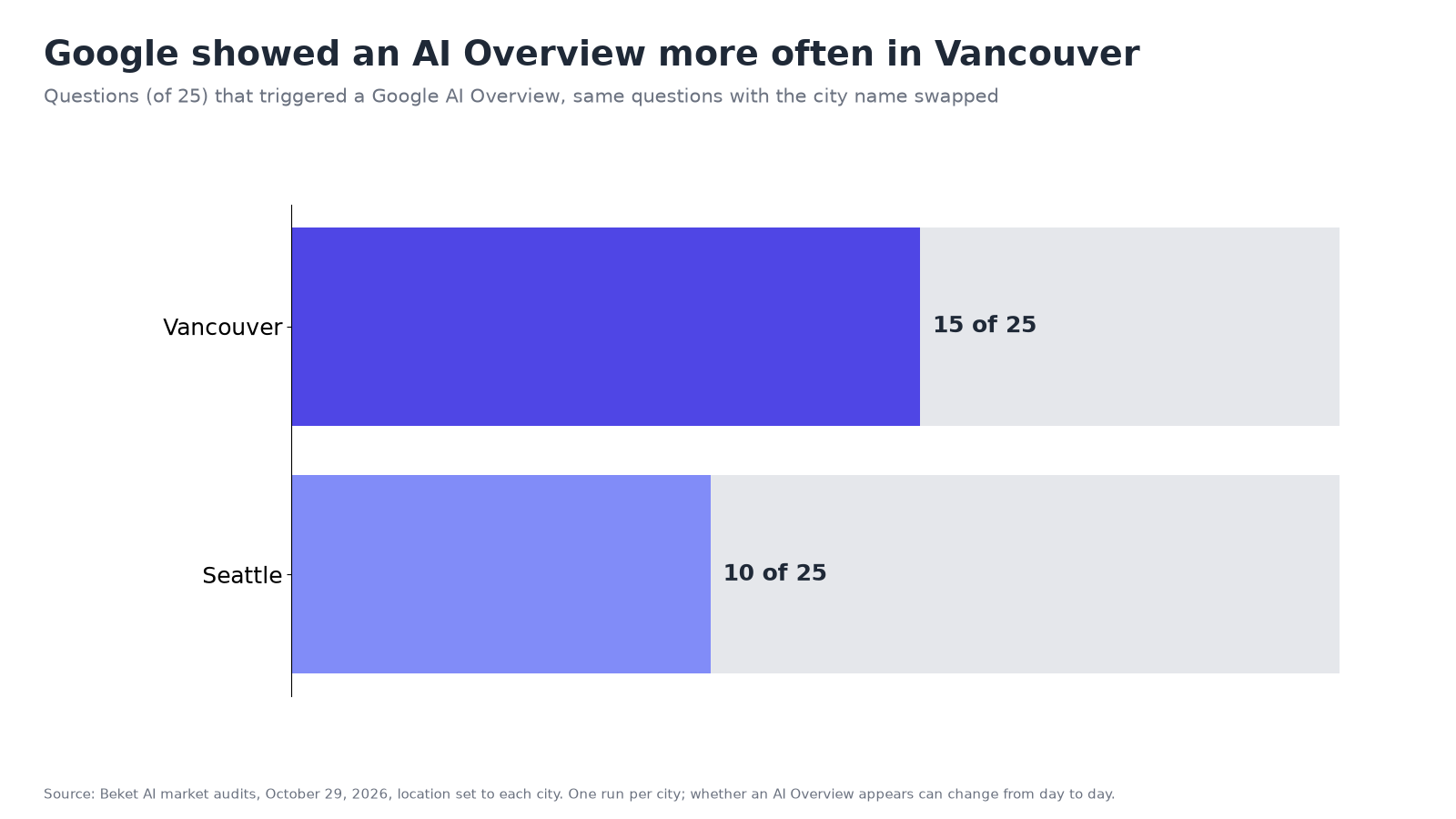
Whether Google shows an AI Overview at all also changed by city. The same 25 questions triggered one in 15 cases in Vancouver and 10 in Seattle. A business that only checks one city would get the wrong idea about how often Google’s AI answer is even in play.
A country-level run tells you something different again. In our study of Canada’s top accelerators (October 30, 2026, location set to Canada, 76 answers), the most-named programs were spread across several cities: Velocity in Waterloo, L-SPARK in Ottawa, Creative Destruction Lab in Toronto and Centech in Montreal. A national view is useful for national brands. It won’t tell a Calgary program what a founder in Calgary sees.
How to benchmark local AI visibility by city or country
- Pick the locations that match your revenue. Each city you serve, or each country for national brands. Don’t benchmark a city you don’t sell in.
- Write one prompt set and keep it fixed. Use the same unbranded questions for every location, with only the place name swapped. If the wording changes, you can’t tell a location effect from a wording effect.
- Include “near me” style prompts too. Questions without a city name test the IP-location effect. These only make sense if your tool can set where the question is asked from.
- Run every engine your customers use, and split results by engine. In our Vancouver and Seattle runs, the engines disagreed on the leaders inside the same city, which is why we argue you can’t trust one AI engine.
- Record names and cited sources per location. The sources show you why an answer differs: a city guide, a local news site or a directory that matters in one market and not the other.
- Measure share, not just presence. AI share of voice, your mentions as a share of all names, is easier to compare across cities of different sizes than raw counts.
- Repeat the runs. One run per city is a snapshot. Re-run on a schedule before you conclude a city is weak or strong; one check is a snapshot, not a system.
What to look for in a regional benchmarking tool
Many AI visibility tools say they support locations. Ask these questions before you rely on one:
- How is the location applied? It might be the place name in the prompt, a location setting the engine accepts, or the network location the question is sent from. Each tests something different. A tool should say which one it uses for each engine.
- Which engines honor the location? Not every engine accepts a location setting in the same way. Ask for a per-engine answer, not a general “yes”.
- City and country granularity. You should be able to choose a city for local businesses and a country for national ones.
- Same prompts across locations. The tool should let you run one fixed prompt set in several places and compare them side by side.
- Per-location sources. Cited URLs and domains for each location, exportable, so you can check the findings yourself.
- Repeat runs on a schedule. Otherwise you can’t separate a real regional difference from day-to-day variation.
- Clear limits. No tool can see every user’s answer. Personalization, memory and signed-in history can change what a real person sees. Be wary of any tool that promises an exact view of “what customers in Toronto see”.
Which GEO and AEO tools support regional LLM benchmarking?
Plenty of generative engine optimization (GEO) and answer engine optimization (AEO) tools mention locations, but “supports regional benchmarking” can mean very different things. Rather than trust a feature list, check that a tool gives you all five of these:
- Location-specific, unbranded prompts. The same fixed questions, without your brand name, run per city or country, plus “near me” style prompts asked from a set location.
- Results split by engine. Separate numbers for ChatGPT, Perplexity and Google AI Overview in each location, not one blended score.
- Repeat runs over time. Scheduled re-runs for every location, so you can tell a real regional gap from day-to-day noise.
- Competitor share by city. Every name the engines mention in each location, with your share against them, so you can compare cities of different sizes.
- Citation sources per location. The URLs and domains each engine cited in each city, so you can see which local guides, directories and news sites drive the answer.
If a tool can’t show you all five for two cities side by side, it is tracking one market and labelling it regional.
How Beket AI handles locations
Beket AI lets you set a location for each audit, either a city (such as “Seattle, Washington, United States”) or a country (such as “Canada”). The location is applied to the engines that support a location setting. Each audit asks unbranded prompts on ChatGPT, Perplexity and Google AI Overview and records the names, the per-engine split and the cited URLs and domains, which is how the studies above were run: one audit per location, same prompts, city swapped.
A free Beket AI audit covers 25 prompts across 3 engines. Beket AI Pro is $49/month, re-audits daily and starts at 50 prompts across 3 engines. Our nine local studies show what this looks like across categories. Run a free audit at beket.ai.
About the author: Nur Rysbek is the CEO of Beket AI.
Sources checked October 30, 2026. Study numbers are from single Beket AI runs on October 29 and 30, 2026; names are counted only when mentioned twice or more. AI answers change by day, wording, location and user.
Related posts
Claude.ai Referral Traffic in GA4: How to Find It and Track It
How claude.ai / referral shows up in GA4, why some Claude visits land in Direct, and how to build an AI assistants channel group with one regex.
The AI Training Opt-Out Is Coming to robots.txt. It Won't Take You Out of AI Answers
Google, Bing, OpenAI and Anthropic will honor one AI training opt-out. What it blocks, what Bing's new grounding control does, and the dates to know.
Publishing Is the Start, Not the Finish
Hitting publish feels like the end of the work. For AI visibility it is barely the beginning: discovery, extraction and citation come after.