
What Is AI Share of Voice? How It's Measured, With Real Numbers

AI share of voice is the portion of all business mentions in AI answers that go to you. Ask ChatGPT, Perplexity or Google AI Overview the questions your customers ask, count every business the answers name, and divide your mentions by the total. If the answers named businesses 100 times and 12 of those were you, your AI share of voice is 12%.
That is the whole idea. The hard part is everything around it: which questions you ask, which engines, which names count, and why the same business can have three very different numbers on the same day. This post works through it with real figures from one of our published studies.
The formula
AI share of voice = your mentions ÷ all business mentions in the same set of answers
Three terms do the work:
- Mention: one business named in one AI answer. If an answer lists five brokerages, that is five mentions.
- The set of answers: a fixed list of questions, run on named engines, on a stated date. Change any of those and the number changes.
- All business mentions: the denominator. Usually your mentions plus your competitors’ mentions. Deciding what belongs here is the most important choice you make (more on that below).
The term comes from advertising, where share of voice meant your share of the ads or media coverage in a category. In AI search, most of the businesses an answer names are not paid placements, so the “voice” is simply who gets named when someone asks.
A worked example: Seattle real estate, October 27, 2026
In our study of which Seattle realtors AI recommends, we asked ChatGPT, Perplexity and Google AI Overview 25 unbranded questions on October 27, 2026. The answers named 33 brokerages and teams a total of 277 times.
Windermere was named 66 times. So its share of voice across all three engines was:
66 ÷ 277 = 23.8%
Compass had 35 mentions (12.6%) and Redfin had 27 (9.7%). Those are the headline numbers. But they hide something.
Every engine gives you a different number
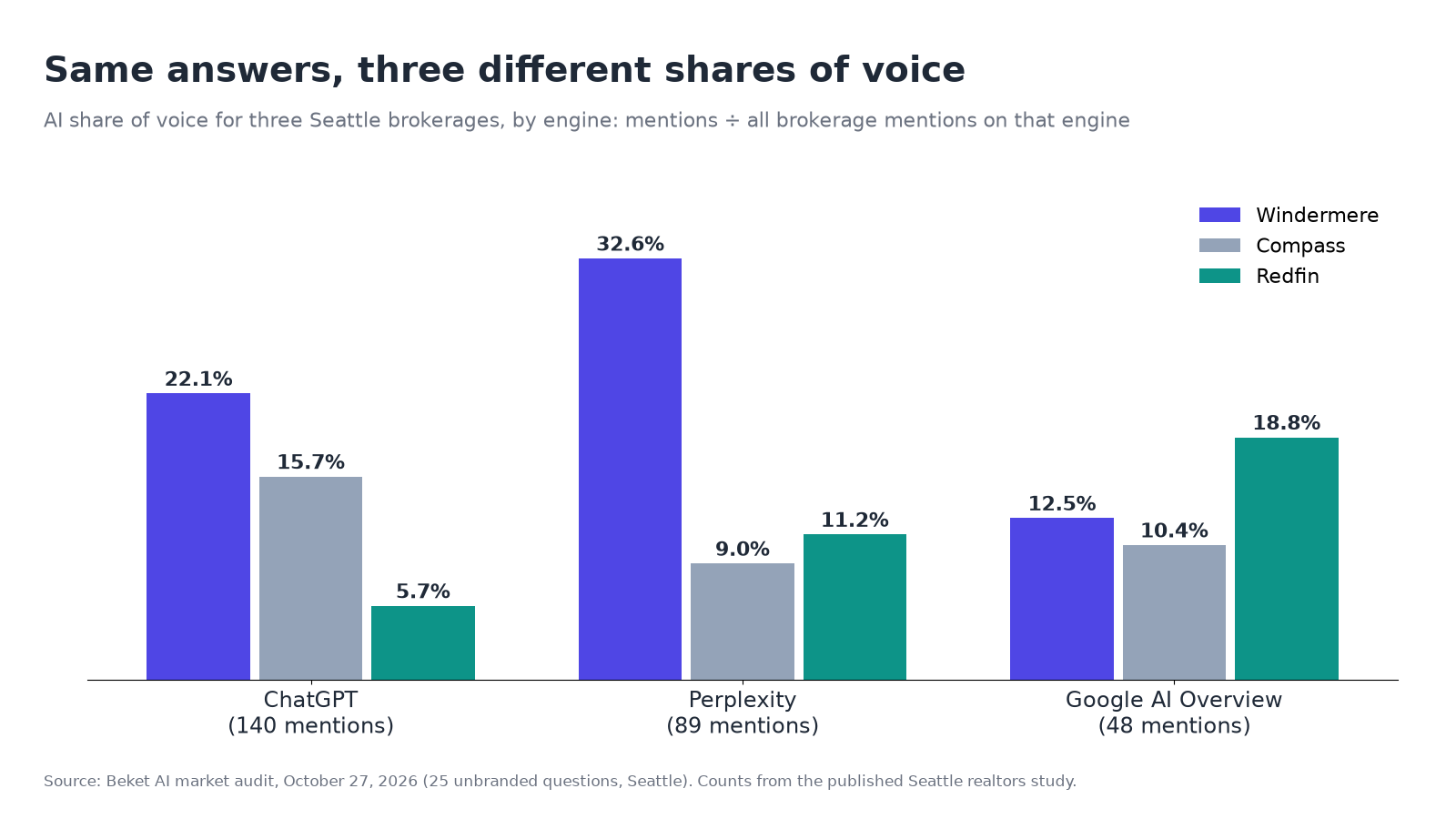
Split the same answers by engine and the picture changes. ChatGPT named brokerages 140 times, Perplexity 89 times and Google AI Overview 48 times. Here is each brand’s share of voice inside each engine:
| Brokerage | All engines | ChatGPT | Perplexity | Google AI Overview |
|---|---|---|---|---|
| Windermere | 66 of 277 (23.8%) | 31 of 140 (22.1%) | 29 of 89 (32.6%) | 6 of 48 (12.5%) |
| Compass | 35 of 277 (12.6%) | 22 of 140 (15.7%) | 8 of 89 (9.0%) | 5 of 48 (10.4%) |
| Redfin | 27 of 277 (9.7%) | 8 of 140 (5.7%) | 10 of 89 (11.2%) | 9 of 48 (18.8%) |
Source: Beket AI market audit, October 27, 2026, from the per-engine counts in the published Seattle realtors study. Percentages are our arithmetic on those counts.
Source: Beket AI market audit, October 27, 2026.
Windermere led overall, but on Google AI Overview Redfin’s share was higher, 18.8% against 12.5%. A Redfin marketer looking only at Google would think they were winning. A Windermere marketer looking only at Perplexity would think they owned a third of the market. Both would be right about one engine and wrong about the market.
Two more things the split shows:
- The engines don’t carry equal weight in the total. ChatGPT produced 140 of the 277 mentions, so it pulls the all-engines number toward its own result. Google AI Overview appeared for only 14 of the audit’s 29 prompts, so it contributed the fewest mentions.
- Report share of voice per engine, then overall. The overall figure is useful as a summary, but the decisions (which sources to work on, which content to write) usually depend on the engine.
What changes the number (besides your actual visibility)
Share of voice is easy to compute and easy to distort. Before you compare two numbers, check these:
1. Who counts in the denominator. In the Seattle realtors study we counted only brokerages and teams. The answers also named listing websites, agent-matching sites, a review site and a search engine, for 108 more mentions (Zillow alone had 67). If those had stayed in, Windermere’s share would have been 66 ÷ 385 = 17.1%, not 23.8%. Same answers, different rule. In our Seattle dentists study (October 16, 2026), the top clinic had 12.1% of clinic mentions but 9.8% of all mentions, because an insurer was the most-named name overall.
2. Name variants. “Keller Williams,” “KW Seattle” and “Keller Williams Greater Seattle” are one brand to a customer but three strings to a counter. The Seattle realtors study combined 43 raw names into 33. Not merging variants splits a brand’s mentions and understates its share.
3. The questions. Branded questions (“is Windermere good?”) inflate the brand’s share. Questions that mention a niche (“dentist that takes Delta Dental”) invite specific names in. A fair measure uses unbranded questions that real customers ask, and keeps the same list over time.
4. The engines and the date. Answers change over time. A share of voice figure without an engine and a date is not comparable with anything.
5. Small samples. Google AI Overview’s 48 mentions came from 14 answers. One extra mention moves a brand’s share there by about two percentage points. Read small-engine numbers as direction, not precision.
Share of voice vs the other AI visibility metrics
Share of voice is one of several numbers that describe how a business shows up in AI answers. They answer different questions:
| Metric | What it measures | Formula | What it misses |
|---|---|---|---|
| Share of voice | Your slice of all the names the answers give | Your mentions ÷ all business mentions | Whether you appear in many answers or a few |
| Visibility (mention rate) | How often you show up at all | Answers that name you ÷ answers checked | How crowded those answers are |
| Average position | Where you sit in the list when named | Mean rank among the businesses an answer names | How often you’re named |
| Citation share | How often your own site is used as a source | Citations to your site ÷ all citations | Mentions that come without a link to you |
| Times named first | How often you’re the top pick | Count of answers where you’re listed first | Everything below first place |
They can move in opposite directions. A brand can appear in more answers (visibility up) while competitors are added to the same answers faster (share of voice down). And being named is not the same as being linked: in our recent look at why being named in an AI Overview matters more as source cards disappear, 5 of the 12 most-named local businesses in our October 28, 2026 Seattle and Vancouver sample had no link to their own website in the answers.
Times named first matters on its own. Windermere was named first 13 times in Seattle, but Every Door Real Estate, with only 12 mentions (4.3% share), was named first 5 times. A small share can still mean frequent top-of-list placements.
What a “good” share of voice looks like
There is no universal benchmark, because it depends on how crowded the category is. Compare two of our studies that used the same 25 questions with local place names:
| Seattle realtors (Oct 27, 2026) | Vancouver realtors (Oct 23, 2026) | |
|---|---|---|
| Brokerages and teams named | 33 | 38 |
| Most named | Windermere (66 mentions) | Oakwyn Realty (36 mentions) |
| Share for the top 5 | 58.5% | 39.7% |
Source: Beket AI market audits, as published in our Seattle and Vancouver realtors studies.
In Seattle, five names took more than half the mentions. In Vancouver the answers were spread across more brokerages. A 10% share is a strong position in a spread-out market and a modest one in a concentrated market. The useful comparisons are you against your direct competitors in the same answers, and you against yourself over time. Our roundup of nine local AI studies shows how much concentration varies by category.
Why it’s worth tracking
Being named matters because the people who come from AI answers tend to be further along. On October 29, 2026, Adobe reported that in September 2026, traffic from AI sources to U.S. retail sites converted 90% better than non-AI traffic and generated 83% higher revenue per visit. In August 2025, AI traffic had converted 9% worse. The data covers more than 1 trillion visits to U.S. retail sites, so it is about online retail, not local services, but the direction is clear: a visit that starts in an AI answer is worth more than it was a year ago.
AI answers also send fewer clicks than classic search, which we covered in why small AI search traffic still matters. When the click is rarer, the mention itself does more of the work. Share of voice is how you see the mention.
How to raise it without shortcuts
Share of voice moves when the sources AI engines rely on say more, and more consistent, things about you. In practice that means accurate listings and profiles, being included in the local lists and directories the engines cite, reviews, and pages on your own site that answer the questions customers ask.
There are shortcuts too, such as publishing many self-promotional “best of” lists that rank yourself first. Google’s John Mueller addressed this on October 29, 2026. As reported by Search Engine Roundtable, he said listicles aren’t spam in themselves, but relying on large numbers of them as a whole strategy is risky, because such tactics tend to get recognized and discounted. In his words, “you really need to focus on that end goal of having something that search engines and AI systems will want to show to people in the long run.”
How Beket AI measures share of voice
Beket AI runs your customers’ questions on AI engines and reports share of voice alongside visibility, average position and citation share, so you can see all of them for the same set of answers. Share of voice is your mentions divided by your mentions plus your competitors’ mentions, and you can review and edit the competitor set that goes into it.
The free audit covers 25 prompts across 3 engines. Pro is $49/month, re-audits daily, and starts at 50 prompts across 3 engines, which is what you need to see share of voice as a trend rather than a single snapshot.
The study figures in this post are what the AI engines returned on the dates stated. They are not Beket AI’s opinion or a ranking of quality. AI answers change over time, and any business named here can ask us for another run.
Related posts
Ads in Google AI Mode Are Coming to Canada: What It Means for Vancouver Businesses
Google is bringing ads in AI Mode to Canada. Here's what that means for Vancouver businesses, and why being named in the answer for free matters more.
Ask AI Where to Shop on Black Friday and You Get Best Buy, Not Amazon (2026 Study)
Same 25 shopping questions to ChatGPT, Perplexity and Google AI Overview in Vancouver and Seattle: Best Buy got 61 mentions, Amazon under 2 per city.
How to See Which AI Crawlers Visit Your Site with Cloudflare (and Which Ones to Allow)
A step-by-step Cloudflare AI Crawl Control guide: see which AI crawlers visit, which send visitors back, and which to allow or block, plus a checklist.