
Ads in Google AI Mode Are Coming to Canada: What It Means for Vancouver Businesses

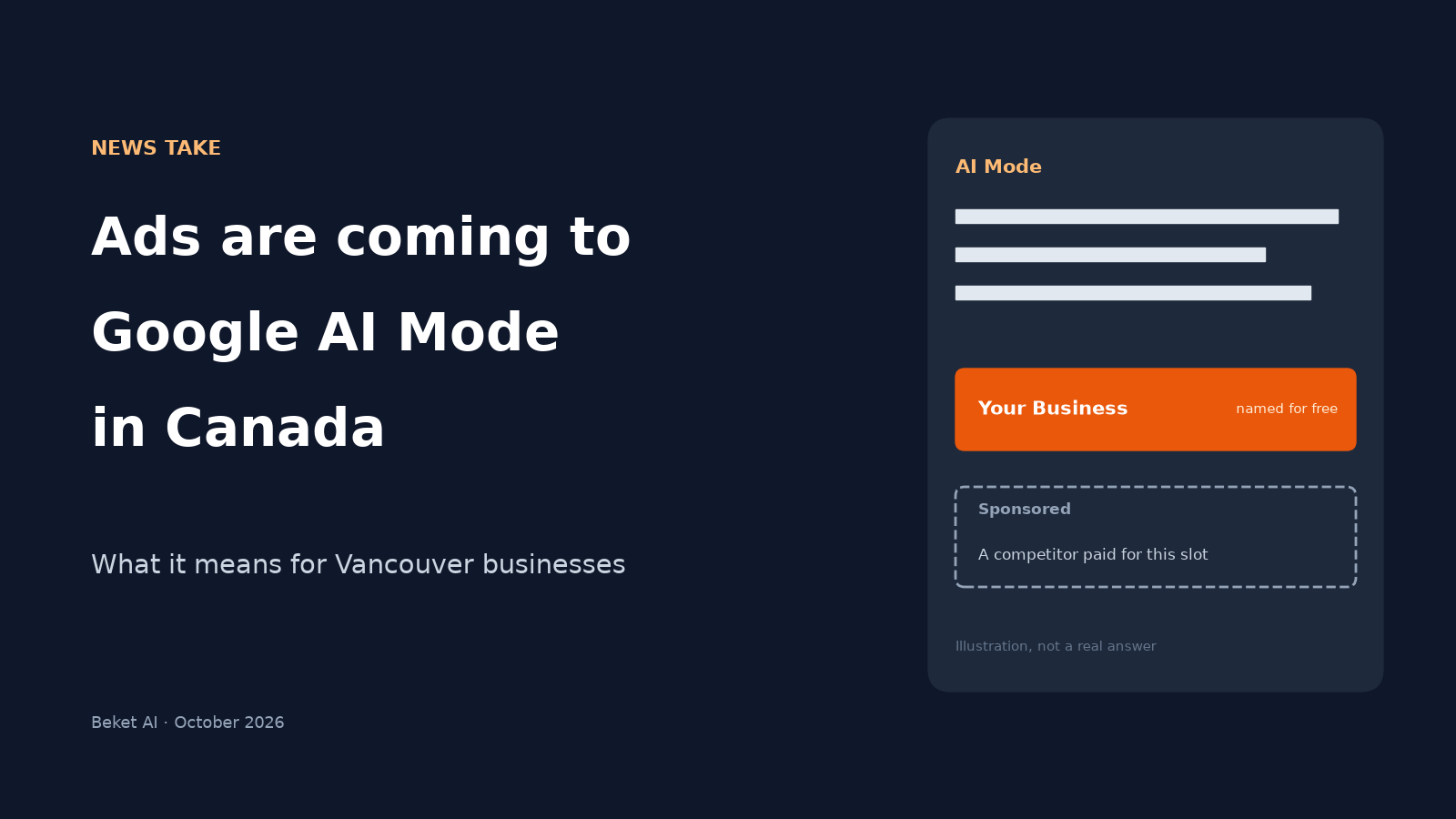
If you run a business in Vancouver, someone new can now show up in Google’s AI Mode answers next to you: whoever paid to be there.
On October 28, 2026, Google announced that it is bringing ads in AI Mode to Canada and nine other countries. Before this, Google wasn’t selling ads inside AI Mode answers in Canada, so the businesses an answer named had it to themselves, and they got there for free. That’s changing, and it makes the free mention more valuable, not less.
This post covers what Google announced, what it left out, and what Vancouver businesses should do about it.
What Google announced
The announcement came in a Google blog post by Shashi Thakur, who runs Google Search Ads, on the same day as Alphabet’s third-quarter earnings call. Three things changed:
- Ads in AI Mode are expanding to 10 countries: Australia, Canada, India, Kenya, Malaysia, New Zealand, Nigeria, Pakistan, the Philippines and Singapore.
- More countries come next. Google says it plans to expand “in Q4 2026” to more locales, “including Brazil, Mexico, and the United Kingdom.” It gave no exact dates (Search Engine Land noted the same).
- Ads on follow-up questions, in the US only. Google is “launching multiturn ads in the U.S.” A Google spokesperson told Search Engine Roundtable that these “show up on responses to follow-up user queries as users engage in back and forth conversations with AI Mode.”
Here’s where things stand, based on Google’s announcement and its Google Ads help page on ads in AI experiences:
| Ads in AI Mode answers | Ads on AI Mode follow-up questions | |
|---|---|---|
| United States | Yes | Yes, launching now |
| Canada | Rolling out (announced Oct 28, 2026), English only | Not announced |
| Australia, India, Kenya, Malaysia, New Zealand, Nigeria, Pakistan (text ads only), Philippines, Singapore | Yes, in English | Not announced |
| Brazil, Mexico, United Kingdom | Planned for Q4 2026 | Not announced |
Sources: Google, Oct 28, 2026; Google Ads Help, checked Oct 29, 2026. Google says its country and language list “may not be exhaustive.”
Two details matter for Canada. Google’s help page lists English as the only language for ads inside AI Overviews and AI Mode, so French-language searches aren’t covered yet. And the follow-up ads are a US launch. Google hasn’t said when they’ll reach Canada.
How the ads get there
Advertisers don’t sign up for AI Mode separately. According to Google’s help page:
- Existing campaigns qualify automatically. Search, Shopping and Performance Max campaigns are eligible, with no new campaign or budget needed.
- Text ads and Shopping ads can appear “directly within or alongside” AI responses, labeled “Sponsored.” Google says it’s also experimenting with formats such as local inventory ads.
- Ads can match the conversation, not just the query. Broad match, AI Max, Shopping and Performance Max can be matched to both the question and the AI’s answer. Exact and phrase match keywords only serve when the question itself shows clear buying intent.
- There’s no opt-out and no separate report. Advertisers can’t target AI Mode alone or exclude it from Search. Results are folded into normal campaign reports.
- Google says ads don’t change the answer. “Paid advertising does not influence the organic responses generated by Google AI,” the help page says, and being cited organically doesn’t affect ad eligibility.
That last point is the important one for anyone who isn’t buying ads. The organic answer and the ad slot are separate systems. Paying doesn’t get you named in the answer, and being named doesn’t depend on paying.
The click-through claim, read closely
Google’s headline stat is that “click-through rates are already similar between sponsored and organic product list items within AI Mode.”
Before you lean on that, a few limits:
- It’s about product listings. As Search Engine Land pointed out, the comparison covers product list items only, “not all organic links or citations in AI Mode.” A Vancouver law firm or plumber isn’t a product listing.
- There are no numbers. Google didn’t share the actual click-through rates or how it measured them (Search Engine Land).
- It’s US data from two weeks. Google’s footnote cites “Google Internal Data, US, August 20, 2026 - September 3, 2026.”
So “similar” tells us ads in AI Mode get clicked about as often as the organic product picks around them. It doesn’t tell us how much traffic either one gets, or what happens to a local service business named a few lines above a sponsored competitor.
Why Google is pushing ads in AI Mode now
The earnings call explains the timing. Google’s Search and other advertising revenue grew 12% to $63.3 billion in the quarter, per Search Engine Land. TechCrunch noted that’s down from 17% growth in Q2 and 19% in Q1.
Asked why, Google Chief Business Officer Philipp Schindler said “the strong growth in AI Mode queries had an impact because of the lower monetization we were seeing in AI Mode.” He named foreign exchange as the biggest factor, and Google didn’t say how much less AI Mode earns per search.
Put simply: people are using AI Mode more, and it earns Google less than regular search. More ad placements in more countries is the fix Google announced. Our read: expect the paid side of AI Mode to keep growing.
What this means for Vancouver businesses
Until this week, the businesses named in a Canadian AI Mode answer didn’t share it with a sponsored placement. Now, when a question has what Google calls “commercial relevance,” a competitor’s ad can sit inside or beside that answer.
That changes the value of an organic mention in three ways.
The free slot now has a paid neighbour. If AI Mode names you for “best mortgage broker in Vancouver,” you’re no longer the only business in front of the searcher. A competitor with a broad-match Search campaign may be right there, labeled “Sponsored.” Being named for free is still worth the most, because you didn’t pay for it and you can’t buy it.
AI Mode leans on your Google listing. In an August 2026 study of US local-service searches, 79.8% of AI Mode’s citations on local-intent queries pointed to Google Maps or Google Business Profile data, against 12.8% to businesses’ own websites. That’s US data, but it suggests your Business Profile is the first thing to defend. We compared the two surfaces in AI Mode vs AI Overviews for local businesses.
The names already vary a lot. Our roundup of nine local AI recommendation studies found AI engines naming 21 to 49 businesses per study, and in the six Vancouver studies the engines rarely agreed on who to name. Those studies didn’t test AI Mode. But they show how much the named list moves, and a business that drops out of it now loses ground to both organic rivals and advertisers.
What to do this month
- Write down where you stand before the ads settle in. Ask AI Mode the five or ten questions your customers ask, such as “best realtor in Vancouver for first-time buyers,” and note who gets named and where any “Sponsored” sections appear. Screenshots with dates are enough. The question lists in our Vancouver realtors study show the kind of unbranded questions to start with.
- Tighten your Google Business Profile. Check your categories, services, service areas, hours and reviews. If AI Mode’s local answers lean on Google’s own data, that’s where you’re most likely to be read.
- Make your name easy to recognize. Use the same business name, address and phone number everywhere, and say clearly what you do and where. Our guide to entity SEO explains why that consistency helps engines name you.
- If you run Google Ads, check your match types. Exact and phrase match only reach AI Mode on clearly commercial questions. Broad match and AI Max can also match the longer, conversational ones. Since there’s no separate AI Mode report, watch your search terms report for the longer questions.
- Don’t assume Canada is the US. Follow-up ads are US-only for now, and only English is listed. Read US case studies with that in mind.
What we’re watching
- When multiturn ads reach Canada. Google hasn’t given a date.
- Real click numbers. Google said “similar” without data, and only for products. We’d like to see numbers for local service questions.
- Local ad formats. Google is experimenting with local inventory ads in AI experiences. If more local formats arrive, the paid side of local AI Mode answers grows.
- French in Quebec. The help page lists English only for now.
AI Mode changes fast, and this post reflects what Google had published as of October 29, 2026.
If you want to know whether AI answers name your business for the questions your customers ask, Beket AI’s free audit runs 25 prompts across 3 AI engines. Beket AI Pro ($49/month) re-runs the audit daily, starting at 50 prompts across 3 engines, so you can see when your mentions change.
About the author: Nur Rysbek is the CEO of Beket AI.
Related posts
How to See Which AI Crawlers Visit Your Site with Cloudflare (and Which Ones to Allow)
A step-by-step Cloudflare AI Crawl Control guide: see which AI crawlers visit, which send visitors back, and which to allow or block, plus a checklist.
What Is AI Share of Voice? How It's Measured, With Real Numbers
AI share of voice is your share of the business mentions in AI answers. Here's the formula, a real Seattle example by engine, and what skews the number.
Google Is Reportedly Hiding AI Overview Source Cards: Why Being Named in the Answer Matters More Now
Google AI Overview source cards are reportedly vanishing on desktop. Our audit of 12 local answers shows why being named in the text now matters more.