
What Is Agentic Commerce? OpenAI's ACP vs Google's UCP, Explained for Merchants (2026)

Walmart tried selling inside ChatGPT and, by its own executive's account, it didn't work well. Daniel Danker, who runs AI acceleration, product and design at Walmart, told Wired that items sold directly inside the chatbot converted at a third of the rate of items that sent shoppers out to Walmart's site, as Modern Retail reported. Last week, Google started doing the opposite in Canada, putting a Buy button inside AI Mode and Gemini.
Both moves fall under one label: agentic commerce. This explainer covers what the term means, how OpenAI's Agentic Commerce Protocol (ACP) and Google's Universal Commerce Protocol (UCP) differ, what changed in 2026, and what a merchant should actually do about it this quarter.
Agentic commerce, defined in one paragraph
Agentic commerce is shopping where an AI assistant does more than recommend. It can build a cart, pass shipping details and a payment credential to the store, and place the order for the shopper, who approves it in the chat. The store keeps selling, charging and shipping as usual. What changes is the front door: the conversation in ChatGPT, Google AI Mode or Gemini replaces your product page and checkout screen for that one purchase.
For that to work, the assistant and your store's backend need a shared format for "here is the cart", "here are the shipping options", "here is a payment token" and "the order went through". ACP and UCP are two competing versions of that format.
The two protocols at a glance
| ACP (Agentic Commerce Protocol) | UCP (Universal Commerce Protocol) | |
|---|---|---|
| Who is behind it | OpenAI and Stripe, who maintain the spec (GitHub) | Google, co-developed with Shopify, Etsy, Wayfair, Target and Walmart, endorsed by 20+ others (Google) |
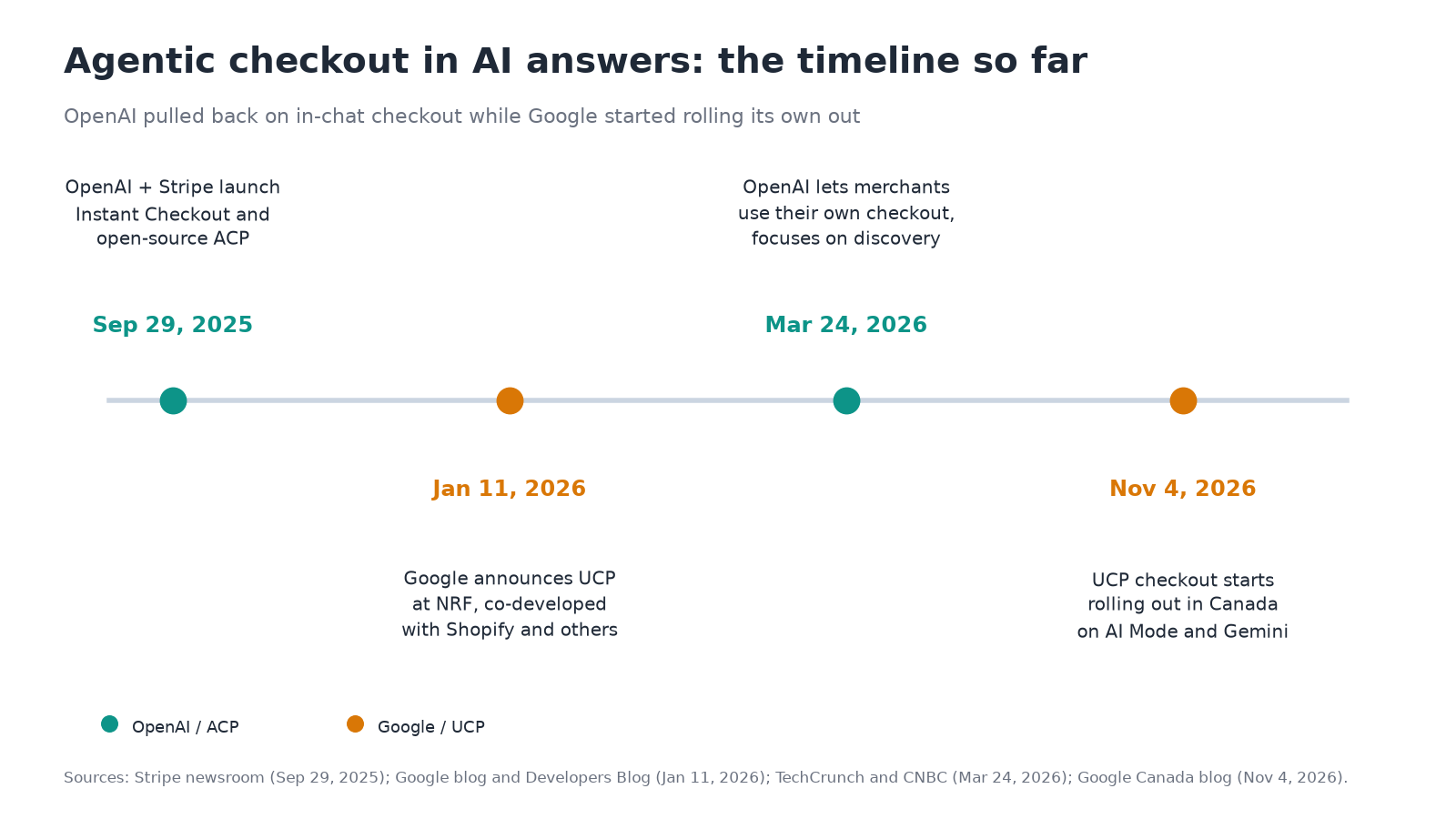
| Launched | September 29, 2025, alongside Instant Checkout in ChatGPT (Stripe) | January 11, 2026, at the National Retail Federation show (Google Developers Blog) |
| Status | Open source (Apache 2.0), labeled beta in its repository | Open source; Google runs the first reference implementation |
| Main surface today | ChatGPT | AI Mode in Google Search and Gemini |
| How the store connects | Product feed to OpenAI, plus checkout session endpoints the assistant calls (Agentic Checkout Spec) | Merchant Center feeds plus a UCP integration; native checkout by default, embedded (iframe) checkout for approved merchants (Google) |
| Transports | REST in OpenAI's checkout spec; the April 2026 spec version in the repo adds MCP | REST and MCP bindings; designed to work with A2A and the Agent Payments Protocol (AP2) |
| Payment | Delegated payment token passed to your payment provider (Stripe's Shared Payment Token was the first) | Google Pay with cards saved in Google Wallet, for now |
| Who is merchant of record | You | You |
| Can you join today? | Product feed onboarding is open to approved partners via an application form (OpenAI) | Select merchants in the US, Canada and Australia, through an interest form (Merchant Center Help) |
The short version: ACP started as the plumbing behind one checkout button in ChatGPT, and UCP was pitched from day one as a broad, vendor-neutral standard that covers discovery, checkout and post-purchase support. Both leave you as the seller, and neither one decides whether an assistant recommends you.
How ACP works
OpenAI's Agentic Checkout Spec is unusually concrete. Your store implements a small set of HTTPS endpoints. ChatGPT calls POST /checkout_sessions with the items, and your server answers with the full cart: line items, tax, shipping options, totals, plus any messages such as "out of stock". As the shopper changes the address or shipping speed, ChatGPT updates the session. When they tap Buy, ChatGPT calls the complete endpoint with a payment token, and you charge it through your existing processor. You then send order events (created, shipped, refunded) back by webhook so the chat stays in sync.
The payment piece is what Stripe added. At launch, Stripe described a Shared Payment Token scoped to one merchant and one cart total, so ChatGPT can start a payment without seeing the card. Reuters reported at the time that merchants would pay OpenAI a fee on completed purchases.
The other half of ACP is the product feed. OpenAI's get-started guide now leads with it: you upload a structured catalog (titles, descriptions, images, price, availability) over SFTP and refresh it at least daily. That feed is what lets ChatGPT show your products accurately, whether or not checkout happens in the chat.
What happened to Instant Checkout
This is the part most ACP explainers skip. On March 24, 2026, OpenAI said "the initial version of Instant Checkout did not offer the level of flexibility that we aspire to provide, so we're allowing merchants to use their own checkout experiences while we focus our efforts on product discovery" (TechCrunch). OpenAI told TechCrunch it was deprioritizing Instant Checkout as a stand-alone feature, with checkout still possible through apps inside ChatGPT or on merchants' own sites.
Analysts told CNBC that OpenAI struggled to onboard merchants, show accurate product data and support multi-item carts or loyalty memberships. Forrester pointed to its March 2026 consumer research: among online adults in the US, UK and Canada who regularly use answer engines, completing a purchase inside the engine was the least-adopted use case, while asking questions and researching products were the top two.
So ACP didn't go away. An OpenAI spokesperson told Digital Commerce 360 that ACP is "the infrastructure that connects users to merchants across the full shopping journey". In practice, ChatGPT today is mostly a discovery channel that hands the shopper to your checkout.
How UCP works
Google built UCP to be broader. Its developer guide describes a modular standard where a merchant picks the capabilities it supports (checkout first, with multi-item carts, loyalty account linking and post-purchase tracking and returns on the roadmap) and the way it connects (APIs, MCP or A2A). Payments run through the Agent Payments Protocol, and Google says UCP primitives map one-to-one to normal retail operations such as checkout.
On Google's surfaces, the first use is native checkout. When Sundar Pichai announced UCP, he said a Buy button would appear on AI Mode in Search and Gemini, with the shopper paying through Google Pay "without ever leaving the conversation" while the retailer stays merchant of record (Google). On November 4, 2026, Google Canada said that checkout began rolling out to Canadian shoppers with early partners including lululemon, Shoppers Drug Mart, Simons and select Shopify merchants.
Access is still narrow. Merchant Center Help lists the US, Canada and Australia, says checkout is for select merchants, and only shows the Buy button on listings with the native_commerce checkout eligibility attribute. Our UCP setup guide for Google AI Mode walks through the prerequisites step by step.
Where they really differ
Who holds the shopper. In ACP's original design, ChatGPT was the shopping interface and your store was the back office. After March, OpenAI's own position is that most purchases finish on your site. UCP keeps checkout inside Google's interface by default, with Google Pay doing the payment step.
How products are found. ACP discovery runs on the feed you send OpenAI. Google's UCP checkout runs on top of Merchant Center feeds you probably already maintain for Shopping ads and free listings, which is a real head start for merchants already on Google.
How far the standard reaches. ACP's spec is centered on the checkout session. UCP is pitched as a full-journey standard with capability negotiation and multiple transports. That makes it more flexible, and more work to implement in full.
How proven it is. ACP has a public track record, including a retreat. UCP checkout on Google is still limited to select merchants, and its Canadian rollout only began on November 4. Neither has published conversion data, so treat every claim of "AI checkout lifts sales X%" with caution.
The bigger number: discovery, not checkout
Whatever happens to in-chat checkout, AI assistants already send shoppers who buy. Adobe, which measures more than 1 trillion visits to US retail sites, found that in September 2026, traffic from AI services converted 90% better than non-AI traffic and generated 83% higher revenue per visit. Adobe forecasts AI-referred traffic to US retail sites will grow 130% year over year over November 1 to December 31, 2026, though it describes the channel as still modest in overall volume.
Those shoppers clicked through to a retailer's site. That is the same pattern OpenAI settled on in March: the assistant does the research, and the store closes the sale. A protocol can make you buyable. It cannot make an assistant name you when someone asks "best waterproof hiking boots under $200". The day after Google's Canadian launch, our study of which Canadian retailers AI names for shopping questions ran 25 unbranded shopping prompts on ChatGPT, Perplexity and Google AI Overview, and the engines named 57 retailers and brands across 651 mentions. Being one of those names is a separate question from having a Buy button.
What to do this quarter
- Decide which surface matters to you. If you sell in the US, Canada or Australia and Google Shopping already drives sales, put UCP's interest form on your list. If ChatGPT is where your buyers research, start with OpenAI's product feed application rather than a checkout build.
- Fix product data first. Both protocols depend on accurate titles, prices, stock and shipping. Looking at OpenAI's pullback, Forrester wrote that inventory management had been "disastrously absent from the plan". A feed that is wrong in one place is wrong in every assistant that reads it.
- Keep key facts readable in your HTML. Prices, sizes, materials and return policy should be in the page itself, not only in a script or an image. Our explainer on whether ChatGPT can read JavaScript shows what each AI crawler actually sees.
- Don't build both protocols at once. Unless you have the engineering team for it, pick the platform where your shoppers already are, ship that, and wait for the other protocol to settle.
- Measure whether AI answers name you. Checkout only matters after an assistant recommends you. Beket AI's free audit runs 25 unbranded buyer prompts across ChatGPT, Perplexity and Google AI Overview and shows which brands each one names. It does not test AI Mode or Gemini Buy buttons.
For the rest of the technical list (crawlable pages, schema, llms.txt, AIPREF and NLWeb), use our agent-ready website checklist for 2026.
The bottom line
Agentic commerce is real, but in late 2026 it is uneven. OpenAI built the first checkout protocol and then moved most purchases back to merchants' own sites. Google is now testing the same idea with more partners and an existing feed system behind it. For most merchants, the protocol decision can wait a quarter. Whether AI answers recommend you, with the right price and stock, can't wait, because that is where these shoppers start.
Facts as of November 9, 2026. Both protocols and their onboarding rules change often, so check the linked OpenAI and Google pages before you build.
Related posts
How to Make Your Store Buyable in Google AI Mode (UCP Setup Guide)
How to set up Google UCP so eligible merchants can show Buy in AI Mode and Gemini. Steps, checklist, and naming vs checkout.
Which SaaS Tools Does AI Recommend? 2026 Study
AI mostly cited vendor pages, not review sites, in 645 citation events. Beket AI asked 25 SaaS buyer prompts across ChatGPT, Perplexity and AI Overview.
Agent-Ready Website Checklist for 2026 (llms.txt, Schema, AIPREF, UCP, NLWeb)
A 2026 checklist for agent-ready sites: crawlable HTML, ReserveAction, llms.txt, AIPREF, UCP and NLWeb, plus where /ai-check fits.