
E-E-A-T: The Trust Test Behind Google Rankings and AI Answers
A plain guide to Experience, Expertise, Authoritativeness, and Trust — with the exact tasks that prove each one.

On this page
Google has to decide which pages to trust. E-E-A-T is the frame it uses.
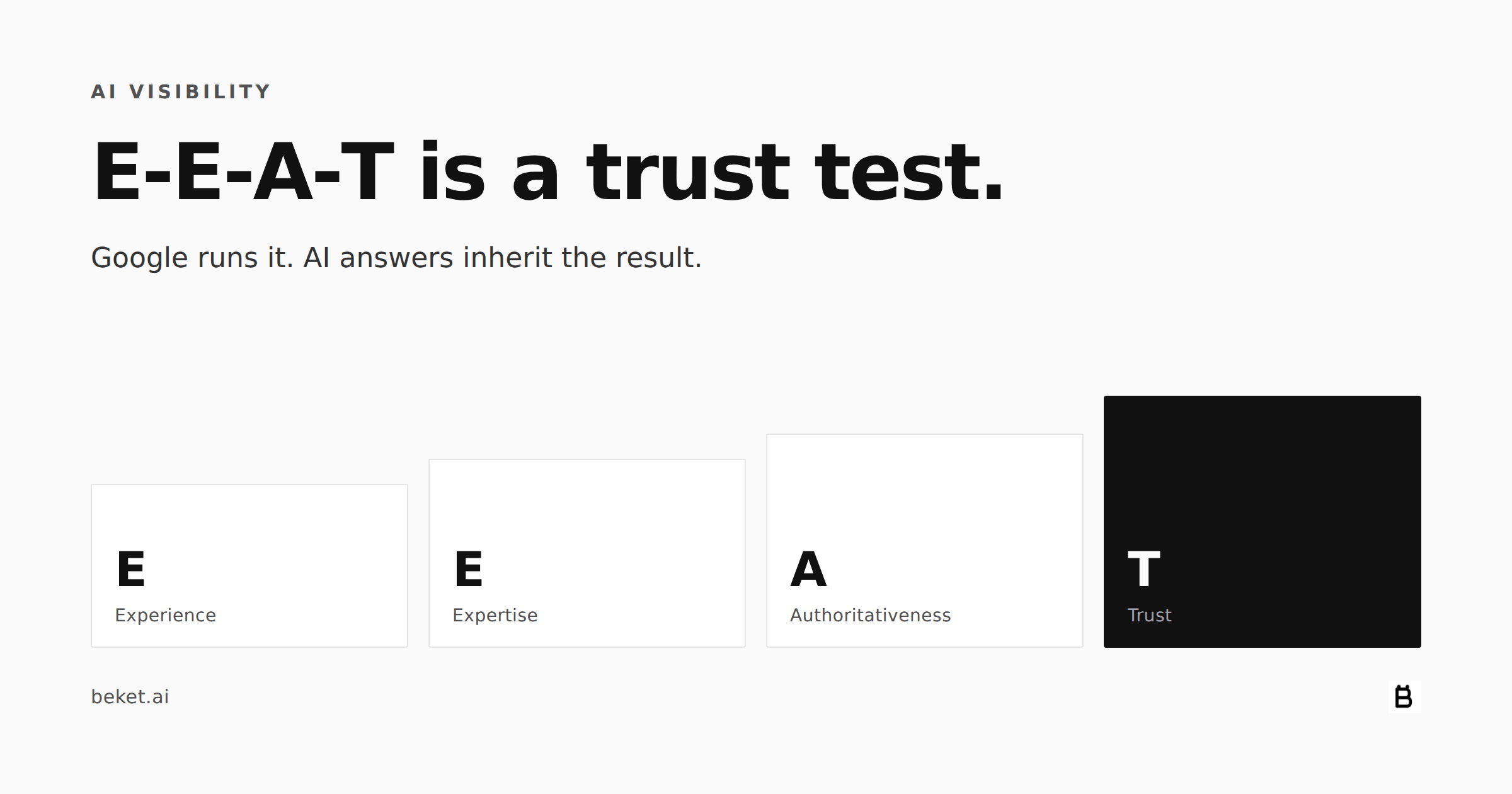
The letters stand for Experience, Expertise, Authoritativeness, and Trust. They come from Google’s Search Quality Rater Guidelines. Human raters use that handbook to judge results. Their scores do not set your ranking. They train the systems that do.
Google launched the framework as E-A-T in 2014. It added the second E, Experience, in December 2022. That change rewards first-hand knowledge. Someone who used the product. Someone who went to the place. Someone who lived through the thing.
This guide covers each pillar, the proof that demonstrates it, and the tasks to run this week.
Why it matters now
E-E-A-T started as a side note. It is now the main quality standard.
The March 2024 core update folded the Helpful Content System into Google’s core ranking systems. That system is Google’s way of scaling E-E-A-T judgment across billions of pages.
It also runs downstream. Ahrefs found that 76% of AI Overview citations come from pages already in the top 10 organic results. AI answers inherit the trust signals of classic search. Fail the trust test in search and you disappear from the answer too.
Weak pages drag down strong ones. A site full of thin content ranks worse as a whole.
Experience: show you were there
Experience means first-hand involvement with the subject.
Consumer Reports buys every product it tests. No free samples from manufacturers. That single policy is an experience signal, and readers understand it in one sentence.
King Arthur Baking tests every recipe in its own test kitchen. The photos are theirs. The failure notes are theirs. A stock photo cannot fake that.
To-do:
- Add a “how we tested” or “how we made this” note near the top of key pages.
- Replace stock images with your own photos, screenshots, or video.
- Write the failures, not just the wins. Say what broke.
- Put your first-hand background on the About page. Link your LinkedIn.
- Invite a guest author when you lack the experience yourself.
Expertise: show you know the field
Expertise means skill and depth. Experience alone does not make you an expert.
Mayo Clinic publishes health content reviewed by named physicians. The reviewer sits on the page. The review date sits next to the name.
The bar moves with the topic. Medical advice needs a doctor. Tax advice needs an accountant. These are YMYL topics, covered below. Plant care advice does not need a botanist. A gardener with twenty seasons has enough.
To-do:
- Give every author a real bio page with credentials and a photo.
- Show the reviewer name and review date on technical or sensitive pages.
- Cite primary sources. Link to the study, not the article about the study.
- Publish clusters, not one-offs. Five deep pages on one topic beat fifty shallow ones.
- Keep a visible changelog on pages you update.
Authoritativeness: show others vouch for you
Authority is what other people say about you. It is always relative to a topic.
The Michelin Guide is an authority on restaurants. It is not an authority on airline safety. Nike is an authority on running shoes and not on tax law. Pick your lane and own it.
Authority is built with links and mentions from sites that already have it. Gary Illyes of Google put it plainly: E-A-T is largely based on links and mentions on authoritative sites.
The National Weather Service gets cited by every news outlet in the country. That is authority earned by being the source, not by asking for links.
To-do:
- Publish original research. Data nobody else has gets cited.
- Build an “As seen in” or press page. List every mention with a link.
- Go on podcasts and webinars in your field. Ask for a link in the show notes.
- Answer journalist queries. A quote in a trade publication is worth more than ten guest posts.
- Collect real reviews on third-party sites. Do not gate them.
Trust: the pillar that carries the roof
Trust means accuracy, honesty, safety. It is the most important of the four. A page judged untrustworthy scores low on E-E-A-T no matter how expert it looks.
Wikipedia is not written by credentialed experts. It is one of the most trusted sites on the web anyway. Every claim carries a footnote. Every edit is public. Every correction is logged. Transparency does the work.
Your bank does the same thing in a different way. HTTPS everywhere. A real address. A phone number that a person answers.
To-do:
- Link privacy policy, terms, and returns in the footer.
- Publish a physical address, phone, and email.
- Run HTTPS across the whole site.
- Disclose sponsored and affiliate content at the top, not the bottom.
- Publish an editorial standards page. Explain how you fact-check and correct errors.
- Kill popups that cover content and video that plays with sound.
YMYL: where the bar is highest
YMYL means “Your Money or Your Life.” Google applies extra scrutiny to topics where bad information causes real damage.
YMYL categories:
- Health and safety
- Money, finance, and transactions
- Civic, legal, and government information
- News and current events
- Information about groups of people
A site in these categories with weak E-E-A-T can drop hard. The August 2018 “medic” update wiped out traffic for health sites that had no credentials behind their content.
To-do:
- Have a certified expert review every YMYL page. Credit them by name.
- Refresh YMYL pages every few months. Track them on an editorial calendar.
- Cite the primary authority: the FDA, the IRS, the CDC, the regulator in your market.
Two things E-E-A-T is not
It is not a direct ranking factor. Google measures proxies that stand in for it. Danny Sullivan, then Google’s Search Liaison, said there is no single technical measure the way there is for page speed. Google uses a range of signals instead.
It is not a score. Google does not store an E-E-A-T number for your site. Quality raters use the concept. The algorithms use signals.
How to measure it
You cannot read a score. You can track two proxies.
Backlinks. Count links from unique, authoritative domains on relevant topics. Volume matters less than source quality.
Mentions. Search Google for "your brand" -site:yourdomain.com. Note the result count. Repeat monthly. A rising line means your name is spreading.
Neither number is official. Both move in the same direction as trust.
E-E-A-T and AI-generated content
Google rewards good content regardless of how it was made. Ahrefs analyzed 600,000 pages and found 81.9% of top-20 content includes some AI-generated material. Google is not punishing the tool.
It punishes the output when the output is thin.
To-do:
- Have a person review every piece before it ships.
- Add first-hand detail the model cannot invent.
- Fact-check every number and every citation. Models hallucinate sources.
Does E-E-A-T apply to ChatGPT and Perplexity
Not by name. E-E-A-T is a Google framework. ChatGPT, Claude, and Perplexity do not run it.
They run something that rhymes with it.
When these assistants search the web, they pull from an index. If they pull from Bing, the results already passed Bing’s Content Quality system. Models also apply internal filters when choosing which sources to quote. The standards land close to E-E-A-T even though nobody calls them that.
Ahrefs found the strongest correlations with AI Overview mentions are all off-site: branded web mentions, branded anchor text, branded search volume. Known brands win the answer box.
The checklist
One-off tasks
- [ ] Link legal and policy pages in the footer
- [ ] Publish address, phone, and email
- [ ] Run HTTPS sitewide
- [ ] Add affiliate and sponsorship disclosures
- [ ] Add schema markup to key pages
- [ ] Publish an editorial standards page
- [ ] Get YMYL pages expert-reviewed and credited
- [ ] Link author bios to professional profiles
- [ ] Build an “As seen in” section
- [ ] Remove intrusive popups and autoplay audio
Ongoing jobs
- [ ] Refresh YMYL pages on a schedule
- [ ] Audit thin pages. Improve them or delete them
- [ ] Add first-hand proof: stories, case studies, original data
- [ ] Back every claim with a source
- [ ] Earn mentions from trusted publications
- [ ] Build links through PR, research, and journalist quotes
- [ ] Grow and interlink topical clusters
- [ ] Appear on podcasts and webinars
Changes take time. Google often waits for the next core update to reassess site quality. Expect months, not days.
The test
Ask one question about every page you publish. A reader should be able to see why they ought to trust this content, this author, and this site. If the answer takes work to find, the page is not ready. Then use beket.ai’s built-in E-E-A-T analysis tool to view score breakdown, strengths, weaknesses and recommendations.
E-E-A-T is not a project you finish. It is a standard you hold.
Where beket.ai comes in
E-E-A-T tells you how to earn trust. It does not tell you whether AI models got your business right.
beket.ai runs standardized queries against ChatGPT, Google AI mode, AI Overview, Claude and Perplexity. It scores each answer against your real business data. It shows the wrong facts, the missing facts, and the sources feeding them. Where the fix can be automated, beket.ai applies it.
Build the trust signals. Then check what the models actually say. Run an audit at beket.ai.
Related guides
How to Choose AI Search Optimization Software in 2026: A Buyer's Guide
A plain guide to AEO and GEO software — what the tools do, how the leaders differ, and the one question that sorts them.
Using the beket.ai MCP: Run Audits and Draft Content by Chat
What the beket.ai MCP is, how to connect it to Claude, ChatGPT, or Cursor, and the one thing to know before you let an assistant act on your account.
Bing Is ChatGPT's Back Door: Why Bing Webmaster Tools Is the Cheapest AI Visibility Lever You're Ignoring
A hands-on guide to setting up and tracking Bing Webmaster Tools for AI search — plus the experiment that made ChatGPT start describing our startup.