
How to Choose AI Search Optimization Software in 2026: A Buyer's Guide
A plain guide to AEO and GEO software — what the tools do, how the leaders differ, and the one question that sorts them.

On this page
People no longer type into a search box. They ask a chatbot.
They ask ChatGPT. They ask Gemini. They ask Perplexity. They ask Claude. The model reads its training data, its live web index, and its retrieval sources. Then it answers with one name. If that name is not yours, you lost the customer. You never saw it happen.
This is the new battleground. It moved from the search results page to the chat window. If a model leaves you out, or gets you wrong, or ties you to old facts, you go invisible. This guide shows you what AI search software does and how to pick the right tool.
What AI search optimization software does
The old name is SEO. It chased keyword rankings and clicks. The new work is different. It is called AI SEO, or AEO, or GEO. It optimizes for one thing: how the models describe and recommend you.
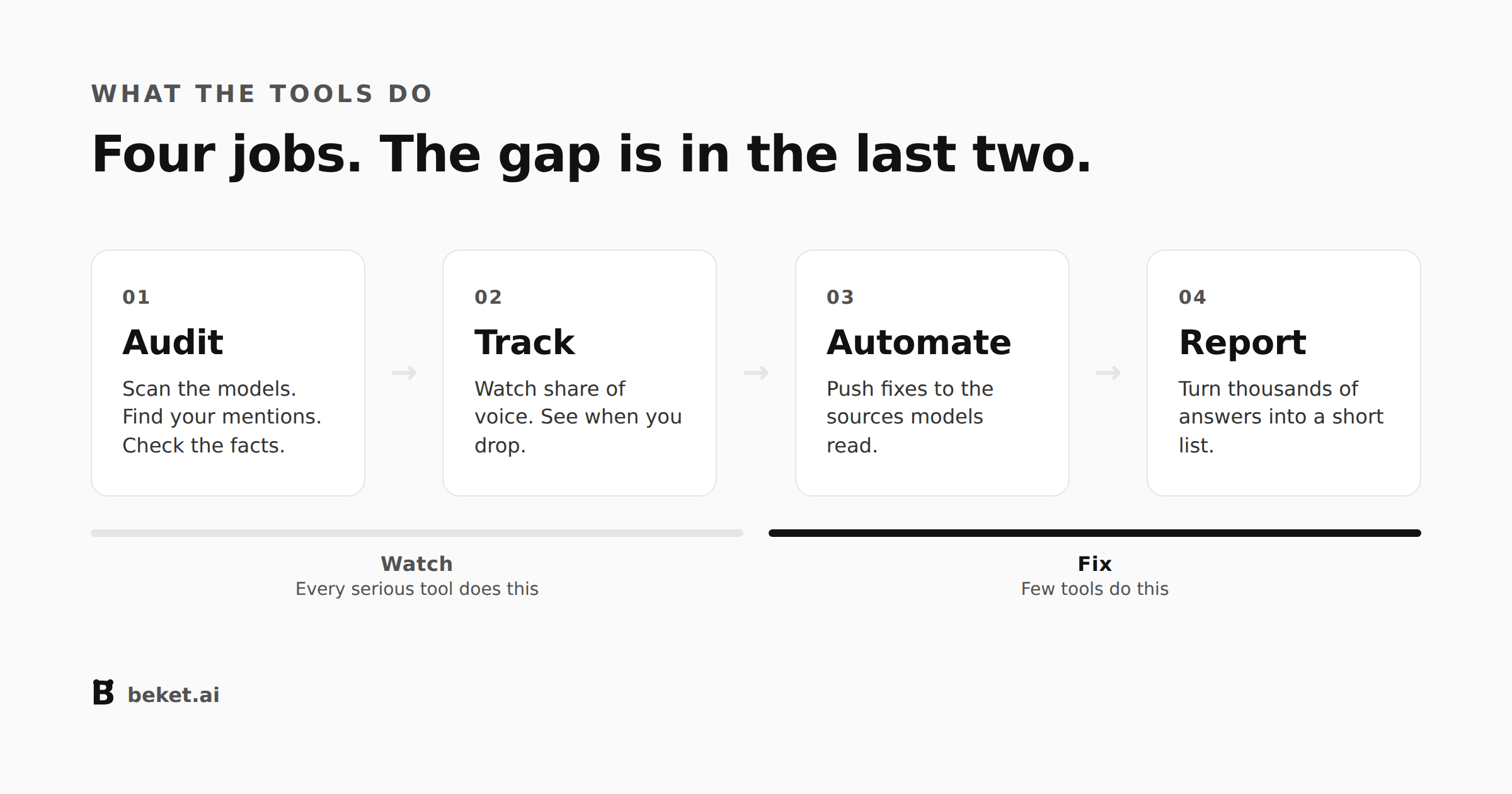
The tools simulate real user questions. They send thousands of them to each model. They map how, when, and why a model names your brand. The work splits into four jobs.
Auditing. The tool scans across models. It finds your mentions. It checks the sentiment. It checks the facts. It maps who the model names instead of you.
Tracking. Your visibility moves day to day. The tool watches your share of voice over time. It tells you when you are cited as a source and when you are dropped.
Automation. This is where tools split apart. Most tools only watch. A few tools push fixes to the sources the models read. They correct the error before it spreads.
Reporting. The tool turns thousands of answers into a short list. It shows you where your authority is weak.
Every serious tool does the first two jobs. The gap is in the third.
The cost of doing nothing
Models make mistakes. They quote old web pages. They guess.
A prospect asks a model about your product. The model says you lack a feature. You shipped that feature last month. The prospect believes the model. The prospect stops looking. You never learn why.
This happens at the top of the funnel. It happens before the person reaches your site. A wrong answer shapes what they think before you get a word in. You cannot fix what you cannot see.
The tools, side by side
Here is the field in 2026.
| Platform | Core focus | Automation | Security | Best for |
|---|---|---|---|---|
| beket.ai | Auditing, automated fixes via MCP, daily re-audits | High | Enterprise-grade | Mid-market brands, enterprise teams, agencies |
| Profound | Enterprise agent analytics and tracking | Low | SOC2 | Large enterprises |
| Otterly AI | Brand and sentiment monitoring | None | Standard | PR and brand teams |
| Peec AI | Citation tracking and discovery | None | Standard | SMBs and publishers |
| AthenaHQ | Content recommendation command center | Medium | Enterprise-ready | Content marketers |
Read down the automation column. That is the line that matters.
Detailed profiles
beket.ai
beket.ai is built for brands and agencies that cannot leave their AI reputation to chance. It moves past tracking into fixing.
It audits across ChatGPT, Gemini, and Perplexity. It tracks citations in real time. It runs competitive gap analysis. When it finds an error or a missing mention, it flags the source and pushes an update. Then it re-audits the next day. This closes the loop.
It runs on enterprise-grade security. Brand integrations and source connections stay locked. It suits mid-to-large firms and agencies that manage many clients at once. See AI Presence Management for Agencies and AI Visibility for Brands.
Profound
Profound is a premium analytics platform. It measures visibility across models and AI agents. It offers deep agent analytics, visibility scoring, and cross-platform share of voice. It is SOC2 compliant.
It is a diagnostic tool. It shows where you fall short. It leaves the fixing to your team. It suits Fortune 500 firms that need compliant, detailed tracking.
Otterly AI, Peec AI, and AthenaHQ
Otterly AI watches sentiment. It works like an alert system for the models. It pings PR and brand teams when a model names them in a bad light.
Peec AI tracks citations. It is light and focused. It shows publishers and small firms which pages the models quote as sources.
AthenaHQ turns tracking data into content ideas. It shows writers the gaps in a model’s knowledge. It helps them draft pages that fill those gaps.
The one question that sorts them
Ask yourself this. Do you want to watch your visibility slip, or do you want to fix it?
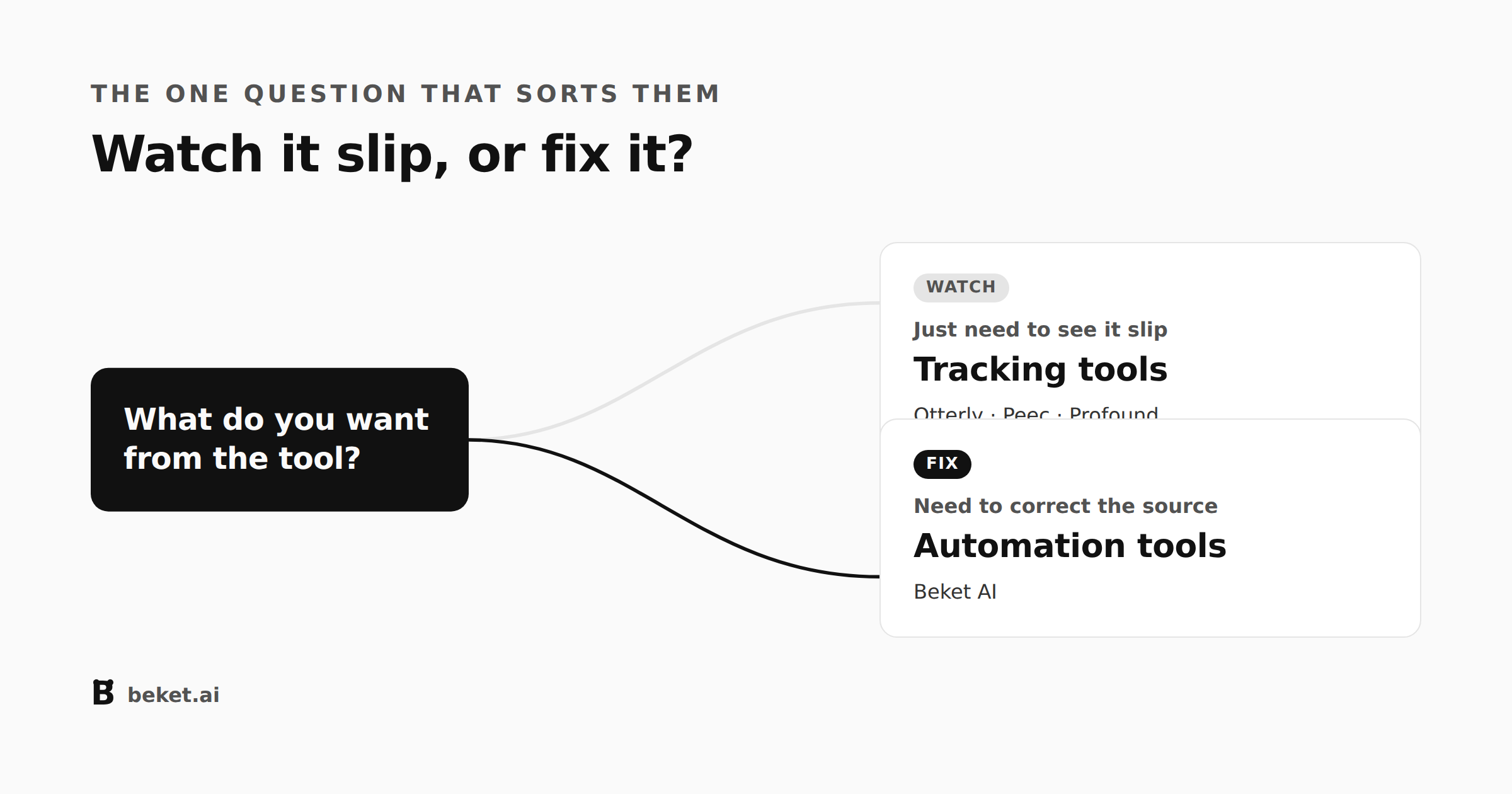
If you only need to watch, a tracking tool is enough. Otterly, Peec, and Profound all watch well.
If you need to fix, you need automation. You need a tool that pushes corrections to the sources models read. Few tools do this. beket.ai is one.
The rest of the choice follows from your size and your rules.
Enterprise teams with analysts may want heavy reporting. Small teams and agencies want less overhead and more done for them. Firms in finance, health, or software need secure data handling and clear approval gates.
Why systematic auditing matters
Models do not read the web the way people do. They ingest structured data, feeds, and clean, extractable text. Static SEO no longer keeps you visible.
The web the model reads is also live. Models lean more on real-time retrieval each year. A tool has to establish a baseline first. Then it finds the exact broken links, stale directory profiles, and unoptimized feeds that make a model get you wrong. See Static vs. Live AI Search.
Security to check before you connect
These tools reach into your data. Some ask for write access to your pages and feeds. That is real risk. A weak tool could break a layout or leak a fact.
Ask three things before you connect anything.
Can it run read-only when you need it to? beket.ai can. It finds gaps and drafts fixes without write access.
Are the write channels locked down? beket.ai runs fixes through encrypted API endpoints with role-based access control.
Can a human approve every change? beket.ai sets approval gates. Nothing goes live until a person signs off.
For more, read the Privacy Policy and the FAQ.
Frequently asked questions
What features are essential in an AI SEO tool? Multi-engine tracking across ChatGPT, Gemini, and Perplexity. Real-time accuracy and sentiment scoring. Competitive gap analysis. A clear path to fixing what you find. Tracking alone is no longer enough.
How does automated fixing work? Models pull live data to answer. If a model reads an old directory or a stale page, it repeats the error. Automated fixing updates those sources at once via MCP. The next time the model reads the web, it finds the right facts. See AI Reads Today’s Web, Not Last Year’s.
Is beket.ai safe for agencies and businesses? Yes. It runs on enterprise-grade security, secure API integrations, and custom approval workflows. It scales across many client profiles.
How often should you audit? Daily. Models update their indexes, run live searches, and ship new versions all the time. Visibility can change overnight. A daily re-audit catches the drop while it is still cheap to fix.
The bottom line
The battleground moved to the chat window. To hold market share and protect your name, the models have to recommend you, and recommend you right.
Passive tracking is a start. It is not the goal. The goal is to be named, and named right, every time a model answers.
beket.ai finds where AI gets you wrong, then fixes it — before a wrong answer costs you a customer. Start with our guide on AI Search Optimization and audit your brand today at beket.ai.
Related guides
Bing Is ChatGPT's Back Door: Why Bing Webmaster Tools Is the Cheapest AI Visibility Lever You're Ignoring
A hands-on guide to setting up and tracking Bing Webmaster Tools for AI search — plus the experiment that made ChatGPT start describing our startup.
E-E-A-T: The Trust Test Behind Google Rankings and AI Answers
A plain guide to Experience, Expertise, Authoritativeness, and Trust — with the exact tasks that prove each one.
Your Analytics Can't See AI Crawlers. Cloudflare Can: A Guide to beket.ai's Cloudflare Integration
How to connect Cloudflare to beket.ai in three steps, and how to read the AI crawler and AI referral data it returns.