
5 AEO Strategies That Work in 2026 (Backed by Vancouver AI Studies)

Most AEO advice still reads like a generic SEO checklist with "AI" pasted on top: add schema, write FAQs, publish more. Our Vancouver market audits tell a sharper story. Across four verticals — lawyers, mortgage brokers, realtors and marketing agencies — ChatGPT, Perplexity and Google AI Overview rarely named the same businesses, Google AI Overview often did not fire at all, and a strong Google Maps ranking did not mean an AI answer would name you.
These five strategies come from those audits (October 23–25, 2026 for the four verticals, plus a November 3, 2026 Maps-vs-AI re-check for realtors). They are not a ranking formula. They are the patterns that kept showing up when we asked the same 25 unbranded buyer questions on three engines and counted who got named and which pages got cited.
What we mean by AEO here
Answer engine optimization (AEO) is the work of getting named and cited when someone asks ChatGPT, Perplexity or Google's AI features a buyer question. It overlaps with SEO and with generative engine optimization, but the scoreboard is different: you care whether the answer names your business and which URL shaped that answer, not only whether a classic blue link ranks.
For a repeatable process around these strategies, see our AEO workflow. This post is about which moves the Vancouver data supports.
Strategy 1: Treat each engine as its own channel
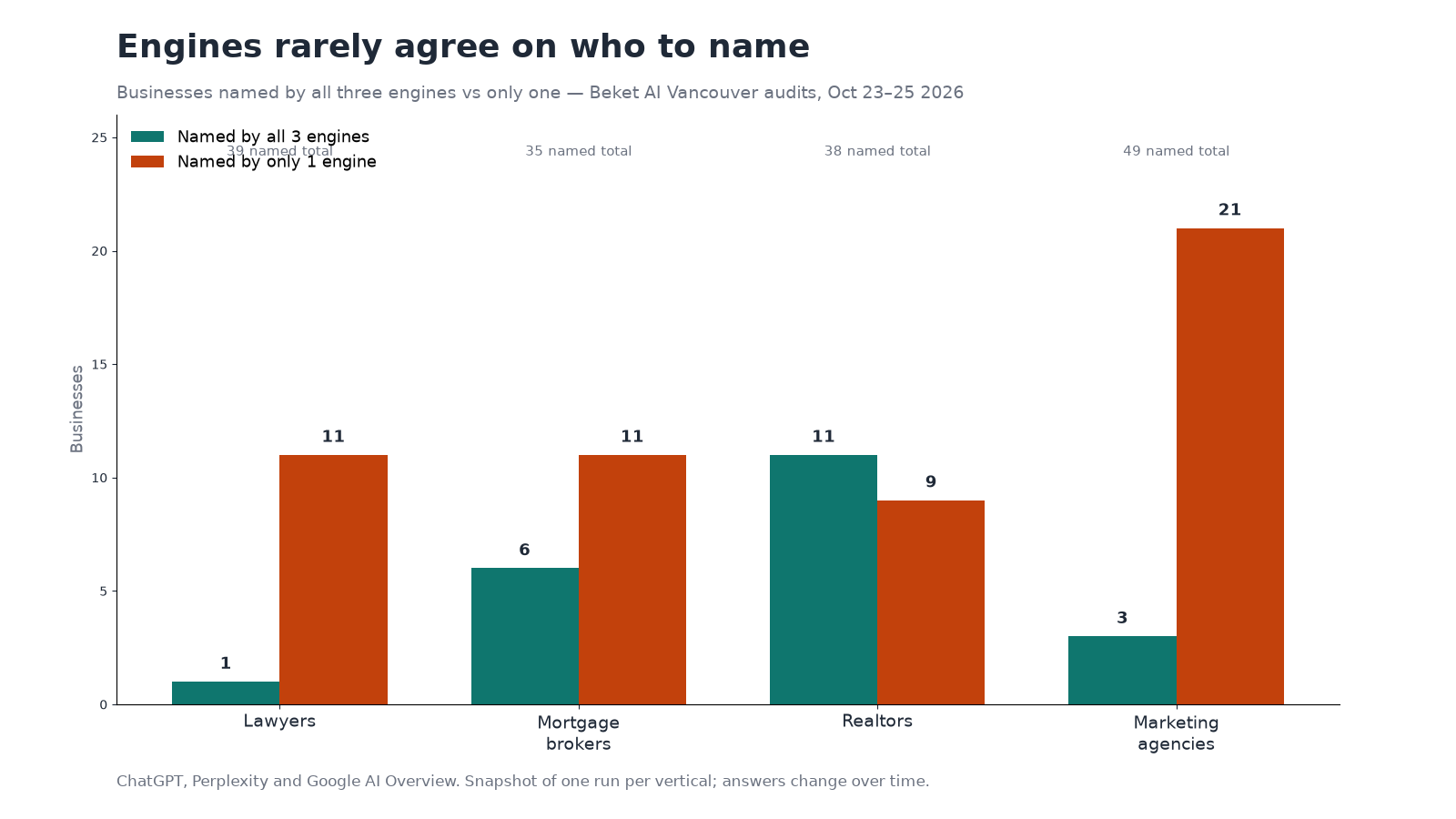
The same 25 unbranded questions produced three different shortlists.
| Vertical (Oct 2026) | Businesses named | Named by all 3 engines | Named by only 1 engine |
|---|---|---|---|
| Lawyers | 39 | 1 | 11 |
| Mortgage brokers | 35 | 6 | 11 |
| Realtors | 38 | 11 | 9 |
| Marketing agencies | 49 | 3 | 21 |
Only one Vancouver law firm, YLaw, was named by ChatGPT, Perplexity and Google AI Overview. Only three marketing agencies — Major Tom, Takt and Optimized Webmedia — cleared all three. A business that "wins AI" on ChatGPT can be invisible on Perplexity the same day.
The engines also disagreed on who led. Examples from the same runs:
- Lawyers: ChatGPT named Blakes most (13 mentions); Perplexity named Watson Goepel LLP most (8); Google AI Overview named YLaw most (3). Fasken led the combined count (16) without leading any single engine.
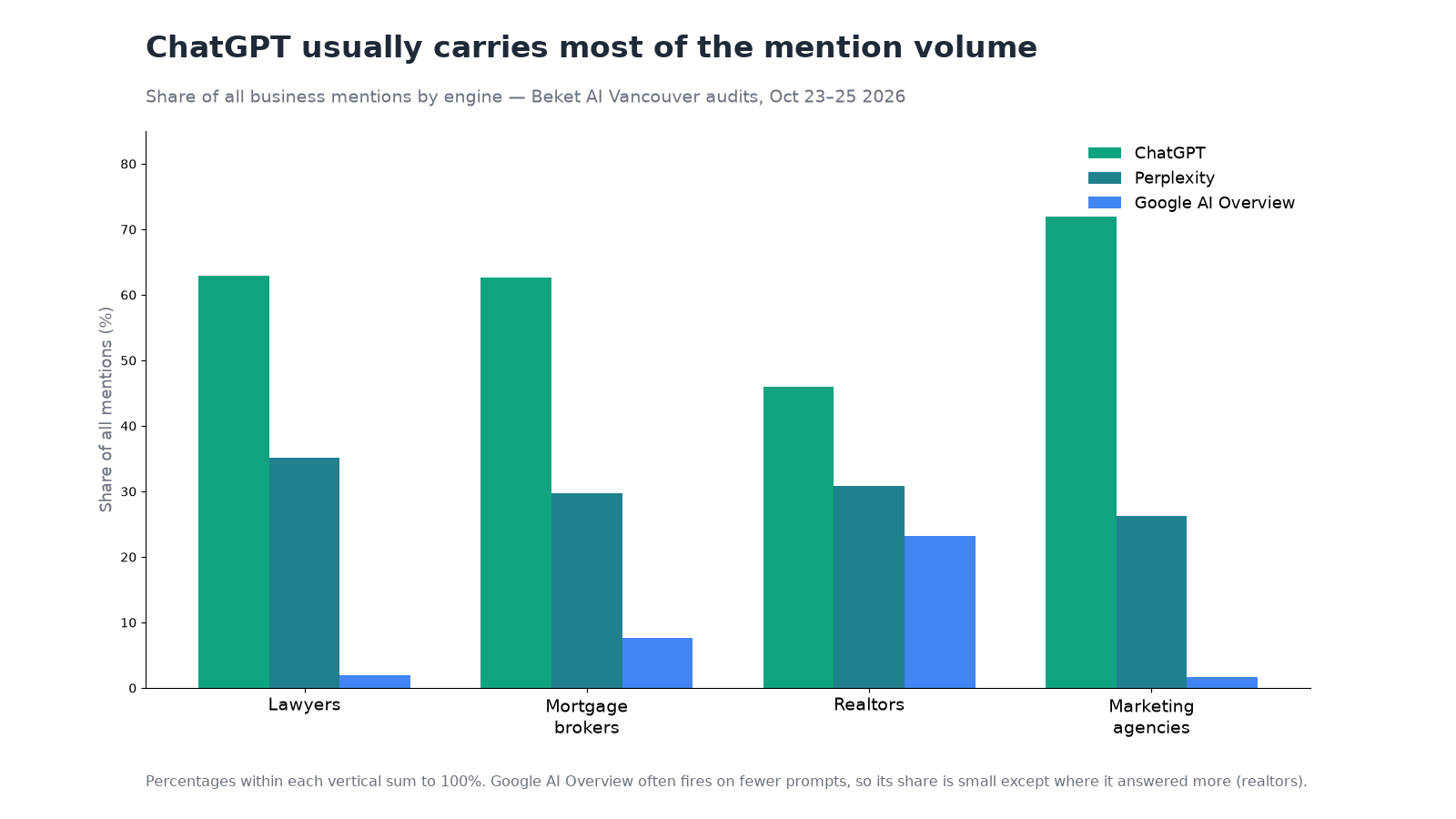
- Marketing agencies: ChatGPT named Takt most (34); Perplexity named Major Tom most (24). ChatGPT alone produced 304 of the 422 total mentions.
What to do: keep a per-engine log. When you check a prompt, record who ChatGPT named, who Perplexity named and whether Google showed an AI Overview. Optimizing only for the engine that already likes you leaves the other two unchecked.
Full breakdowns: Vancouver lawyers, mortgage brokers, realtors, marketing agencies.
Strategy 2: Aim to be named, and track citations separately
A mention puts your name in the answer a buyer reads. A citation is a linked source the engine used. You want both, and they do not always travel together.
In our November 3, 2026 Maps vs AI study of Vancouver realtors, one agent's website was the third most-cited domain in the whole audit (24 citations), yet the engines never named that agent as a recommendation. An AI can mine your page for a fact and still send the buyer to someone else.
The reverse also happens: directories get cited while your brand is only mentioned, or a regulator gets cited while no business is named at all. In our sample of 264 ChatGPT citations from five Vancouver audits, 18% of links went to directory, list or review sites and 10% to regulator, government, nonprofit or university pages.
What to do: for every prompt you track, log two columns — "named?" and "which URLs were cited?" Fixing a wrong fact on a cited page is different work from getting into the named shortlist. Treat them as two jobs.
Strategy 3: Publish pages that match the buyer questions AI already gets
When ChatGPT linked a business's own site in our citation sample, most links went to homepages (129 of 175 own-site links). The clearest situational pattern was narrower: for a self-employed mortgage question, 7 of 11 broker-site links went to pages built for that exact case (/self-employed, /self-employed-mortgage-bc), not generic homepages.
That matches how ChatGPT search works in public docs: it rewrites a question into targeted searches, then ranks results (OpenAI). A page titled and written for "presale condo realtor in Vancouver" or "tenant rights lawyer Vancouver" is easier to retrieve for that rewrite than a vague services mega-page.
Our audits deliberately used unbranded questions — the kind a buyer asks before they know your name. Combined across the four verticals, that produced 210 to 422 business mentions per audit from the same 25-prompt template. Brands that only audit branded vanity searches miss the questions that decide the shortlist.
What to do:
- List 15–25 unbranded questions your buyers ask (service + city + situation).
- For the ones where competitors get named and you do not, publish or rewrite a page that answers that question in the first screen, with your name, location and offer in plain text.
- Keep the homepage honest too — two-thirds of own-site ChatGPT links in our sample still landed there.
Strategy 4: Be present where the engines already look
Third-party pages carried real weight in every vertical we measured.
| Signal from Beket AI Vancouver audits | What showed up |
|---|---|
| ChatGPT citation mix (264 links, five audits) | 66% own site, 18% directory/list/review, 10% regulator/gov/nonprofit/university |
| Mortgage + realtor citations (all engines) | BC Financial Services Authority (BCFSA) was the most-cited domain in both audits |
| Marketing agencies (all engines) | clutch.co led with 63 of 693 cited links; sortlist.com 51; agencies.semrush.com 38 |
| Marketing agencies (ChatGPT sample) | 24 of 77 links went to directories; some "best PPC" answers cited directories only |
| Realtors (ChatGPT sample) | Half of 18 links went to agent-rating / directory sites |
Public research points the same way for brand presence off your own site. Ahrefs data reported by Search Engine Land found branded web mentions correlated more strongly with AI Overview brand mentions (Spearman 0.664) than raw backlinks (0.218) among about 75,000 brands with DR above 40. Links still matter for classic search; for AI naming, extractable facts and third-party mentions showed up as the tighter relationship in that dataset.
What to do: open the sources the engines cite for your prompts. Complete the directories that keep appearing. Keep regulator and association listings accurate. Earn reviews and roundups that state the service, city and outcome in plain language. Do not skip your Google Business Profile — just do not assume Maps work covers AI answers (next strategy).
Strategy 5: Measure AI visibility apart from Maps and classic SEO — and re-check
Maps success did not transfer cleanly into AI recommendations.
On November 3, 2026 we ran the same 25 Vancouver realtor questions through Google Maps and through ChatGPT, Perplexity and Google AI Overview. Of the 50 businesses in the Maps top 3, AI engines named only 7 (14%) on a strict agent/team match, or 13 (26%) if we also counted the brokerage printed on the Maps listing. Even the loose count left 37 of 50 Maps businesses unnamed by every engine. BrightLocal's larger September 2026 local study (200,085 searches) found a similar gap at scale: Maps named the tracked business in 66% of searches, while AI surfaces named it in 32% to 38% (BrightLocal).
Google AI Overview coverage is uneven too. In our October realtor run it appeared for 8 of 25 questions; eleven days later, on November 3, it appeared for 17 of 25. ChatGPT still carried most mention volume in three of the four October verticals:
What to do: keep Maps and Search Console reports. Add a separate AI sheet (or tool) with the same unbranded prompts, run on a schedule. Compare names and citations week to week. One screenshot is a snapshot, not a system — answers moved between our October 23 and November 3 realtor runs even when the leader (Oakwyn Realty) stayed on top.
What these strategies are not
They are not a promise that schema, FAQ blocks or an llms.txt file will get you named. Google's own AI optimization guide already pushes back on several of those shortcuts. They are also not a substitute for accurate, crawlable pages. If OAI-SearchBot or other search crawlers cannot read your site, none of the five strategies above have much to work with.
And they are not a ranking of any firm we studied. The counts are what the engines returned on those dates. AI answers change. A business can ask Beket AI for another run of any of these studies.
How to put the five to work this month
| Priority | Move | Evidence it matters |
|---|---|---|
| 1 | Build a 25-prompt unbranded set and log names + citations per engine | Engines disagreed in every Vancouver vertical |
| 2 | Ship or rewrite situation pages for the prompts you lose | Self-employed mortgage citations hit matching deep pages |
| 3 | Fix the directories and regulator listings the engines already cite | 18% / 10% of ChatGPT links; Clutch / BCFSA domain leaders |
| 4 | Stop using Maps rank as an AI KPI | Only 14% of Maps top-3 realtors named (strict) |
| 5 | Re-run the same prompts on a schedule | Realtor AIO coverage and name lists moved in 11 days |
You can run the checks by hand. Beket AI's free audit on beket.ai runs 25 prompts across ChatGPT, Perplexity and Google AI Overview and shows who each answer names and which sources it cites. Pro is $49/month with daily re-audits, starting at 50 prompts across the same three engines. Beket AI does not apply fixes to your site and does not claim to see any engine's internal ranking systems — it shows what the answers returned so you can do the work on pages and listings yourself.
For a quick technical pass (robots.txt, llms.txt and related readiness signals), use the separate 9-point check at beket.ai/ai-check. That is not the 25-prompt audit.
About the data
- Four market audits (Vancouver, English): lawyers, mortgage brokers and realtors on October 23, 2026; marketing agencies on October 25, 2026. Each used 25 selected unbranded questions on ChatGPT, Perplexity and Google AI Overview, plus discovery prompts in the answer logs. Mentions and per-engine splits come from each audit's market report.
- Citation sample: 264 ChatGPT links from the first-100-links export across five Vancouver audits (lawyers, mortgage, realtors, marketing agencies, holiday shopping), detailed in How to get cited by ChatGPT.
- Maps comparison: November 3, 2026 re-run of the 25 realtor questions against Google Maps top 3 and the three AI engines, detailed in Google Maps vs AI.
- Limits: one city, snapshot runs, Google AI Overview often appeared for only a subset of prompts. Counts describe what the engines returned those days, not service quality.
Related posts
Free Tools to Check How AI Sees Your Website (2026 Guide)
Free ways to check how AI sees your website: ChatGPT mentions, Search Console, Bing, Cloudflare, Clarity, Ahrefs, Semrush, and Beket AI's audit vs /ai-check.
How to Write YouTube Descriptions for AI Search: A Practical Test
A cautious guide to updating YouTube descriptions for AI search, with study limits, practical editing tips and a measurement workflow.
ChatGPT Business Hub Is Live: How to Claim Your Business and What It Shows (and Doesn't)
OpenAI's Businesses in ChatGPT beta is live. Claim your profile, see 28-day mentions and clicks, and learn what Business Hub still doesn't show.