
Google Maps vs AI: Do Vancouver's Top Realtors on Maps Get Named by ChatGPT? (2026 Study)

Your Google Business Profile is verified, your reviews are strong, and you show up in the Google Maps top 3 for the searches that matter. Does that mean ChatGPT will name you when someone asks it for a recommendation?
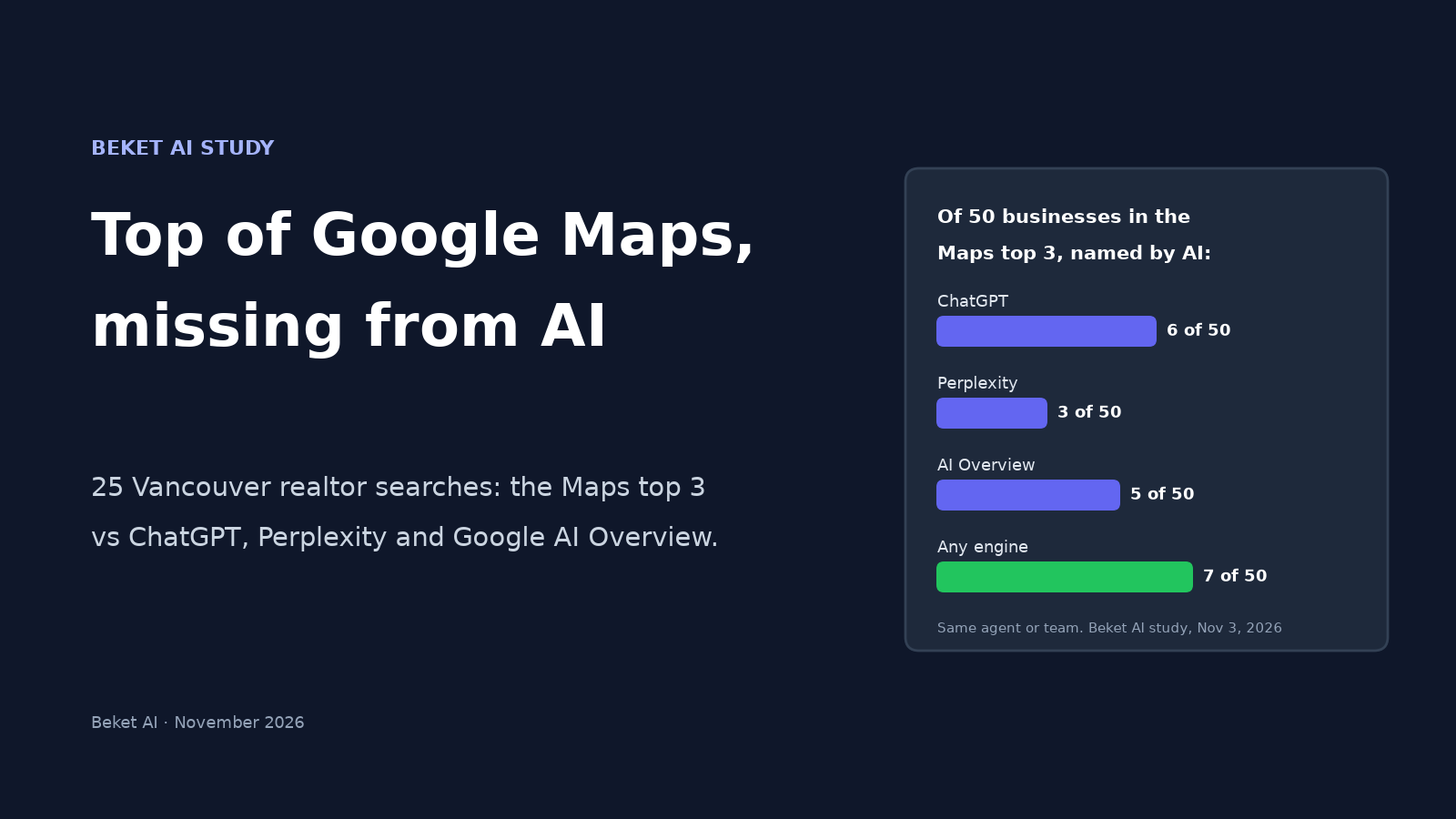
We tested it. On November 3, 2026, we ran 25 Vancouver realtor searches through Google Maps and through a Beket AI audit of ChatGPT, Perplexity and Google AI Overview, then compared who each one named. The short answer: mostly not. Of the 50 businesses in the Maps top 3, the AI engines named 7.
This post covers what we found, why the map pack and AI answers pick different businesses, and six fixes grounded in what the data showed. It's local SEO for AI, based on one city and one category, but the pattern is one any local business can check for itself.
What we tested
We used the same 25 unbranded questions from our October Vancouver realtors study, such as "best realtors in Vancouver BC", "realtors in Burnaby", "presale condo realtors in Vancouver" and "how to choose a real estate agent in Vancouver".
- AI side: one Beket AI audit of all 25 questions on ChatGPT, Perplexity and Google AI Overview, located in Vancouver, in English. Google AI Overview appeared for 17 of the 25 questions. Across all answers, the engines named 51 different realtors, teams and brokerages: 43 on ChatGPT, 31 on Perplexity and 25 on Google AI Overview.
- Maps side: the same 25 questions typed into a Google Maps search centred on Vancouver the same day. We recorded the first three organic listings and skipped ads (16 of the 25 searches showed sponsored listings first). That's 75 slots. Three went to industry associations rather than businesses, leaving 72 business slots held by 50 different businesses.
Beket AI reports which businesses each engine named across the whole audit, not answer by answer. So "named" below means an engine named that business somewhere in its answers to the 25 questions, not necessarily for the same search that put it in the Maps top 3. That's a generous test for the AI side, and the overlap was still small.
Maps winners were mostly missing from AI answers
Maps and AI answers don't use the same kind of name. Maps listings are mostly individual agents and teams, often with keyword-heavy titles. AI answers mostly named brokerages. So we counted matches two ways:
- Strict: the AI named the same agent or team that holds the Maps listing.
- Loose: strict, or the AI named the brokerage printed in the Maps listing title (for example, an agent listing that ends in "Oakwyn Realty" counts if the AI named Oakwyn Realty). We didn't look up brokerages that the listing doesn't show.
| Maps top-3 businesses named (of 50), strict | Loose | Maps #1 businesses named (of 18), strict | Loose | |
|---|---|---|---|---|
| ChatGPT | 6 | 12 | 3 | 5 |
| Perplexity | 3 | 8 | 1 | 3 |
| Google AI Overview | 5 | 11 | 3 | 5 |
| Any engine | 7 (14%) | 13 (26%) | 3 (17%) | 5 (28%) |
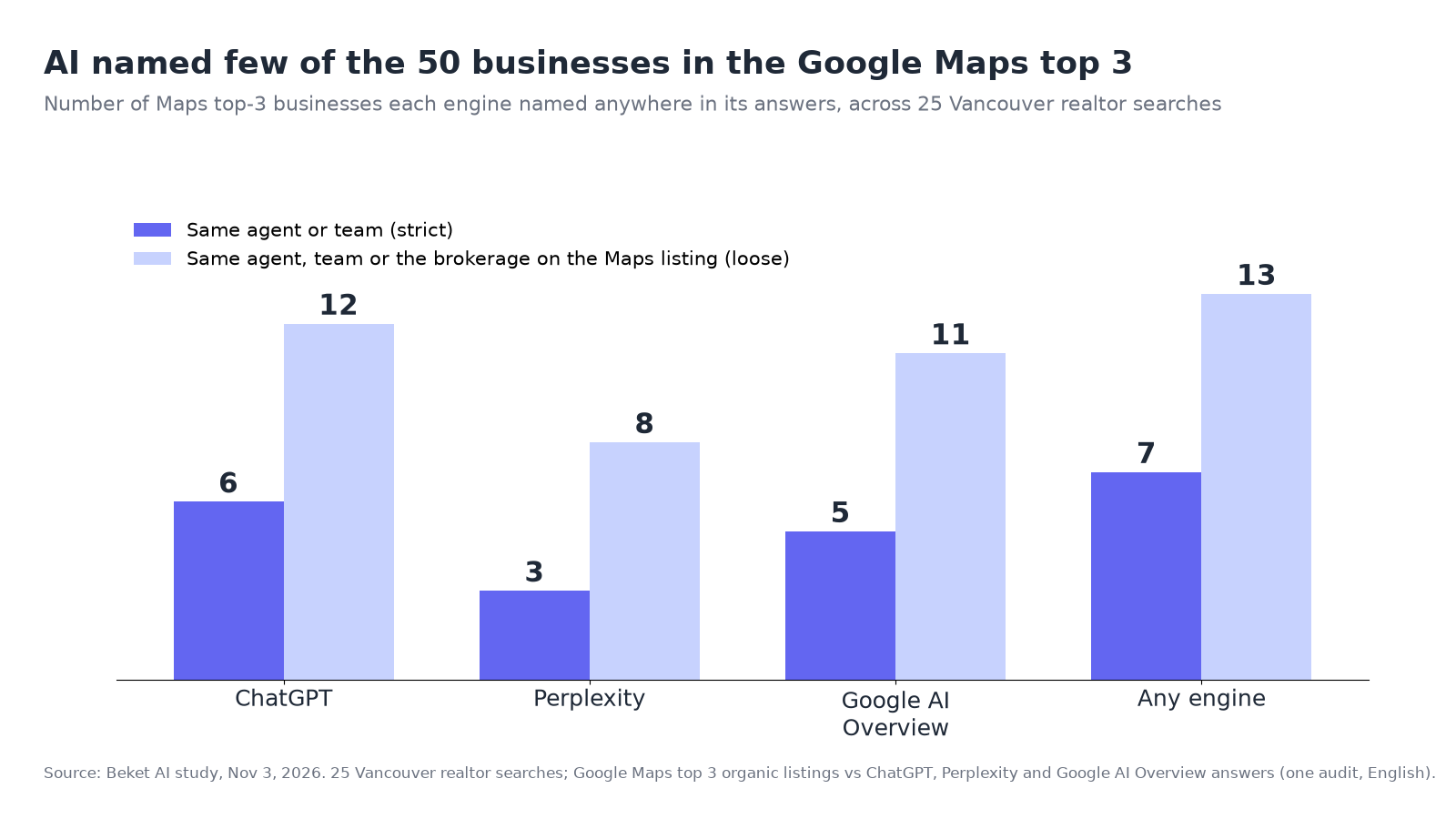
Source: Beket AI study, Nov 3, 2026.
Even the loose count, which gives the AI credit whenever it names the brand behind an agent, leaves 37 of the 50 Maps businesses unnamed by every engine.
A few businesses show how far apart the two lists can be:
- The strongest Maps performer was named, but not often. One team listing (Pete Shpak, Vuppie Real Estate Team) held 9 of the 75 slots and was #1 for 7 of the 25 searches. The AI engines named Vuppie Real Estate Team 8 times in total: 4 on Perplexity, 3 on Google AI Overview and 1 on ChatGPT.
- Two agents with four Maps slots each weren't named at all. Stephanie Wong and Ron Parpara each appeared in the Maps top 3 for 4 searches. Neither was among the 51 businesses the AI engines named.
- Cited isn't the same as named. Ron Parpara's website was the third most-cited domain in the whole audit, with 24 citations, yet the engines didn't name him as a recommendation. An AI can use your page as a source for a fact and still recommend someone else.
The AI's favourites were mostly not on Maps
We also checked the reverse. Of the 10 businesses the AI engines named most often, only one, Place Real Estate Team, appeared in the Maps top 3 itself. Five more appeared only through a Maps listing that showed their brokerage name: Oakwyn Realty (41 AI mentions), RE/MAX (26), RE/MAX Crest Realty (20), eXp Realty (12) and Engel & Völkers (11). Four didn't appear in the Maps top 3 for any search, even loosely: Macdonald Realty (18), Sotheby's International Realty Canada (11), Royal LePage (11) and RE/MAX Select Properties (10).
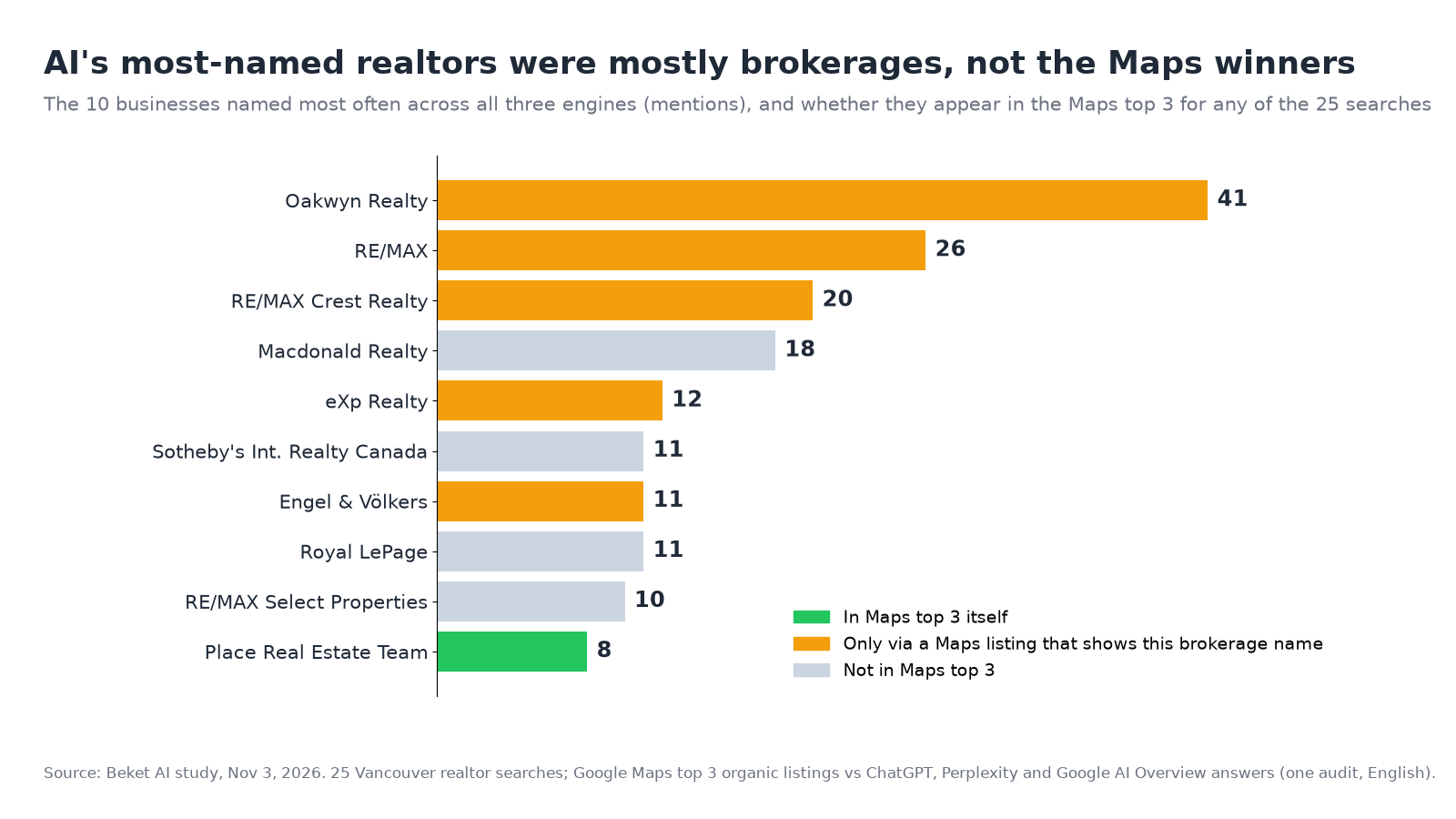
Source: Beket AI study, Nov 3, 2026.
Nine of those ten are brokerages or brands. In this category, Maps rewards the individual agent's listing, and AI answers lean toward the firm.
The brokerage-versus-agent split cuts both ways, so read the numbers with it in mind. The strict count understates the overlap, because an AI that names Oakwyn Realty is pointing people toward the agents who work there. The loose count overstates it, because naming Oakwyn isn't the same as recommending the specific Oakwyn agent who ranks on Maps.
How this compares with our October run and larger studies
We ran the same 25 questions on October 23, 2026, and the AI side moved a lot in eleven days. Google AI Overview appeared for 17 of the 25 questions this time, against 8 of 25 in October. The engines named 51 businesses this time, against 38. Oakwyn Realty stayed the most-named business both times, with 41 mentions now and 36 then, and 8 of the 10 most-named businesses were the same both times. Answers change from run to run, so treat any single audit as a snapshot.
Larger studies point the same way. For a much bigger sample, BrightLocal's September 2026 study of 200,085 local searches found that Google Maps named the business it tracked in 66% of searches, while AI surfaces named it in 32% to 38% (source). Our study adds the realtor-by-realtor view for one city.
Why the map pack and AI answers disagree
They rank different things. Google says local results are based mainly on relevance, distance and prominence (Google Business Profile Help). The map pack ranks Business Profiles against one search from one spot, and a profile whose title matches the search words well can do well. That's one reason so many Maps listings in our data carried long titles like "Top 1% REALTOR® Burnaby & Greater Vancouver".
AI answers run a small research job. Google says AI Overviews may use "query fan-out", running several related searches across subtopics and data sources before writing an answer (Google Search Central). Those searches turn up articles, directories, rankings and brokerage pages, and the businesses that appear across many of them get named. Brokerages with many agents and many pages have more chances to show up on them.
They read different sources. ChatGPT search sometimes partners with other search providers and may share your general location with "trusted third-party providers" for local listings (OpenAI). A strong Business Profile helps on Google but doesn't carry over automatically. We compared which listing feeds which assistant in Bing Places vs Google Business Profile vs Apple Business.
Some questions aren't about businesses at all. For "how much do realtors charge in Vancouver BC", the Maps top 3 were three industry associations. On the AI side, the most-cited domain across the audit was bcfsa.ca, the provincial real estate regulator, with 99 citations. Question-style searches pull answers from whoever explains the topic best.
What closes the gap
None of this means you should stop doing local SEO. Your Maps ranking still matters. The gap comes from what AI answers need that the map pack doesn't.
1. Give AI searches pages to find. Nine of the ten businesses AI named most were brokerages or brands, which usually have many agent, area and listing pages. A solo agent's site with one homepage gives a fan-out search little to land on. Publish a page for each service and each area you cover, such as "presale condos in Mount Pleasant" or "selling a house in West Vancouver", that says who you are, what you do there and what it costs.
2. Make sure Google can use those pages. Google AI Overview appeared for 17 of our 25 questions, up from 8 in October. Google says a page needs to be indexed and eligible to show a snippet to appear as a supporting link in AI features, with no extra technical requirements (Google Search Central). Check that your area pages aren't blocked by robots.txt, tagged noindex or set to nosnippet.
3. Use one name everywhere. To match Maps listings with AI answers, we had to merge many versions of the same name, such as agent names with and without the brokerage, "PREC" suffixes and team names. If your Maps title, website and directory profiles all use different versions, an AI has a harder time knowing they're the same business. Pick one name, use it everywhere, and add LocalBusiness structured data that matches. Our local business schema markup guide walks through it.
4. Be listed where the answers look. Beyond the regulator, the most-cited domains in our audit included agent review and directory sites such as rankmyagent.com (19 citations), zillow.com (13) and realtor.ca (12). Claim and complete your profiles on the directories that show up in your category's answers, as well as Bing Places.
5. Earn reviews that describe the work. Star ratings didn't separate the Maps leaders: 65 of the 73 rated listings in our Maps top 3 had 4.8 stars or more. For example, a review that says "she sold our East Van townhouse in nine days" (an illustration, not a real review) gives a page, and an AI reading it, something specific to match. Ask clients to mention the type of home and the neighbourhood.
6. Answer the questions people ask, on your own site. Ron Parpara's site was cited 24 times, which shows AI engines will use an agent's own pages as sources. Put your fees, service areas, languages, specialties and licensing on your site in plain text, next to your name, so a page that gets cited also makes clear who to call.
Measure both, separately
Your Maps rank tells you how you do in the map pack. It tells you nothing about AI answers, so track them on their own:
- Pick 20 to 30 questions a new client would ask without knowing your name, such as "best [service] in [neighbourhood]".
- Ask them on ChatGPT, Perplexity and Google AI Overview, and run them more than once, because answers change between runs.
- Log who got named and which sources were cited. The cited sources are your to-do list: those are the pages and listings to get onto or fix.
- Repeat on a schedule. Our two runs eleven days apart gave different results.
For more local results, see what nine studies in Seattle and Vancouver show.
You can do this by hand with a spreadsheet. Beket AI's free AI visibility check runs 25 prompts across ChatGPT, Perplexity and Google AI Overview and shows which businesses each engine names and which sources it cites. Beket AI Pro is $49 a month and re-audits daily, starting at 50 prompts across the same three engines. You do the work on your pages and listings, and Beket AI shows you whether the answers changed.
Method note
This study used one Beket AI audit of 25 unbranded realtor questions on ChatGPT, Perplexity and Google AI Overview, located in Vancouver, in English, on November 3, 2026. Maps results were recorded from a Vancouver-centred Google Maps search the same day: the first three organic listings for each question, with ads skipped. Three association listings were left out of the business counts. It's a one-day snapshot, and Maps results can vary with location and account. Names were matched at the audit level: a business counts as named if an engine named it in any of its answers, not necessarily for the same search. We merged name variants (agent and team names, brokerage suffixes, "PREC") and report both strict and loose matches. Counts describe what the engines and Maps returned that day. They aren't a rating of any realtor.
Related posts
How to Get Cited by ChatGPT: What 264 Citations From Vancouver Audits Show
What ChatGPT linked to in five Beket AI audits of Vancouver businesses in October 2026, and six practical ways to get your own pages cited.
Which Vancouver Hotels Does AI Recommend? 2026 Study
Fairmont Pacific Rim led 416 AI mentions of Vancouver hotels on November 3, 2026. See who ChatGPT, Perplexity and Google AI Overview named, and how.
How to Fix Wrong Information About Your Business in ChatGPT
ChatGPT has your hours, address or services wrong? Find where the error comes from, fix the sources behind it, and use OpenAI's feedback options correctly.