
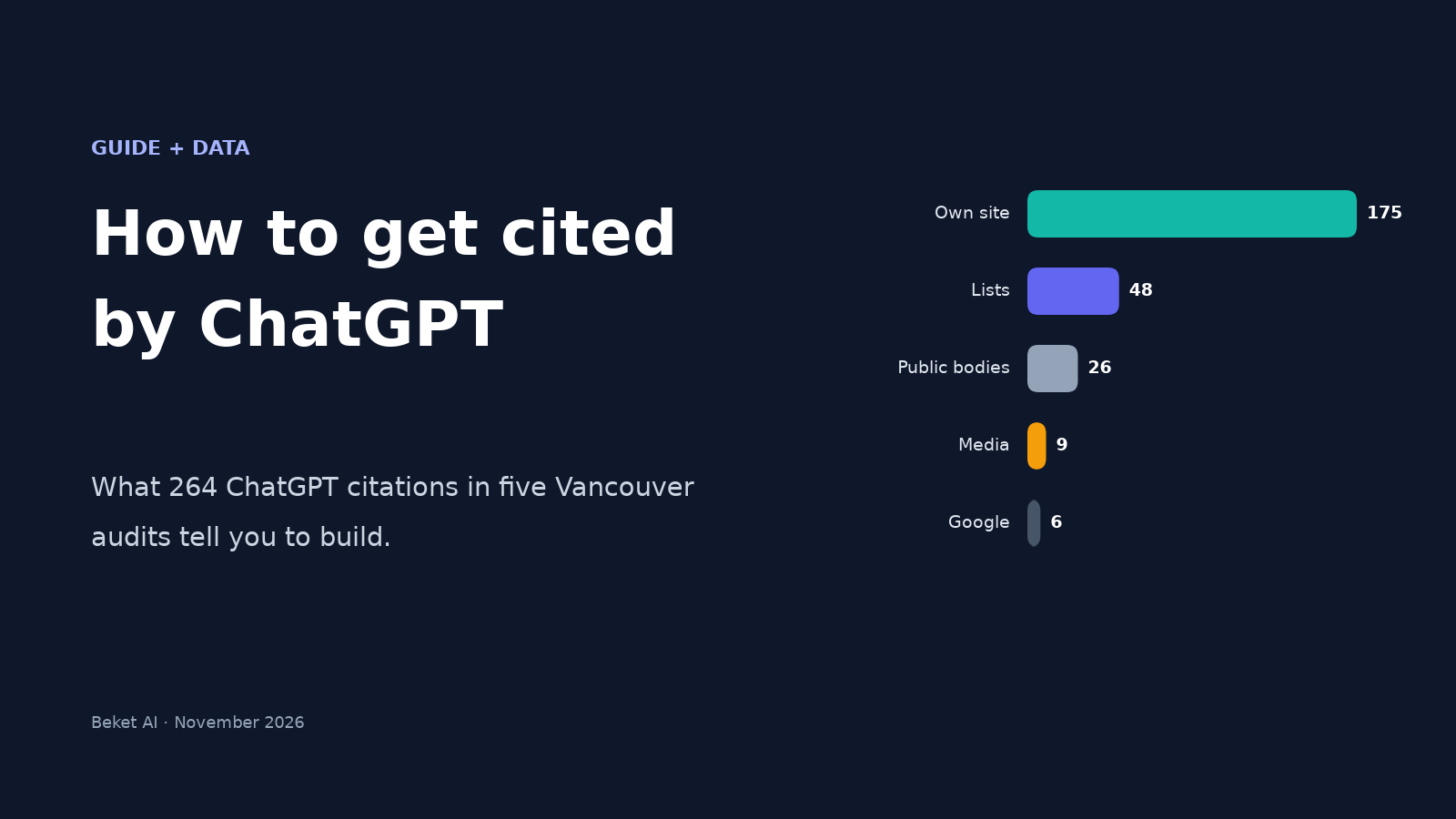
How to Get Cited by ChatGPT: What 264 Citations From Vancouver Audits Show

On October 23, 2026, a Beket AI audit asked ChatGPT, in two different ways, for Vancouver mortgage brokers who work with self-employed borrowers. Of the 11 links its two answers gave to broker websites, 7 didn't go to a homepage. They went to pages like ctcmortgages.ca/self-employed, sashaidema.ca/self-employed-mortgage-bc and rowansmith.ca/self-employed-mortgage: pages written for that exact borrower.
That pattern showed up again and again when we went through the links ChatGPT cited in five Vancouver audits from October 2026. This guide covers what we found and what it means if you want ChatGPT to cite your site, and to name your business when it does.
Cited vs mentioned: what you're aiming for
When ChatGPT searches the web, it can do two things for a business. It can mention you by naming you in the answer, and it can cite you by linking a page as a source. They often go together, but not always. A directory can be cited while you're only mentioned. A regulator's page can be cited while no business is named at all.
You want both. Being mentioned puts you in front of the person asking. Being cited means your page shaped the answer and gives them a link to click. This guide focuses on citations, because those show which pages ChatGPT actually read.
What we looked at
We used five completed Beket AI audits of Vancouver businesses: lawyers, mortgage brokers and realtors (all run October 23, 2026), marketing agencies (October 25) and holiday shopping (October 29). Each audit asked ChatGPT, Perplexity and Google AI Overview the kind of questions real customers ask, without naming any business.
From each audit we exported the first 100 cited links across all three engines and kept the ones ChatGPT gave. That left 264 ChatGPT citations from 47 answers. We sorted every link by the type of page it pointed to. Full details are in About the data at the end. It's a sample, so treat the patterns as signals, not ranking factors.
| Type of page ChatGPT linked to | Links | Share |
|---|---|---|
| A business's own website | 175 | 66% |
| Directory, list or review site | 48 | 18% |
| Regulator, government, nonprofit or university | 26 | 10% |
| Local media or city guide | 9 | 3% |
| Google Search or Maps link | 6 | 2% |
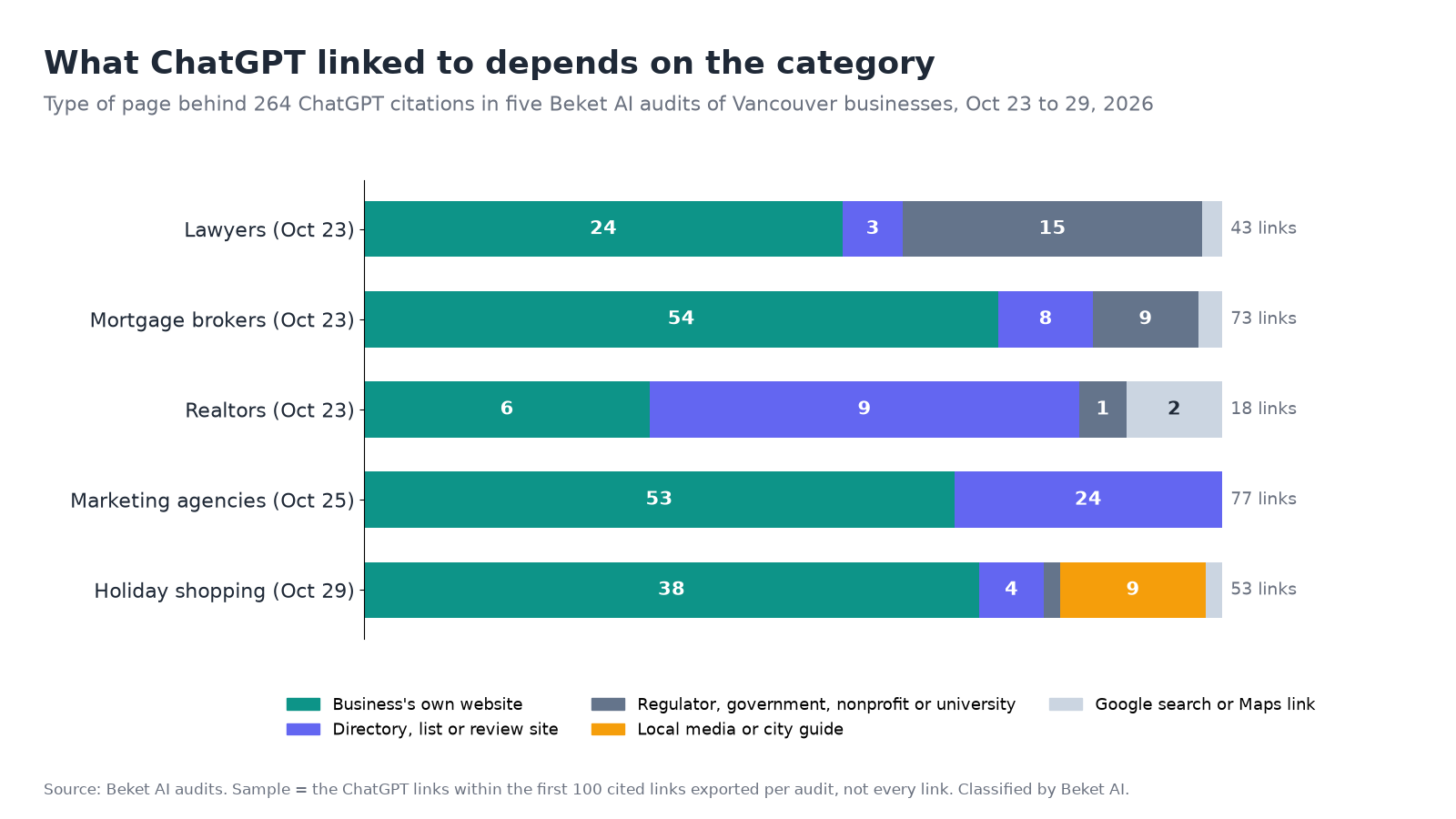
The mix changed a lot by category:
Here's what each pattern tells you to do.
1. Make your homepage say what you are, plainly
Two-thirds of the links (175 of 264) went to businesses' own sites, and most of those, 129, went to a homepage rather than a deeper page. In our sample, when ChatGPT linked a business it recommended, the homepage was by far the most common page it chose.
So treat your homepage as the page ChatGPT is most likely to send people to. Make sure the first screen says, in plain words, what you do, for whom and where: "Family law firm in Vancouver, BC", not "Your partner through life's transitions". Put your address and service area in text, not only in a map embed.
Six links weren't to a business site at all. Five were Google searches for a named firm, two of them literally for the firm's name plus "official website", and one was a Google Maps place link. We can't tell from the data why ChatGPT did this. But if it names you and then links a search for your website instead of your website, the chance of a click goes down. A consistent business name across your site and listings, and Organization schema that points to your official profiles, make it easier to tie the name to the right site.
2. Build pages for specific customer situations
The other 46 own-site links went to deeper pages, and they were the clearest pattern in the data. When the question was narrow, ChatGPT tended to cite a page about that narrow thing:
- "Mortgage brokers for self-employed borrowers" (asked two ways) → self-employed pages on five broker sites, including the three above, plus
wattsmortgages.ca/self-employed-mortgages-vancouver-b-lending-solutionsandpragmatic.mortgage/services/self-employed. - "Mortgage brokers for new immigrants" → newcomer pages such as
bcmortgagesolutions.ca/new-to-canada-mortgagesandtruenorthmortgage.ca/mortgage-solutions/newcomers-to-canada. - "Mortgage brokers who speak Mandarin" → individual advisor pages at RBC and BMO, a broker's
/aboutpage, andmorninglee.ca/mandarin-speaking-mortgage-broker. - "Startup lawyers" →
coalharbourlaw.ca/startupsand Watson Goepel's start-up package page.
This lines up with how OpenAI describes ChatGPT search: it rewrites a question into one or more targeted search queries, then ranks results "using multiple factors" (OpenAI). A page built around "self-employed mortgage, Vancouver" matches a targeted query far better than a homepage that lists eight services.
What to do: list the five to ten specific situations your customers are in (by need, by customer type, by language, by neighbourhood) and give each one a real page. Say who it's for in the first paragraph, explain what's different about that situation, and name the people who handle it. Individual staff pages count. In the Mandarin answer, five of the ten links were pages about a single advisor. Our AEO workflow covers how to turn those questions into a page plan.
3. Get your regulator and public listings right
In legal and financial questions, ChatGPT often cited public bodies alongside, or instead of, businesses. In the lawyers audit, 15 of the 43 ChatGPT links went to regulators, government, legal aid or nonprofit sites. Two short questions, "tenant rights lawyers in Vancouver" and "family lawyers in Vancouver", got answers whose links all went to government, legal aid, clinic, referral or nonprofit pages, and none to a law firm. In the mortgage audit, ChatGPT linked the BC Financial Services Authority (BCFSA) 9 times.
Across all three engines, BCFSA was the most cited domain in both the mortgage brokers audit (157 of 638 cited links) and the realtors audit (74 of 622). We wrote more on this in our Vancouver mortgage brokers study.
You won't get cited instead of a regulator, and you shouldn't try. What you can do:
- Make sure your public licence or registry record is accurate and uses the same business name as your website.
- Put your licence or registration details on your site, in text.
- If a question in your field is really a "know your rights" question, publish a plain explainer that links the official source. That makes your page a useful companion to the source ChatGPT is already citing.
4. Be on the lists that ChatGPT uses for your category
Directories mattered most where buyers compare many similar firms. In the marketing agencies audit, 24 of 77 ChatGPT links went to directories and "best of" lists. Clutch alone accounted for 12, and some questions, such as "best PPC agencies", were answered with directory links only. Across all three engines, clutch.co was the most cited domain in that audit (63 of 693 links), ahead of sortlist.com (51) and agencies.semrush.com (38).
Realtors were the extreme case. Only 18 ChatGPT links made it into our sample, and half (9) went to agent-rating and directory sites such as RankMyAgent.
What to do: ask ChatGPT the unbranded questions your customers ask, open the sources it cites, and note which lists keep showing up. Those are the profiles worth completing. Use the same description, services and location you use on your own site. An agency's own "top agencies in Vancouver" article was cited in our sample too, so a well-made comparison page on your own site can work, as long as it's honest about the competitors.
5. For events and retail, get into local guides
Holiday shopping was the only category where local media and city guides showed up in ChatGPT's links: 9 of 53, including Vancouver Magazine, Destination Vancouver and a local tourism site listing Christmas markets. The rest were mostly the markets' and stores' own sites (38).
If you sell to the public at a time of year, or run an event, the guides that round up "where to shop" or "what's on" are part of how ChatGPT builds its answer. Pitch them early, and make sure your own event or store page has the dates, address and hours in text so the guide and your site agree.
6. Don't block the crawler, and check where visits land
None of this matters if ChatGPT can't read your pages. OpenAI says publishers who want to appear in ChatGPT search should allow its search crawler, OAI-SearchBot, and its published IP addresses (OpenAI). OAI-SearchBot is controlled separately from GPTBot, OpenAI's training crawler, so you can opt out of training and still be eligible for search. OpenAI also says sites that opt out of OAI-SearchBot won't be shown in ChatGPT search answers (OpenAI). Because OpenAI says it sometimes partners with other search providers, it's also worth making sure Bing can index your site. Our guide to how ChatGPT search works goes deeper.
Then track the visits. Every one of the 264 ChatGPT links in our sample carried a utm_source=chatgpt.com tag, so clicks from ChatGPT can appear under that source in Google Analytics. Watch which pages people land on. If they're your situation pages, the work in step 2 is paying off.
What this data can't tell you
OpenAI says placement in ChatGPT search "is not guaranteed" (OpenAI), and nothing here is a formula. Our sample shows which kinds of pages ChatGPT linked to in five Vancouver categories in late October 2026. It doesn't show why a particular page was picked over another, and answers change from run to run. A firm that was cited on October 23 may not be cited today.
The practical answer is to check your own questions regularly. A free Beket AI visibility check asks 25 questions across ChatGPT, Perplexity and Google AI Overview and shows which sources each one cites. Beket AI Pro ($49/month) re-runs your questions daily, starting at 50 questions across the same three engines, so you can see when a new page starts getting cited. Run a free check.
About the data
- Audits: five completed Beket AI market audits of Vancouver businesses. Lawyers, mortgage brokers and realtors were run on October 23, 2026, marketing agencies on October 25 and holiday shopping on October 29 (Pacific time). Each audit asked the same questions on ChatGPT, Perplexity and Google AI Overview. A sixth Vancouver audit (roofers) did not complete and is excluded.
- Questions: 29 on-topic ChatGPT answers per audit, 145 in total. None of the questions named a business. 125 were short searches such as "startup lawyers in Vancouver", and 20 were longer, conversational requests for firm recommendations.
- Sample: our citation export returns the first 100 cited links per audit across all engines. The ChatGPT links within those exports were 264 links from 47 answers: lawyers 43, mortgage brokers 73, realtors 18, marketing agencies 77, holiday shopping 53. Because the export is capped, the sample doesn't include every link from every answer, and the per-category counts reflect where each audit's first 100 links happened to fall.
- All-engine domain counts (BCFSA, Clutch, Sortlist, agencies.semrush.com) come from each audit's full citation totals across ChatGPT, Perplexity and Google AI Overview, not from the ChatGPT-only sample.
- Classification: Beket AI sorted each link into one of five page types. Banks and big retailers' own sites (for example RBC advisor pages or Best Buy) count as a business's own website. "Homepage" means the link pointed to the root of a domain.
- Limits: one city, five categories and a single run per audit. AI answers vary between runs and change over time. These numbers describe what ChatGPT cited on those dates, not a ranking algorithm.
Related posts
How to Fix Wrong Information About Your Business in ChatGPT
ChatGPT has your hours, address or services wrong? Find where the error comes from, fix the sources behind it, and use OpenAI's feedback options correctly.
Google Maps vs AI: Do Vancouver's Top Realtors on Maps Get Named by ChatGPT? (2026 Study)
We compared the Google Maps top 3 for 25 Vancouver realtor searches with ChatGPT, Perplexity and Google AI Overview. AI named 7 of the 50 Maps businesses.
Bing AI Mode vs Google AI Mode: Same Name, Different Engine (2026)
Bing renamed Copilot Search to AI Mode and AI Overview. How Bing AI Mode differs from Google's in listings, controls, reporting and reach, with a checklist.