
Bing Places vs Google Business Profile vs Apple Business: Which Listing Feeds Which AI Answer?

We pulled 748 cited links from nine of our Vancouver and Seattle studies on plumbers, dentists, lawyers, movers, retailers and more. Not one pointed to Bing Maps or Apple Maps. ChatGPT, on the other hand, linked to Google Maps 10 times.
That doesn’t mean Bing Places and Apple Business are useless for AI search. A citation only shows what an engine chose to link, not every piece of data it read. But it does show why “which listing should I fix first?” is a fair question, and why the answer is different for each AI assistant.
This post compares the three free business listings, Google Business Profile, Bing Places for Business and Apple Business (the new name for Apple Business Connect), and lines up what each company has actually documented about where its data shows up.
The short answer
- Google Business Profile is the one to get right first. It feeds Google Search and Maps, and Google’s own AI answers kept linking back to Google’s pages in our data.
- Bing Places matters for Microsoft’s surfaces, including Copilot, and indirectly for any assistant that leans on Bing’s web results. It takes minutes to set up if you import from Google.
- Apple Business controls your place card in Apple Maps, Siri, Safari and Spotlight. It’s a must for anyone whose customers use iPhones, but no major AI chatbot has documented using it.
Comparison table
| Google Business Profile | Bing Places for Business | Apple Business | |
|---|---|---|---|
| Where you manage it | business.google.com | bing.com/forbusiness (moved from bingplaces.com in Oct 2025) | business.apple.com (replaced Business Connect on April 14, 2026) |
| Cost | Free | Free | Free |
| Documented surfaces | Google Search and Maps local results | Bing search results and Bing Maps; Microsoft says deeper Copilot integration is planned | Apple Maps, Safari, Spotlight, Wallet, Mail, Siri |
| AI tie-in the company has documented | Gemini web app can connect to your profile to edit it and read insights | Bing says Copilot uses the same crawling, indexing and ranking base as Bing search | None for third-party chatbots |
| Fastest way to fill it in | You start here | Import from Google | Entered by hand |
| Ads on the listing’s surface | Google Ads, plus ads in AI Mode | Microsoft Ads | Maps ads in the US and Canada (announced for summer 2026) |
| Showed up as a cited link in our 748-link sample | Yes (Google AI Overview, AI Mode and ChatGPT) | No | No |
What our audit data shows
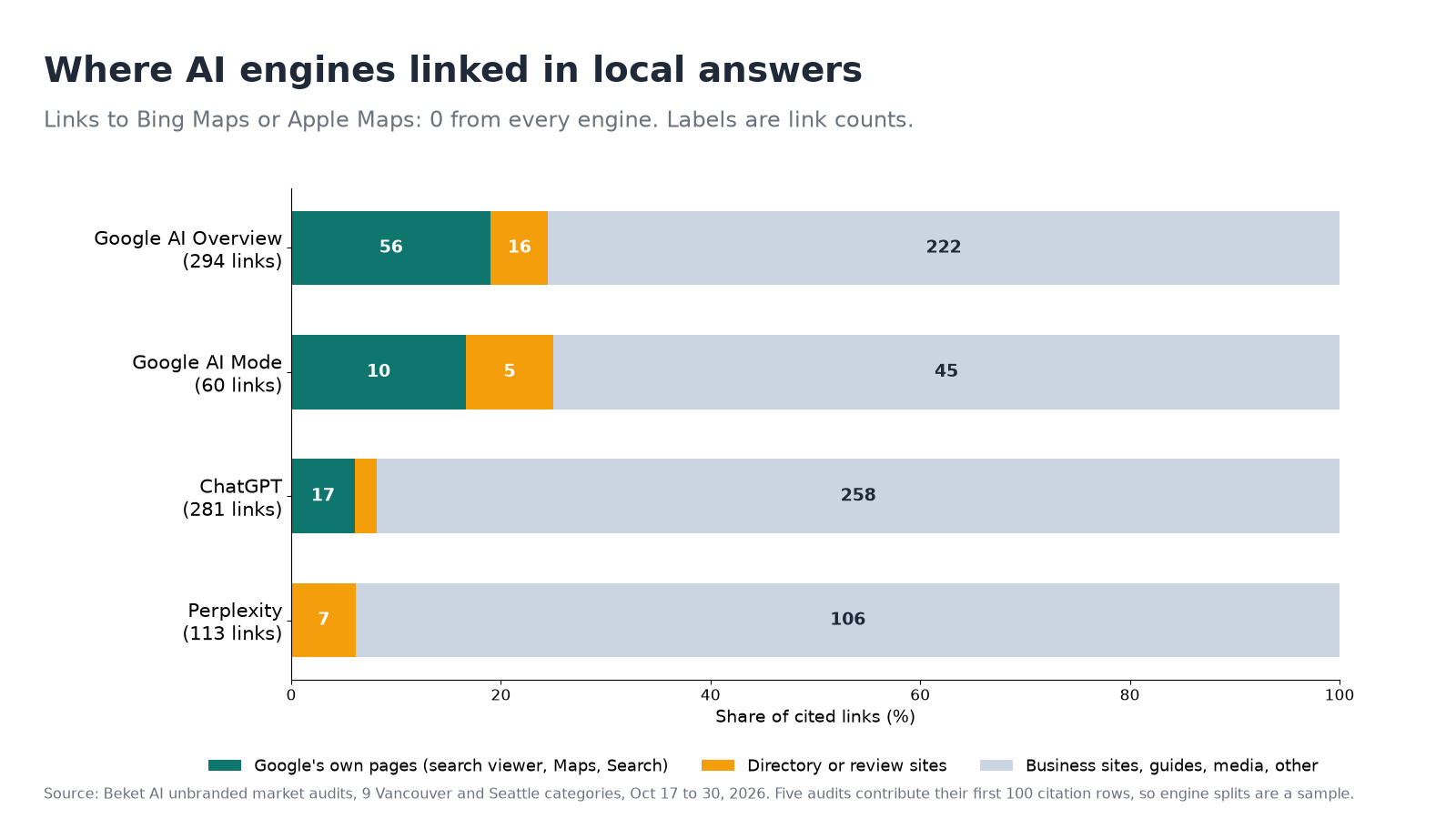
We sorted every cited link in our recent local studies by type. The sample covers nine Beket AI market audits run between October 17 and 30, 2026, across four engines. For four audits we have every citation; for the other five, our export returns the first 100 citation rows, so treat the engine split as a sample, not a census.
| Engine | Cited links in sample | Google’s own pages | Directory or review sites | Bing Maps or Apple Maps |
|---|---|---|---|---|
| Google AI Overview | 294 | 56 | 16 | 0 |
| Google AI Mode | 60 | 10 | 5 | 0 |
| ChatGPT | 281 | 17 (10 Google Maps, 7 Google Search) | 6 | 0 |
| Perplexity | 113 | 0 | 7 | 0 |
Three things stand out:
- Google’s AI answers point back to Google. About one in five links in Google AI Overviews went to Google’s own pages, mostly google.com search-viewer links, rather than to a business website.
- ChatGPT links to Google Maps. That’s notable because, in Search Engine Land’s 2025 test, ChatGPT drew its web results from Bing and seemed to see Google ratings only when a page Bing had indexed repeated them. OpenAI hasn’t said where its map links come from.
- Most links went to business websites, local guides, media and city pages. Directories like Yelp, Zocdoc and HomeStars were a small share (34 of 748). Your own site and what local publications say about you show up far more often.
AI answers change over time, and this is the data the engines returned on those dates. A business that wants its own category rerun can ask us.
Google Business Profile: the one Google’s AI reads around you
Google says local results are mainly based on relevance, distance and prominence, and that “businesses with complete and accurate info are more likely to show up in local search results.” Prominence includes how many websites link to you and how many reviews you have.
Google’s AI is also starting to act on the profile directly:
- The Gemini web app can connect to your Business Profile to update hours, contact details and action links, draft review replies and show performance insights. It works for owners or managers of a single verified profile, with a personal Google account.
- Google is piloting AI-powered messaging where an agent answers routine customer questions sent from Search and Maps and hands off to you when it can’t. As Search Engine Roundtable puts it, the agent can only answer as well as your profile does.
If you have time for only one listing, this is it. Our local business schema markup guide covers how to make your website say the same things your profile says.
Bing Places: the listing behind Microsoft’s answers
Microsoft calls Bing Places a free platform to “appear in Bing search results and Bing Maps.” The October 2025 relaunch moved it to bing.com/forbusiness, made the Google import keep your name, hours and contact details, and promised “deeper integrations with Bing Maps and Copilot.”
Bing’s Webmaster Guidelines say that “Bing and Copilot search experiences rely on the same core crawling, indexing, and ranking foundation as traditional search.” So the work that helps you rank on Bing is also the work that makes you eligible for Copilot answers.
What about ChatGPT? OpenAI says ChatGPT search uses third-party search providers and partner data, including maps, but it doesn’t name which provider powers local results. It may also share your approximate location with providers that supply “nearby business listings,” per OpenAI’s help center. Search Engine Land’s test found ChatGPT didn’t see Bing Places profile details, though that came partly from asking ChatGPT about itself, so take it as a hint rather than proof. We cover the Bing side in more depth in does Bing Webmaster Tools help ChatGPT visibility and how ChatGPT search works.
Our view: claiming Bing Places takes about as long as the import, it controls what Bing and Bing Maps show about you, and Bing’s index is what Copilot builds on. That’s reason enough to do it.
Apple Business: your place card on every iPhone
Apple Business replaced Apple Business Connect on April 14, 2026, folding Apple’s business tools into one free platform. Apple says it helps businesses reach customers “across Apple Maps, Mail, Wallet, Siri, and more,” with place cards that display across Apple Maps, Safari and Spotlight. Apple also announced ads on Maps for the US and Canada starting summer 2026.
Apple says claimed businesses get 30 percent more views. That’s Apple’s own figure, and it’s about Maps views, not AI answers.
None of the AI search documentation we reviewed from OpenAI, Perplexity, Google or Microsoft mentions Apple’s place cards, and Apple Maps links never appeared in our sample. Still, the place card is what iPhone users see when they look you up in Maps or ask Siri, so a wrong phone number there can cost you calls.
Which listing to fix first
- Google Business Profile. Verify it, then fill in every field: categories, hours (including holidays), services, attributes, photos. Reply to reviews.
- Your own website. Business websites were among the most-cited sources in our sample. Match your name, address, phone and hours to your profile, and add LocalBusiness schema.
- Bing Places. Import from Google at bing.com/forbusiness, then check what the import missed.
- Apple Business. Claim your location, enter hours and your website, and add an action link like “book” or “call.”
- One or two directories that matter in your category. In our sample that meant Zocdoc and Opencare for dentists, HomeStars for Vancouver electricians, and Yelp for dentists and house cleaners.
A 10-minute consistency check
- Same business name on all three listings and your website, with no extra keywords
- Same phone number format and the same primary category wording where you can
- Hours match, including holiday hours
- Website link goes to the right location page, not just your homepage
- No duplicate listings on Apple or Bing
- Search your business name in ChatGPT, Perplexity and Google AI Mode and note what each gets wrong
The last step is the one people skip. A listing tells an engine what’s true. Asking the engines shows you what they actually say. You can see how that plays out across nine local categories in our roundup of nine Seattle and Vancouver studies.
How we got the numbers
We exported cited links from nine unbranded Beket AI market audits (Vancouver lawyers, realtors and mortgage brokers; Seattle lawyers, realtors and mortgage brokers; Seattle plumbers; Seattle dentists; Vancouver electricians; Vancouver movers; Seattle house cleaning; Seattle retail; Vancouver retail), run October 17 to 30, 2026. We grouped links by domain: Google-owned pages, Bing and Apple Maps pages, well-known directory and review sites, and everything else. Four audits returned every citation; five returned their first 100 rows. Citations show what an engine linked, not everything it used to write an answer.
Want to see which sources AI engines cite for your own business? The free Beket AI audit runs 25 prompts across 3 engines.
Related posts
The AI Training Opt-Out Is Coming to robots.txt. It Won't Take You Out of AI Answers
Google, Bing, OpenAI and Anthropic will honor one AI training opt-out. What it blocks, what Bing's new grounding control does, and the dates to know.
What Is Zero-Click Search? Why One Study Says 68% and Another Says 22%
Zero-click search explained: what counts, why 2026 studies range from 22% to 68%, the Canada vs U.S. numbers, and what local businesses should measure.
Local AI Visibility: How to Benchmark AI Answers by City and Country
AI engines answer differently by location. How to benchmark AI visibility by city or country, and what a GEO or AEO tool needs for regional LLM benchmarking.