
What Is Zero-Click Search? Why One Study Says 68% and Another Says 22%

Two respected clickstream reports came out this year with very different answers to the same question. One says 68% of U.S. Google searches end without a click. The other puts U.S. desktop searches at 22%. Both disclose their methods, and both use the term “zero-click search.”
They aren’t contradicting each other so much as counting different things. Once you see what each one counts, the term gets much more useful, especially if you run a local business, where a lot of the value of a search never shows up as a website visit.
Zero-click search, defined
A zero-click search is a search that ends without the searcher clicking any result. The person either gets what they need from the results page itself (an AI Overview, a map pack, a business phone number, a sports score) or gives up, or types a new search instead.
SparkToro has been measuring it for years. Its first published research in 2019 found that 49% of Google searches ended without a click. The idea predates AI answers. Featured snippets, knowledge panels and map packs already answered many questions on the results page. AI Overviews and AI Mode made those answers longer and more complete.
A search usually ends in one of four ways:
| What the searcher does next | Zero-click? |
|---|---|
| Closes the tab or stops browsing | Yes |
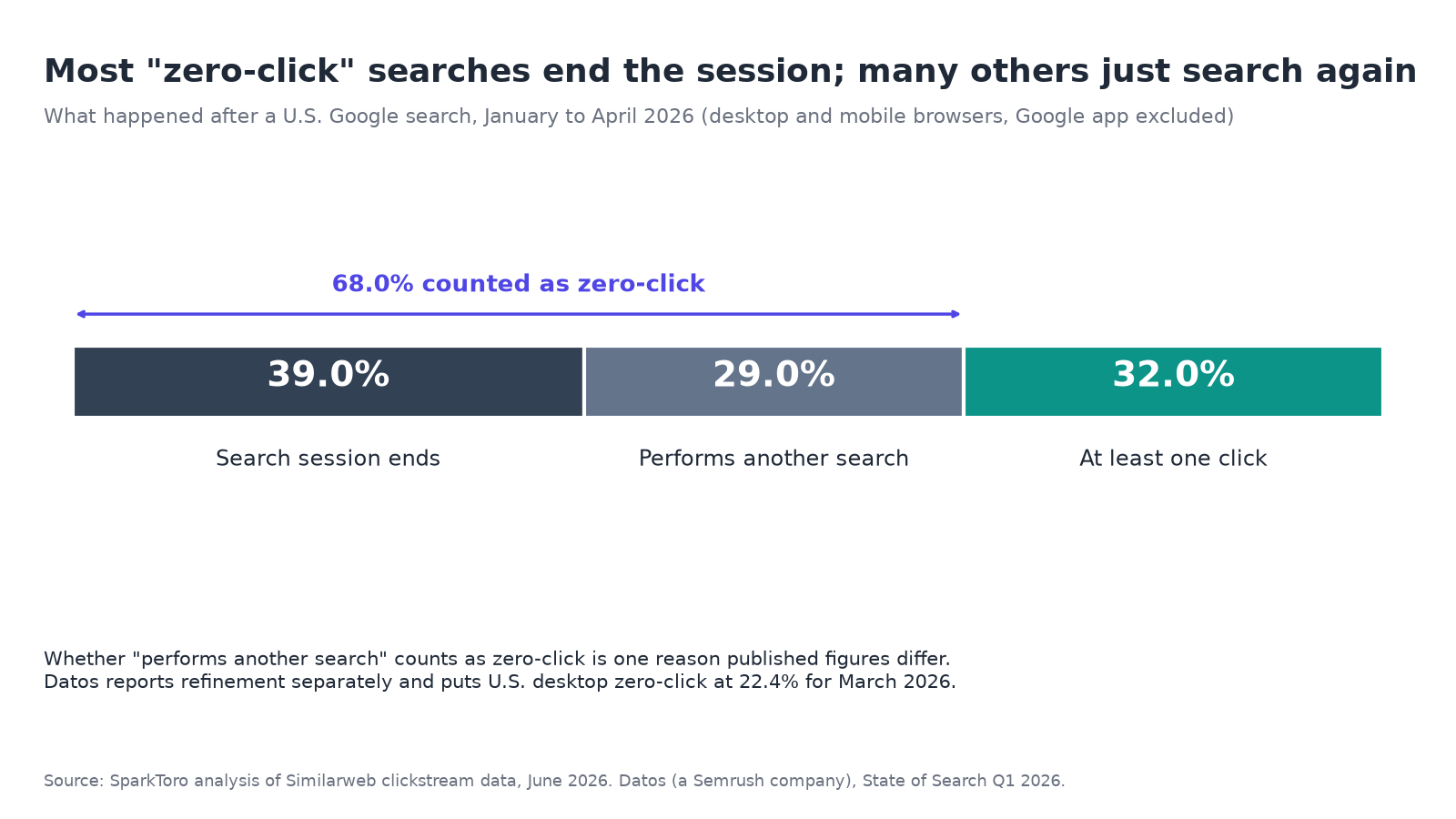
| Types a new or refined search | Yes, in SparkToro’s count; reported separately by Datos |
| Clicks a Google property (Maps, YouTube, Images) | No |
| Clicks an organic result or an ad | No |
The second row is where the two studies below part ways.
Why one study says 68% and another says 22%
Source: SparkToro analysis of Similarweb clickstream data, June 2026; Datos State of Search Q1 2026.
The 68% figure. In June 2026, SparkToro published Similarweb panel data for U.S. Google searches from January to April 2026: 68.01% ended without a click, up from 60.45% in 2024. That count includes searches where the person simply searched again. The study covers desktop and mobile browsers, assumes two-thirds of searches happen on mobile, and excludes the Google mobile app, where SparkToro says zero-click behavior is likely even higher.
The 22% figure. Datos, a Semrush company, publishes a quarterly State of Search report from its desktop panel. Its Q1 2026 report says U.S. zero-click searches fell from 24.5% in December 2025 to 22.4% in March 2026. Datos reports search refinement as its own category (15% to 16% of searches) instead of folding it into zero-click, and the data is desktop only. Rand Fishkin, writing in the same report, noted that it misses “the 2/3rds of searches that happen on mobile.”
So the two numbers differ on at least three things:
- Whether a follow-up search counts. SparkToro counts it as zero-click. Datos doesn’t.
- Devices. SparkToro blends mobile and desktop. Datos is desktop only.
- Panels. Different companies, different panelists, different periods.
They even point in different directions: Datos shows desktop zero-click falling through early 2026, while SparkToro’s blended figure is up 7.56 points since 2024. Neither number is wrong. When someone quotes a zero-click percentage, ask which of these choices sits behind it before you compare it with anything.
Zero-click searches in Canada vs the U.S.
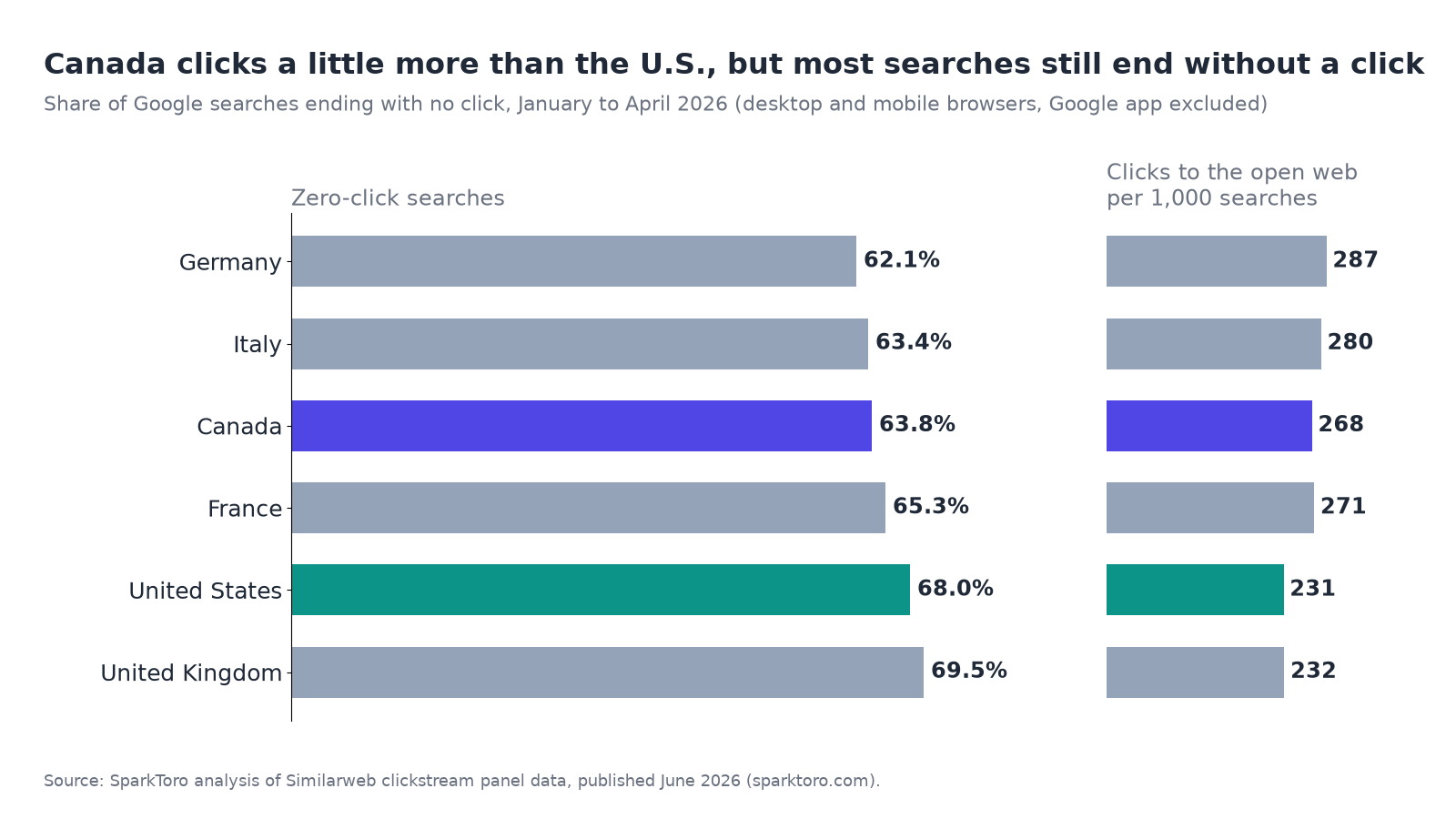
For businesses in Vancouver or Seattle, the country split is useful. About a week after the U.S. study, SparkToro published the same measurement for five more countries, again from Similarweb’s January to April 2026 panel.
Source: SparkToro, Similarweb panel data, January to April 2026.
| Canada | United States | |
|---|---|---|
| Zero-click searches | 63.8% | 68.0% |
| Searches with at least one click | 36.2% | 32.0% |
| Performs another search | 25.6% | 29.0% |
| Search session ends | 38.2% | 39.0% |
| Clicks to the open web per 1,000 searches | 268 | 231 |
Source: SparkToro, from Similarweb panel data. The study notes clicks per 1,000 searches are likely slightly undercounted because some searchers click more than one result.
Canadian searchers clicked a bit more often than Americans and ran fewer follow-up searches, but in both countries roughly two of every three searches ended without a click. Fishkin pointed out that Canada’s rates sit closer to the European countries than to the U.S., so language alone doesn’t explain the gaps.
What AI Overviews have to do with it
AI Overviews didn’t invent zero-click search, but the research points the same way: when an AI summary appears, people click less.
- Pew Research Center tracked the browsing of 900 U.S. adults in March 2025. On Google searches with an AI summary, users clicked a traditional result in 8% of visits, against 15% on searches without one. They clicked a link inside the summary in 1% of visits, and they ended their browsing session on 26% of pages with a summary versus 16% without.
- SparkToro’s 2026 study says AI Overviews now appear on more than 20% of Google searches and, when present, reduce click-through by nearly 60%. It found AI Mode played a small role in the period: only 0.34% of searches moved into AI Mode from January to April 2026.
Google disputes the “traffic is collapsing” reading. In an August 2025 post, Liz Reid, head of Google Search, wrote that total organic click volume from Search to websites “has been relatively stable year-over-year” and that Google is sending “slightly more quality clicks,” meaning clicks where people don’t quickly return. She also acknowledged that for quick-answer questions, people “may be satisfied with the initial response and not click further.” Google did not publish the underlying numbers.
Both things can be true at once: total clicks can hold up while each individual search is less likely to send one, if people are searching more. SparkToro’s own data shows follow-up searches rising 7.2 points from 2024 to 2026.
A November 2026 study from Fractl and Search Engine Land, which surveyed 1,007 U.S. adults and analyzed a Datos clickstream panel, adds the why. People read the AI answer first, then click when the stakes rise:
- 71% want to see a real source before a final decision or purchase.
- 77% have caught an AI summary being wrong at least once.
- Zero-click bounces fell from 43% to 34% since 2024 on the research and comparison searches in the panel, while re-queries rose from 54% to 63%. People are refining their searches, not walking away.
- Forums and community threads earned the most trust of any source type.
Fractl notes the clickstream figures are directional, equal-weighted per keyword rather than population-level rates. The takeaway still holds: people use the AI answer as a first pass and click to verify, so the business cited as the source is the one most likely to earn that click.
What zero-click means for a local business
For a plumber, dentist or law firm, a zero-click search is often not a lost customer. Someone searching “emergency plumber near me” may tap the call button on a Business Profile, ask for directions, or read an AI Overview that names three companies and then call one. None of that is a website visit, and all of it can be a job.
In the same 2026 post, SparkToro lists local businesses among the categories that still benefit from SEO. The difference is where the value shows up.
That changes what you should measure:
| Instead of only… | Also look at… | Where to find it |
|---|---|---|
| Website clicks from Google | Calls, direction requests, messages and bookings from your Business Profile | Business Profile performance report |
| Organic clicks | Impressions and the queries that trigger them | Search Console Performance report (AI Overviews and AI Mode are included in the “Web” search type, per Google) |
| Ranking position | Whether AI answers name your business, and how often compared with competitors | Running your customers’ questions on AI engines |
Two caveats on those Google numbers. A “call” in the Business Profile report is a tap on the call button, not a completed call, and Search Console doesn’t separate AI Overview impressions from regular results. We covered the workarounds in how to track AI Overview traffic in Search Console and GA4.
The answer is the new first page
In a zero-click search, the only businesses that get any benefit are the ones named on the page. That is why being named inside the answer matters more than ever. In our look at why being named in an AI Overview matters more as source cards disappear, the businesses Google named in its answers and the business websites it linked were mostly different.
The same logic applies beyond Google. ChatGPT, Perplexity and other assistants answer in the chat, and the traffic they send is small, which we went through in why small AI search traffic still matters. If you can’t count the click, count the mention. AI share of voice is one way to do that: your mentions divided by all business mentions in the same set of answers.
What tends to help you get named is not new:
- Keep your Business Profile complete and accurate: hours, categories, services, phone number, photos and reviews. Google’s AI features guidance lists keeping Business Profile information up to date among the SEO basics that still apply to AI Overviews and AI Mode.
- Answer the questions customers actually ask on your own pages, in plain language, with specifics such as service areas, prices or price ranges, and licensing.
- Be listed where AI engines look: local directories, industry associations, local news and review sites.
- Check the answers regularly. AI answers change over time, so a single check is a snapshot.
How Beket AI fits in
Beket AI is built for this problem. It runs your customers’ questions on three AI engines and shows whether your business is named, how often, in what position, and which competitors appear in the same answers. The free audit covers 25 prompts across 3 engines. Pro is $49/month, re-audits daily, and starts at 50 prompts across 3 engines, so you can see mentions as a trend rather than a one-off.
Statistics in this post come from the third-party studies linked above, measured on their own panels and dates. Zero-click figures vary with definitions, devices and data sources, so compare numbers only when they were measured the same way.
Related posts
Bing Places vs Google Business Profile vs Apple Business: Which Listing Feeds Which AI Answer?
Bing Places vs Google Business Profile vs Apple Business, compared: where each listing shows up, which AI answers use it, and what 748 cited links show.
Should Nonprofits Optimize Reports and White Papers for AI Citations?
Yes, with nuance. What a 25-question audit of ChatGPT, Perplexity and Google AI shows about which reports get cited, and how to make yours easier to cite.
The AI Training Opt-Out Is Coming to robots.txt. It Won't Take You Out of AI Answers
Google, Bing, OpenAI and Anthropic will honor one AI training opt-out. What it blocks, what Bing's new grounding control does, and the dates to know.