
Should Nonprofits Optimize Reports and White Papers for AI Citations?

Audit date: October 31, 2026
Yes, with one caveat about what “optimizing” means. If your reports and white papers exist to inform policy debates, they should be easy for AI engines to find, read and cite. ChatGPT, Perplexity and Google’s AI Overviews answer research questions by linking sources, and a report that sits behind a PDF-only download, a vague title or a blocked crawler is harder to pick up. But you don’t need special AI files or tricks. Most of the work is publishing practice that also helps human readers: an HTML version of each report, key findings stated up front, clear titles and dates, honest markup, and not blocking the crawlers that power AI search.
To see what this looks like in practice, we ran a Beket AI audit with 25 research-report questions across ChatGPT, Perplexity and Google AI Overview on October 31, 2026. The engines returned 846 source links for those questions. Government and intergovernmental sites led the most-cited domains, and one advocacy-style think tank, the Urban Institute, made the top 10. In the ChatGPT links we could inspect, HTML report pages outnumbered direct PDF links 25 to 3.
Why AI engines cite research-style content
When someone asks an AI engine for “the latest research on” a policy topic, the engine searches the web and attaches links to the pages it drew from. Research reports are natural candidates. They make specific claims, carry dates and named authors, and usually come from an organization with a track record on the issue.
That opportunity has a flip side. Reports have long been easy to overlook even without AI. A 2014 World Bank working paper, Which World Bank Reports Are Widely Read?, found that more than 31% of the bank’s policy reports had never been downloaded and almost 87% had never been cited. AI answers are now one more place where a report either shows up as a source or doesn’t.
Google’s guidance is a useful reality check. Its page on AI features and your website says “there are no additional requirements to appear in AI Overviews or AI Mode, nor other special optimizations necessary,” and that “there’s also no special schema.org structured data that you need to add.” So for an advocacy nonprofit, “optimizing for AI citations” mostly means making sure the strongest version of each report is a crawlable, readable, well-labelled web page.
What our audit found
We asked ChatGPT, Perplexity and Google AI Overview 25 unbranded questions of the kind a journalist, policy staffer or funder might type, such as “best reports on affordable housing policy in Canada” and “white papers on food insecurity in the US.” The full list is at the end of this post. The location was set to the United States and the language to English.
| Audit detail | Value |
|---|---|
| Audit date | October 31, 2026 (one run, answers recorded 10:19 to 10:27 PM PT) |
| Engines | ChatGPT, Perplexity, Google AI Overview |
| Questions | 25 selected questions, plus 4 discovery questions the audit added on its own |
| Answers to the 25 questions | 67 (ChatGPT 25, Perplexity 25, Google AI Overview 17) |
| Source links in those answers | 846 |
| Source links including discovery questions | 1,009 |
Per-engine breakdown
| Engine | Answers (of 25) | Source links | Links per answer | Range per answer |
|---|---|---|---|---|
| ChatGPT | 25 | 260 | 10.4 | 3 to 19 |
| Perplexity | 25 | 466 | 18.6 | 10 to 20 |
| Google AI Overview | 17 | 120 | 7.1 | 4 to 11 |
Source: Beket AI audit, October 31, 2026. Counts cover the 25 selected questions only.
Perplexity linked the most sources per answer. Google showed no AI Overview for 8 of the 25 questions, including “latest research on climate policy advocacy” and “latest research on student debt policy,” so those searches had no AI summary to be cited in at all.
Which organizations got cited most
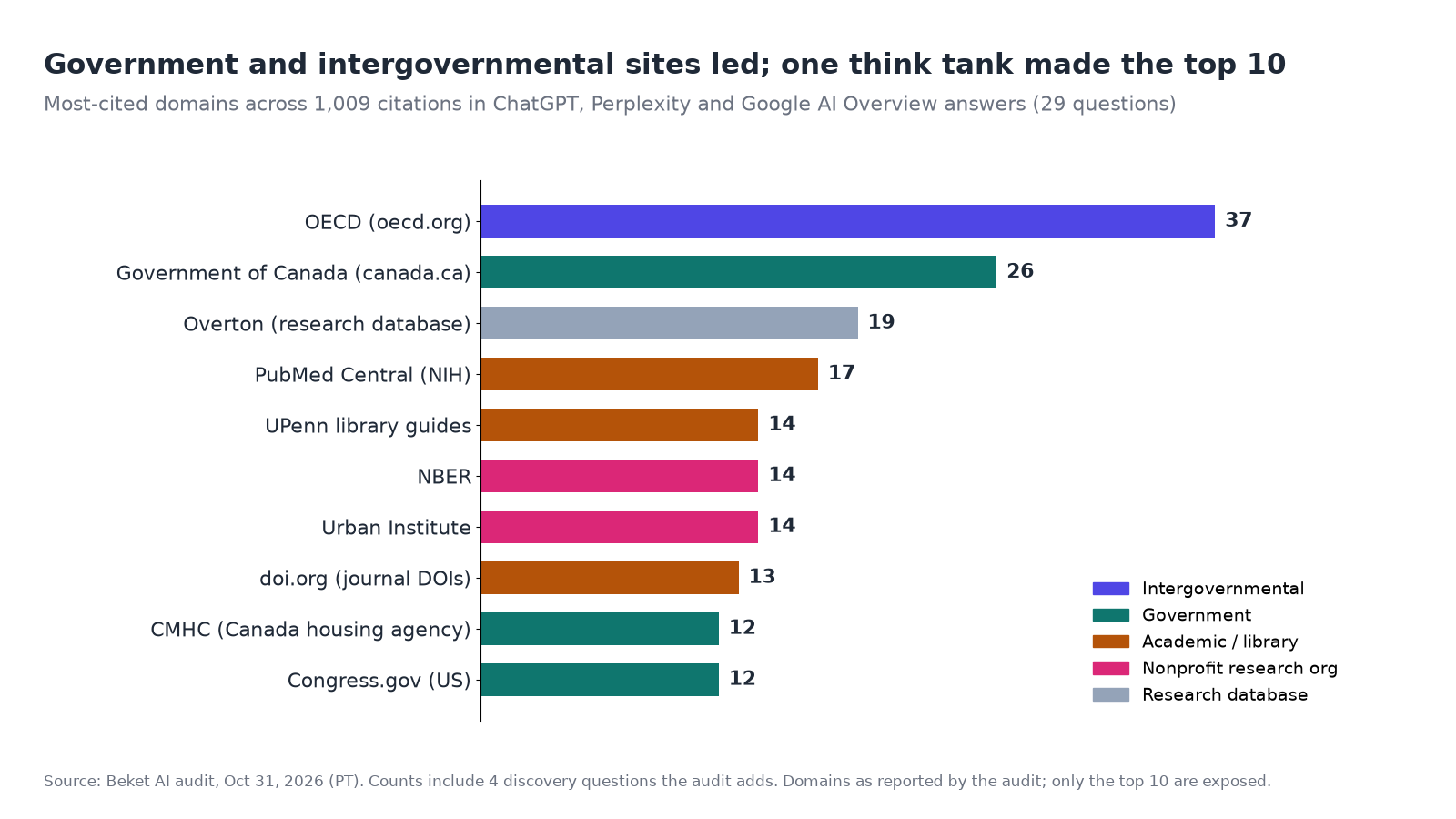
The 10 most-cited domains account for 178 of the 1,009 citations. Four are government or intergovernmental sites: the OECD (37), the Government of Canada (26), Canada’s housing agency CMHC (12) and Congress.gov (12). Three are academic sources (PubMed Central, doi.org links and university library guides). Two are nonprofit research organizations: NBER and the Urban Institute (14 each). The remaining one is Overton, a database of policy documents.
The other 831 citations are spread across domains outside the top 10, which the audit doesn’t list. These counts include the 4 discovery questions, which asked where to find policy research. That’s likely why library guides, Congress.gov and Overton show up. Beket AI doesn’t split the domain list by engine.
Beket AI also counts the organizations named in the answer text. For this audit, that list had four names: Overton (43 mentions: ChatGPT 25, Perplexity 15, Google AI Overview 3), Policy Commons (38), ProQuest (12) and RAND Corporation (3). Policy Commons and ProQuest showed up only in the audit’s “where to find research” group of questions; Overton and RAND also showed up in the topic questions. This is a signal worth noting for nonprofits: when people ask AI how to find policy research, it points them to repositories, so getting your reports listed in those repositories is part of being found.
What formats got linked
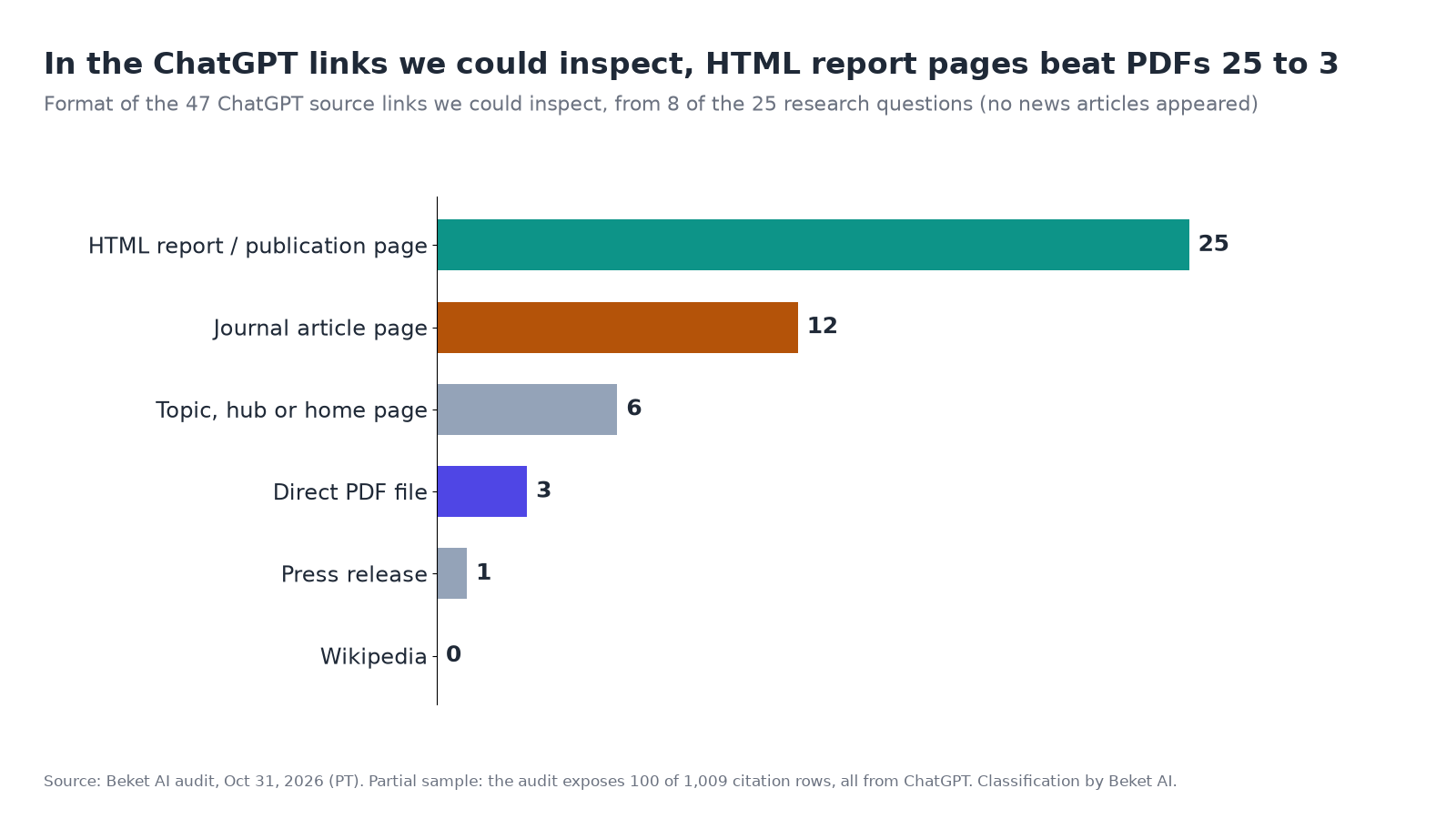
We could inspect 47 individual ChatGPT links from 8 of our 25 questions (why only 47 is explained below). Of those:
- 25 were HTML report or publication pages, such as the OECD’s full HTML version of a pay transparency report, Canadian government evaluation reports and Statistics Canada articles.
- 12 were journal article pages, mostly for “latest research on climate policy advocacy,” where every link went to a journal or DOI.
- 6 were topic, hub or home pages, such as a data hub or an organization’s issue page.
- 3 were direct PDF files. One was an OECD report PDF, one a Government of Canada outcomes report and one a Statistics Canada census PDF.
- 1 was a press release, the Center for American Progress’s release on its gender wage gap analysis.
- No Wikipedia pages and no news articles appeared among the 47.
Nonprofits did get linked when they had a clear report page. In the visible answers, ChatGPT linked report pages from the National Partnership for Women & Families, Ecotrust Canada and Resources for the Future, an Assembly of First Nations housing page and World Economic Forum report pages. The Urban Institute’s sample link in the domain list was a PDF, so PDFs can still be cited. They just weren’t the main format in the links we could see.
What’s partial in this data
- Citation rows are capped. Beket AI returned 100 of the 1,009 citation rows. All 100 were from ChatGPT, and 53 came from the discovery questions. So the format breakdown is based on 47 ChatGPT links: 4 complete answers plus parts of 4 more. It says nothing direct about Perplexity or Google AI Overview links.
- Only the top 10 domains are listed, and that list mixes in the discovery questions.
- The answer text isn’t exposed, so we can’t see how each source was used in the answer.
- Five ChatGPT answers to Canada questions were flagged off-topic by the audit, most likely because the location was set to the United States. Their links are still in the counts above.
- One run on one night. AI answers change by day, wording, location and user.
How to make reports easier for AI to cite
1. Publish an HTML version alongside the PDF
Google can index PDFs. They’re on its list of file types it can index. Even so, an HTML page gives every report a stable URL with a readable title, a summary, headings and links that both people and crawlers can follow. In our sample, HTML report pages were linked far more often than PDFs. The pattern to copy is what the OECD does: a full report on a web page, with the PDF as a download.
At minimum, give each report its own landing page with the executive summary, key findings, methods and a link to the PDF. Don’t just post a link to a file.
2. Put the key findings and numbers up front
AI answers often quote a single finding. Make it easy to lift: a short “key findings” list near the top, each finding with its number, the place and the time period it covers (“X% of renters in Ontario in 2025”). Write headings as plain statements of what the section shows. A finding buried on page 34 of a PDF is easy to miss.
3. Use clear titles, dates and author markup
Give each report a descriptive title that names the topic and place, a visible publication date (and an “updated” date when you revise it), and named authors and the publishing organization on the page.
Structured data can describe this, as long as it’s accurate. Schema.org has a Report type, described as “a Report generated by governmental or non-governmental organization,” with properties such as author, publisher, datePublished and reportNumber. Pair it with Organization markup for your nonprofit. Keep the expectations realistic: Google says no special schema is needed for its AI features and that structured data should match the visible text on the page. Treat markup as clear labelling, not as a switch that gets you cited.
4. Don’t block the crawlers that power AI search
This is the step most likely to be getting in your way without anyone noticing. AI companies separate crawling for training from crawling for search and answers:
- OpenAI: OpenAI’s crawler documentation says sites that opt out of OAI-SearchBot “will not be shown in ChatGPT search answers,” while GPTBot is the training crawler. Each setting is independent.
- Perplexity: Perplexity says PerplexityBot “is designed to surface and link websites in search results” and “is not used to crawl content for AI foundation models.”
- Google: AI Overviews and AI Mode are part of Search and rely on Googlebot. Google-Extended is a separate control for Gemini training and grounding. Google says it doesn’t affect inclusion in Google Search.
So a nonprofit can opt out of AI training and still be citable in AI search. We explain the difference in AI training opt-out vs AI grounding. If your site sits behind Cloudflare, check its AI crawler settings too. Our Cloudflare AI Crawl Control guide walks through them.
5. Get your reports cited in the places AI already reads
In our audit, AI pointed people looking for policy research to repositories and databases, and most citations went to government, intergovernmental and academic sources. Submitting reports to policy repositories, getting them referenced by agencies and coalition partners, and earning coverage all create more paths to your work. We cover why these third-party mentions matter in brand mentions are the new backlinks for AI search. For the rest of your site, see the nonprofit website checklist.
How to check whether ChatGPT, Perplexity and Google AI cite your reports
- Write down the questions your audience asks. Use the questions a reporter, legislative aide or funder would type, not your report titles. Our 25 questions below are a starting template.
- Run them in each engine and open the sources. In ChatGPT and Perplexity, look at the linked sources under each answer. In Google, check whether an AI Overview appears and which links it shows. Note whether your organization is named, linked, or both, and which page gets the link: the HTML page, the PDF or a news story about it.
- Check your analytics. OpenAI says ChatGPT adds utm_source=chatgpt.com to referral links, so those visits can be counted in Google Analytics. Google says clicks from AI Overviews and AI Mode are counted within Search Console’s overall Web search traffic.
- Repeat it. One check is a snapshot. Track how often you’re named against peer organizations over time. That’s AI share of voice.
How Beket AI fits in
Beket AI runs this kind of check for you. It asks your questions on three AI engines and shows which organizations are named, how often, on which engine and which sources are cited. The free audit covers 25 prompts across 3 engines. Pro is $49/month and re-audits daily, starting at 50 prompts across 3 engines.
The 25 questions we asked
- best reports on affordable housing policy in Canada
- latest research on climate policy advocacy
- white papers on food insecurity in the US
- best research reports on homelessness in the United States
- latest reports on child poverty in Canada
- most cited think tank reports on immigration policy
- best white papers on criminal justice reform
- latest research on universal basic income pilots
- best reports on the gender pay gap in 2026
- research on minimum wage increases and employment
- best policy reports on renewable energy transition
- latest nonprofit research on mental health access in the US
- best reports on early childhood education policy
- research reports on gun violence prevention policy
- best white papers on digital rights and online privacy
- latest research on racial wealth gap in America
- best reports on public transit funding
- reports on refugee resettlement outcomes in Canada
- best research on plastic pollution policy
- latest data reports on hunger and food banks in Canada
- best think tank reports on healthcare costs in the US
- research on the effectiveness of advocacy campaigns
- best reports on wildfire and climate adaptation policy
- latest research on student debt policy
- reports on Indigenous housing in Canada
Discovery questions the audit added on its own (included in the 1,009 total and the domain chart, not in the per-engine table):
- “How do the top academic and professional indexes for public policy research and gray literature compare to each other?”
- “I’m a policy analyst looking for tools to track and search global policy briefs and government reports. Which platforms are most recommended?”
- “What are the best search engines or databases for finding policy research reports and think tank papers?”
- “What databases or search platforms should I use to find policy research documents and impact papers to inform new legislation?”
Audit data comes from one Beket AI run on October 31, 2026 (PT), with the location set to the United States. AI answers vary by day, wording, location and user, so treat these numbers as a snapshot, not a ranking of organizations or reports. Other statistics link to their public sources.
About the author: Nur Rysbek is the CEO of Beket AI.
Related posts
What Is Zero-Click Search? Why One Study Says 68% and Another Says 22%
Zero-click search explained: what counts, why 2026 studies range from 22% to 68%, the Canada vs U.S. numbers, and what local businesses should measure.
How to Verify Googlebot, GPTBot and Other AI Crawlers (and Catch the Fakes)
Anyone can call their bot Googlebot or GPTBot. How to verify real AI crawlers with official IP lists and reverse DNS, block fakes, and keep real ones in.
Bing Places vs Google Business Profile vs Apple Business: Which Listing Feeds Which AI Answer?
Bing Places vs Google Business Profile vs Apple Business, compared: where each listing shows up, which AI answers use it, and what 748 cited links show.