
How to Write Press Releases for AI Search: What 850,000+ AI Citations Show (2026)

Most press releases are written for two readers: a journalist skimming for a story, and an investor checking the numbers. In 2026 there's a third reader that comes back far more often than either. ChatGPT, Claude and Gemini pick up newswire releases, and they keep citing them in answers for weeks.
Two public datasets now show what that third reader responds to. The clearest is a study from Notified, the company that runs GlobeNewswire, covering 26,670 English-language releases and more than 850,000 timestamped AI citation events. The other is Muck Rack's ongoing "What Is AI Reading?" research. Neither proves cause and effect, and Notified has an obvious interest in newswires looking good. Still, the patterns are specific enough to change how you write the next release.
This guide turns those findings into steps you can apply before you hit send, plus a checklist at the end.
What the data says, in one chart
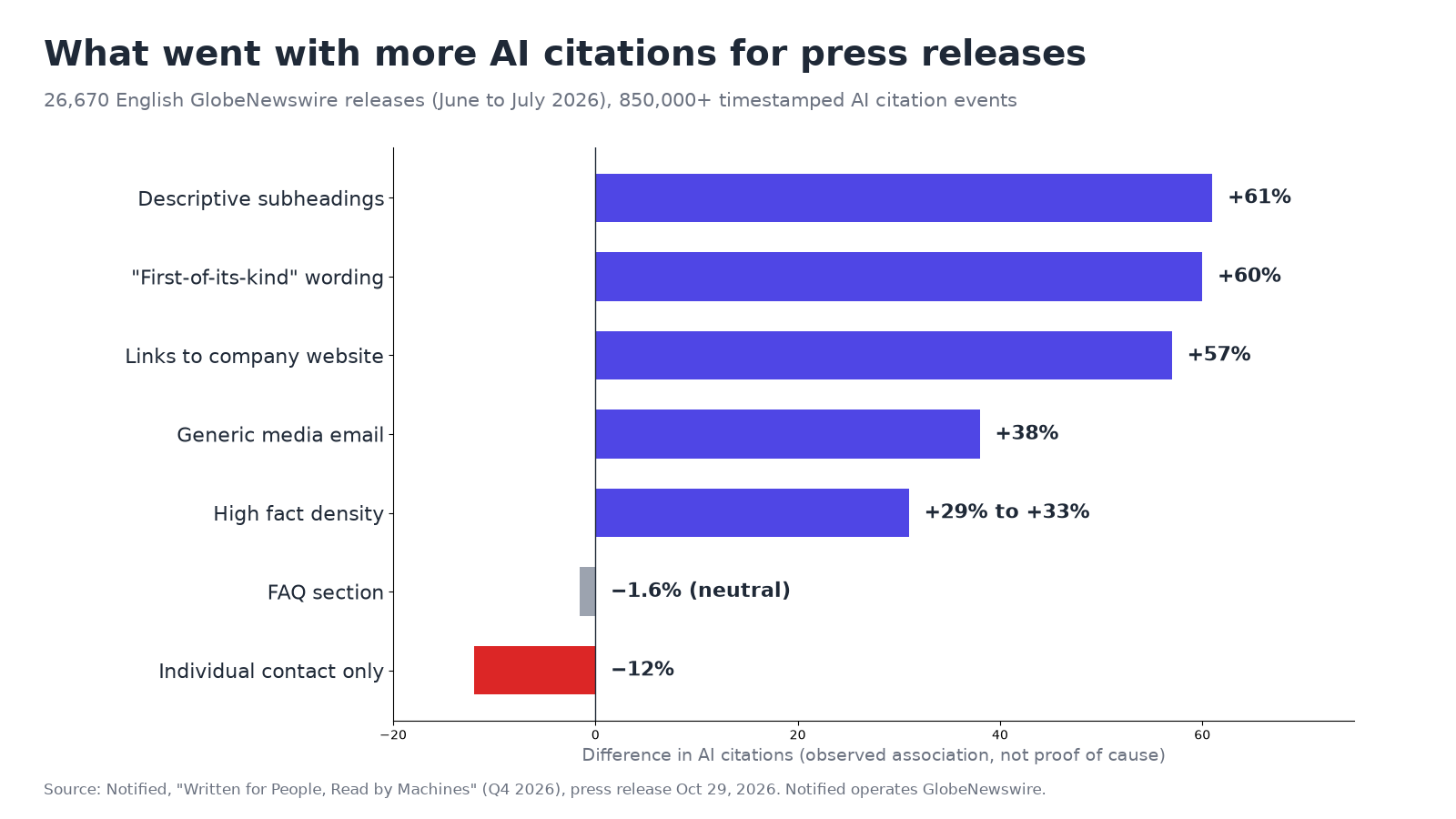
Notified's Q4 2026 report compared releases with and without specific features and measured how many AI citations each group got. These are the differences it published:
| Feature of the release | Difference in AI citations |
|---|---|
| Descriptive subheadings such as "Key Findings" or "Financial Highlights" | +61% |
| Novelty stated plainly ("first-of-its-kind") | +60% |
| Link to the company's own website | +57% |
| Generic corporate media email (for example media@company.com) | +38% |
| High fact density | +29% to +33% |
| FAQ section | −1.6% (neutral) |
| Only an individual named as the contact | −12% |
Notified is clear that these are "observed associations, not proof of causation." A release with good subheadings may also be better written in a dozen other ways. Treat the numbers as a sense of direction, not a promise that adding headings gets you 61% more citations.
Muck Rack's research points the same way from a different angle. In its analysis of more than a million links cited by AI models, releases that got cited had about twice as many statistics, about 2.5 times as many bullet points and about 30% more objective sentences than releases that didn't.
Step 1: Replace generic sections with headings that say what's inside
The biggest gap in Notified's data was structure. Releases built around descriptive subheadings got 61% more AI citations.
A descriptive heading tells a model what the next paragraph contains before it reads it. "Key Findings", "Pricing and Availability", "Financial Highlights" and "About the Study" all work. "Overview", "More Details" and a wall of unbroken paragraphs don't.
Try this on your next draft: read only the headings. If someone could answer "what happened, what does it cost, when, where, and who said it" from the headings alone, the structure is doing its job.
Step 2: Put the facts in plain, checkable sentences
High fact density went with 29% to 33% more citations in Notified's data, and Muck Rack found cited releases carried roughly double the statistics of uncited ones. Muck Rack's data lead Matt Dzugan described the pattern this way: releases that are "more objective, more fact-based, more statistic-based" get cited "a lot more than a fluffy hype piece."
In practice that means:
- One fact per sentence where you can: a number, a date, a place, a named product or partner.
- Bullet points for anything list-shaped, like features, locations or results.
- Fewer adjectives. "Industry-leading" and "revolutionary" give an AI nothing to repeat. "Available in 14 Canadian cities from December 1" does.
- Quotes that add information rather than enthusiasm. A quote that explains why a decision was made is more useful to a model than one that says the team is thrilled.
The same habits help your own pages too. Our guide on how to get cited by ChatGPT, based on 264 citations from Vancouver audits, looks at which pages ChatGPT actually cited.
Step 3: Say what's new, in so many words
This was the most surprising finding. Releases built on proprietary research earned no citation lift unless they stated their novelty plainly. Releases that used "first-of-its-kind" language got 60% more citations.
A model can't infer that your survey is the first of its kind. If it's genuinely new, say so in the first paragraph and say why: the first study of this market, the first product in this category in Canada, the first time this data has been published. If it isn't new, don't claim it is. A claim an AI repeats and a journalist later disproves is worse than no citation.
Step 4: Link to your own website
Linking to the company's own site went with 57% more AI citations, and Notified called it "the most consistent signal" in the data.
The link gives a model a path from the announcement to the source of truth about your company: your product page, pricing, locations and team. Link the specific page the release is about, not just your homepage, and make sure that page states the same facts the release does. A release that says one price and a product page that says another hands AI two versions to choose from.
Step 5: Use a generic media contact
This one is easy to miss. Releases with a generic corporate media address, such as media@company.com, got 38% more citations. Releases that named only an individual contact got 12% fewer.
Notified doesn't explain why, and it may simply be that companies with a media inbox also run more organized communications. Either way, it costs nothing to list a generic press address alongside (or instead of) a person's name.
Step 6: Skip the FAQ block unless readers need it
FAQ sections showed a neutral relationship with AI citations in Notified's data (−1.6%). Adding a Q&A section to a release won't hurt, but don't expect it to be the thing that gets you cited. The time is better spent on headings, facts and a clear statement of what's new.
Step 7: Get the first version right
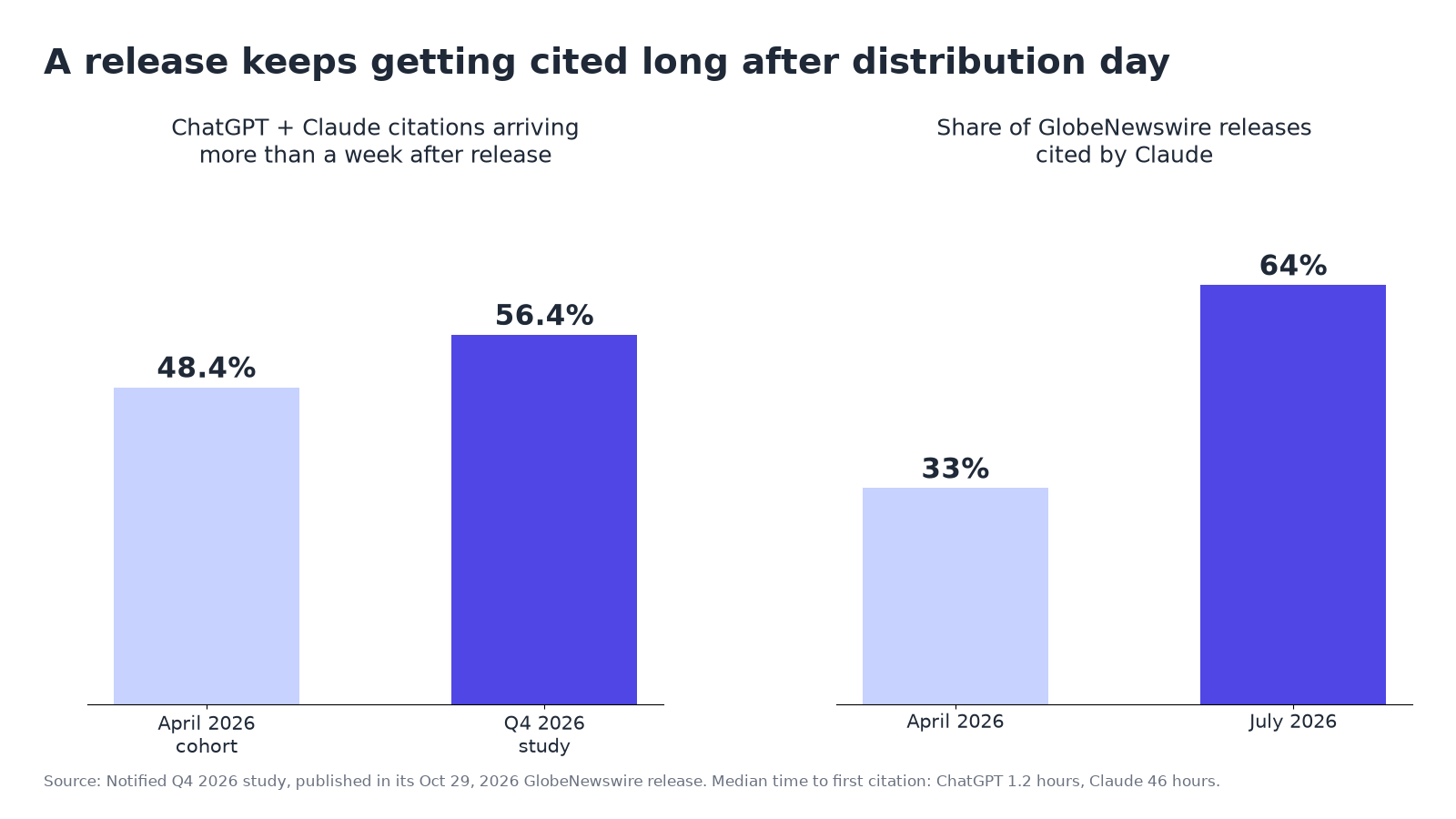
Notified found that 56.4% of ChatGPT and Claude citations arrived more than a week after a release went out, up from 48.4% in April 2026. ChatGPT was fast, with a median of 1.2 hours to its first citation. Claude took a median of 46 hours. The share of GlobeNewswire releases cited by Claude rose from 33% in April to 64% in July 2026.
The detail that matters most for your workflow: both models mostly cited the version they crawled first. If you push a release with the wrong price and correct it an hour later, AI answers may keep repeating the first version for weeks. Fact-check before distribution, not after.
This is the same reason a single citation is never the end of the story. Our piece on why AI citations decay and how to plan for it covers what happens to citations over time.
Where press releases fit in the bigger picture
Press releases are a small slice of what AI cites. Muck Rack's research puts the three major wires (PR Newswire, Business Wire and GlobeNewswire) at about 1% of AI citations. Its October 2026 edition found more than 84% of citations come from earned and third-party sources such as journalism, government sites, academic research and third-party company content. Paid and advertorial content was just 0.3%.
Two things follow from that:
- A release works best as a seed, not the whole crop. Muck Rack notes that releases often get picked up by journalists and other outlets, and that downstream coverage is where much of the citation value sits. Our guide to why brand mentions work like backlinks for AI search explains why those third-party mentions matter.
- Releases show up for some questions and not others. Muck Rack found press releases appear almost exclusively in answers to industry trend questions, at 3.5 times the rate they appear in "best of" answers. A release about your new product is unlikely to get you named when someone asks for the best option in your category. That still depends on reviews, coverage and your own pages.
That last point is also why PR and content teams can't work separately here. We wrote about it in why your PR team and your content team are solving the same problem.
The pre-send checklist
| Check | Done? |
|---|---|
| Headings describe what's under them ("Key Findings", "Pricing and Availability") | ☐ |
| Each key fact (number, date, place, product, partner) is in its own plain sentence | ☐ |
| Lists use bullet points | ☐ |
| The first paragraph says plainly what's new, and the claim is true | ☐ |
| The release links to the specific page on your site it's about | ☐ |
| That page states the same facts as the release | ☐ |
| A generic media email is listed | ☐ |
| Quotes add information, not just enthusiasm | ☐ |
| Every number has been checked before distribution | ☐ |
How to check whether it worked
Press releases mostly show up in answers to trend and news questions, so test those. A week or two after a release goes out, ask ChatGPT, Claude or Gemini an unbranded question about the trend your announcement fits, such as "what's new in [your category] in Canada this year?", and note whether your company comes up and which source is cited. Run the same questions again a few weeks later, since AI answers change over time.
For the bigger question, whether AI names you when buyers ask who to choose, Beket AI's free audit runs 25 unbranded prompts across ChatGPT, Perplexity and Google AI Overview and shows which businesses each engine names. A release can help with the first kind of question. The second usually takes coverage, reviews and clear pages on your own site.
Sources: Notified, "Written for People, Read by Machines" Q4 2026 report, as summarized in its October 29, 2026 press release; Muck Rack, "What Is AI Reading?" (2026 update, May 2026, October 2026). Figures are as published by each source on the dates given.
Related posts
Which Legal AI Tools Does AI Recommend? 2026 Study
Spellbook led with 113 mentions; Harvey had 100. A Beket AI study of 25 legal AI buyer prompts across ChatGPT, Perplexity and Google AI Overview.
Which SF Marketing Agencies Does AI Recommend? 2026 Study
Jives Media led 242 agency mentions in a Beket AI study of 25 San Francisco buyer prompts across ChatGPT, Perplexity and Google AI Overview.
Can ChatGPT Read JavaScript? What Each AI Crawler Sees in 2026 (and How to Test Your Site)
Can ChatGPT read JavaScript? What ChatGPT, Claude, Perplexity, Gemini and Copilot see on JS-rendered pages in 2026, plus a 15-minute test for your site.