
Which Legal AI Tools Does AI Recommend? 2026 Study

Study date: November 7, 2026
Spellbook was the most-mentioned name in this Beket AI legal AI software study, with 113 mention events, ahead of Harvey at 100. But the engines did not agree on a leader: ChatGPT and Google AI Overview named Harvey most, while Perplexity named Spellbook most.
Beket AI asked 25 unbranded buyer questions about legal AI software for law firms and in-house teams. ChatGPT and Perplexity returned answers to all 25; Google AI Overview returned answers to 23. The final dataset contains 73 answers.
These counts are mention events, not recommendation rates or distinct prompts. One answer can name a vendor more than once. A total of 67 does not mean a tool appeared in 67 different answers. The results measure names surfaced in this run, not product quality, legal accuracy or suitability for confidential work.
The study at a glance
| Detail | Result |
|---|---|
| Scope | Legal AI software for law firms and in-house legal teams |
| Location targeting | None |
| Language | English |
| Engines | ChatGPT, Perplexity, Google AI Overview |
| Selected prompts | 25 unbranded buyer questions |
| Requested executions | 75 |
| Completed answer rows | 73 |
| Raw market-report labels | 30 |
| Normalized vendor/tool labels | 27 |
| Normalized mention events | 594 |
The 27 labels are not 27 independently verified legal AI products. Some are vendors rather than products, and some are general software providers. Classification limits are explained below.
Which names received the most mentions?
Spellbook and Harvey together accounted for 213 of 594 normalized mentions (35.9%). The top four labels—Spellbook, Harvey, Thomson Reuters and Clio—accounted for 298 of 594 (50.2%).
| Vendor/tool label | Total mentions | ChatGPT | Perplexity | Google AI Overview |
|---|---|---|---|---|
| Spellbook | 113 | 66 | 32 | 15 |
| Harvey | 100 | 67 | 15 | 18 |
| Thomson Reuters | 47 | 15 | 17 | 15 |
| Clio | 38 | 5 | 25 | 8 |
| LexisNexis | 36 | 18 | 12 | 6 |
| Ironclad | 31 | 14 | 6 | 11 |
| Luminance | 29 | 22 | 4 | 3 |
| Relativity | 23 | 15 | 8 | 0 |
| Litera | 22 | 9 | 10 | 3 |
| Gavel | 18 | 3 | 13 | 2 |
| DISCO | 14 | 11 | 0 | 3 |
| Everlaw | 14 | 13 | 0 | 1 |
| Microsoft | 13 | 10 | 3 | 0 |
| Sirion | 12 | 6 | 4 | 2 |
| LegalOn | 10 | 5 | 0 | 5 |
| Juro | 9 | 5 | 4 | 0 |
| LinkSquares | 9 | 8 | 0 | 1 |
| Reveal | 9 | 9 | 0 | 0 |
| vLex | 9 | 8 | 0 | 1 |
| Logikcull | 7 | 7 | 0 | 0 |
| Anthropic | 6 | 1 | 0 | 5 |
| Casetext | 6 | 0 | 0 | 6 |
| Evisort | 6 | 4 | 0 | 2 |
| Assembly | 4 | 0 | 4 | 0 |
| Salesforce | 4 | 2 | 0 | 2 |
| Dan Cumberland Labs | 3 | 0 | 0 | 3 |
| Filevine | 2 | 0 | 0 | 2 |
Source: Beket AI market audit, November 7, 2026; market-report mention events after the normalization described below. All retained labels are shown, including general and uncertain vendors.
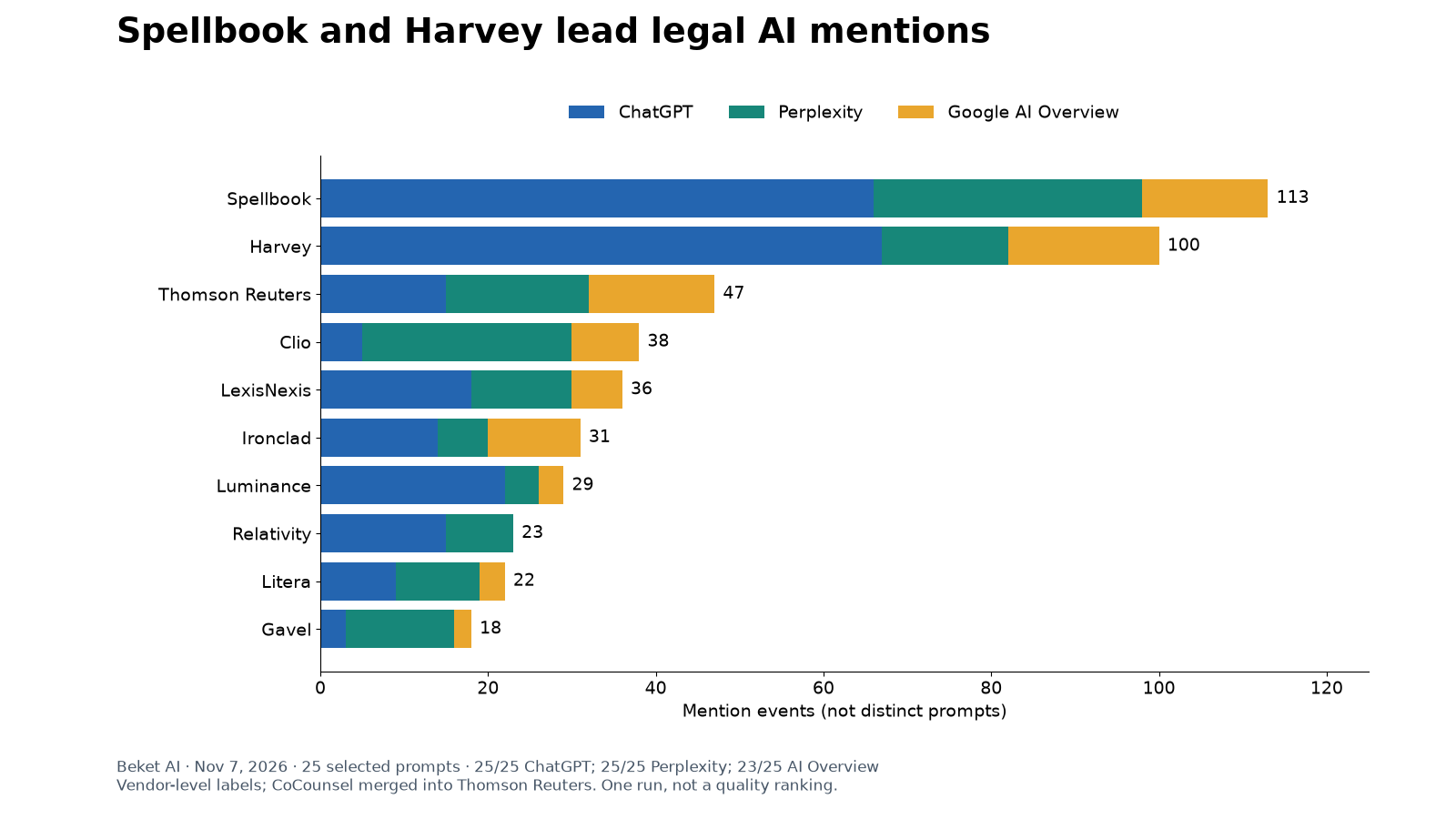
The concentration differs by engine. That is why a single blended number can hide useful detail. Our guide to AI share of voice explains why the denominator matters when reading visibility metrics.
What each engine named
ChatGPT: Harvey narrowly ahead of Spellbook
ChatGPT returned 25 of 25 selected prompts and contributed 323 normalized mention events across 23 labels. Harvey led with 67, just ahead of Spellbook at 66. Luminance followed with 22, then LexisNexis at 18. Relativity and Thomson Reuters each had 15.
The one-mention gap at the top is a result from this run, not evidence of a stable preference. Repeating the same prompts could produce a different ordering.
Perplexity: Spellbook first, Clio second
Perplexity returned 25 of 25 selected prompts and contributed 157 normalized mention events across 14 labels. Spellbook led with 32, Clio had 25, Thomson Reuters 17, Harvey 15 and Gavel 13.
Clio therefore placed second on Perplexity despite receiving just 5 mentions on ChatGPT and 8 on Google AI Overview. An overall leaderboard alone would miss that engine-specific difference.
Google AI Overview: Harvey first, with two unanswered prompts
Google AI Overview returned 23 of 25 selected prompts, contributing 114 normalized mention events across 21 labels. Harvey led with 18. Spellbook and Thomson Reuters tied at 15, followed by Ironclad at 11 and Clio at 8.
The two missing prompts were:
- “best AI tools for drafting legal briefs”
- “best AI software for e-discovery”
The progress indicator counted 25 AI Overview executions as landed, but the final answer log contains only 23 completed answer rows. We use the final log for coverage and do not treat the two missing answers as measured zero-mention responses. The available tools do not explain the discrepancy.
How much did the engines overlap?
10 of the 27 normalized labels appeared on all three engines: Spellbook, Harvey, Thomson Reuters, Clio, LexisNexis, Ironclad, Luminance, Litera, Gavel and Sirion.
Another 11 appeared on exactly two engines: Relativity, DISCO, Everlaw, Microsoft, LegalOn, Juro, LinkSquares, vLex, Anthropic, Evisort and Salesforce.
The remaining 6 appeared on only one engine: Reveal, Logikcull, Casetext, Assembly, Dan Cumberland Labs and Filevine.
This is overlap in vendor/tool labels, not agreement on which product is best. Similar engine disagreement appears in our NYC marketing agencies study, though the markets and question sets differ and their mention totals are not directly comparable.
Which source domains were cited most?
The audit recorded 844 citation events. The API's top-domain rollup was led by:
| Domain | Citation events |
|---|---|
| clio.com | 52 |
| legal.thomsonreuters.com | 49 |
| spellbook.com | 49 |
| gavel.io | 45 |
| lexisnexis.com | 37 |
| harvey.ai | 25 |
| legalontech.com | 21 |
| youtube.com | 20 |
| ironcladapp.com | 18 |
| assembly.com | 16 |
These are citation events, not unique URLs or independently checked endorsements. A vendor can lead citations without leading mentions: clio.com received 52 citation events, while Spellbook led the normalized mention table. For the distinction between surfacing a name and earning a source link, see how to get cited by ChatGPT.
Method and counting rules
Beket AI ran one market audit on November 7, 2026, for “legal AI software for law firms and in-house legal teams,” in English, with no location targeting. The audit was created at 1:28 PM PT and completed at 1:43 PM PT. Audit ID: 61985604-6efe-427a-a9cf-b61d997098ba.
We selected 25 buyer-style prompts without naming a legal AI vendor. The connectors were ChatGPT (CHATGPT_APP), Perplexity (PERPLEXITY) and Google AI Overview (GOOGLE_AI_OVERVIEW). Extra prompt generation was disabled: there were no added discovery prompts. All 73 returned answer rows were unbranded. There were no duplicate prompt/engine pairs or off-topic rows, and no recovery run was required.
Coverage comes from the final answer log. Mention totals and per-engine splits come from the completed market report. The raw report contained 30 labels and 596 mention events. We made two explicit merges and one exclusion:
- CoCounsel (Thomson Reuters) → Thomson Reuters. The raw report counted Thomson Reuters at 44 and CoCounsel (Thomson Reuters) at 3. Combining them produces 47: 15 on ChatGPT, 17 on Perplexity and 15 on Google AI Overview. This is a vendor-level grouping, not a claim that all 47 mentions refer specifically to CoCounsel or any other one product. Casetext remains a separate raw label; no broader ownership-based consolidation was attempted.
- LegalOnTech.com → LegalOn. LegalOn had 7 raw mentions and LegalOnTech.com had 3, producing 10 under LegalOn.
- SelectHub excluded. Its 2 mentions were removed because it is a software comparison publisher, not a legal software tool.
After those adjustments, 27 vendor/tool labels and 594 mention events remain. Microsoft, Anthropic and Salesforce are general vendors. Assembly and Dan Cumberland Labs remain in the table but require further manual classification before being described as dedicated legal tools. The API returns vendor labels, not a reliable product-level split. We have not silently recast those labels as legal AI products.
Counts are mention events, not recommendation rates, unique-prompt appearances, market share, adoption or a quality score. An answer can contain multiple references to a name, so a per-engine count can exceed 25. We do not infer unique-prompt coverage for a vendor from these totals. Raw answer metadata does not expose the complete model prose, so this study does not independently validate each surrounding claim or recommendation context.
All 25 buyer prompts
- best AI tools for contract review
- best legal research AI for small law firms
- best AI legal software for in-house legal teams
- best AI tools for solo lawyers
- best AI tools for drafting commercial contracts
- best AI software for reviewing nondisclosure agreements
- best AI tools for contract redlining
- best AI tools for summarizing legal documents
- best AI legal research tools with verifiable case citations
- best AI tools for litigation research
- best AI tools for drafting legal briefs
- best AI tools for discovery document review
- best AI software for e-discovery
- best AI tools for legal due diligence
- best AI tools for contract risk analysis
- best AI contract management software for legal departments
- best AI tools for comparing contract versions
- best AI tools for extracting clauses from contracts
- best AI tools for employment law firms
- best AI tools for intellectual property lawyers
- best AI tools for regulatory compliance research
- best affordable legal AI software for small firms
- best secure AI tools for confidential legal documents
- best AI legal drafting tools that work in Microsoft Word
- best AI tools for legal intake and client communication
What this study does—and does not—show
The strongest finding is not a universal winner. It is that the leader changes by engine: Harvey leads on ChatGPT and Google AI Overview, while Spellbook leads on Perplexity. Spellbook's overall lead comes from the aggregate of those different patterns.
This is one time-bound, task-mixed sample. Contract review, legal research, discovery and client intake are different jobs; combining them favors neither a controlled product comparison nor a practice-area recommendation. No location setting does not make the results representative of every jurisdiction. The two missing AI Overview answers also mean the engine samples are not identical.
For law firms and in-house teams, being named by AI is separate from evaluating confidentiality, legal reliability, jurisdiction coverage and workflow fit. None of those product qualities was tested here.
A free Beket AI audit starts on the homepage and covers 25 prompts across 3 engines: ChatGPT, Perplexity and Google AI Overview. That is a brand visibility check; this article reports a separate market-level study.
Related posts
Can ChatGPT Read JavaScript? What Each AI Crawler Sees in 2026 (and How to Test Your Site)
Can ChatGPT read JavaScript? What ChatGPT, Claude, Perplexity, Gemini and Copilot see on JS-rendered pages in 2026, plus a 15-minute test for your site.
How to Write Press Releases for AI Search: What 850,000+ AI Citations Show (2026)
How to write press releases that ChatGPT and Claude cite: 7 steps from Notified's study of 26,670 releases and Muck Rack data, plus a pre-send checklist.
White-label AI visibility reports for agencies
Compare AI visibility tools for agencies that need daily monitoring and white-label reports. Monthly pricing for ~5 client sites, with sources as of Nov 2026.