
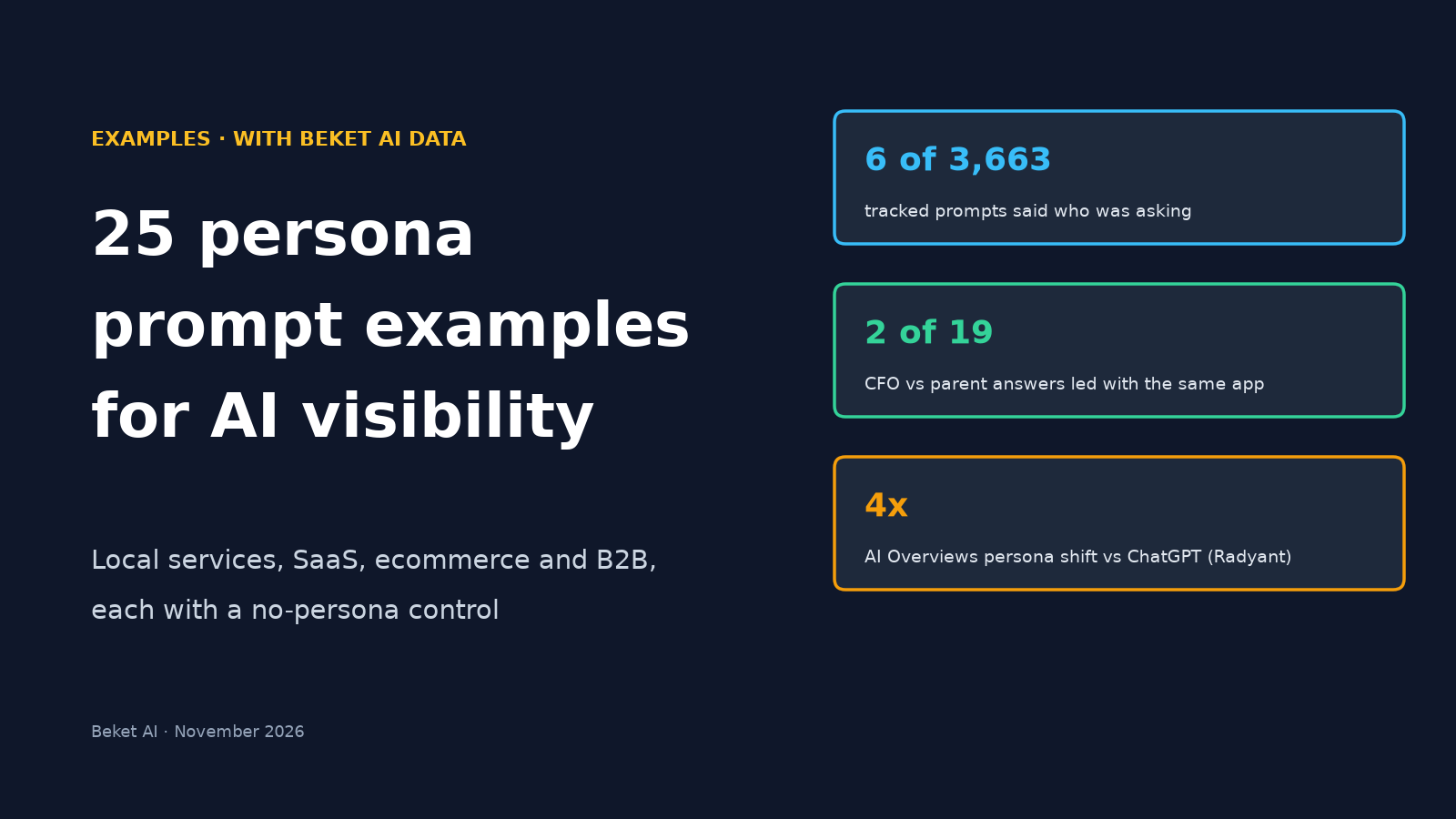
25 Persona Prompt Examples for Tracking AI Visibility (Local Services, SaaS, Ecommerce, B2B)

A tracked prompt like "best payroll software" tells you what an AI engine says to nobody in particular. Real buyers rarely ask that way. They start with who they are: "I'm the office manager at a 12-person dental clinic." "I'm a dad with two kids under five." That opening line can change which businesses get named.
This post gives you 25 persona prompt examples you can copy into an AI visibility check, grouped by vertical: local services, SaaS, ecommerce and B2B. Each one pairs a persona line with an unbranded buying question and notes what it's meant to test. All of them are illustrative. Swap in your own category, city and buyer.
If you want the method behind the examples (control prompts, clean sessions, repeated runs), start with our guide to persona prompts for AI visibility testing. This page is the swipe file.
Why bother with persona prompts at all
Two pieces of evidence, one public and one ours.
The public test. The AI search agency Radyant ran 8 funnel-builder questions with 8 persona prefixes (one of them a no-persona control) across ChatGPT, Google AI Overviews, Gemini, Microsoft Copilot and Perplexity from March 18 to May 10, 2026, collecting 17,929 responses. In its persona study, 28% of the 350 brand, persona and model combinations moved by 5 percentage points or more once a persona was added. Google AI Overviews was the most sensitive engine, with an average per-persona shift of 8.9 points against 2.2 on ChatGPT. Adding any persona also narrowed the field a little: average brand visibility fell from 30.0% with no persona to 28.3–29.3%.
Our own small test. On November 17, 2026 we asked ChatGPT, Perplexity and Google AI Overview 8 unbranded budgeting-app questions, each prefixed with "I'm a startup founder.", "I'm a CFO." or "I'm a parent." We got 64 of 72 possible answers. When we compared two personas on the same question and the same engine, the first app named matched in 8 of 19 founder–CFO pairs, 5 of 19 founder–parent pairs and only 2 of 19 CFO–parent pairs. The full write-up is in our persona study of budgeting apps.
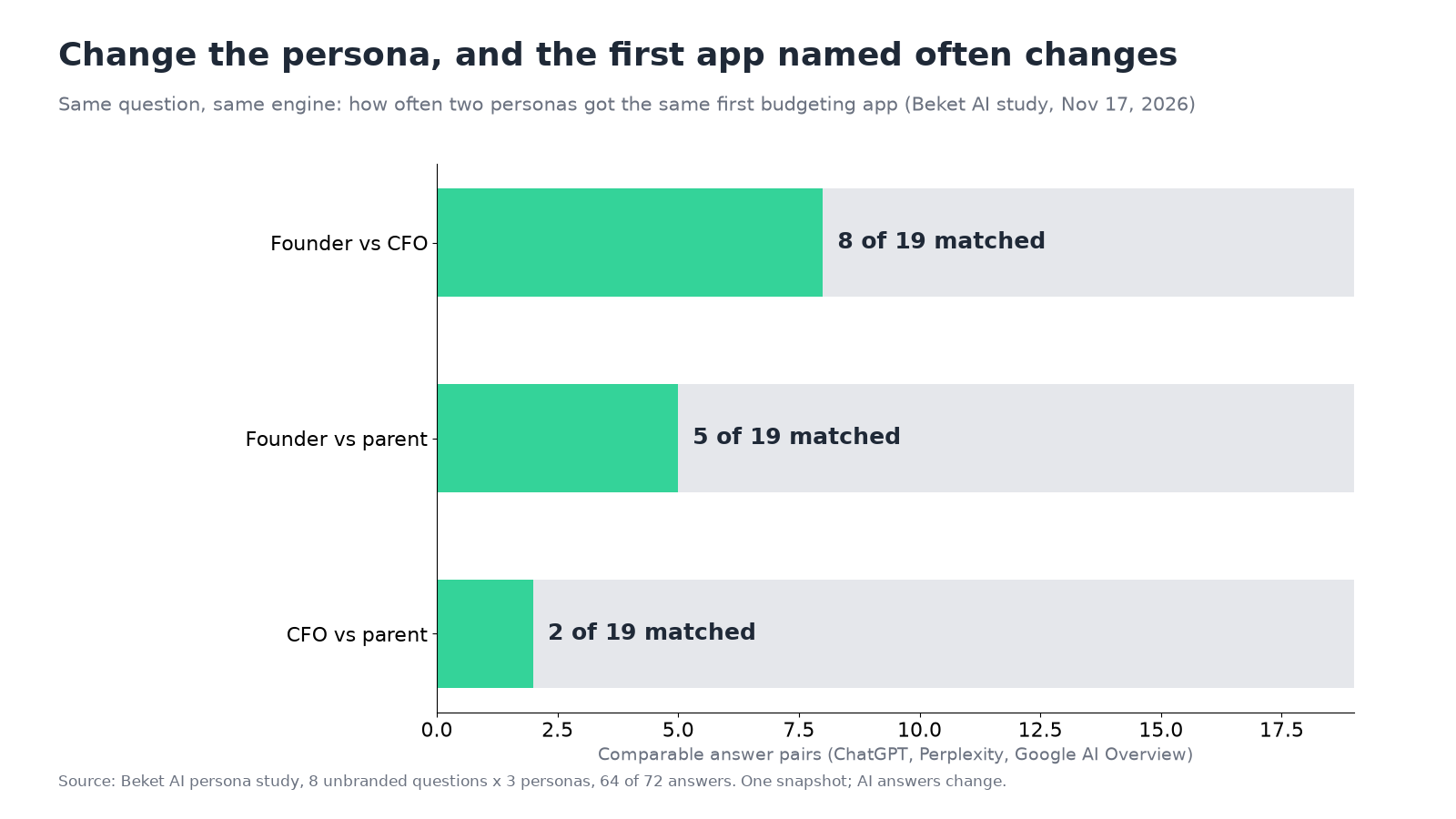
Both are snapshots. AI answers change from run to run, and a persona doesn't move every brand on every engine. But together they say the neutral prompt is only one view of the market.
Most tracked prompts never say who's asking
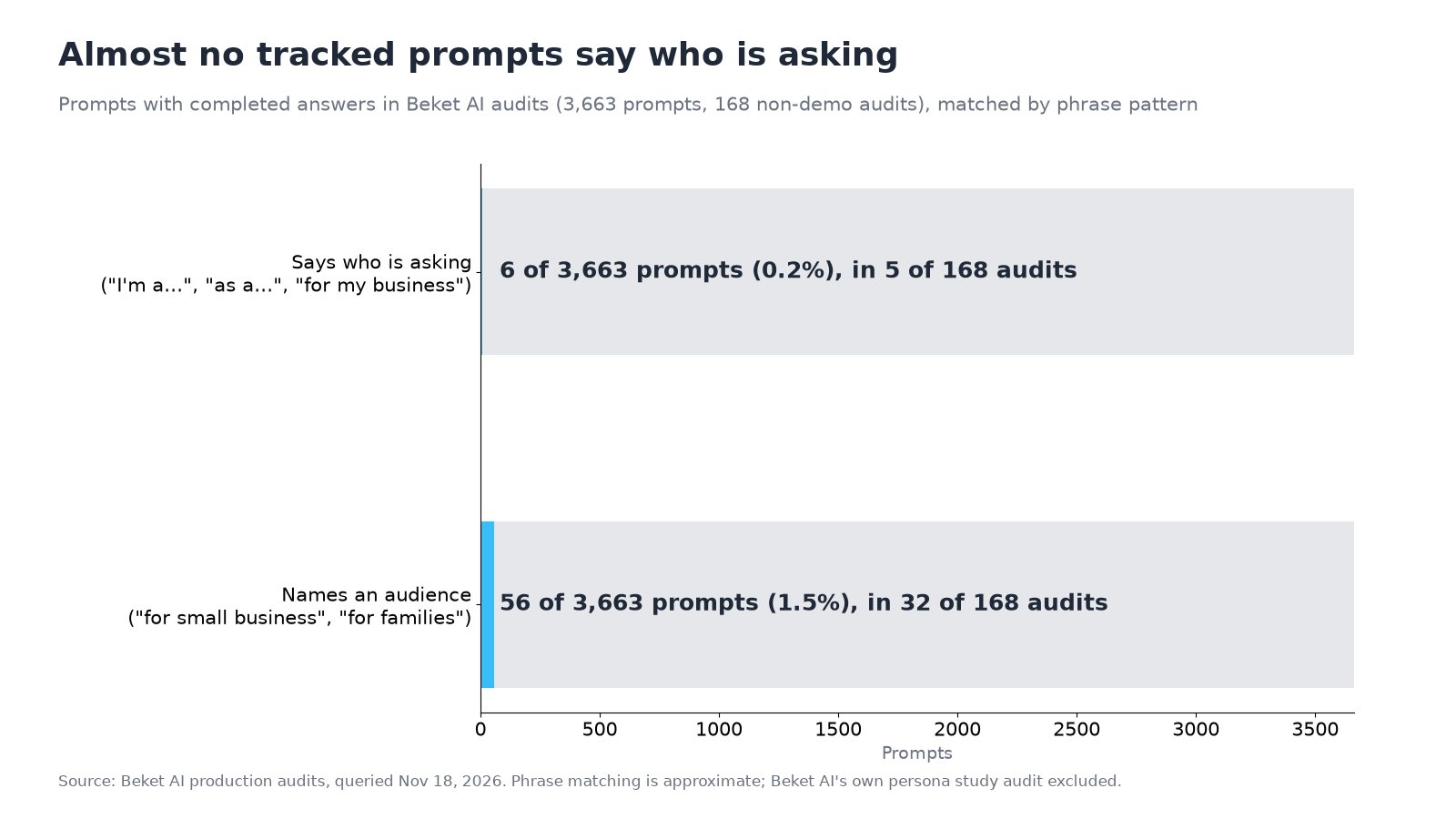
We wanted to know how often real prompt sets include a persona, so we looked at the prompts in Beket AI's own production audits (aggregate counts only, no prompt text or customer details). On November 18, 2026, 3,663 prompts with completed answers across 168 non-demo audits matched our phrase patterns like this:
| Prompt pattern | Prompts | Audits |
|---|---|---|
| Says who is asking ("I'm a...", "as a...", "for my business...") | 6 (0.2%) | 5 of 168 |
| Names an audience but not the asker ("for small business", "for families") | 56 (1.5%) | 32 of 168 |
We excluded our own persona study audit, and phrase matching is approximate, so treat these as rough counts. The direction is clear, though: almost every tracked prompt is a neutral question.
That's the gap these examples fill. You don't need to replace your neutral prompts. Add a handful of persona versions next to them.
How to read the examples
Every example has three parts:
- Persona line: one or two sentences in the buyer's voice. Keep it short. Radyant's prefixes were as bare as "I'm CTO at a company."
- Question: unbranded, so the engine has to choose. Never put your own brand or a competitor in it.
- What it tests: the constraint the persona adds (budget, team size, urgency, compliance, family needs).
For each one, also run the same question with no persona line. That's your control. Without it, you can't tell whether the persona changed anything.
Local services: 7 examples
Local prompts move with location, so set the city in the question or in the tool's location setting, and keep it the same across persona and control versions. For more local question ideas, see the questions customers ask AI before hiring a local business.
| # | Persona line | Question | What it tests |
|---|---|---|---|
| 1 | "I'm a first-time homeowner and I don't know much about plumbing." | "Who should I call for a leaking water heater in Denver?" | Whether beginner framing favors businesses that explain things plainly |
| 2 | "I manage three rental properties." | "Which plumbing companies in Denver handle landlord accounts?" | Repeat-customer and account-based services |
| 3 | "I'm a parent of a nervous 6-year-old." | "Which dentists in Austin are good with anxious kids?" | Family and comfort signals in reviews and pages |
| 4 | "I'm 72 and live alone." | "Which home cleaning services in Phoenix are trustworthy for seniors?" | Trust, background checks, senior-specific wording |
| 5 | "I run a small restaurant." | "Which commercial cleaning companies in Chicago do overnight kitchen cleaning?" | Business vs residential service pages |
| 6 | "I just got rear-ended and I'm not sure if I need a lawyer." | "Which car accident lawyers in Seattle offer free consultations?" | Urgency and first-step framing |
| 7 | "I'm on a tight budget." | "What's a good, affordable electrician in Portland for replacing a panel?" | Whether price signals (ranges, financing) get picked up |
SaaS: 6 examples
SaaS answers often split by company size and role. A founder and a CTO asking the same question can get different shortlists, which is what Radyant saw with role-only prefixes.
| # | Persona line | Question | What it tests |
|---|---|---|---|
| 8 | "I'm a solo founder with no developers." | "What's the easiest CRM to set up in a day?" | No-code and ease-of-setup positioning |
| 9 | "I'm the CTO at a 200-person company." | "Which CRM has the best API and data export?" | Technical depth and documentation |
| 10 | "I'm a CFO who has to justify every new tool." | "Which project management tool gives the best value for a 50-person team?" | Pricing transparency and ROI framing |
| 11 | "I run a 12-person marketing agency." | "What's the best client reporting tool for agencies?" | Agency-specific features (white label, multi-client) |
| 12 | "I'm in healthcare and need HIPAA compliance." | "Which scheduling software is safe to use for patient appointments?" | Compliance pages and trust signals |
| 13 | "I'm switching from spreadsheets for the first time." | "What payroll software should a 10-person company start with?" | Beginner and migration content |
Ecommerce: 6 examples
Shopping prompts tend to carry budget, recipient and use-case constraints. Those are exactly the details a persona adds.
| # | Persona line | Question | What it tests |
|---|---|---|---|
| 14 | "I'm a new mom and I'm short on sleep." | "What's the best baby monitor that's easy to set up?" | Ease-of-use claims in product copy and reviews |
| 15 | "I'm a college student on a budget." | "What's a good laptop for school under $700?" | Price filtering and spec-to-need matching |
| 16 | "I run 10K races twice a month." | "Which running shoes are best for regular half-marathon training?" | Enthusiast vocabulary vs generic listings |
| 17 | "I have sensitive skin and eczema." | "What's a gentle everyday moisturizer?" | Ingredient and dermatologist claims, and how carefully the engine hedges |
| 18 | "I'm buying a gift for my dad, who loves grilling." | "What's a good grilling gift under $100?" | Gift intent and price ranges |
| 19 | "I live in a small apartment with no yard." | "What's the best robot vacuum for pet hair in a small space?" | Size and living-situation fit |
B2B and professional services: 6 examples
B2B buyers often name their role and their company's situation in the same breath. Keep both in the persona line.
| # | Persona line | Question | What it tests |
|---|---|---|---|
| 20 | "I'm head of procurement at a mid-size manufacturer." | "Which industrial packaging suppliers can handle custom orders in the Midwest?" | Capability and region pages |
| 21 | "I'm a startup founder raising our first round." | "Which law firms help startups with seed financing?" | Stage-specific practice pages |
| 22 | "I'm the HR lead and we just passed 50 employees." | "What benefits providers work well for growing companies?" | Size-threshold content |
| 23 | "I'm an IT manager after a phishing incident." | "Which managed security providers offer fast incident response for small businesses?" | Urgency and service-level claims |
| 24 | "I'm a nonprofit director with a small budget." | "Which accounting firms specialize in nonprofits?" | Niche specialization signals |
| 25 | "I'm a marketing director who needs to report AI visibility to my CEO." | "What tools track whether ChatGPT and Google AI Overviews mention our company?" | Category language your buyers actually use |
Turning the examples into a prompt set
Twenty-five is a menu, not a to-do list. A workable starting set looks like this:
- Pick 3 personas that really buy from you. Use your sales notes or support tickets, not a marketing persona deck.
- Pick 5 to 10 unbranded questions that matter at the buying moment.
- Run each question 4 times: once with no persona and once per persona. Ten questions and three personas gives 40 prompts.
- Record per engine: whether you're named, your position, who's named first, and which sources are cited.
- Compare against the control, then repeat on a schedule, because one run proves little.
A simple sheet keeps it honest:
| Question | Persona | Engine | Named? | Position | First business named | Sources cited |
|---|---|---|---|---|---|---|
| Q1 | None (control) | ChatGPT | ||||
| Q1 | Persona A | ChatGPT | ||||
| Q1 | Persona B | ChatGPT |
Two habits that keep the results clean. Test in logged-out or fresh sessions, because chat history and memory can shape answers on their own (we covered what OpenAI and Google document in Are ChatGPT answers the same for everyone?). And change only the persona line between versions. If you also change the wording of the question, you won't know which change mattered.
What to do when a persona drops you
If you show up in the neutral answer but disappear for one persona, look at what that persona cares about and whether your site says it in their words. Radyant's write-up suggests that brands with generic positioning lost visibility when a role was stated, while brands with role-specific content and vocabulary tended to gain. It calls that a hypothesis consistent with its data, not a confirmed mechanism, so treat it as a lead to test.
Practical checks:
- Is there a page for that buyer? A landlord, a CFO or a nonprofit should find a section or page that speaks to them directly.
- Do your pages use their vocabulary? "Landlord accounts," "HIPAA," "seed financing," "under $100."
- Do third-party sources describe you for that audience? Reviews, directories and articles that mention the persona's use case give engines more to cite.
Track it without doing it by hand
Running 40 prompts across several engines every week gets tedious fast. Beket AI re-audits prompts daily on ChatGPT, Gemini, Perplexity, Microsoft Copilot, Google AI Overviews and Google AI Mode, so persona versions can sit in the tracked set next to the neutral ones. Enterprise adds custom prompt volume, specific model versions and Claude, GPT and Grok. The free audit runs 25 prompts on any 3 of those engines and shows who gets named and which sources get cited, so you can see where you stand before building a full persona set. Plans are on the pricing page.
Related posts
Service Page Template for AI Search: Structure, Examples and What AI Engines Cite
A service page template built for AI search: 9 blocks, a copy-paste version and two examples, backed by Beket AI data on which pages ChatGPT and Google cite.
Beket AI Changelog: What Shipped in October and November 2026
What shipped in Beket AI in October and November 2026: one headline number, market audits, public API docs at beket.ai/docs and stale page refresh.
AI SEO for Contractors: 7 Steps From Our Plumber, Roofer and Electrician Studies (2026)
AI SEO for contractors in 7 steps, from what ChatGPT, Google AI and Perplexity named and cited in our plumber, roofer, electrician, mover and cleaner studies.