
Beket AI Changelog: What Shipped in October and November 2026

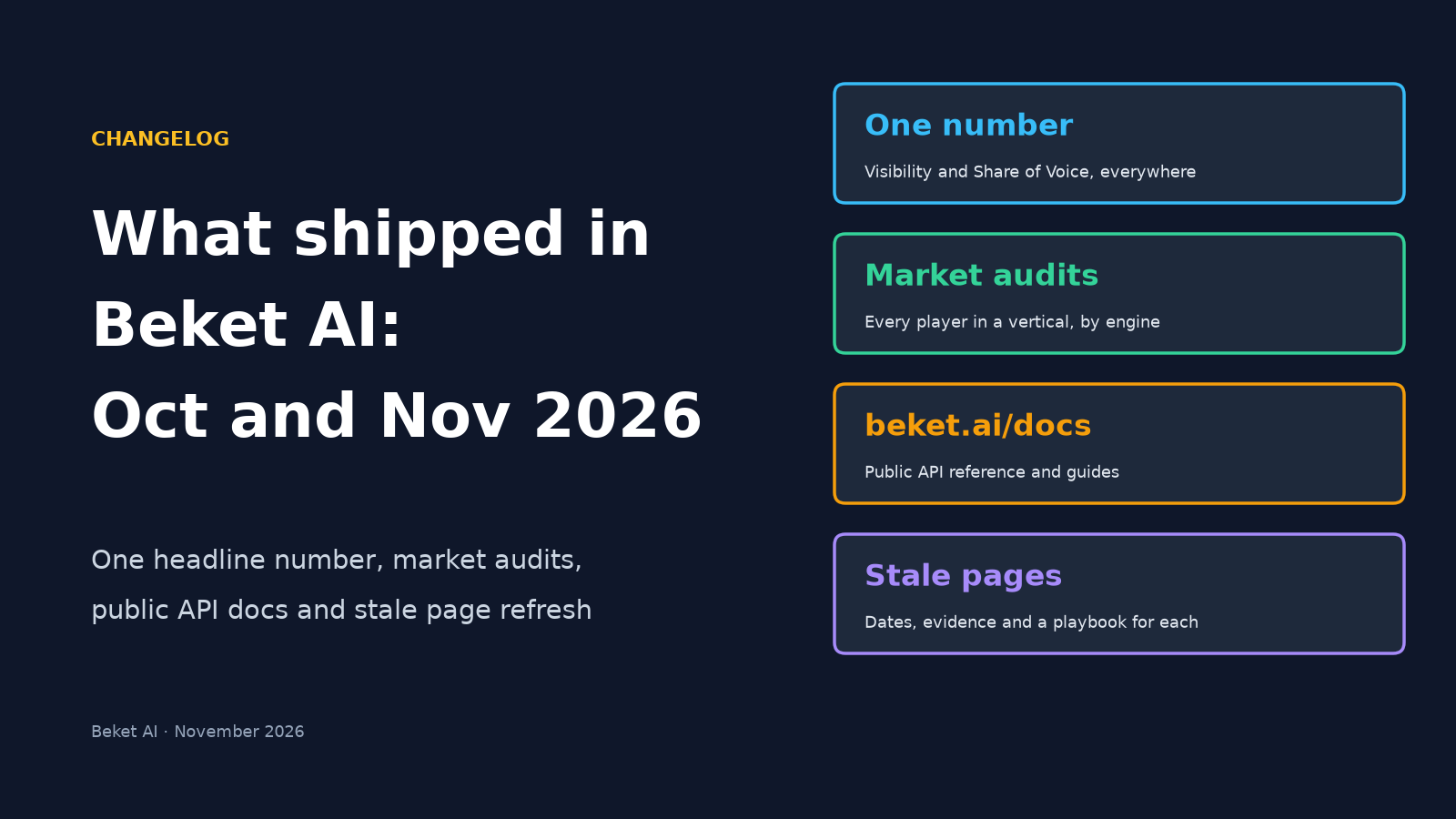
Here is what shipped in Beket AI over October and November 2026. Four updates are live: one headline number across the product, market audits, a public API reference at beket.ai/docs, and stale page refresh. Each section says what the update is, why it matters for AI search visibility and, where there is a place to go, where to find it.
One headline number everywhere
What it is. A report used to carry several "visibility" numbers, and each part of the product picked a different one. Now the same headline row, Visibility and Share of Voice, is the only number shown on the web overview, in Slack, in the MCP summary and in GraphQL. We also retired the extra composite score that sat beside it, so there is one number. This is live as of 23 October.
Why it matters. If you track AI visibility over time, you need to know which number you are looking at. When the web overview says one thing and a Slack message says another, you spend your time reconciling figures instead of deciding what to do. With one headline row, the number you see in a report is the number a teammate sees in Slack or an integration sees through the API. If you want a refresher on how the share-of-voice figure is built, we walk through the formula in What Is AI Share of Voice?.
Where to find it. On the report's web overview, in Slack, in the MCP summary and in GraphQL.
Market audits
What it is. A market audit maps every player in a vertical, with no single brand as the focus. It gives you monthly snapshots and a trend, so you can see how a market changes over time. In October the leaderboard became broken down by engine, and it went live on 24 October. When a market audit runs several engines, it says which engine named which brand. Creating a market audit needs a paid plan.
Why it matters. AI answers rarely name one business in isolation. They name a set of them, and which set you appear in depends on the question and the engine. A view of the whole vertical shows who is being named around you and how that moves month to month, which a single-brand report cannot show. For an example of looking across a whole category rather than at one company, see our study Which Online Learning Platforms Does AI Recommend? Because answers shift as models change, a trend is more useful than one snapshot. We cover that in ChatGPT Has Core Updates Too.
Public API reference at beket.ai/docs
What it is. The public API reference now lives at beket.ai/docs. It is generated from the OpenAPI spec, and it comes with hand-written guides that are tested against the spec. The OpenAPI document itself is public. Every route an API key can reach is either documented or excluded with a stated reason, and the response examples come from a live fixture. The reference covers configuration, the prompt manager, topics, results, sources and brand facts. It went live on 26 October.
Why it matters. AI visibility data is most useful when it reaches the places your team already works. A public reference that matches how the API behaves lets you pull your results, sources and brand facts into your own reports and tools without guessing at field names or response shapes.
Where to find it. At beket.ai/docs.
Stale page refresh
What it is. Beket AI checks each page's dates, meaning the declared date, the HTTP date and the sitemap date, along with its content history. It flags the pages that are out of date and gives you a playbook for each one. Every stale page becomes an action item with the evidence behind it. A stale-page drawer shows the copy, the steps and the playbook to follow. Dates are written out in full, for example "12 Sep 2025". This is live as of 17 November.
Why it matters. A page can look current while its dates say otherwise, and different dates on the same page can disagree. Checking all three, plus how the content has changed, turns "some pages feel old" into a specific list with evidence and a next step for each page. That gives you somewhere concrete to start when you decide what to update first.
Where to find it. Each stale page shows up as an action item, and the stale-page drawer holds its steps and playbook.
What's next
More updates are on the way. We will cover them here as they go live.
Related posts
25 Persona Prompt Examples for Tracking AI Visibility (Local Services, SaaS, Ecommerce, B2B)
25 persona prompt examples for AI visibility tracking, by vertical, each with an unbranded question, what it tests and a control, plus Beket AI data.
GEO Checklist for Ecommerce: 20 Checks Before AI Shopping Answers Pick Your Products (2026)
GEO for ecommerce in 20 checks: feeds, crawler access, product pages, reviews and tracking, each tied to what Google, OpenAI and Microsoft publish.
Service Page Template for AI Search: Structure, Examples and What AI Engines Cite
A service page template built for AI search: 9 blocks, a copy-paste version and two examples, backed by Beket AI data on which pages ChatGPT and Google cite.