
Service Page Template for AI Search: Structure, Examples and What AI Engines Cite

Most service businesses treat the homepage as the page that has to win. Our audit data says AI engines don't see it that way.
We looked at every non-demo audit in Beket AI's own data where ChatGPT, Perplexity, Google AI Overviews or another engine cited the audited business's own website. In 77% of those answers (1,472 of 1,904), the engine linked to at least one page other than the homepage. In 98 of the 102 audits, a deeper page got cited at least once. That deeper page is often a service page, an about page or a guide, and it's the one doing the work.
So the service page is where the answer gets built. Below is a service page template written for that job: nine blocks, what each one is for, a copy-and-paste version, and two filled-in examples.
The short version
- Open with a two-sentence answer: what you do, for whom, where, and the price range or how pricing works.
- Give each service its own page. Don't fold ten services into one list.
- State scope, process, timing, price and proof in plain text, under headings that read like the questions buyers ask.
- Name your service area honestly on one page. Don't spin up near-identical city pages.
- Mark up only what's visible on the page, then check what AI actually says about you.
What our audit data shows about the pages AI cites
This is aggregate data from Beket AI's production audits, pulled on November 18, 2026. To keep a few audits that re-run every day from swamping the numbers, we kept only the latest completed answer for each question and engine, dropped demo audits, and counted audits and answers rather than raw citation events. No customer names, brands or prompts are shown here.
Of 169 audits with any citations in their latest answers, 102 had at least one answer that cited the audited business's own site.
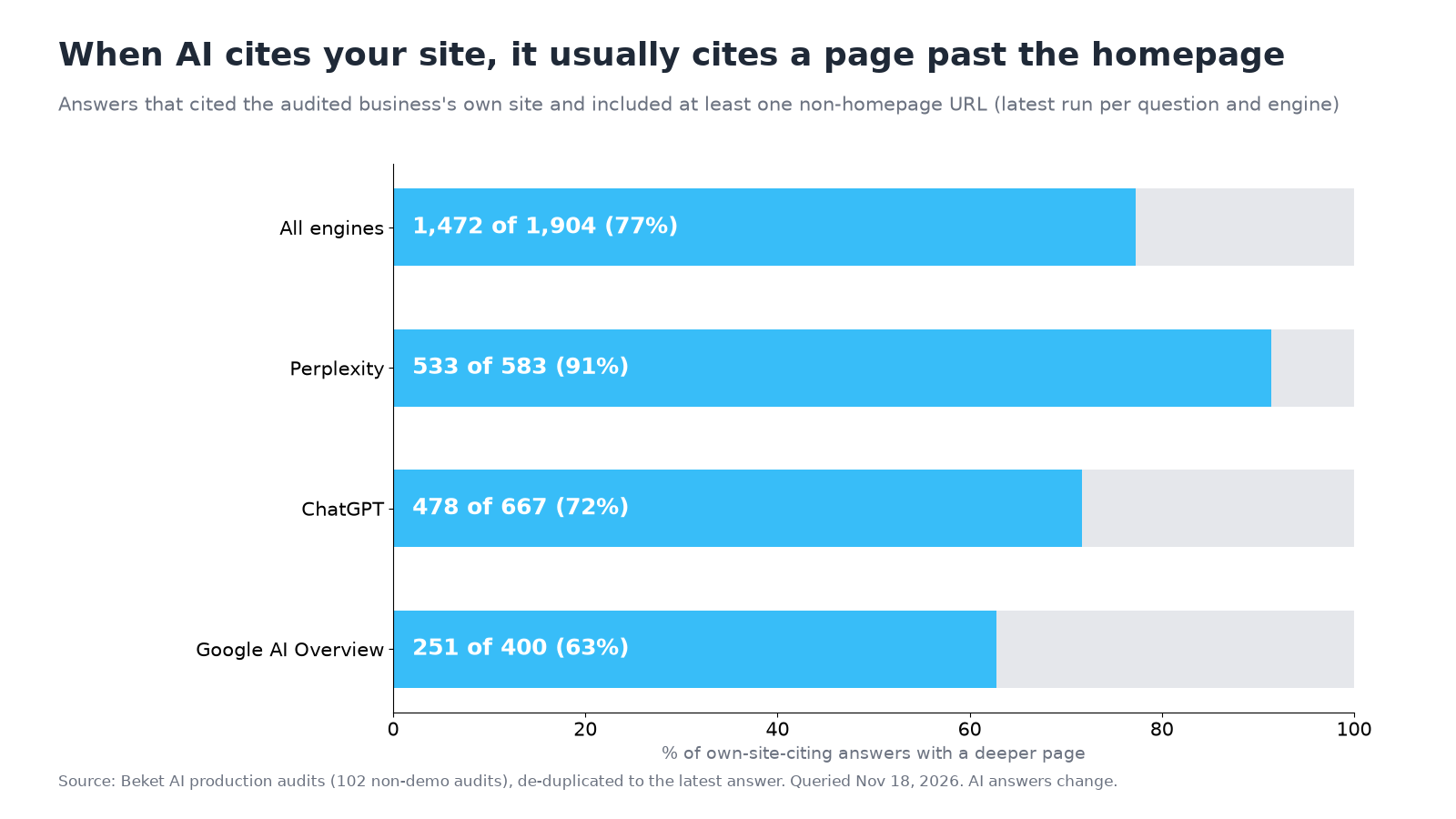
| Engine | Answers citing the business's own site | With a non-homepage page | Share |
|---|---|---|---|
| Perplexity | 583 | 533 | 91% |
| ChatGPT | 667 | 478 | 72% |
| Google AI Overview | 400 | 251 | 63% |
| All engines (incl. smaller samples) | 1,904 | 1,472 | 77% |
Other engines (Microsoft Copilot, Gemini, Google AI Mode and Claude) had too few own-site citations in this set to break out on their own, so they're only in the total.
We also sorted the cited URLs by pattern to see which kinds of pages show up. This is rough, since plenty of service pages live at URLs like /water-heaters/ that no pattern catches, so treat it as directional.
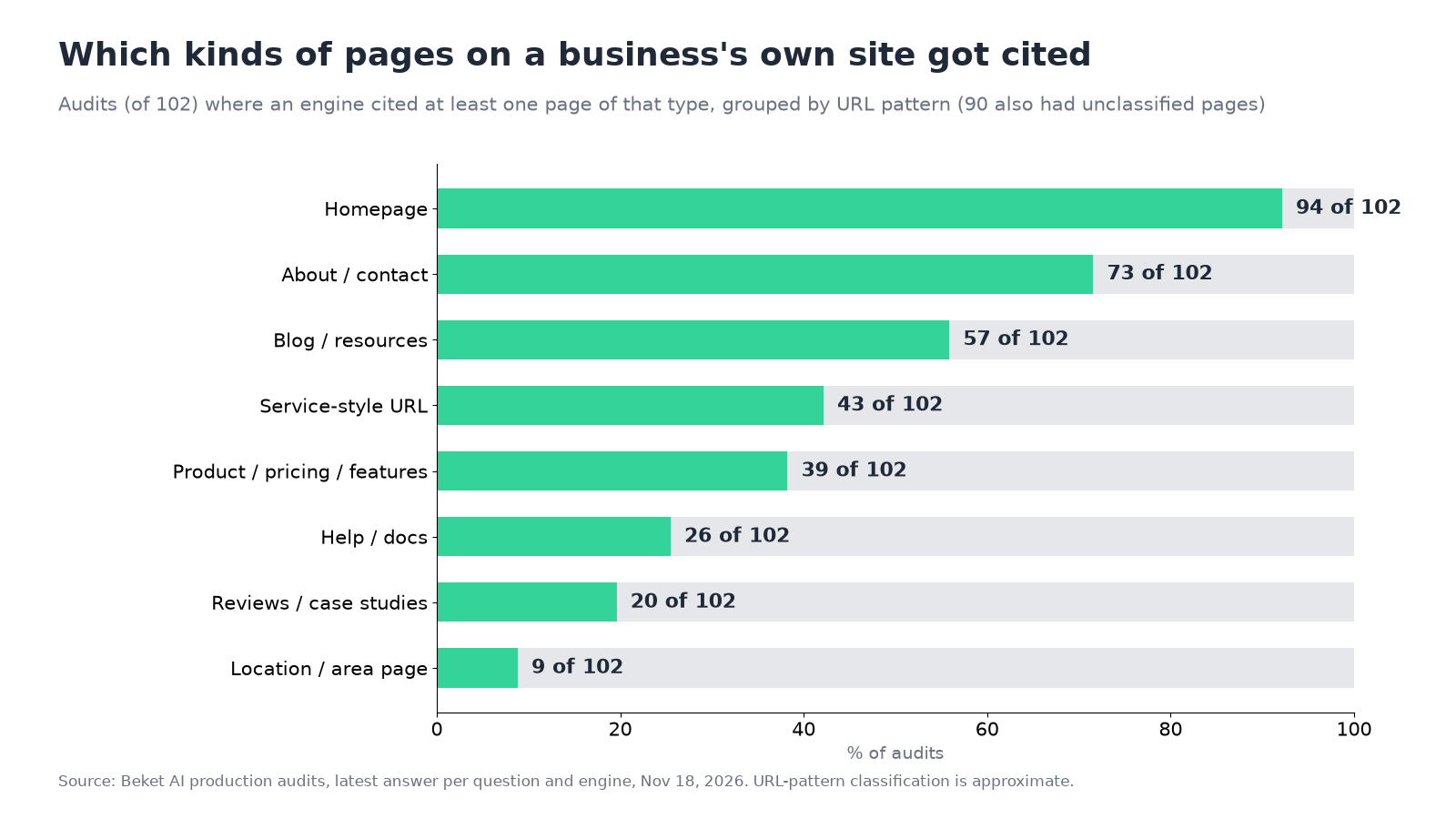
Two things stand out. Pages that explain who you are, how you work and what something costs get cited across a lot of audits. Standalone location pages rarely do (9 of 102 audits).
Outside research points the same way. In Kevin Indig's Q4 2026 AI search meta-analysis on Search Engine Land, an AirOps study of 15,000 prompts found that 85% of the 548,534 pages ChatGPT retrieved were never cited. Pages whose headings matched the query more closely had higher citation rates. The same review cites a Growth Memo and Siteline test of Claude agents across 100 B2B products: when no real price was disclosed, 45% of pricing runs cited at least one third-party source, compared with 18% when a numeric public price was available. If you leave a gap, something else fills it.
The service page template: 9 blocks
Each block answers one question a buyer (or an AI engine working for one) needs answered before choosing you. Keep them in this order and use plain HTML text, not images or tabs that need a click to load.
| # | Block | What it answers | Write it as |
|---|---|---|---|
| 1 | Answer-first intro | What is this, who is it for, where? | Two sentences, with the service, the customer, the area and how pricing works |
| 2 | Who it's for and not for | Is this right for me? | 3 to 5 bullet cases, plus one "we don't do" line |
| 3 | What's included | What do I actually get? | A list of the concrete deliverables or tasks |
| 4 | How it works | What happens after I contact you? | 3 to 6 numbered steps, with timing |
| 5 | Price | What will this cost? | A starting price, a range, or exactly what drives the quote |
| 6 | Service area and hours | Do you cover me, and when? | Named cities or neighborhoods, hours, emergency or same-day rules |
| 7 | Proof | Why trust you? | Licenses, years, a short case with real numbers, a review quote with a link |
| 8 | Common questions, answered in the copy | What else would I ask? | Short H3s phrased as buyer questions, each with a direct 2 to 3 sentence answer |
| 9 | Next step | How do I book? | One clear action: phone, booking link or quote form, with what to prepare |
A few notes on the blocks people usually get wrong:
- Block 1 carries the most weight. Google's own documentation says AI Overviews and AI Mode use "query fan-out", running several related searches to build one answer. A buyer asking "who can replace a water heater near Ballard this week" may trigger searches on price, availability and reviews. An intro that answers the core question in two sentences gives every one of those searches something to quote.
- Block 5 is the one people hesitate over. You don't need a fixed price. "From $X, most jobs land between $Y and $Z, and here's what pushes it higher" is enough. We covered why in the model is pricing your product, with or without you.
- Block 8 is not a separate widget. Write the questions as H3 headings inside the page, answered in normal paragraphs. The questions should come from real buyers. Our list of questions customers ask AI before hiring a local business is a good starting point.
Copy-and-paste template
Swap the brackets for your details. Delete any line you can't fill honestly; an empty claim is worse than a missing one.
H1: [Service] in [City/Area] | [Business name]

[Business name] [does service] for [type of customer] in [area].
[Pricing in one line: "Most jobs cost $X–$Y" / "Flat fee of $X" / "Quoted after a free [inspection/call]"].

H2: Who this is for
- [Situation 1, in the customer's words]
- [Situation 2]
- [Situation 3]
We don't [the related job you don't do]; for that, [where to go instead].

H2: What's included
- [Deliverable/task 1]
- [Deliverable/task 2]
- [Warranty or guarantee, with the exact terms]

H2: How it works
1. [First contact: how, and how fast you reply]
2. [Assessment/quote: what you check, how long it takes]
3. [The work: typical duration]
4. [Follow-up: what happens after]

H2: How much does [service] cost in [City]?
[Starting price or range]. [The 2–3 things that change the price].
[What's included in that price, and what costs extra].

H2: Where we work and when
[Named cities/neighborhoods]. [Hours]. [Same-day/emergency rules].

H2: Why [customers] choose us
- [License/certification number and issuing body]
- [Years in business / jobs completed, if you can back it up]
- [One short case: problem, what you did, result]
- "[Review quote]" — [Reviewer first name], [platform, linked]

H2: [Buyer question 1, phrased as they'd ask it]
[Direct 2–3 sentence answer.]

H2: [Buyer question 2]
[Direct 2–3 sentence answer.]

H2: Book [service]
[One action: call/book/quote]. [What to have ready].
Two filled-in examples
These are illustrative. The businesses are made up, and the prices are left as placeholders on purpose, so use your own real numbers.
Example 1: a plumber's water heater page (fictional business)
Water Heater Replacement in North Seattle | Example Plumbing Co.
Example Plumbing Co. replaces tank and tankless water heaters for homeowners and small landlords in Ballard, Fremont, Green Lake and Wallingford. Most standard tank swaps are a flat $[X] including haul-away; tankless conversions are quoted after a free 20-minute site check.
Who this is for: no hot water, a leaking tank, a heater over 10 years old, or switching to tankless. We don't service commercial boilers.
How it works: call or book online → same-day callback → on-site check and written quote → most tank installs done the same day → permit and inspection handled by us.
Proof: Washington plumbing contractor license #[number], [number] water heater installs in [year], and a linked review.
Example 2: a law firm's practice page (fictional business)
DUI Defense Lawyer in Bellevue, WA | Example Law Group
Example Law Group defends first-time and repeat DUI charges in King County district courts. We offer a free 30-minute consultation; most first-offense cases are handled on a flat fee of $[X], explained before you sign.
What's included: license hearing deadline check, case review, court appearances, and plea or trial representation.
How it works: free call → document review within [n] business days → written fee agreement → court dates handled by the same attorney.
Common question, answered in the copy: "Will I lose my license?" gets a direct, plain-language answer with the deadline that applies.
Notice what both have in common: the first two sentences could be quoted word for word as an answer, and nothing important is hidden behind a button.
Service areas without doorway pages
The fastest way to wreck this is to clone the page for 40 suburbs. Google's spam policies list "having multiple domain names or pages targeted at specific regions or cities that funnel users to one page" as doorway abuse. Our own data hints that thin location pages rarely earn AI citations anyway (9 of 102 audits).
What works better:
- Put your real service area on each service page (block 6) and on one area page that lists every city you cover.
- Build a separate city page only when you have something specific to say there: a local office, local job photos, local pricing differences or a local permit rule.
- Keep your Google Business Profile service area matching what the page says. Google's AI features guide tells site owners to keep Business Profile information up to date.
Structured data: keep it honest
Google says there's no special schema you need to add to appear in AI Overviews or AI Mode, and that structured data should match the visible text on the page. That's the rule to follow. A LocalBusiness block with your name, address, phone, hours and area served is still worth having, as long as every value also appears on the page. Our local business schema markup guide walks through which fields matter.
Pre-publish checklist
- The first two sentences name the service, the customer, the area and the pricing approach
- One service per page, with its own URL and H1
- Headings read like buyer questions ("How much does X cost in Y?")
- A starting price, range or clear quote rule is on the page
- Steps, timing and what's included are in plain text, not images
- License, warranty and review claims are specific and linked
- Service area is listed honestly, with no cloned city pages
- Schema values match what's visible on the page
- The page is linked from your homepage or main nav and indexable
- Crawlers for Google, ChatGPT search and Perplexity aren't blocked in robots.txt or by your CDN
Check whether it's working
A service page can look perfect and still not get picked. The only way to know is to ask the engines the questions your buyers ask, without your brand name in them, and see who gets named and which pages get linked. Do it by hand with five or six questions, or follow our guide to showing up in Google AI Overviews for the Google side.
If you'd rather see it across engines at once, a free Beket AI audit runs 25 prompts on any 3 of the 6 engines we track (ChatGPT, Gemini, Perplexity, Microsoft Copilot, Google AI Overviews and Google AI Mode) and shows who each engine names and which sources it cites. Pro re-checks 50 prompts on 3 engines daily from $49 a month per site, so you can see whether a rewritten service page starts showing up.
The Beket AI figures above come from our production audits as of November 18, 2026, and reflect what the engines returned in those audits. AI answers change over time.
Related posts
AI SEO for Contractors: 7 Steps From Our Plumber, Roofer and Electrician Studies (2026)
AI SEO for contractors in 7 steps, from what ChatGPT, Google AI and Perplexity named and cited in our plumber, roofer, electrician, mover and cleaner studies.
25 Persona Prompt Examples for Tracking AI Visibility (Local Services, SaaS, Ecommerce, B2B)
25 persona prompt examples for AI visibility tracking, by vertical, each with an unbranded question, what it tests and a control, plus Beket AI data.
Best AEO Tools for Ecommerce in 2026: What Each Tracks, Priced and Compared
AEO tools for ecommerce compared: who tracks ChatGPT and AI Mode shopping cards, SKUs and merchants, with published prices from Profound to Beket AI.