
Best AEO Tools for Ecommerce in 2026: What Each Tracks, Priced and Compared

Ask ChatGPT for "the best trail running shoes under $150" and you may not get a paragraph of brand names. You may get a row of product cards with photos, prices and a "buy" link that points to a retailer, not necessarily to the brand's own store. A tool that only counts whether your brand name appears in the text will miss most of what happened on that screen.
That's the main thing to know when you shop for AEO tools for ecommerce: most AI visibility tools were built to track brands in answer text, and only some of them read the shopping layer (product cards, SKUs and the merchants behind each link). This comparison covers six tools on exactly that point, using only what each vendor publishes about itself.
Why the shopping layer is worth tracking
AI shoppers are no longer a rounding error. Adobe's October 2026 retail report, based on more than 1 trillion visits to US retail sites, found that in September 2026 (Adobe):
- AI traffic to US retail sites grew 71% year over year.
- AI-referred visits converted 90% better than other traffic, up from converting 9% worse in August 2025.
- AI traffic produced 83% higher revenue per visit.
- The average US retail homepage scored only 63% on Adobe's Citation Readability Score, meaning more than a third of the content wasn't readable by AI systems.
Adobe also forecast AI traffic up 159% year over year on Thanksgiving and 95% on Black Friday. If that's where your highest-value visitors come from, you want to know which of your products these answers show, at what price, and through which store.
What to judge an ecommerce AEO tool on
Four questions separate the tools below more than engine logos or dashboard screenshots do:
- Which shopping surfaces does it read? ChatGPT's product cards, Google AI Mode's shopping units and Copilot's shopping results are different surfaces. Most tools cover one.
- Brand level or product level? "Your brand was mentioned 40 times" and "your 2-person tent appeared in 12 of 30 shopping answers, at position 2, priced at $189" are different reports.
- Does it show the merchant layer? Product cards often list several sellers. If Amazon or a reseller owns most of the links to your products, your own store loses the click even when your product wins.
- Can you see the price before the demo? Several product-level shopping reports sit on custom-priced enterprise plans.
The comparison at a glance
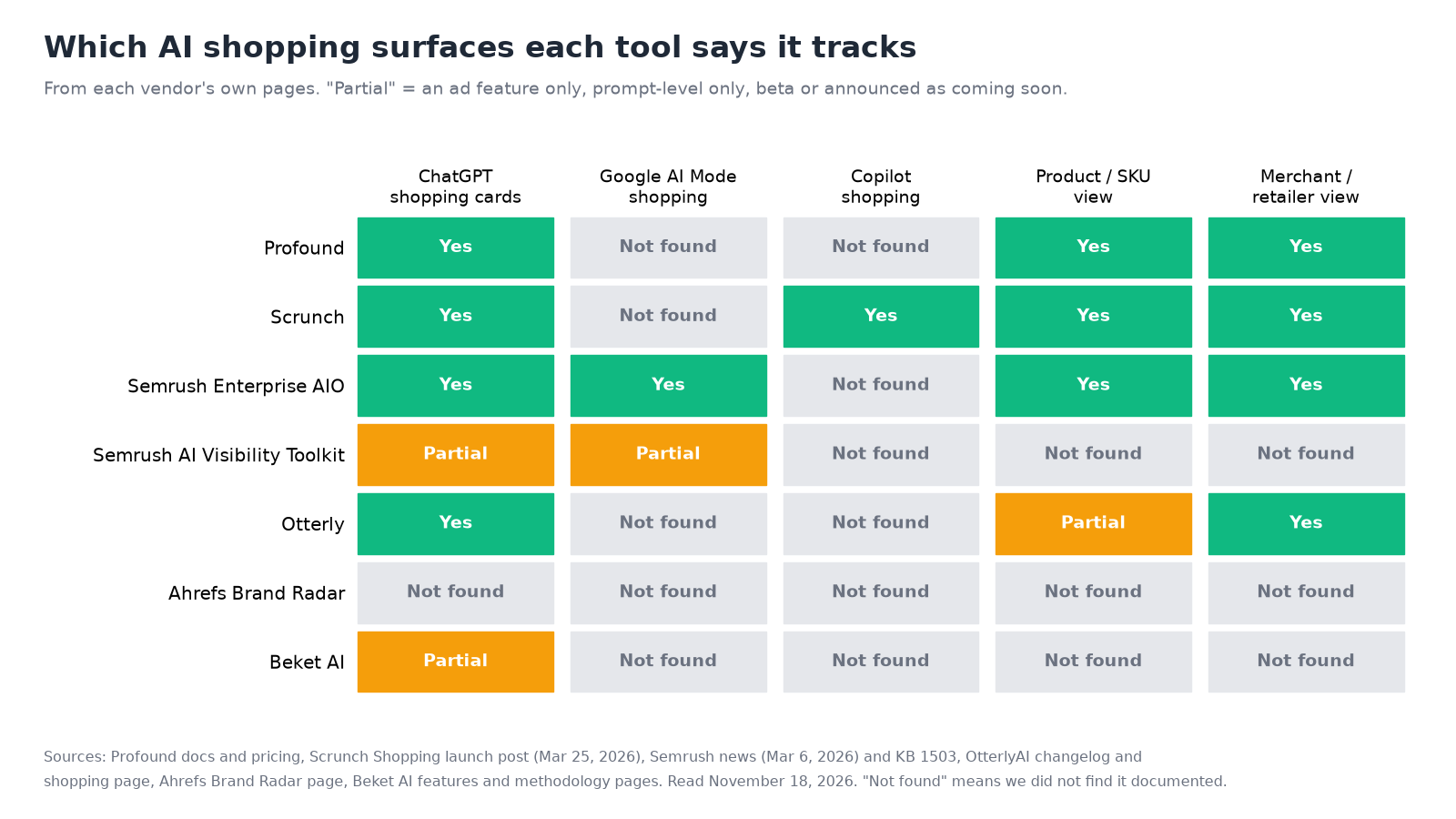
| Tool | Shopping surfaces it documents | Product / SKU view | Merchant view | Published entry price |
|---|---|---|---|---|
| Profound | ChatGPT Shopping | Yes | Yes (who owns the checkout) | Custom (Enterprise only) |
| Scrunch | ChatGPT and Copilot (Perplexity "soon") | Yes | Yes (incl. DTC vs third-party share) | $250/mo (Core) |
| Semrush Enterprise AIO | ChatGPT Shopping and Google AI Mode Shopping | Yes | Yes | No published price (demo) |
| Semrush AI Visibility Toolkit | AI Mode shopping ads as a result type; "AI-powered shopping surfaces" in general terms | Not documented | Not documented | $99/mo per domain, billed annually |
| Otterly | ChatGPT Shopping cards, on every plan | Per prompt, not per catalog | Yes (retailers named) | €29/mo (Lite, 16 prompts) |
| Ahrefs Brand Radar | None documented | No | No | $129/mo Lite (5 custom prompts); index from $199/mo |
| Beket AI (ours) | ChatGPT shopping placement check in beta | Not yet | Not yet | Free audit; Pro $49/mo per website |
All facts come from each vendor's own pages, read on November 18, 2026. We haven't run hands-on tests of the other tools, and we make Beket AI, so weigh our section accordingly.
The tools, one by one
Profound: the deepest ChatGPT Shopping view, if you're buying enterprise
Profound's Shopping feature is built for exactly this job. According to its documentation, it runs your tracked prompts through ChatGPT, checks whether each one triggers shopping mode, and captures the full response: product tiles, images, prices, merchant links and buy buttons. On top of that it reports:
- Shopping Mode Rate: how often prompts in your category trigger the shopping interface instead of a text answer.
- SKU-level analysis: which specific products appear, for which prompts, and how ChatGPT describes their attributes.
- A merchant layer: which retailers and direct stores own the checkout links for your products.
The limits are clear in Profound's own docs: Shopping Analysis "is currently focused on ChatGPT Shopping", and other surfaces such as Perplexity and Gemini are "evolving". On price, Profound's pricing page now shows only a custom Enterprise plan; the page says the Starter and Growth plans were retired in September 2026. ChatGPT Shopping is listed under that Enterprise plan.
Best for: retail and CPG brands with large catalogs and an enterprise budget that mainly care about ChatGPT.
Scrunch: product tracking across ChatGPT and Copilot, with a DTC-share metric
Scrunch launched its upgraded Shopping feature on March 25, 2026. It tracks how your products appear in AI shopping results on ChatGPT and Copilot, with Perplexity announced as coming "soon". The Shopping tab help article lists share of shelf, first-position rate, product position trends, ratings, pricing, retailer coverage and a DTC vs third-party split: how often AI shopping results link to your own site rather than a retailer.
The same launch post said product-feed ingestion was coming "soon", so check whether it has shipped before you rely on catalog-level tracking. Scrunch's pricing page lists Core at $250/mo (15,000 AI responses a month, 8 platforms, 1 brand, 5 seats) and a custom Enterprise plan. The pricing page doesn't say which plan includes Shopping, so ask before you buy.
Best for: brands that sell both direct and through retailers and want to see how much of the AI click goes to someone else's store.
Semrush: two very different products under one name
Semrush covers ecommerce at two levels, and it's easy to mix them up.
- Enterprise AIO. In a March 6, 2026 announcement, Semrush expanded the AIO AI Shopping report to cover both ChatGPT Shopping and Google AI Mode Shopping, with a merchant view and a product view (recommendation frequency, average position, prompt coverage, retailer presence and trends). That makes it the only tool in this list that documents product-level tracking on Google AI Mode's shopping results. Enterprise AIO is sold through a demo; we found no published price.
- AI Visibility Toolkit. The self-serve toolkit costs $99/mo per domain, billed annually, with 25 custom prompts tracked daily. Its Prompt Tracking documentation says shopping ads are tracked as a distinct result type when product cards appear in AI Mode, and Semrush's ecommerce page says the toolkit tracks brands and products "including in AI-powered shopping surfaces". We didn't find a documented product-level or merchant report in the toolkit itself.
Best for: teams already on Semrush. Enterprise AIO if Google AI Mode shopping matters to you; the toolkit if you mainly need brand-level tracking next to your SEO data.
Otterly: the cheapest way to see ChatGPT Shopping cards
Otterly added ChatGPT Shopping cards tracking to every brand report on June 23, 2026, according to its changelog. Its AI Shopping Analytics page describes what you get: which of your products surface for each prompt, which retailers are named beside you, and how that changes over time, market by market. Its help center notes that the related ChatGPT ads tracking is currently paused until ads are available again.
The unit is the prompt, not your catalog: you see products that show up for the prompts you write, and we didn't find a feed or catalog import on Otterly's pages. Otterly's pricing page (shown to us in euros) lists Lite at €29/mo for 16 prompts, Standard at €189/mo for 120 prompts and Premium at €489/mo for 403 prompts, each on 4 of 7 engines.
Best for: small stores that want to see ChatGPT's product cards for a handful of buying prompts without an enterprise contract.
Ahrefs Brand Radar: strong for brand research, not for product cards
Brand Radar tracks brand mentions and citations across AI Overviews, AI Mode, ChatGPT, Perplexity, Gemini and Copilot, from a pre-built index of 578 million prompts plus your own custom prompts (Claude is available for custom prompts). Every paid Ahrefs plan includes a small custom-prompt quota (Lite, at $129/mo, includes 5), and the AI Visibility Index starts at $199/mo.
Ahrefs' pages don't describe a shopping-card, SKU or merchant view. Ahrefs' CMO Tim Soulo has said so publicly: in a Medium post comparing Brand Radar with Profound, he wrote that if AI shopping visibility is critical for an ecommerce business, "Profound's Shopping features are ahead of us here."
Best for: ecommerce SEO teams already on Ahrefs that want category-level brand research, paired with a separate shopping tracker if needed.
Beket AI: brand and product prompts across six engines, shopping check in beta
Beket AI is our product, so here's what it does and doesn't do today. It runs your buyer questions (including product-level ones like "best waterproof hiking boots for wide feet") on the engines you choose from ChatGPT, Gemini, Perplexity, Microsoft Copilot, Google AI Overviews and Google AI Mode, with Claude, GPT and Grok as add-ons. It records what each answer says about you and your competitors and which sources it cites.
For shopping specifically, our features page lists a check for "Our products are missing from AI shopping" (shopping placement and shopping feed checks) as a beta that is built and waiting for its production release. Our methodology page defines the metric: of the ChatGPT answers in your market that show a shopping carousel, how many show your brand. It's a count, not a score. There's no SKU or merchant view yet, so if you need those today, Profound, Scrunch or Semrush Enterprise AIO go further.
Pricing from beket.ai/pricing: a free audit of 25 prompts on any 3 of the 6 engines, then Pro at $49/mo per website for 50 prompts on 3 engines, re-checked daily, with extra engines at $19/mo each and 25-prompt packs at $25/mo. The agency plan is $245/mo for 5 websites.
Best for: stores that want to see what all six major AI engines say about their products and category before paying for a shopping-specific platform.
Published prices, side by side
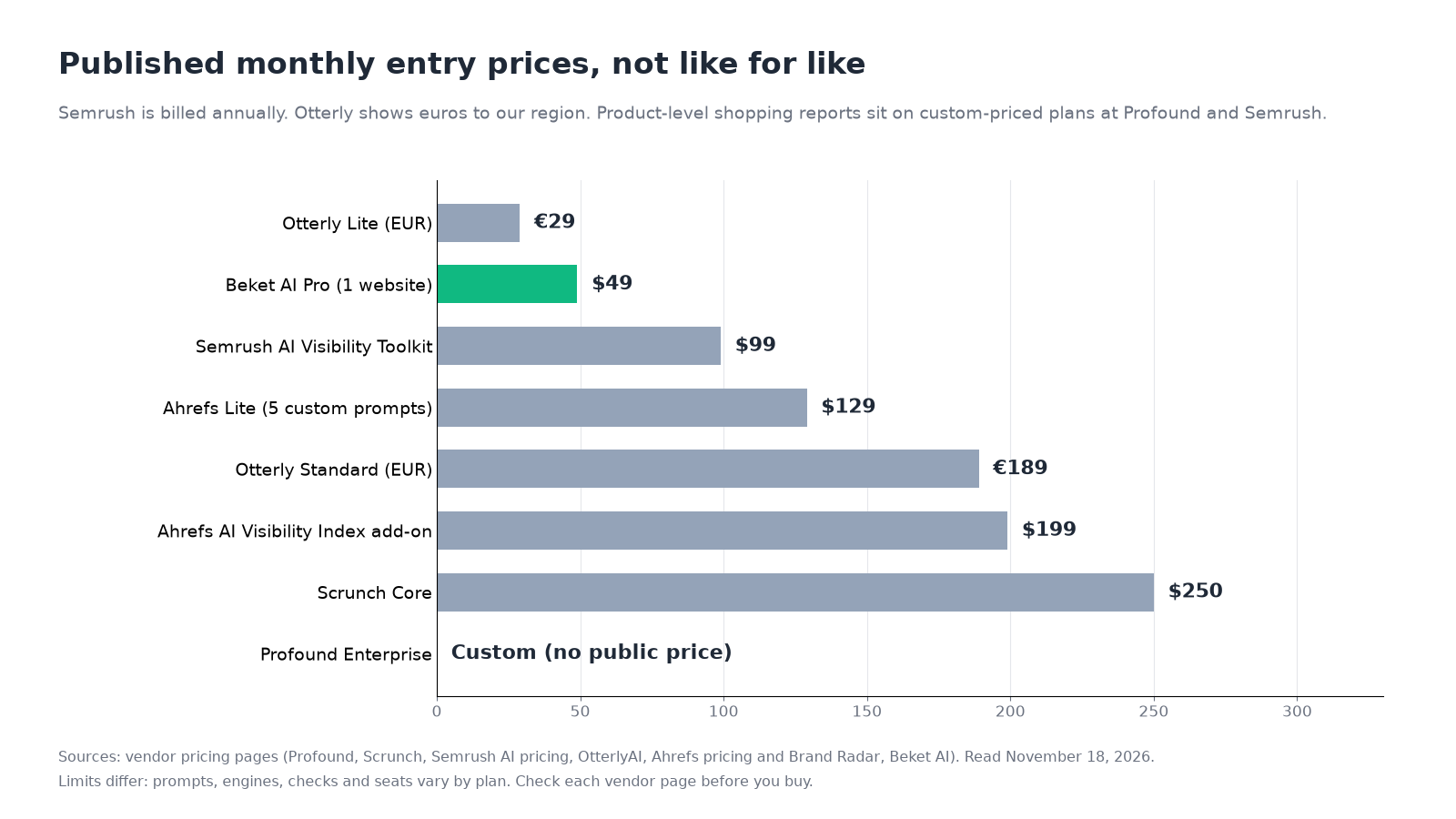
These aren't like-for-like. Prompts, engines, checks and seats differ by plan, and the two tools with the deepest product-level shopping reports (Profound and Semrush Enterprise AIO) don't publish a price.
Which one fits your store
| Your situation | Start with | Why |
|---|---|---|
| Large catalog, enterprise budget, ChatGPT is the priority | Profound | SKU-level ChatGPT Shopping data, Shopping Mode Rate and merchant layer |
| You sell through Amazon and other retailers as well as direct | Scrunch | Retailer share and DTC vs third-party split, on ChatGPT and Copilot |
| Google AI Mode shopping matters most | Semrush Enterprise AIO | The only one here documenting product-level AI Mode Shopping tracking |
| Small store, tight budget, want to see ChatGPT's product cards | Otterly | Shopping cards on every plan from €29/mo |
| Already on Ahrefs, need brand research | Ahrefs Brand Radar + a shopping tool | Strong index, no shopping layer |
| Want a cross-engine baseline before buying anything | Beket AI free audit | 25 prompts on any 3 of 6 engines, no card |
What none of these tools does for you
A tracker tells you where you're missing. The fixes still live in your store: a complete product feed, product pages that crawlers can read, real reviews and specs in plain text, and coverage in the roundups engines cite. If you're starting there, read how ChatGPT shopping picks products and our guide to submitting a product feed to ChatGPT.
It also helps to remember that shopping answers move fast. In our Black Friday shopping study, ChatGPT, Perplexity and Google AI Overview named Best Buy far more often than Amazon for the same 25 shopping questions, which is not the answer most store owners would have guessed. Any of these tools is only as useful as the prompt set you give it. Write prompts the way your buyers shop ("best X under $Y for Z"), not the way your product catalog is organized.
For a broader look at AI visibility tools beyond ecommerce, see our comparison of the best GEO tools.
How we put this together
We read each vendor's pricing, feature, documentation and changelog pages on November 18, 2026, and used only claims those pages make about their own product, plus one public statement from Ahrefs' CMO about Ahrefs. "Not documented" or "not found" means we didn't find it on the vendor's pages, not that the feature can't exist. Vendors ship quickly in this category, so check each page before you buy. Beket AI is our own product.
If you want to see what ChatGPT, Gemini, Perplexity, Copilot, AI Overviews and AI Mode say about your products today, run a free Beket AI audit.
Related posts
Does AI Recommend Different Apps to a Founder, a CFO and a Parent? 2026 Study
We asked ChatGPT, Perplexity and AI Overview 8 budgeting-app questions as a founder, a CFO and a parent on Nov 17, 2026. The first app changed.
Best SEO Conferences 2026–27: Dates, Prices, AI Sessions
Remaining 2026 SEO conferences and 2027 dates (SMX Munich, brightonSEO, SMX Advanced) with official prices, venues, AI search sessions and networking tips.
GEO for SaaS: How to Get Your Software Recommended by ChatGPT and AI Overviews
A 7-step GEO for SaaS guide: build a buyer prompt set, baseline each AI engine, make product and pricing pages quotable, get into the roundups engines cite, and track share over time.