
How Does ChatGPT Shopping Work? How It Picks Products, Explained for Merchants

When someone asks ChatGPT for "the best carry-on under $200" or "a gift for a runner," the answer often comes back as a row of product cards with images, prices, review summaries and a list of stores. Merchants keep asking the same thing: where do those products come from, and why did ChatGPT pick these ones?
OpenAI has published more about this than most people realize. It doesn't publish ranking weights, but its help center, merchant page and developer docs do say which inputs it uses, how it chooses the store for a product, and which labels it writes itself. This explainer pulls those pages together as of November 17, 2026, and adds what changed this year: shopping research was folded away, and Instant Checkout was scaled back.
How does ChatGPT shopping work, in short?
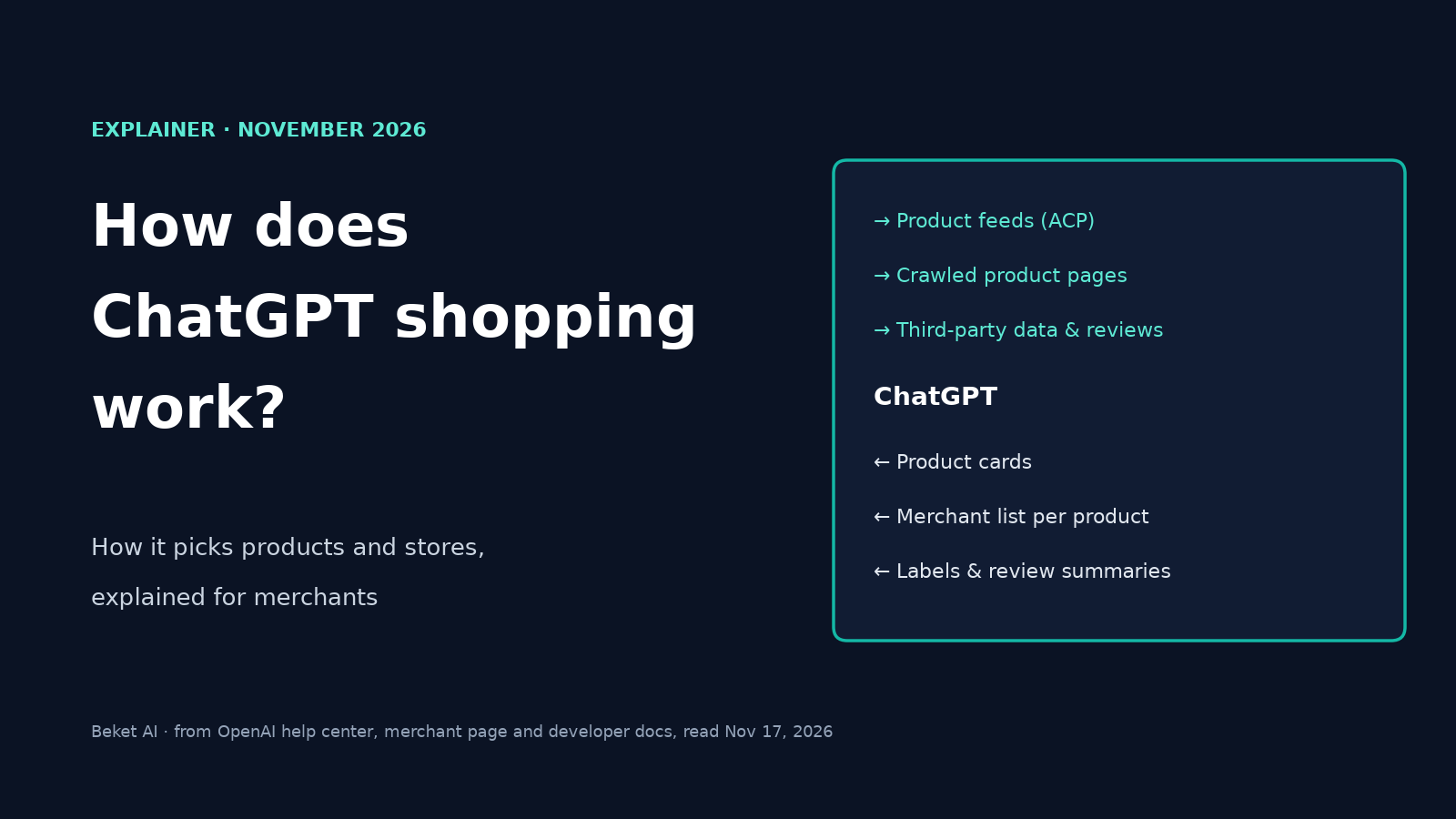
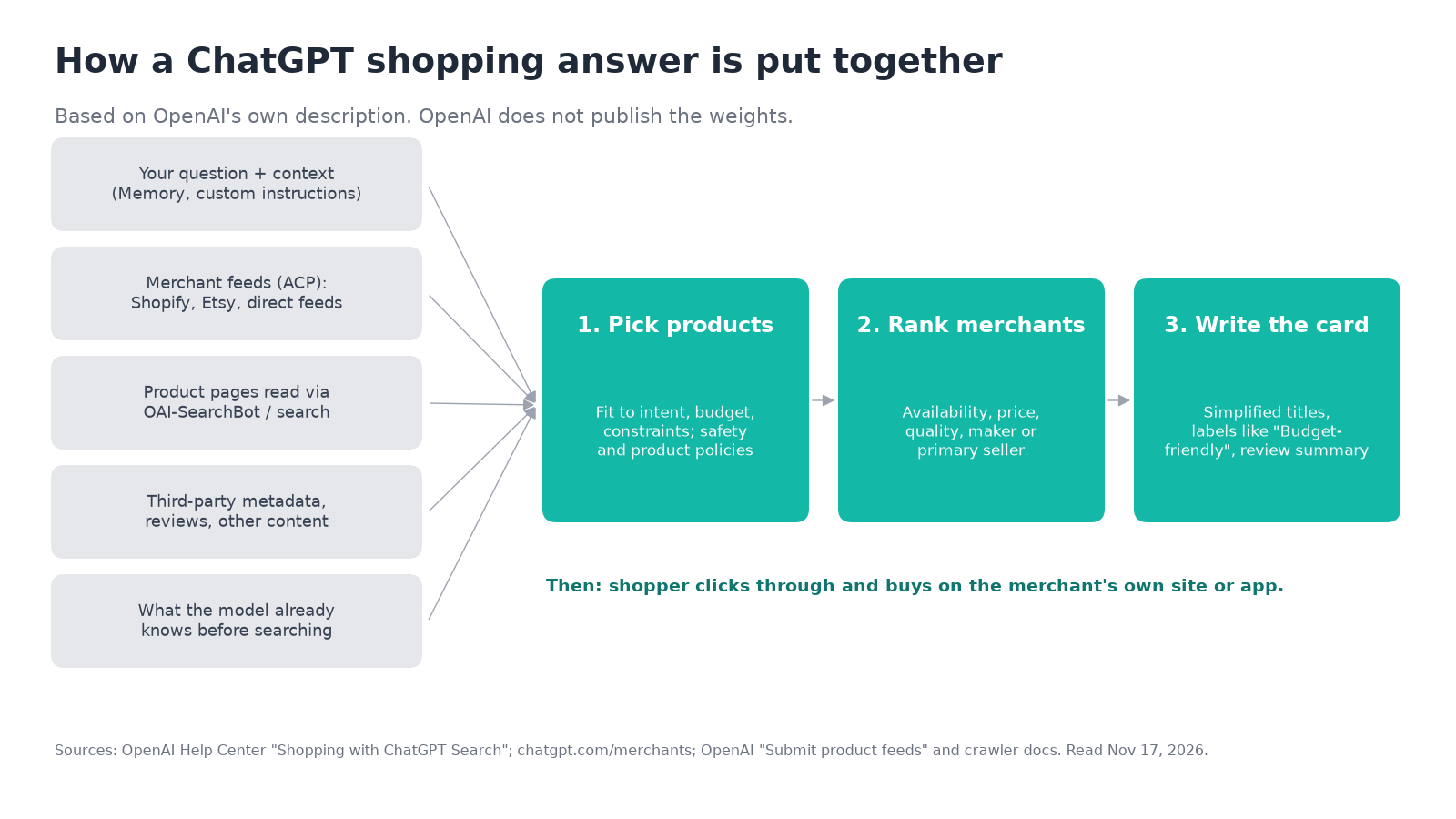
ChatGPT shows products when it decides your question has shopping intent. It doesn't keep a separate product search engine you can rank in. It reads your request (plus Memory or custom instructions, if you use them) and pulls product data from three places: feeds that merchants share with OpenAI, product pages its crawler can read, and data and reviews from third-party providers. It then picks products that fit your stated needs. For each product, it ranks the stores that sell it by availability, price, quality and whether the store is the maker or primary seller (OpenAI Help Center).
OpenAI says these product results are organic. They "are not ads," and ads in ChatGPT are a separate unit. When a shopper decides to buy, they finish on the merchant's own site or app (ChatGPT merchants page).
Where ChatGPT gets product data
| Input | What it is | How a store gets into it |
|---|---|---|
| Merchant product feeds | Structured catalog data (titles, prices, availability, images, variants) shared with OpenAI through the Agentic Commerce Protocol (ACP) | Shopify and Etsy catalogs are already integrated. Other merchants apply on the merchants page or upload in Business Hub after identity verification |
| Public product pages | Pages crawled by OAI-SearchBot and read when ChatGPT searches | Allow OAI-SearchBot in robots.txt and its published IP ranges |
| Third-party providers and content | Structured metadata from other providers, plus reviews and other content on public sites | Indirect: your product has to be covered and reviewed elsewhere |
Sources: Submit product feeds, ChatGPT merchants page, OpenAI crawlers, Shopping with ChatGPT Search.
A few details from those pages matter more than they look:
- A feed is optional, but it gives you control. The merchants page asks, "Do I need a product feed if ChatGPT already crawls my site?" and answers: "No, but feeds give you greater control over how your products appear, helping ensure more accurate and up-to-date information."
- The feed is for discovery, not the sale. OpenAI's developer guide says the feed "does not update a cart or confirm a purchase. Your live website or plugin still checks the current offer when a customer acts."
- Blocking OAI-SearchBot removes you from answers. OpenAI says sites opted out of OAI-SearchBot "will not be shown in ChatGPT search answers, though can still appear as navigational links."
- It's US-only for now. "Shopping is currently live for ChatGPT users in the U.S.," with more regions planned, according to the merchants page.
We cover the feed fields and common rejections in our guide to submitting a ChatGPT product feed, and the crawl side in how ChatGPT search works.
How ChatGPT picks which products to show
OpenAI's help article lists three things ChatGPT weighs when it decides which products to surface:
- Structured metadata from first-party and third-party providers, such as price and product description, "and other third-party content."
- Model responses generated by ChatGPT before it considers any new search results. In other words, what the model already "knows" about a category and its brands shapes the shortlist before fresh results come in.
- OpenAI safety standards and product policies.
The weighting changes with the question. OpenAI's example: if you give a $30 budget, ChatGPT "will focus more on price," and if you don't mention price, it may focus on other things. For a goofy dog costume, it says it may look at "available options, price, reviews, and ease of use." It also warns that "not all available products will necessarily be shown."
For merchants, the second point is easy to miss. A product that is already well covered on the web (in reviews, comparisons and "best of" lists) has a head start before ChatGPT even searches. That's why the advice for getting a brand cited by ChatGPT carries over to products. Clean data gets you in the pool. Being talked about gets you on the shortlist.
How ChatGPT chooses which store to send you to
Picking the product and picking the store are separate steps. When a shopper opens a product, ChatGPT may show a list of merchants selling it. OpenAI says that list is built from "merchant and product metadata from third-party providers or directly from the merchants themselves." Merchants are ranked on:
- availability
- price
- quality
- whether they are "the maker or primary seller of that item"
OpenAI adds that it expects this to change, "such as by personalizing merchant rankings even more to user preferences" (OpenAI Help Center).
Two pricing details explain a lot of merchant complaints:
- The first price isn't always the lowest. The price in ChatGPT's first response "typically reflect[s] the price from the first merchant listed, which may not be the lowest available price." The product detail view tries to highlight the cheapest option it knows about, which may get a "Best price" label.
- Updates lag. When merchants change prices or shipping terms, "there may be some delay" before ChatGPT shows them. A feed with accurate availability and prices is the main lever OpenAI documents for closing that gap.
If you're a brand that also sells through retailers, the "maker or primary seller" factor works in your favor. That only helps, though, if your own product pages and feed are complete enough for ChatGPT to recognize you as the source.
The labels and summaries are written by ChatGPT
Much of what a shopper reads on a product card isn't your copy:
- Titles and descriptions may be simplified versions ChatGPT generates "since merchants often use varying titles and descriptions for the same product."
- Labels like "Budget-friendly" or "Most popular" are generated by ChatGPT. OpenAI says they are "not guarantees or verified statements." For example, "Budget-friendly" might mean reviewers often mention value, not that the product is the cheapest.
- Review summaries are model-generated from reviews on public websites, and "reviews and ratings are not verified by OpenAI."
You can't edit those labels directly. You can shape the material behind them: specific, consistent product titles across your site, your feed and your retailers, and real reviews that mention the attributes you want to be known for.
What happened to shopping research and Instant Checkout
The keyword data shows people searching for whether ChatGPT shopping research was removed. Here is the record as of November 17, 2026:
| Date | Change | Source |
|---|---|---|
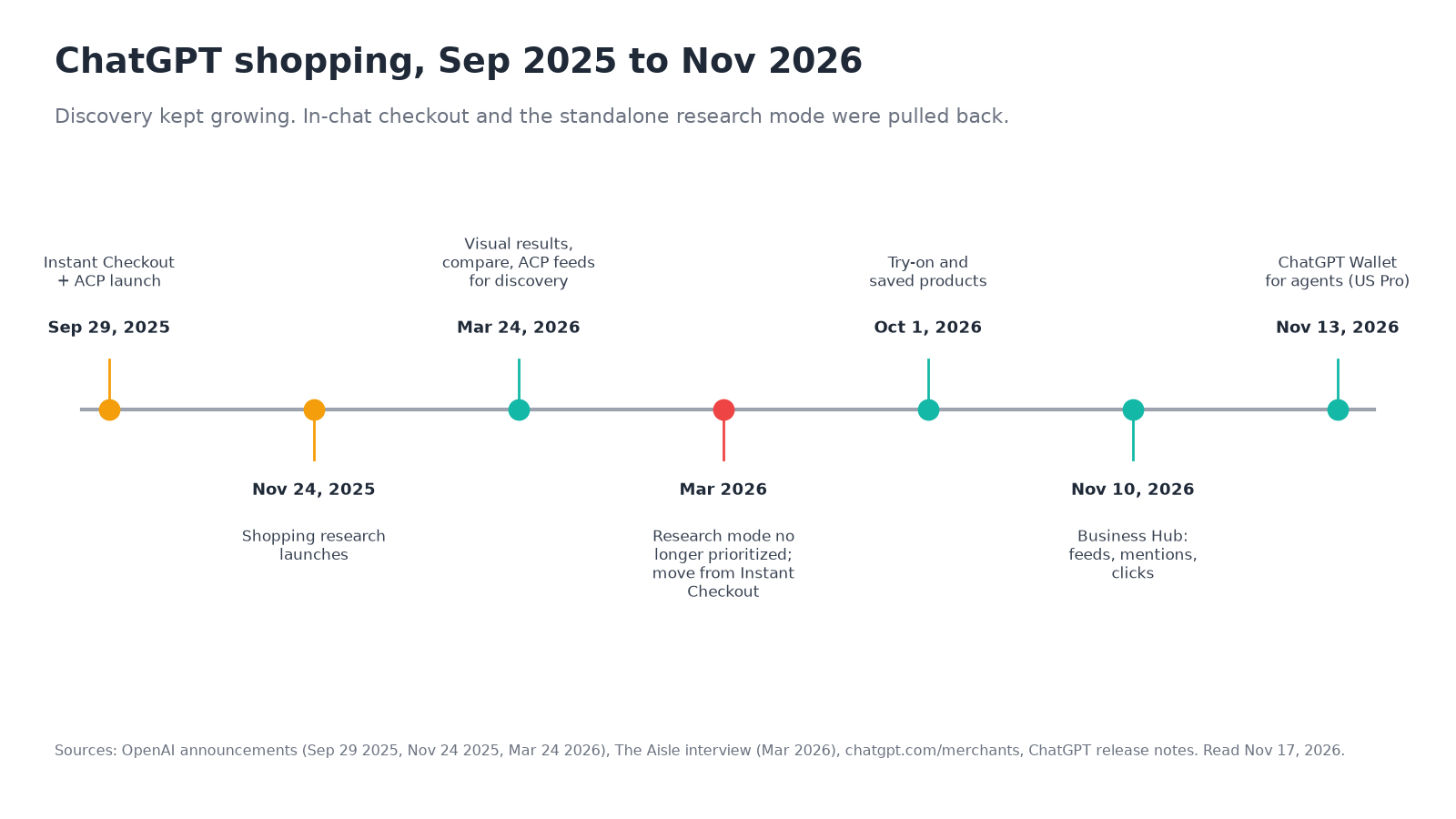
| Sep 29, 2025 | Instant Checkout launches with ACP: buy from US Etsy sellers inside chat, merchants pay a fee on completed purchases | OpenAI |
| Nov 24, 2025 | Shopping research launches: a GPT-5 mini variant asks clarifying questions and builds a buyer's guide "in minutes" | OpenAI |
| Mar 24, 2026 | Richer visual product results, side-by-side comparison and image search. ACP expanded to cover product discovery feeds | OpenAI, CNBC |
| Mar 2026 | OpenAI's commerce product lead says shopping research is no longer prioritized as a standalone feature: "most users aren't willing to wait more than a couple of seconds" | The Aisle |
| Oct 1, 2026 | Virtual try-on for clothing and saving products to Library | ChatGPT release notes |
| Nov 10, 2026 | Business Hub: claim your business, connect a product feed, see mentions and website clicks | ChatGPT release notes |
| Nov 13, 2026 | ChatGPT Wallet: agents (dots) can pay on a merchant's own checkout for US Pro users | ChatGPT release notes |
On Instant Checkout, the merchants page is now direct: "We're moving away from a standalone Instant Checkout experience in ChatGPT and prioritizing better shopping discovery and merchant-owned checkout experiences." It also says there are "no fees on purchases that start in ChatGPT."
On shopping research, OpenAI hasn't published a removal notice that we could find. The current shopping help article doesn't mention the feature. The fair reading is that its job (comparing, refining and narrowing options) moved into ordinary ChatGPT answers. For the checkout side, including how Wallet and agent payments work, see our explainer on agentic commerce, ACP vs UCP.
For merchants, the takeaway is that the discovery layer kept growing while the in-chat checkout bets got pulled back. The product list is where the competition happens.
What merchants can actually control
Here's how each documented signal maps to something you can do:
| What OpenAI says it uses | What you can do |
|---|---|
| Merchant feeds (via ACP) | Shopify and Etsy stores are already in. Others can apply on the merchants page or connect a feed in Business Hub |
| Crawlable product pages | Allow OAI-SearchBot, keep price, stock and key specs in the HTML text, and return clean 200s |
| Price and availability for merchant ranking | Keep feed and page prices in sync. Stale prices are the documented cause of mismatches |
| "Maker or primary seller" | Use the same product names and identifiers (such as GTINs) on your site, feed and retailer listings |
| Reviews from public websites | Earn reviews on your site and on third-party sites that describe real use cases |
| What the model knows before searching | Get covered in reviews, comparisons and roundups for your category |
None of these guarantee a spot. OpenAI says plainly that not every relevant product is shown, and it doesn't publish the weights.
How to check whether ChatGPT recommends your products
Because ChatGPT tailors answers to the question and, for signed-in users, to memory, one manual chat tells you little. A better check:
- Write 10 to 25 unbranded shopping questions a real buyer would ask, with budgets and constraints ("waterproof hiking boots for wide feet under $150").
- Run them in a fresh, logged-out or memory-off session, and note which brands, products and stores appear.
- Repeat over a few weeks, because results shift as feeds, prices and coverage change.
Beket AI runs this kind of check for you. A free audit sends 25 prompts to any 3 of the 6 engines we track (ChatGPT, Gemini, Perplexity, Microsoft Copilot, Google AI Overviews and Google AI Mode). It shows whether your brand is named, which sources get cited, and how that compares with competitors. For a sense of how these answers behave during peak season, see our AI Black Friday shopping study.
Caveats
- This explainer is based on OpenAI's public pages, read on November 17, 2026. OpenAI changes shopping features often, and some pages were updated days before we read them.
- OpenAI documents the inputs and merchant-ranking factors but not their weights. Anyone claiming a precise formula is guessing.
- Shopping is US-only per OpenAI. Results elsewhere may differ or not show product cards at all.
- Answers vary by user, memory, location and wording. Test with many prompts, not one.
Related posts
How to Let Google-Agent Into Your Store Without Letting Scrapers In (2026 Checklist)
Google's new guide shows how to let its AI agent through your CDN and firewall. A checklist built on Google's checks, with Cloudflare steps, before Black Friday.
Is Your Business Ready for Gemini Tasks? What the Agent Checks Before It Calls or Buys
Google made Gemini Tasks free on Nov 17, and it can call US businesses. See what Google documents, how to opt out, and a checklist to finish before Black Friday.
SE Ranking vs Surfer SEO: An AI Visibility Review Roundup (2026)
SE Ranking reviews vs Surfer SEO reviews for AI visibility: which engines each tracks, price per prompt, and what independent testers found when they checked the numbers.