
GEO for SaaS: How to Get Your Software Recommended by ChatGPT and AI Overviews

A B2B buyer who needs a help desk tool used to type "best help desk software" into Google, open six tabs and build a spreadsheet. Now a growing share of them ask ChatGPT for a shortlist and only open tabs for the three names it gives back. If your product isn't in that answer, you never get the visit to lose.
That's what GEO for SaaS (generative engine optimization) is about: making sure ChatGPT, Google AI Overviews, AI Mode, Perplexity, Gemini and Copilot can find, understand and recommend your software when buyers ask category questions. This guide walks through seven steps, using public research and the SaaS tools study Beket AI ran on November 9, 2026.
Why SaaS needs its own GEO playbook
Software buying went to chat faster than most categories. G2 has surveyed B2B software buyers twice this year:
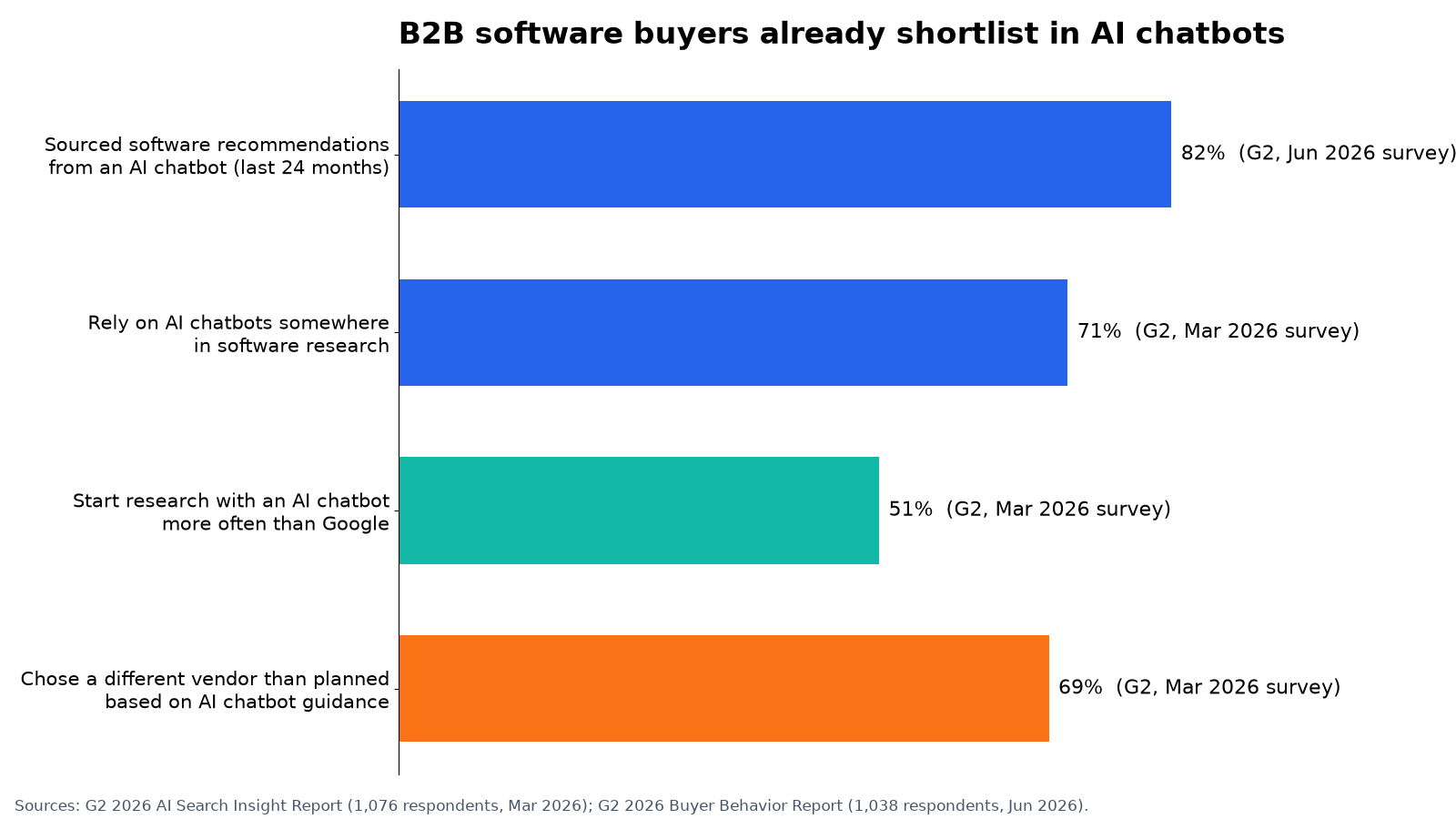
- In a March 2026 survey of 1,076 B2B decision-makers, 51% said they start software research with an AI chatbot more often than with Google, up from 29% in April 2025. 71% rely on AI chatbots somewhere in their research, and 69% chose a different vendor than they first planned because of chatbot guidance (G2 AI Search Insight Report, press release).
- In a June 2026 survey of 1,038 decision-makers, 82% had sourced software recommendations from an AI chatbot in the previous 24 months. Review sites (38%) narrowly passed AI chatbots (37%) as the top source shaping the shortlist (G2 Buyer Behavior Report, press release).
Google's own results are moving the same way. Semrush tracked 400 commercial keywords across banking, software and ecommerce and found AI Overviews on 88% of them in August 2026, up from 45.75% in September 2025. Every decision-stage modifier it tracked ("alternatives", "reviews", "pricing", comparisons and so on) triggered an AI Overview between 82% and 96% of the time (Semrush). Those are the exact searches where a SaaS shortlist gets made.
Two things make SaaS different from local businesses or ecommerce:
- There's no single listing to claim. A plumber has a Google Business Profile and a store has a product feed. A SaaS company has its own site, docs, pricing page, review profiles and whatever third-party roundups exist. The AI assembles its answer from all of it.
- The engines disagree on sources. In a study of 230 AI answers to B2B software buying questions collected on November 7, 2026, two engines named the same brands about 41% of the time but cited the same domains only about 6% of the time (Okara). "Rank in AI" is really six separate goals.
Step 1: Build a buyer prompt set, not a keyword list
Start with the questions a buyer would actually type when they don't know your name yet. Group them by the decisions that make up a SaaS shortlist:
| Prompt type | Example | What it tests |
|---|---|---|
| Category | best help desk software for a small support team | Whether you're in the default shortlist |
| Team size or stage | best CRM for a 10-person sales team | Whether you're matched to your ideal customer size |
| Use case | which project management tool for software development teams | Whether your use-case positioning lands |
| Industry | best accounting software for freelancers | Vertical fit |
| Alternatives | alternatives to [market leader] for startups | Whether you're seen as a challenger |
| Price | best affordable email marketing tool for growing brands | Whether your pricing is understood |
| Persona | I'm a CFO. Which accounting tool should we use? | Whether role context changes the answer |
Five of these examples come straight from the 25 questions in our SaaS tools study. Keep every prompt unbranded. Branded prompts ("is [your tool] good?") test recall, not discovery.
Don't skip the persona row. A study of 17,929 AI responses in the funnel-builder category (March 18 to May 10, 2026) found that a one-line role prefix such as "I'm CTO at a company" moved some brands' visibility by up to 24 percentage points. Google AI Overviews was the most persona-sensitive platform, with average per-persona shifts about four times larger than ChatGPT's (Radyant). Our guide to persona prompts for AI visibility shows how to write these variants.
Step 2: Baseline each engine separately, and more than once
Run the prompt set on every engine your buyers use and record three things per answer: whether you're named, whether your domain is cited, and who else shows up.
Run it more than once. In the same Okara study, asking ChatGPT the same question twice on the same day returned answers that shared 62% of their brands and only 41% of their cited sources. One screenshot of ChatGPT recommending you (or ignoring you) tells you little. Repeated runs tell you your share. For why answers also vary between users, see are ChatGPT answers the same for everyone?
Expect gaps, too. In our November 9 study, ChatGPT and Perplexity answered all 25 prompts, but Google AI Overview appeared for only 18 of 25. Perplexity produced 377 citation events against ChatGPT's 191. A missing AI Overview isn't a zero for you. It means no overview was shown for that query in that run.
A free Beket AI audit runs 25 prompts on any 3 of the 6 tracked engines (ChatGPT, Gemini, Perplexity, Microsoft Copilot, Google AI Overviews and Google AI Mode). Pro plans re-run your prompts daily, starting at $49 a month per site.
Step 3: Make your product and pricing pages quotable
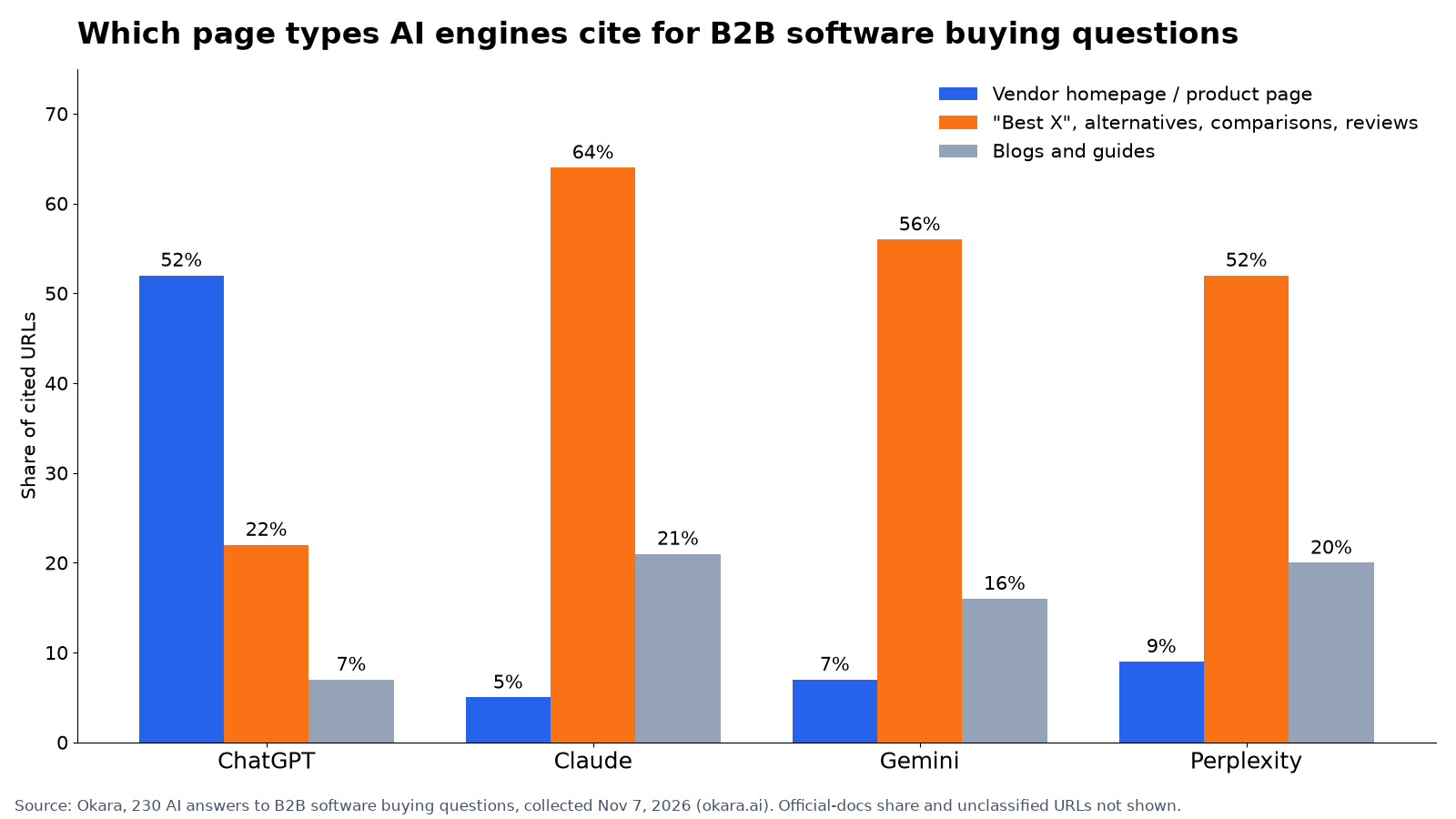
ChatGPT leans on vendor pages much more than the other engines do. In the Okara data, 52% of ChatGPT's cited URLs were vendor homepages or product pages, compared with 5% to 9% for Claude, Gemini and Perplexity.
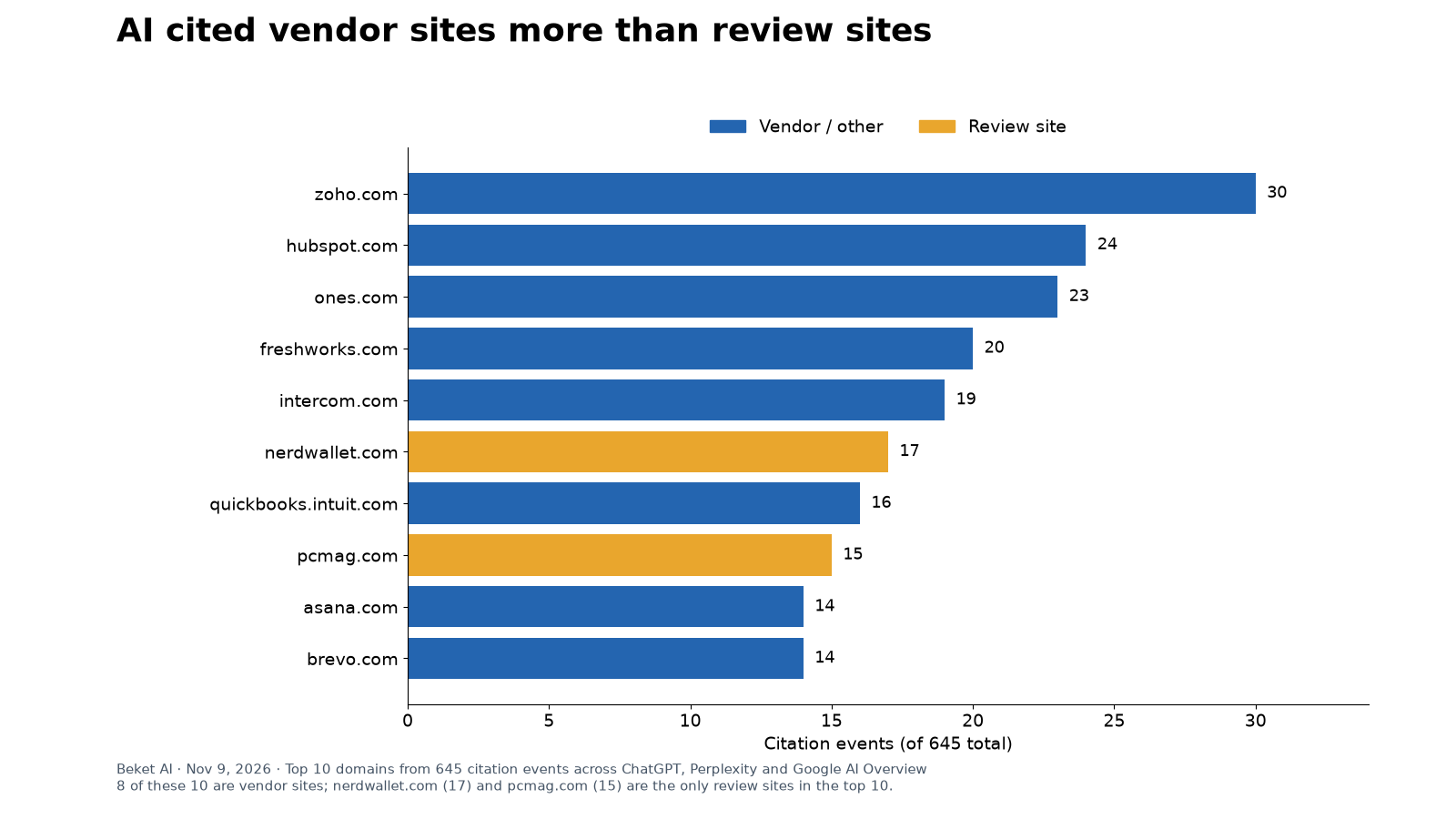
Our own study pointed the same way. Of the top 10 domains cited across 645 citation events, eight were vendor sites (zoho.com led with 30) and only two were review sites (nerdwallet.com 17, pcmag.com 15).
So your own pages have to answer the questions an AI is trying to answer, in plain text it can lift:
- Who it's for. "Help desk software for support teams of 5 to 50" beats "the future of customer experience."
- What it costs. Publish real prices, tiers and limits in HTML text, not only inside an image or a "contact sales" button. If pricing is custom, say what it depends on.
- What it integrates with. List the integrations by name.
- How it compares. Honest comparison pages ("[your tool] vs [leader]: when to pick which") give the engines a ready-made answer for alternatives prompts.
- What it doesn't do. Clear limits make the rest of your claims more believable, and they stop the AI recommending you for the wrong job.
Our SaaS FAQ page guide has a template for turning sales-call questions into direct, quotable answers.
Step 4: Get into the roundups the other engines cite
For Claude, Gemini and Perplexity, the Okara study found that "best X" lists, alternatives pages, comparisons and reviews made up 52% to 64% of cited URLs. Publishing more on your own blog won't fix a gap there. You need to be in the articles they already trust.
How to find them:
- Take the prompts from Step 1 where a competitor is named and you aren't.
- Open the sources cited in those answers. Note every third-party roundup, comparison or review page.
- Sort them by how often they come up across prompts and engines.
- Work the list: pitch the editor with something new (original data, a fair trial account, real pricing), correct outdated facts about you, or ask to be considered in the next update.
Review profiles matter beyond their direct citations. G2's March survey found review-site citations are the top signal that makes buyers trust an AI chatbot's recommendation, and in June review sites edged out chatbots as the top shortlist influence. Keep your profiles current, with the same pricing and positioning as your site.
Step 5: Write use-case and persona pages
If your homepage speaks to everyone, the engines have nothing to match when a buyer adds context like "for a 20-person agency" or "I'm the CFO."
The Radyant study's interpretation was that brands with generic positioning lost visibility when buyers stated their role, while brands with role-specific content and vocabulary gained. The authors present this as a hypothesis consistent with their data, not a confirmed mechanism, but it lines up with how answer engines match intent.
Practical moves:
- One page per core use case, written in the words that buyer uses ("ticket routing for SaaS support teams", not "omnichannel CX").
- Role pages that answer the questions each persona asks: security and SSO for the CTO, total cost and contract terms for the CFO, onboarding time for the team lead.
- Industry pages only where you have real customers and specifics to show. Thin pages that just swap the industry name in help nobody.
Step 6: Keep facts current and crawlable
AI engines often search the web before answering, and ChatGPT's background searches often include the current year. The Okara study found that 76% of ChatGPT's captured background searches (152 of 201) included the year "2026". That's not a reason to change the year in your titles. It's a reason to keep pricing, feature comparisons and "best of" content up to date, and to say when it was last updated.
Two technical checks:
- Don't block the search crawlers you want to be cited by. Check robots.txt and any bot rules at your CDN for the AI search crawlers, such as OpenAI's OAI-SearchBot. Training crawlers are a separate decision.
- Put key facts in the HTML. Pricing tables rendered only by client-side JavaScript, or hidden behind a login, may not be visible to every crawler.
Step 7: Track share over time, not single wins
GEO for SaaS is ongoing, because answers churn. Re-run the same prompt set on a schedule and report:
- Share of answers you're named in, per engine
- Share of citations that point to your domain
- Which competitors appear when you don't
- Which third-party pages keep showing up as sources
Keep "named" and "cited" apart. In our SaaS study, zoho.com was both the most-named suite and the most-cited domain, but ones.com and intercom.com were in the top five cited domains without appearing on the market report's mention leaderboard. Being linked and being recommended are different wins.
The GEO for SaaS checklist
- 20 to 50 unbranded buyer prompts covering category, team size, use case, industry, alternatives, price and persona
- Baseline on each engine your buyers use, run more than once
- Named, cited and competitors recorded for every answer
- Product pages say who it's for, in plain words
- Real prices and limits in HTML text
- Integrations listed by name
- Honest comparison and alternatives pages
- List of third-party roundups cited in answers you lose, with an outreach plan
- Review profiles current and consistent with your site
- Use-case and role pages for your core buyers
- "Last updated" dates on pricing and comparison content
- AI search crawlers allowed in robots.txt and CDN rules
- Monthly (or daily) re-runs with share of answers and share of citations per engine
Where to start this week
If you only do one thing, write down 25 questions your best customers asked before they bought, run them on three engines, and open the sources behind every answer that named a competitor instead of you. That list tells you which pages to fix and which roundups to get into.
You can do that by hand in an afternoon, or run a free Beket AI audit to get the answers, mentions and citations for 25 prompts on 3 engines in one report.
The third-party figures above come from the sources linked, each with its own sample and method. AI answers change over time, so treat any single study, including ours, as a snapshot.
Related posts
Which Seattle Plumbers Does AI Name for Booking? 2026 Study
We asked Gemini, Google AI Mode and AI Overview 10 booking questions about Seattle plumbers on Nov 17, 2026. 2 Sons Plumbing & Sewer led with 10 of 44 mentions.
Does AI Recommend Different Apps to a Founder, a CFO and a Parent? 2026 Study
We asked ChatGPT, Perplexity and AI Overview 8 budgeting-app questions as a founder, a CFO and a parent on Nov 17, 2026. The first app changed.
Are ChatGPT Answers the Same for Everyone? How Persona, Memory and Location Change Recommendations
No. ChatGPT answers change with chance, who's asking, Memory and location, and Google AI Mode personalizes too. What each layer does and how to test your brand cleanly.