
Are ChatGPT Answers the Same for Everyone? How Persona, Memory and Location Change Recommendations

Ask a friend to type the exact question you just asked ChatGPT, and there is a good chance their answer will name different brands than yours. It isn't a glitch, and it isn't one cause. At least five separate things sit between a question and the answer someone sees, and three of them are about the person asking.
That matters if you run a business. When an owner says "ChatGPT recommends us, I checked," the honest follow-up is: recommends you to whom? This explainer walks through what OpenAI and Google document about personalization, what independent research measured, and how to test your brand's AI visibility without your own account skewing the result.
The short answer
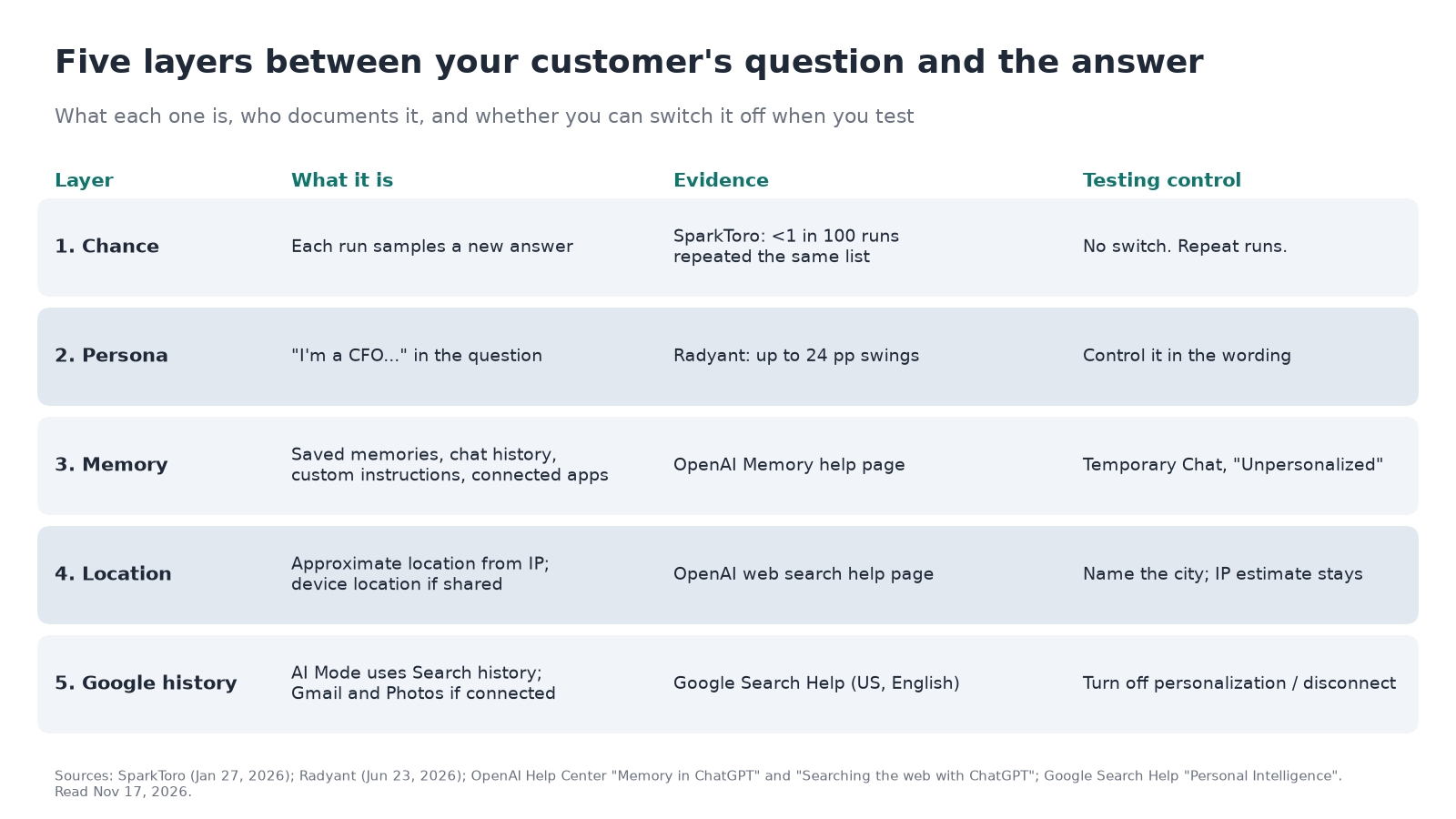
No, ChatGPT answers are not the same for everyone, and they are often not the same for the same person twice. Here are the layers, in the order they usually matter for brand recommendations:
| Layer | What changes the answer | Who documents it | Can you switch it off when testing? |
|---|---|---|---|
| Chance | Each run generates a fresh answer | SparkToro research | No. You can only repeat runs |
| Persona | What the asker says about themselves ("I'm a CFO...") | Radyant persona study | Yes, through the wording you test |
| Memory | Saved memories, past chats, custom instructions, files, connected apps | OpenAI: Memory in ChatGPT | Mostly: a Temporary Chat set to "Unpersonalized" |
| Location | Approximate location from IP; device location if shared | OpenAI: Searching the web with ChatGPT | Partly: device sharing is off by default, the IP estimate is not |
| Google personalization | AI Mode uses your Search history, plus Gmail and Photos if connected | Google Search Help: Personal Intelligence | Yes, in your Google settings |
The rest of this post takes them one at a time.
1. Chance: the same question rarely gets the same list
Before personalization even comes in, large language models generate a new answer each time. SparkToro's Rand Fishkin and Gumshoe.ai's Patrick O'Donnell had 600 volunteers run 12 recommendation prompts through ChatGPT, Claude and Google's AI a combined 2,961 times (published January 27, 2026). Their findings:
- There was less than a 1 in 100 chance that ChatGPT or Google's AI returned the same list of brands in any two of 100 responses.
- Getting the same list in the same order was closer to 1 in 1,000.
- Even list length varied, from 2 or 3 names to 10 or more.
Worth knowing: the volunteers used their normal settings, so this number already blends chance with each person's own memory and location. And the study had a useful counterpoint. As Search Engine Land summarized it, some brands appeared in 60% to 90% of responses for a given intent even though their position jumped around. Exact rank is noise. How often you show up across many runs is a signal.
We covered run-to-run movement in more depth in why an AI answer is a weather report, not a fact. The rest of this post is about the part people actually mean when they ask whether answers are "different for everyone": the asker.
2. Who you say you are changes who gets recommended
Real buyers rarely ask a neutral question. They lead with context: "I run a 12-person agency," "I'm the CTO," "I'm a parent on a budget." That context alone can move recommendations.
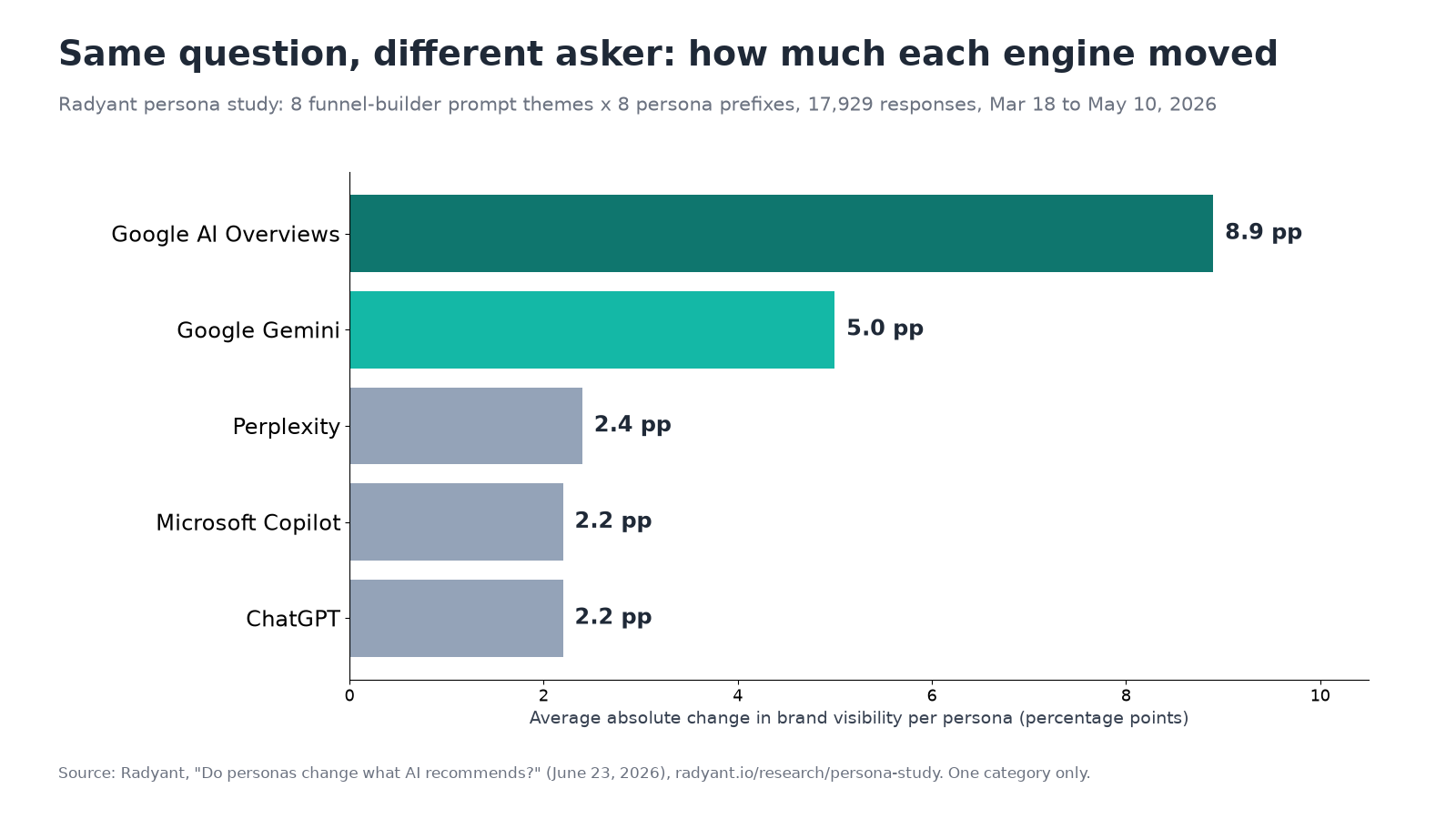
The AI search agency Radyant tested this in its persona study (June 23, 2026). It ran 8 funnel-builder prompt themes with 8 persona prefixes, including a no-persona control, across five engines from March 18 to May 10, 2026, for 17,929 responses about 10 brands. The prefixes were bare on purpose ("I'm CTO at a company."), so any change came from the role alone.
Two things stand out for anyone asking about ChatGPT specifically:
- ChatGPT was among the least persona-sensitive engines in this test, with an average shift of 2.2 percentage points per persona. Google AI Overviews moved four times as much (8.9 points), and Gemini produced the single biggest gain, +24 points for one brand under a "Head of Performance Marketing" prefix.
- Personas narrowed the field. Average visibility across the 10 brands was 30.0% with no persona and 28.3% to 29.3% with one. In Radyant's reading, brands with generic positioning tended to lose when the asker named a role, and brands with role-specific content tended to gain. Radyant presents that as a hypothesis consistent with its data, not a confirmed mechanism.
One category, one study. But the takeaway holds up: "Are ChatGPT answers the same for everyone?" has a different answer on each engine, and the engine your buyers use matters. If you want to run this kind of test yourself, our guide to persona prompts for AI visibility has the step-by-step version.
3. What ChatGPT remembers about the asker
This is the layer most people have in mind. OpenAI's Memory help page says that when Memory is on, ChatGPT can draw on, depending on plan and region:
- past chats ("Reference chat history")
- saved memories
- custom instructions
- saved files in Library or a Space
- content from connected apps, such as Gmail
Two lines from that page matter most for brand visibility:
- Memory can shape the search itself. OpenAI says that when Memory is enabled, "ChatGPT may use relevant details to formulate a more useful search query," with location or dietary preferences refining a restaurant search as the example. So two people can trigger different web searches from identical wording, and different searches surface different businesses.
- ChatGPT decides what's relevant. It "looks for relevant context when it is likely to improve a response," not on every message, and the Sources panel "may not show every factor that shaped a response." You can't always tell from the answer how personalized it was.
Practical upshot: if you check your own brand from your own account, your history of asking about your company, your industry and your competitors may be part of the context. That is the opposite of how a first-time buyer sees it.
The clean way to check, per OpenAI: start a Temporary Chat and choose Unpersonalized, which skips existing memories and custom instructions. You have to pick that before the chat starts, and temporary chats don't create or update memories.
4. Where the asker is
For anything local, location may be the biggest single factor. OpenAI's web search help page says:
- ChatGPT "may use an approximate location based on your IP address to provide relevant local results."
- Sharing your device's location is optional and off by default. If you turn it on, ChatGPT can use more specific information for nearby businesses.
- ChatGPT may share that general location with its search partners. OpenAI's own example: "good restaurants near me" from someone in the San Francisco area may be rewritten as "top restaurants San Francisco."
- A VPN or network location can change the inferred location, and if Memory is on, "saved location information may also influence search results."
So a Seattle plumber checking "best plumber near me" from home, from a phone on cellular data, and through an office VPN can see three different answers before persona or memory comes into it. The fix OpenAI itself suggests is simple: put the city, neighborhood or postal code in the question.
5. Google is personalizing AI answers too
The same question applies to Google's AI answers, and Google has been explicit about it. Per Google Search Help, Personal Intelligence in AI Mode "references previous searches and activity saved in your Search Services History to provide suggestions tailored to your tastes and preferences." It's available in the US, in English, for users 18 or older with history and personalized recommendations enabled.
People can go further and connect Gmail, Calendar and Google Photos. Google's own example is AI Mode suggesting family activities based on a hotel booking in Gmail and travel photos. Connecting those apps is opt-in, and Google says it's for personal accounts, not Workspace business, enterprise or education accounts.
For a brand, this means a returning customer who has bought from you (with a receipt sitting in Gmail) may get a different AI Mode answer than a stranger asking the same thing. Google also warns that "AI Mode might not always get personalization right."
So what can a business actually measure?
If every answer is a little different, it's tempting to conclude AI visibility can't be measured. The research points the other way: you can't measure one answer, but you can measure how often you appear across many clean, repeated, unbranded questions. A practical setup:
- Strip your own context. Use a Temporary Chat set to Unpersonalized, or a separate account that has never asked about your brand. In Google, check AI Mode while signed out or with personalization off.
- Name the place. For local businesses, write the city into the question instead of relying on "near me."
- Ask unbranded buyer questions. "Who should I hire to fix a leaking water heater in Seattle?", not "Is [your brand] good?"
- Repeat, then count. Run the same set more than once and track the share of answers that name you, not your position in one list.
- Add persona variants on purpose. If your buyers usually say who they are, test those openers alongside a neutral control, as in our persona prompt guide.
- Check each engine separately. Radyant's data shows engines react differently. A brand doing fine in ChatGPT can still be dropped from AI Overviews for certain buyers.
- Know the limits of API checks. Visibility tools that query models through an API may not see what a signed-in user sees. We broke that down in ChatGPT API vs ChatGPT.
Shopping answers follow the same pattern. OpenAI says ChatGPT uses memory and custom instructions when it picks products, which we covered in how ChatGPT shopping works.
Where Beket AI fits
Beket AI runs unbranded buyer questions across the engines your customers use and tracks how often your business is named over time. It tracks six engines: ChatGPT, Gemini, Perplexity, Microsoft Copilot, Google AI Overviews and Google AI Mode. The free audit covers 25 prompts on any 3 of them. Pro is $49/month per site with daily re-audits, which is how you turn noisy single answers into a trend.
It won't show you the exact answer one specific customer saw, and nothing can, because that answer depends on their memory, location and history. What it gives you is the repeatable baseline that sits underneath all of that.
Caveats
- Based on OpenAI and Google help pages and the SparkToro and Radyant studies, read on November 17, 2026. Personalization features change often and vary by plan, region and platform.
- Radyant's study covers one software category. SparkToro's volunteers used their own settings, so its numbers mix chance with personalization. Neither is peer-reviewed.
- Neither OpenAI nor Google publishes how much weight memory, location or history gets in a given answer. Anyone claiming a precise figure is guessing.
Related posts
Is Your Business Ready for Gemini Tasks? What the Agent Checks Before It Calls or Buys
Google made Gemini Tasks free on Nov 17, and it can call US businesses. See what Google documents, how to opt out, and a checklist to finish before Black Friday.
Which Seattle Plumbers Does AI Name for Booking? 2026 Study
We asked Gemini, Google AI Mode and AI Overview 10 booking questions about Seattle plumbers on Nov 17, 2026. 2 Sons Plumbing & Sewer led with 10 of 44 mentions.
Does AI Recommend Different Apps to a Founder, a CFO and a Parent? 2026 Study
We asked ChatGPT, Perplexity and AI Overview 8 budgeting-app questions as a founder, a CFO and a parent on Nov 17, 2026. The first app changed.