
Which AI Search Analytics Tools Recommend Ways to Improve Citations?

Most AI search analytics tools tell you whether you were cited. Far fewer tell you what to change to get cited more. When you compare tools, ask one question of each feature: does it only describe the last run, or does it point to a specific question, a specific source and a specific page you can work on?
This guide covers what these tools measure, which features actually give you citation recommendations, what Google Search Console, GA4 and Bing Webmaster Tools add for free, and a checklist for judging any tool, including Beket AI.
What do AI search analytics tools measure?
They put questions to AI engines such as ChatGPT, Perplexity and Google AI Overviews, then record what comes back. The core numbers are much the same from tool to tool:
| Metric | What it tells you | What it doesn’t tell you |
|---|---|---|
| Mentions | How often an answer names your business | Whether the answer was accurate or favorable |
| AI share of voice | Your mentions as a share of all names in those answers | How many people actually saw those answers |
| Position | Where you appear among the names an answer lists | Whether anyone clicked |
| Citations | Which URLs an answer linked as sources | Why the engine picked those pages |
| Per-engine split | How ChatGPT, Perplexity and Google differ | Whether the gap will hold next week |
| Crawler activity | Which AI bots fetched your pages | Whether a fetch turned into a citation |
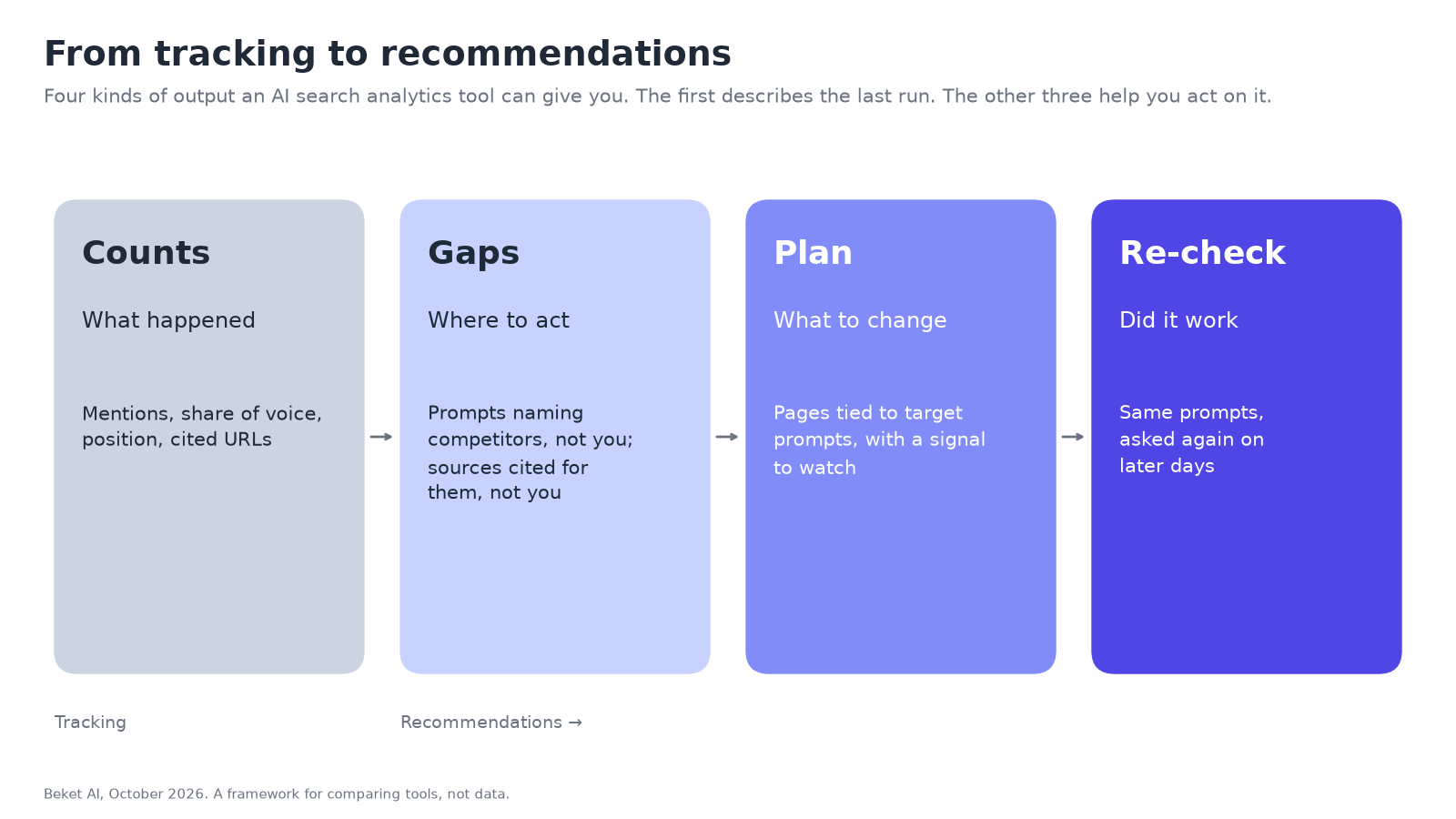
All of these are tracking. They are needed, but none of them is a recommendation. A dashboard that says “cited in 12% of answers” tells you where you stand, not what to fix.
What’s the difference between tracking and a citation recommendation?
A useful recommendation answers three questions: which question (prompt), which source and which page. Here is how the same finding looks as tracking and as a recommendation:
| Finding | Tracking-only output | Recommendation output |
|---|---|---|
| A competitor is named and you aren’t | “Your share of voice is 4%” | “These 6 unbranded prompts name 3 competitors and not you; start with these 2” |
| Answers cite a site you’re absent from | “Top cited domains: list” | “This directory or forum is cited for your competitors; here is the action: claim a listing, answer a thread, pitch an article” |
| You have no page for a question | “Not mentioned” | “Write a comparison page targeting these prompts; here is what to watch to see if it worked” |
| Something changed | A new number next to the old one | “A new competitor appeared on Perplexity since the last run” |
The right column depends on data the left column doesn’t need: the exact prompts, the cited URLs from each answer and a record of past runs. When you look at a tool, check whether it exposes those three things. If it doesn’t, its “recommendations” are probably generic advice.
Why recommendations have to be per engine
The engines cite very differently, so advice that ignores the engine is weak advice. In a Beket AI study we ran on October 29, 2026, we asked the same 25 shopping questions in Vancouver and Seattle (one run, 145 answers):
| Engine | Answers | Sources cited | Answers with no cited source |
|---|---|---|---|
| ChatGPT | 58 | 204 | 17 |
| Perplexity | 58 | 845 | 0 |
| Google AI Overview | 29 | 195 | 1 |
Source: Beket AI Black Friday study, October 29, 2026. Both cities combined. One run, so read it as a snapshot.
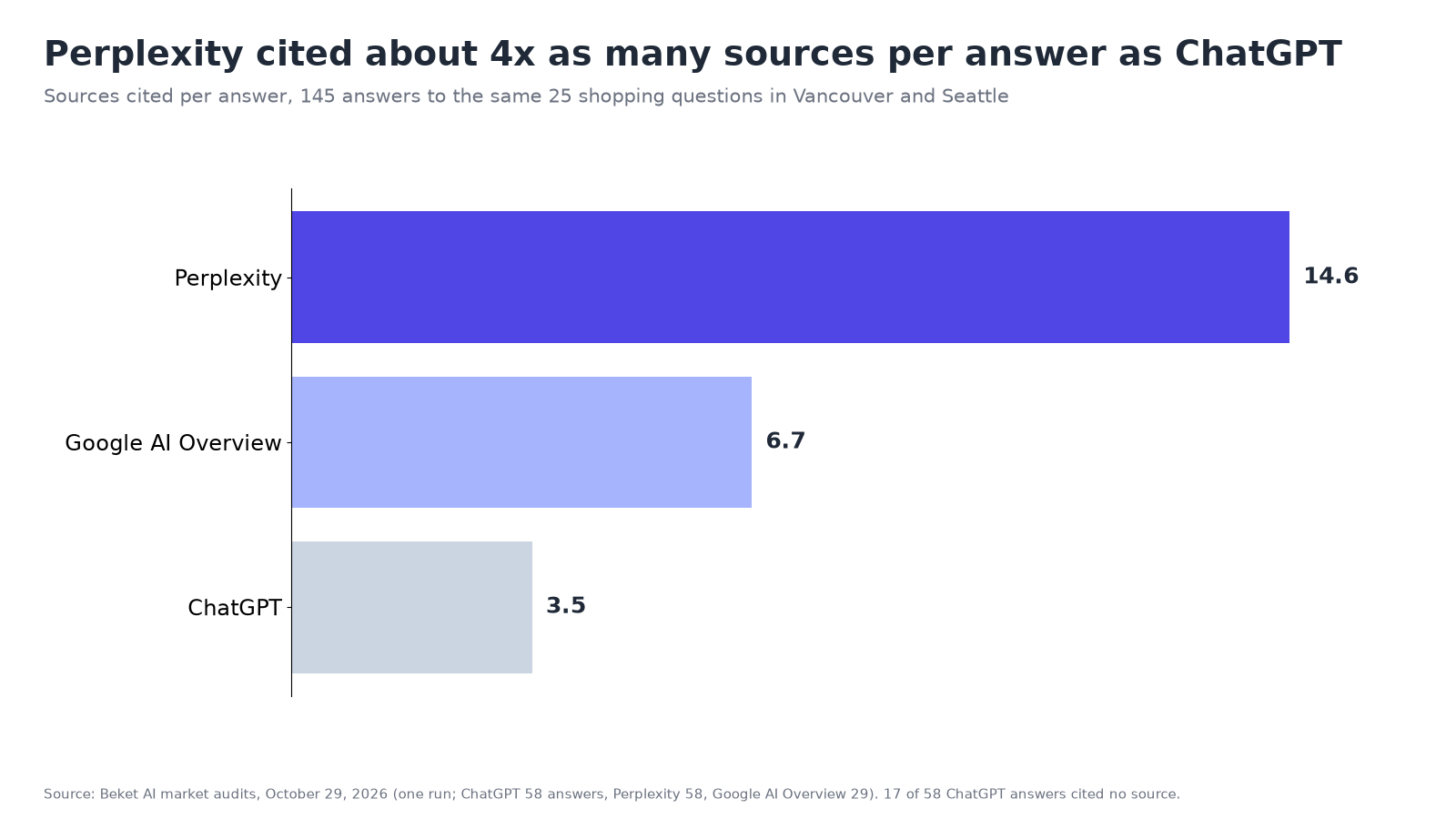
Perplexity cited about four times as many sources per answer as ChatGPT. Nearly a third of ChatGPT’s answers cited nothing at all. A source gap on Perplexity is often something you can act on. A missing mention on ChatGPT may have no cited page behind it to fix. That is also why we argue you can’t judge your standing from one AI engine.
What do Google Search Console, GA4 and Bing Webmaster Tools show?
The three free first-party tools are worth setting up before you pay for anything. Only one of them comes close to a recommendation.
Google Search Console. The Generative AI performance report (rolled out to all sites on August 31, 2026) shows impressions from AI Overviews and AI Mode by page, country, device and date. It shows how often links to your site appeared. It does not show which questions triggered them or give any advice. Google’s own guidance is that “there are no additional requirements to appear in AI Overviews or AI Mode, nor other special optimizations necessary” (Google Search Central). Our guide on tracking AI Overview traffic walks through the report.
Google Analytics 4. GA4 shows what visitors did after they arrived. Visits from AI assistants that pass a referrer or a UTM tag show up under that source. ChatGPT tags its links: in our October 29 audit export, all 107 ChatGPT citation URLs carried utm_source=chatgpt.com. Clicks from Google’s AI Overviews are not split out from regular Google organic traffic. GA4 measures outcomes, not citations, and some AI visits arrive with no referrer at all, as we explained in your AI traffic is hiding in direct.
Bing Webmaster Tools. The AI Performance report counts how often your pages were cited in Microsoft Copilot and Bing’s AI answers, with grounding queries and page-level citations. Its Topics Portfolio beta, launched October 13, 2026, adds “Opportunity Queries”, queries “where other sites appear and yours does not”. That is the closest thing to a citation recommendation from a search engine itself. Microsoft says to treat its numbers as “directional signals for planning”, not exact counts. Our Bing AI Performance report guide covers setup.
| Free tool | Measures citations? | Shows the questions? | Recommends changes? |
|---|---|---|---|
| Google Search Console (Generative AI report) | Impressions of your links in AI Overviews and AI Mode | No | No |
| GA4 | No, only visits and what they did | No | No |
| Bing Webmaster Tools (AI Performance) | Yes, citation counts by page | Grounding queries (a sample) | Opportunity queries, in beta |
None of the three covers ChatGPT or Perplexity answers. That is the gap third-party AI search analytics tools fill.
Which features actually help you improve citations?
You’ll find these features under different names in different tools. These four are the ones that turn tracking into a to-do list:
- Prompt gaps. Unbranded questions where competitors are named and you aren’t, ranked by how winnable they look. This tells you which questions to work on first.
- Source gaps. Domains and URLs the engines cite for those questions where you’re absent, sorted by what you can do there: post or reply (forums, Q&A, social), claim (directories, review sites) or pitch (editorial). Third-party pages often matter more than your own, a point we made in your AI citations are coming from somewhere you aren’t looking.
- A content plan tied to prompts. Recommended pages that name the prompts they target, the format (guide, comparison, landing page) and what to watch to know whether the page worked.
- Scheduled re-runs. The same prompts, asked again on later days, so you can tell a real change from day-to-day noise. One check is a snapshot, not a system.
Advice that skips all four, such as “add more schema”, “publish an llms.txt” or “write more content”, is a general SEO checklist, not a citation recommendation. Google says you don’t need “new machine readable files, AI text files, or markup” for its AI features.
What to look for before you trust a tool’s recommendations
- You choose the prompts, and they’re unbranded. A prompt like “best [service] in [city]” tests discovery. A prompt with your own brand name only tests recall.
- Per-engine results. ChatGPT, Perplexity and Google AI Overviews behave differently, as the table above shows.
- The cited URLs, exportable. Without the actual URLs you can’t check a source-gap recommendation yourself.
- Every recommendation names a prompt and a source. If it doesn’t, it isn’t specific enough to act on.
- Re-measurement on the same prompts. Otherwise you can’t tell whether a change worked.
- Honest limits. No tool sees every user’s answer, and AI answers change by day, wording and person. Be wary of any tool that promises guaranteed citations or rankings.
- Your first-party data stays in the picture. Use Search Console, GA4 and Bing Webmaster Tools alongside the tool to check what it tells you.
How Beket AI handles citation recommendations
Beket AI asks unbranded questions on ChatGPT, Perplexity and Google AI Overview and records which businesses each answer names, how often, on which engine, and which sources it cited. On a completed audit for a business, Beket AI also gives:
- Winnable prompts: questions where the business is absent or weak but could win, ranked by score, with the competitors named in those answers.
- A content roadmap: a ranked list of recommended pieces. Each one comes with its format, funnel stage, rationale, target prompts and a leading indicator, such as being cited for a target prompt within a set number of weeks. A roadmap item can be turned into a content brief.
- Citation gaps you can act on: sources where a competitor is cited and the business isn’t, limited to places where you can post, reply or claim a listing, each with a suggested action.
Beket AI’s integrations are Webflow, Google Analytics and Cloudflare. With Cloudflare connected, Beket AI shows which AI crawlers visited your site and which AI surfaces sent visitors. Our Cloudflare AI crawler guide explains the Cloudflare side.
A free Beket AI audit covers 25 prompts across 3 engines. Beket AI Pro is $49/month, re-audits daily and starts at 50 prompts across 3 engines. Run a free audit at beket.ai.
About the author: Nur Rysbek is the CEO of Beket AI.
Sources checked October 30, 2026. Google’s and Microsoft’s reports change, so confirm details in the linked documentation.
Related posts
SEO vs GEO vs AEO: What's Actually Different (and What Google Says Isn't)
SEO wins the ranked link, AEO the answer passage, GEO the name in the AI answer. A side-by-side table, what Google says, and where the difference is real.
Top Accelerators in Canada, According to ChatGPT, Perplexity and Google AI (2026 Study)
We asked ChatGPT, Perplexity and Google AI Overview 25 questions about Canadian accelerators. Velocity, L-SPARK and CDL were named most.
Google AI Overview vs ChatGPT: Which One Names the Local Shop? (2026 Study)
Same 25 holiday shopping questions in Seattle and Vancouver: local shops got 36% of ChatGPT's Seattle mentions and 8% of Google AI Overview's.