
SEO vs GEO vs AEO: What's Actually Different (and What Google Says Isn't)

In May 2026, Google added a line to its own documentation that settles one part of this debate. In its guide to optimizing for generative AI features, Google defines AEO as “answer engine optimization” and GEO as “generative engine optimization,” then says: “From Google Search’s perspective, optimizing for generative AI search is optimizing for the search experience, and thus still SEO.” (Search Engine Journal covered the guide on May 15, 2026.)
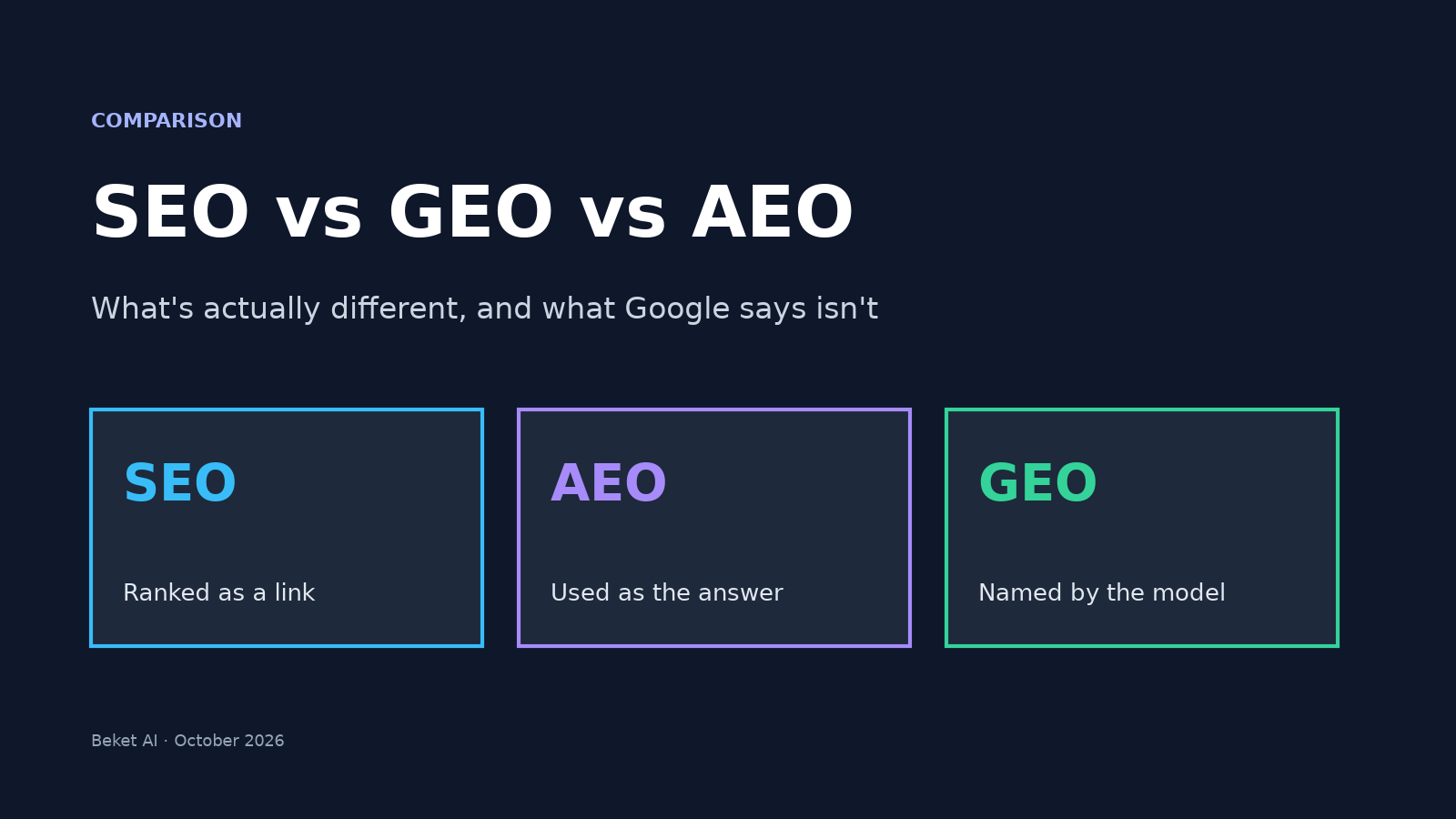
So, is SEO vs GEO vs AEO a fake fight? Not quite. Google is speaking for Google. ChatGPT and Perplexity run their own crawlers, pick their own sources and decide for themselves which businesses to name. And the thing you are trying to win changes from one to the next: a ranked link, the passage an answer is built from, or your name in the answer.
Here is what each term means, where they overlap, and where the difference is real.
The short version
- SEO (search engine optimization) is about getting your pages ranked and clicked in search results.
- AEO (answer engine optimization) is about getting your page used as the source of a direct answer: a featured snippet, an AI Overview, a voice answer.
- GEO (generative engine optimization) is about getting your business named, described correctly and cited when an AI model writes an answer, in ChatGPT, Perplexity, Gemini or Google’s AI features.
AEO and GEO are used loosely, and plenty of people treat them as the same thing. There is no standards body for either term. The split above is the one we use at Beket AI because it lines up with something you can actually measure: a link, a passage, or a name.
SEO vs AEO vs GEO, side by side
| SEO | AEO | GEO | |
|---|---|---|---|
| What you’re trying to win | A ranked link that gets clicked | The passage an answer is built from | Your business named (and described correctly) in the answer |
| Where it shows up | Google and Bing results pages | Featured snippets, Google AI Overviews and AI Mode, Copilot answers, voice assistants | ChatGPT, Perplexity, Gemini, Google AI Overviews and AI Mode |
| Unit of success | Ranking position, click | Being the cited source for a question | A mention, ideally early and with a reason to pick you |
| Who has to reach your site | Googlebot, Bingbot | The same search crawlers (Google’s AI features use the Google Search index) | Each engine’s own search crawler too, such as OAI-SearchBot for ChatGPT search and PerplexityBot for Perplexity |
| What mostly drives it | Relevance, technical health, links, content quality | Clear, specific answers on pages that already rank | Your own pages plus what other sites, reviews, directories and forums say about you |
| How you measure it | Search Console, rank tracking, analytics | Search Console (AI features are counted in web search data), Bing’s AI Performance report for Copilot | Running real customer questions on each engine and counting who gets named |
| Google’s position | This is the job | “Still SEO” | “Still SEO” for Google’s AI features; we found no comparable statement from OpenAI or Perplexity |
Sources: Google Search Central, Google’s AI features guide, OpenAI crawler docs, Perplexity crawler docs, checked October 30, 2026.
Where they overlap: almost everything on Google
For Google’s own AI features, the three terms collapse into one job. Google says AI Overviews and AI Mode are “rooted in our core Search ranking and quality systems” and retrieve pages from the Search index. Its AI features guide adds that to be shown as a supporting link, “a page must be indexed and eligible to be shown in Google Search with a snippet,” and that “there are no additional technical requirements.”
The same guide also lists tactics you can skip for Google Search, including llms.txt files, “chunking” content into tiny pieces, rewriting content just for AI, chasing inauthentic mentions and special schema markup.
What Google does recommend reads like an SEO checklist with a local twist: content that adds something beyond common knowledge, a crawlable site, and up-to-date Merchant Center and Business Profile details. If you want the concrete steps, our 7-step guide to showing up in Google AI Overviews walks through them.
Where they really differ
1. Different engines, different gatekeepers
Google’s AI answers draw on Google’s index. ChatGPT’s search and Perplexity draw on their own crawling. OpenAI says sites that block OAI-SearchBot “will not be shown in ChatGPT search answers,” and Perplexity says PerplexityBot is what surfaces and links sites in its results. A site can be perfectly set up for Google and still be invisible in ChatGPT search because a robots.txt rule, firewall or bot setting blocks one crawler. Our comparison of which AI crawlers to allow in robots.txt covers GPTBot, OAI-SearchBot and Google-Extended.
This is the strongest practical reason GEO is more than a new name for SEO: you are dealing with several gatekeepers, not one.
2. A link and a name are different wins
SEO counts links and clicks. GEO counts names. In our own data, those didn’t line up.
On October 28, 2026, Beket AI ran 14 unbranded local questions about lawyers, realtors and mortgage brokers in Seattle and Vancouver through Google AI Overviews. Twelve got an AI Overview. Of the 12 businesses in the two cities’ top-10 lists of most-named organizations, 5 were named without a link to their own website. Going the other way, 36 of the 43 business websites linked as sources belonged to businesses outside those top-10 name lists. We wrote it up in our AI Overview named-vs-linked audit.
The 14 questions: best law firms in Seattle; family lawyers in Seattle; tenant rights lawyers in Seattle; luxury real estate agents in Seattle; realtors for first time home buyers in Seattle; best mortgage brokers in Seattle for low rates; mortgage brokers for first time home buyers in Seattle; personal injury lawyers in Vancouver; startup lawyers in Vancouver; best realtors in Vancouver BC; presale condo realtors in Vancouver; luxury real estate agents in Vancouver; best mortgage brokers in Vancouver for low rates; private mortgage lenders in Vancouver BC.
That is a small sample from one day. AI answers change, and this is what Google AI Overviews returned on that date; any business in these categories can ask us for another run. But it shows why a ranking report can’t tell you whether AI answers name you. A business can be linked and barely mentioned, or named and not linked.
3. The research behind “GEO” tested something SEO doesn’t
The term GEO comes from a 2023 research paper by researchers at Princeton and IIT Delhi, published at KDD 2024. They rewrote web pages in nine ways and measured how much each version showed up in answers generated from the top 5 Google results.
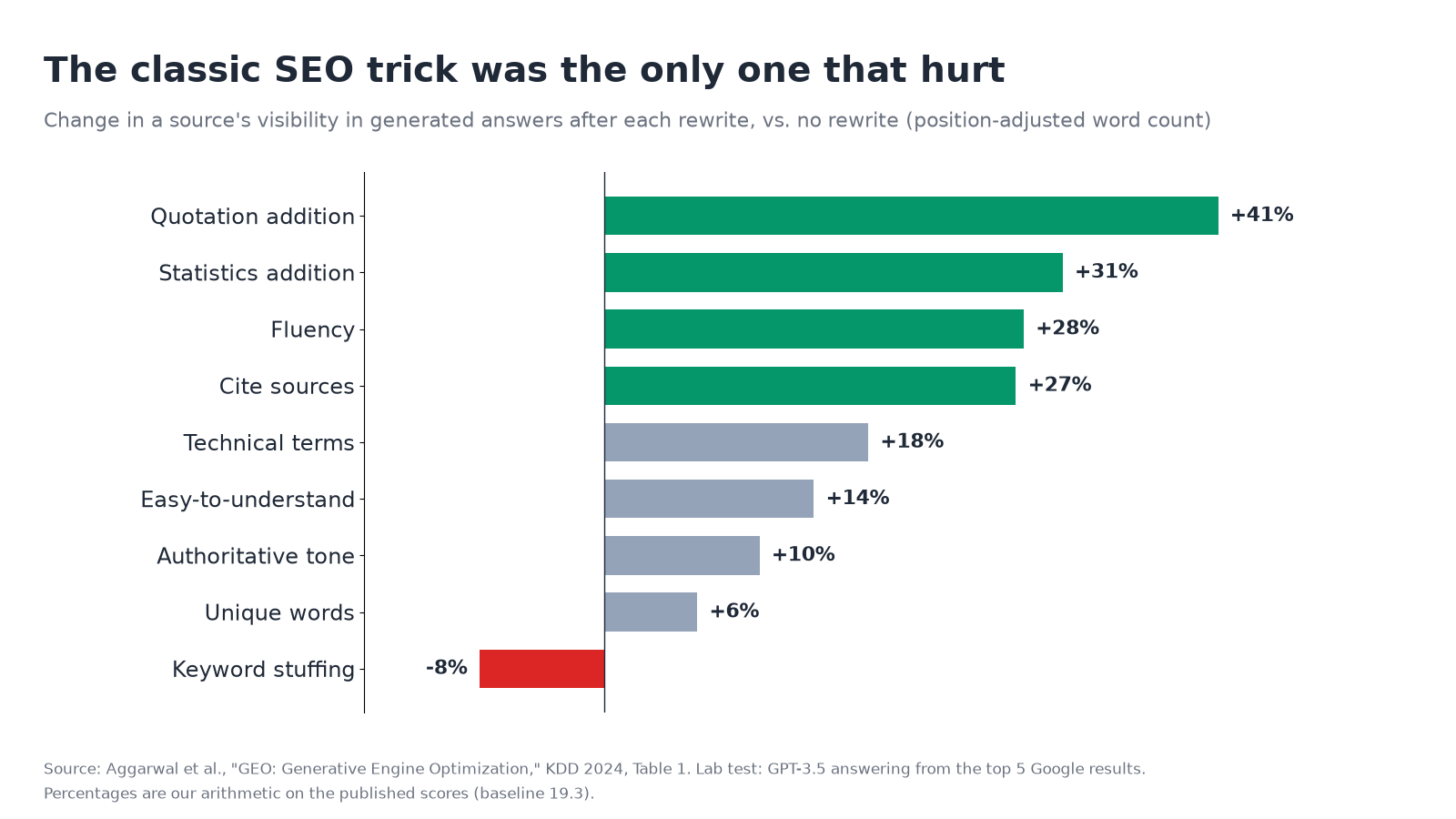
Source: Aggarwal et al., “GEO: Generative Engine Optimization,” KDD 2024, Table 1 (position-adjusted word count). Percentages are our arithmetic on the published scores.
Adding quotations, statistics and cited sources helped the most. Keyword stuffing, an old SEO habit, was the only rewrite that lowered visibility. The authors also found the gains were largest for pages ranked lower in the search results: citing sources raised visibility by 115.1% for the fifth-ranked source and lowered it by 30.3% for the top-ranked one.
Read this as direction, not a recipe. It was a lab setup using GPT-3.5, and today’s engines are different. It also lines up with Google’s own advice: specific, sourced, useful content beats repeating the keyword.
4. You measure them differently
For SEO, Search Console tells you where you rank and what gets clicked. For Google’s AI features, Google counts AI Overview and AI Mode appearances inside the same Search Console web data. For Copilot, the AI Performance report in Bing Webmaster Tools shows when your pages are cited.
None of those tell you whether ChatGPT or Perplexity names your business when someone asks for “the best family lawyer in Seattle.” For that, you have to ask the questions and count. The metric most people use is AI share of voice: your mentions divided by all business mentions in the same set of answers.
Clicks are a weak way to judge AEO and GEO
AI answers send few clicks. A Pew Research Center analysis of March 2025 browsing data found people clicked a link inside a Google AI summary in just 1% of visits, and clicked a traditional result in 8% of visits with a summary versus 15% without one.
But clicks may undercount the value. On October 29, 2026, Search Engine Land reported a small test by SEO consultant Cyrus Shepard: after one site opted out of Google’s AI features, its AI impressions went to zero and its regular organic clicks also fell. Shepard calls it a possible “SERP halo effect,” where appearing in the AI answer helps the normal listing get clicked. He didn’t share the traffic volume, dates or size of the drop, so treat it as one data point. It’s still a reminder that SEO and AEO/GEO aren’t separate channels you can switch off one at a time.
What to do with this
You don’t need three programs. You need one, checked three ways:
- Get the SEO basics right first. Indexed pages, snippets allowed, a fast and crawlable site, an accurate Google Business Profile. Everything else depends on it, including Google’s AI features.
- Open the door to the other engines. Check that robots.txt, your firewall and your host allow the search crawlers you want, such as OAI-SearchBot and PerplexityBot, not just Googlebot.
- Write answers worth quoting. Specific prices, service areas, credentials, numbers with sources. Google calls this “non-commodity content,” and the GEO research points the same way.
- Work on what others say about you. Reviews, directories, local press and community threads show up in AI answers. Google says chasing inauthentic mentions “isn’t as helpful as it might seem,” so earn them.
- Measure names, not just clicks. Track rankings in Search Console, and separately check whether AI answers name you for the questions your customers ask.
Beket AI handles step 5. A free audit runs 25 prompts across 3 engines (ChatGPT, Perplexity and Google AI Overview) and shows which businesses each engine names. Pro is $49/month and re-audits daily, starting at 50 prompts across the same 3 engines.
Related posts
Google AI Overview vs ChatGPT: Which One Names the Local Shop? (2026 Study)
Same 25 holiday shopping questions in Seattle and Vancouver: local shops got 36% of ChatGPT's Seattle mentions and 8% of Google AI Overview's.
Which AI Search Analytics Tools Recommend Ways to Improve Citations?
Most AI search analytics tools only track citations. Here's what Search Console, GA4 and Bing show, which features give real fixes, and what to look for.
Christmas Shopping in Vancouver vs Seattle: AI Sends One City to Markets, the Other to Malls
Same 25 shopping questions, two cities. AI gave holiday markets 31% of Vancouver store mentions and named no mall twice. In Seattle, malls led.