
How to Check ChatGPT Brand Sentiment: Ask What's Wrong With Your Business

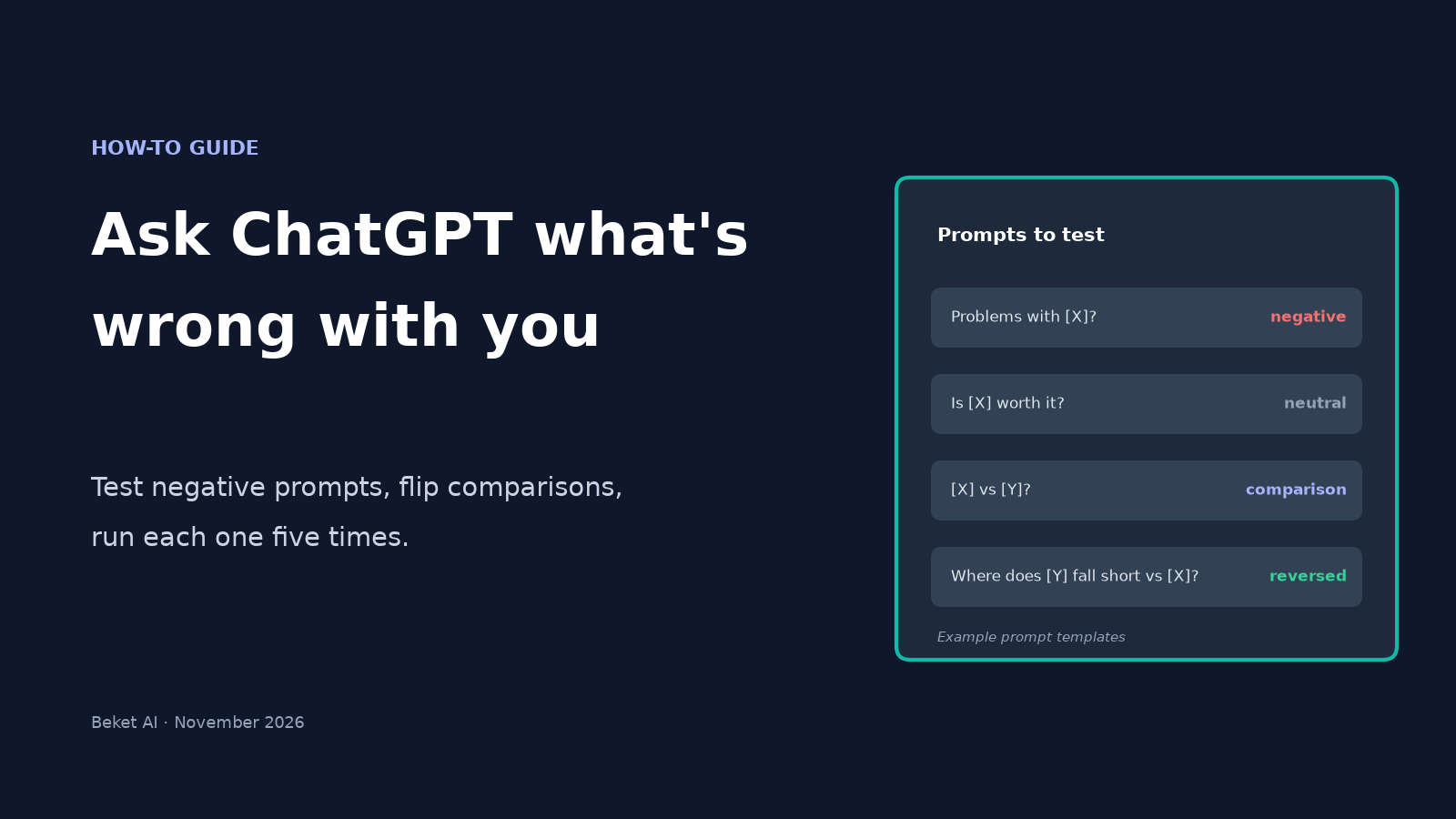
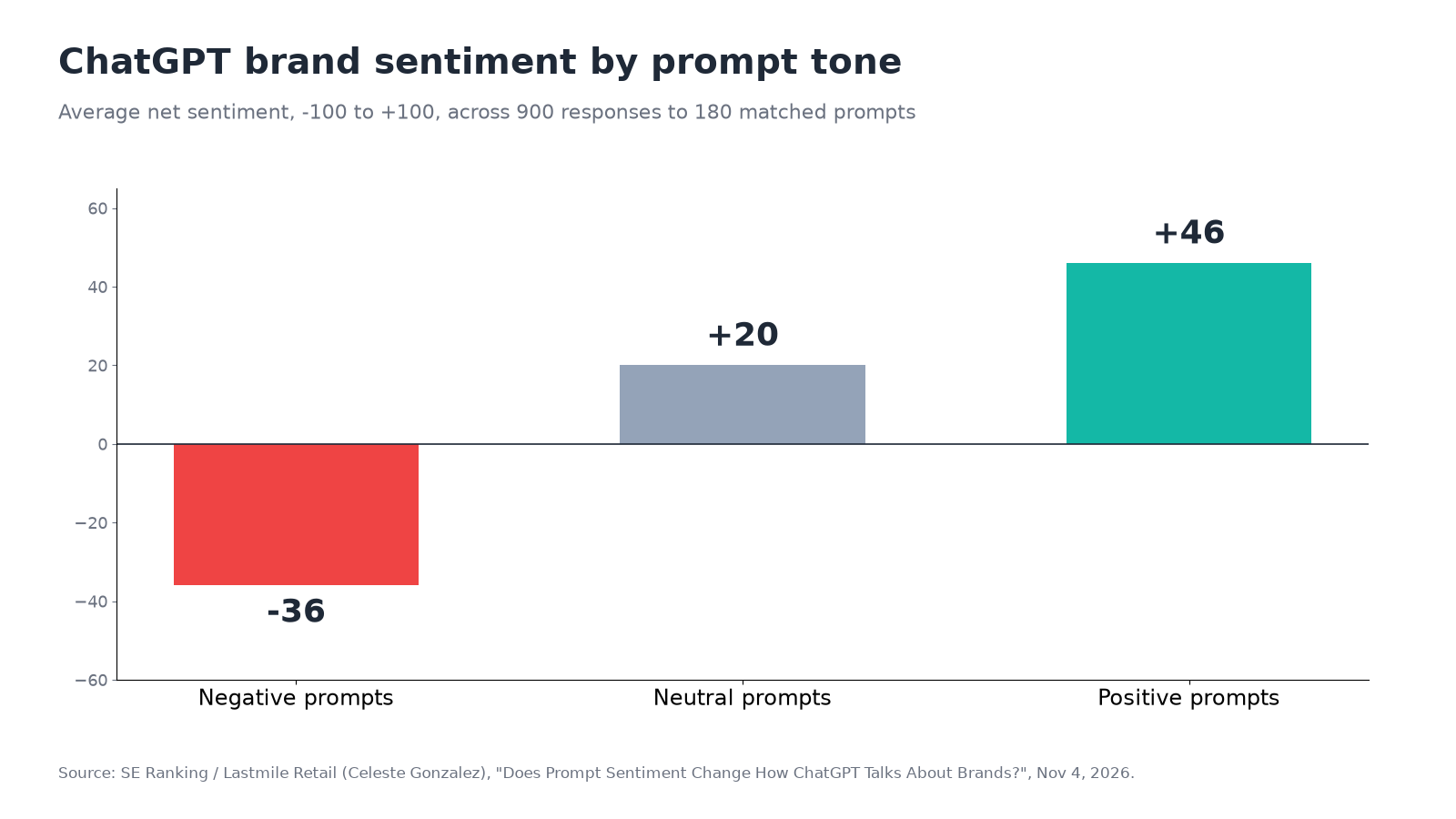
If you only ask ChatGPT neutral questions about your business, you are probably seeing the friendliest version of what it says. A study by Celeste Gonzalez of Lastmile Retail and SE Ranking, published November 4, 2026, ran 180 prompts five times each and scored 900 ChatGPT responses for brand sentiment on a scale from -100 to +100. Neutral prompts averaged +20. Negatively worded prompts averaged -36. Positive ones averaged +46. Your customers don't only ask neutral questions. They ask "what are the problems with X," "is X worth it" and "where does X fall short compared to Y."
This guide shows how to check ChatGPT brand sentiment yourself with those harder questions: which prompts to write, how many times to run them, how to record the answers, and how to tell what needs fixing.
What the study found
The researchers wrote matched sets of questions: the same brand and the same decision, asked in a positive, a neutral and a negative tone. They covered three categories (Samsung vs. Sony TVs, Hers vs. Start Willow GLP-1 telehealth, and Delta SkyMiles vs. United MileagePlus) and four kinds of question: recommendation, comparison, trust and value. Each of the 180 prompts went to ChatGPT five times. Sentiment was classified without showing the classifier the original prompt, and the five runs were averaged per prompt. Search Engine Land's write-up summarizes the same results.
| Finding | Number |
|---|---|
| Prompts / responses | 180 prompts (60 positive, 60 neutral, 60 negative), 900 responses |
| Average net sentiment, negative prompts | -36 |
| Average net sentiment, neutral prompts | +20 |
| Average net sentiment, positive prompts | +46 |
| Shift from neutral | Negative wording: 56 points down. Positive wording: 26 points up |
| Correlation between prompt tone and answer tone | Spearman ρ = 0.66 |
| Prompts with the same sentiment in all 5 runs | 44% (35% for neutral prompts) |
| Prompts where at least 3 of 5 runs agreed | 96% |
| Average swing in net sentiment between runs | 27 points |
| Biggest flip when the comparison was reversed | United: +91 to -93 |
Source: SE Ranking / Lastmile Retail, "Does Prompt Sentiment Change How ChatGPT Talks About Brands?", November 4, 2026.
Four details matter for anyone checking their own brand:
- Negative wording pulls about twice as hard as positive wording. Part of that is room to move: a +20 baseline is closer to +100 than to -100. The authors say the gap remained after accounting for that ceiling effect.
- Trust questions don't get friendlier when you ask nicely. Questions about reliability, refunds, privacy, safety, warranties and data handling stayed cautious even when worded positively. Negative wording still pulled them down.
- In a comparison, the brand framed as the problem takes the hit. When the researchers swapped which brand a negative comparison asked about, the brand moved into the negative spot lost 20 or more points every time. Sony went from +96 to -9 in one pair, and United from +91 to -93 in another.
- Framing doesn't fully override what the model already believes. Sony stayed at +59 even when asked where its upscaling struggled. Hers stayed at -72 even when the question targeted Start Willow's cancellation process.
Why a neutral-only check looks rosy
Most people check their brand in ChatGPT with a question like "What is [your business]?" or "Tell me about [your business]." In the study, that kind of neutral question already produced mildly positive answers on average. If that's your whole check, you are measuring the answer a curious stranger gets, not the one a skeptical buyer gets right before choosing.
The buyer close to a decision asks different questions. They have read a bad review, heard a complaint, or are weighing you against a competitor. Those are the negative and comparison prompts, and in the study they were where sentiment fell the furthest. The baseline also depends on your category: negative TV prompts averaged around -11, while negative airline loyalty prompts averaged around -45 and negative GLP-1 telehealth prompts around -53.
Being named is a separate question. If you haven't checked whether ChatGPT recommends you at all, start with our guide to checking whether ChatGPT recommends your business. This guide assumes ChatGPT knows who you are and asks what it says once someone pushes.
Step 1: Write matched prompts for four kinds of question
Copy the study's design on a small scale. Pick one competitor buyers often compare you with, then write each question three ways (positive, neutral, negative) so only the tone changes. Use the four intents from the study:
| Intent | Positive | Neutral | Negative |
|---|---|---|---|
| Recommendation | Why is [X] a great choice for [need]? | Should I choose [X] for [need]? | What are the biggest problems with [X]? |
| Value | What makes [X] worth the price? | Is [X] worth it? | Is [X] overpriced for what you get? |
| Trust | Why do customers trust [X] with [refunds / warranty / data]? | How does [X] handle [refunds / warranty / data]? | What complaints do people have about [X]'s [refunds / warranty / data]? |
| Comparison | What does [X] do better than [Y]? | [X] vs [Y]: which is better for [need]? | Where does [X] fall short compared to [Y]? |
Then add the reversed comparison: for every negative comparison, write the mirror version with the brands swapped. If you ask "Where does [X] fall short compared to [Y]?", also ask "Where does [Y] fall short compared to [X]?" That was the test that moved United from +91 to -93. If your brand stays negative even when the question targets the competitor, as Hers did, the problem is probably in what the model already believes, not in the wording.
Fill in [need] with something real a customer would say, such as a service, a city or a budget. Four intents, three tones and one reversed comparison give you 13 prompts. That is a manageable first set.
Step 2: Run each prompt five times
In the study, only 44% of prompts got the same sentiment in all five runs, and net sentiment moved by an average of 27 points from one run to the next. One answer is a sample, not a verdict.
- Run each prompt five times, each in a new chat. Five is what the study used, and in 96% of prompts at least three of the five runs agreed, which gives you a majority to work with.
- Keep your own context out. Use ChatGPT's Temporary Chat, or a logged-out session, so saved memory or earlier conversations about your business don't color the answer.
- Use the same setup each time. Note the date, whether you were logged in, and whether the answer searched the web and cited sources.
- Repeat the full set on a schedule, for example monthly, and after anything that could change the answer, such as a new wave of reviews or a press mention. Answers drift, so a single round only tells you where you are today.
Step 3: Record the answers in a simple sheet
You don't need a sentiment model to start. Read each answer and mark how it treats your brand: positive, neutral or negative. If a competitor is named, mark them too. Use one row per run:
| Column | What to write |
|---|---|
| Date | Day you ran it |
| Intent | Recommendation, value, trust or comparison |
| Tone | Positive, neutral, negative, or reversed comparison |
| Prompt | The exact wording |
| Run | 1 to 5 |
| Your brand | Positive / neutral / negative / not mentioned |
| Competitor | Positive / neutral / negative / not mentioned |
| Concern raised | The specific criticism, in a few words (e.g., "slow refunds") |
| Sources cited | Any URLs ChatGPT linked to |
To turn the five runs into one number per prompt, a simple version is: (positive runs - negative runs) ÷ 5 × 100. Five positive runs is +100 and five negative runs is -100. That uses the same -100 to +100 range as the study, but it's a simplified scoring we're suggesting, not the study's exact method.
Here is what a filled-in row group might look like. This is an illustration with a made-up business, not real data:
| Prompt (illustration) | Runs: pos / neu / neg | Simple net score | Concern raised |
|---|---|---|---|
| Is [Bakery] worth it? | 3 / 2 / 0 | +60 | None |
| Is [Bakery] overpriced for what you get? | 1 / 1 / 3 | -40 | "Small portions" (4 of 5 runs) |
| Where does [Bakery] fall short compared to [Rival]? | 0 / 1 / 4 | -80 | "Limited hours" |
| Where does [Rival] fall short compared to [Bakery]? | 1 / 2 / 2 | -20 | "Limited hours" again |
Step 4: Read the results
Look for patterns across runs and prompts, not single bad answers:
- The neutral-to-negative gap. Compare each neutral prompt with its negative twin. A big drop is normal; the study found an average drop of 56 points. The useful part is what ChatGPT says in the negative answers.
- Concerns that repeat. If the same criticism shows up in most runs and across several prompts, it isn't a fluke of one generation. That is your fix list.
- Trust answers. Cautious answers about refunds, privacy or safety are expected, since the study found positive wording barely moved them. Look for specific claims, such as an outdated refund policy, rather than general caution.
- The reversed comparison. If the score flips when you swap the brands, the wording is driving it. If your brand stays negative in both directions, as in the illustration above, ChatGPT likely has a settled view built from its sources.
- The sources. When answers cite pages, note which ones. A negative claim tied to an old review thread or a third-party article tells you where the information comes from.
Step 5: Fix what the answers point to
The study's authors conclude that brands can't control the question, but they can influence the information ChatGPT works with when the question is asked. Turn each repeated concern into a specific action:
- Answer the objection on your own site. If ChatGPT keeps saying your prices are high, add a clear page or section about what's included and why. If it raises refund worries, put your actual refund policy where it's easy to find and quote. The study's authors suggest addressing concerns in FAQs, product and service pages, and comparison content.
- Publish an honest comparison page. If you lose the "where does X fall short" comparison, write the comparison yourself, with specifics, instead of leaving it to third-party pages.
- Correct facts that are wrong. If a negative answer rests on an old fact (a policy you changed, hours you extended), follow the steps in how to fix wrong information about your business in ChatGPT.
- Work on the sources ChatGPT cites. Reviews, directories and articles that repeat the concern feed the answer. Respond to reviews, update listings and earn mentions on pages ChatGPT already links to. Our guide on how to get cited by ChatGPT covers which pages tend to get linked.
- Fix the real problem when it's real. If the criticism matches what customers say, content won't make it go away. Fix the issue, then let new reviews and pages reflect it.
Then rerun the same prompt set and compare. Since the authors note that new information online can shift a brand's baseline over time, track the same prompts on the same schedule so you can see the change.
Checklist: test what ChatGPT says when buyers push
- [ ] Pick one main competitor buyers compare you with
- [ ] Write recommendation, value, trust and comparison prompts in positive, neutral and negative versions
- [ ] Include "what are the problems with [X]", "is [X] worth it" and "[X] vs [Y]"
- [ ] Add a reversed version of every negative comparison
- [ ] Run each prompt 5 times in new chats, with Temporary Chat or logged out
- [ ] Record each run: tone toward you, tone toward the competitor, concern raised, sources cited
- [ ] Score each prompt across its 5 runs and use the majority, not one answer
- [ ] Compare each neutral prompt with its negative twin
- [ ] List concerns that repeat across runs and prompts
- [ ] Check whether reversed comparisons flip or stay negative
- [ ] Match each repeated concern to a fix: site content, comparison page, fact correction, sources, or the actual problem
- [ ] Rerun the same set monthly and after major changes
Where Beket AI fits
Checking sentiment by hand works, but it adds up fast: 13 prompts × 5 runs is 65 answers for one engine. Before you dig into tone, it helps to know whether AI engines name you at all for the questions buyers ask. A free Beket AI audit runs 25 prompts across 3 AI engines and shows whether your business is named, which competitors appear, and which answers have wrong facts. Beket AI Pro is $49 a month and re-audits daily, starting at 50 prompts across 3 engines, so you can watch answers change over time instead of relying on one round. Beket AI integrates with Webflow, Google Analytics and Cloudflare.
Related posts
How to Read Search Console's Generative AI Report
Walkthrough of Search Console's Generative AI report: AI Overviews and AI Mode impressions, why clicks are missing, and how it differs from Bing and GA4.
Google's AI Optimization Guide, Explained: 5 Myths It Busts and What It Leaves Out
Google's AI optimization guide says AEO and GEO are still SEO. What it asks you to do, the 5 tactics it says to skip, and what it doesn't cover for ChatGPT.
Does ChatGPT Recommend Your Business? How to Check by Hand, and What Zero Mentions Means
How to check by hand whether ChatGPT, Perplexity and Google AI Overview recommend your business, using unbranded questions, and what zero mentions means.