
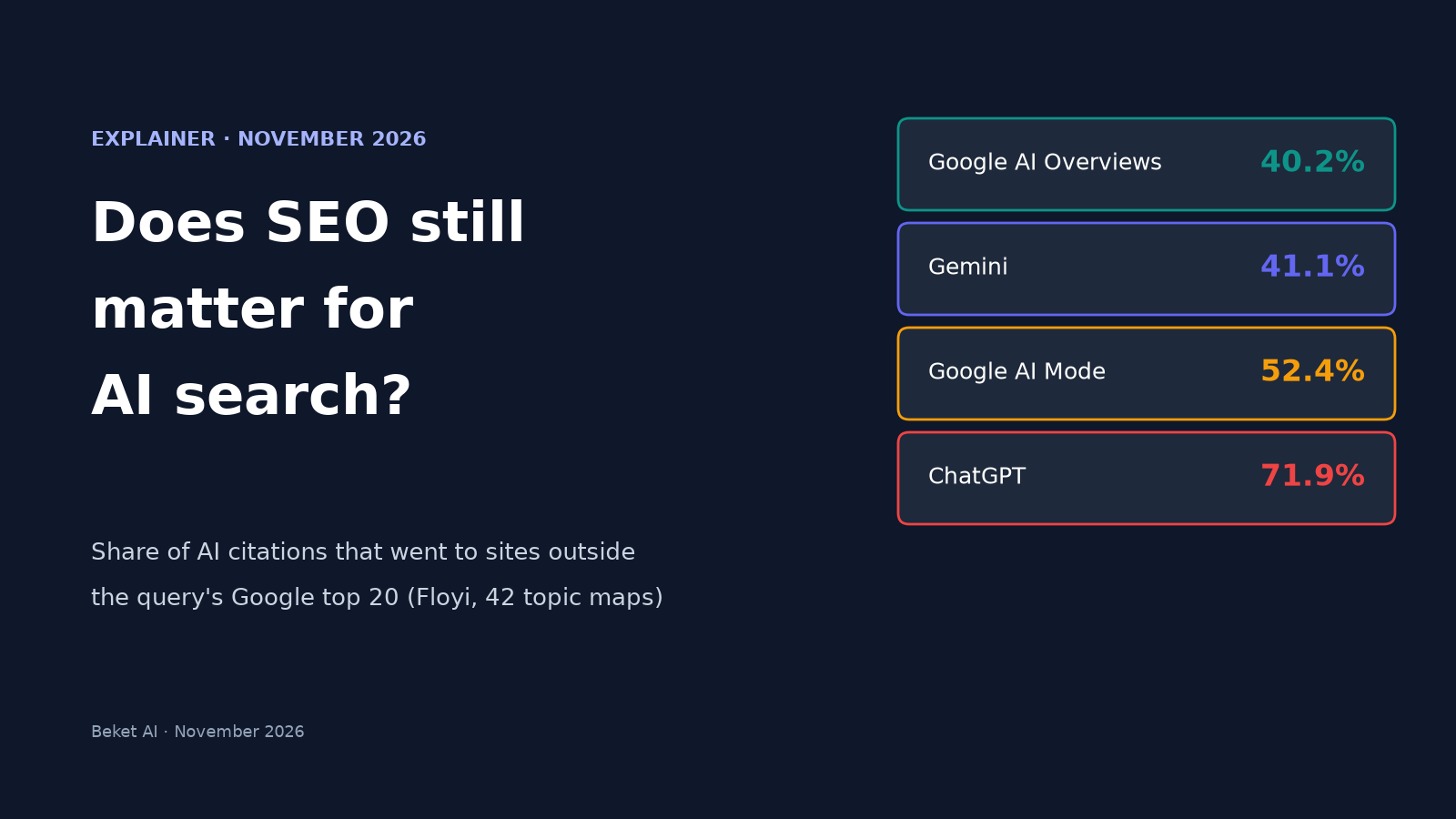
Does SEO Still Matter for AI Search? What Rankings Predict, Engine by Engine (2026)

Google started rolling out its November 2026 core update on November 10, and it can take up to two weeks to finish (Search Engine Roundtable). Rankings will move. So the obvious next question for anyone who cares about AI answers: if my Google position changes, does my visibility in ChatGPT, Gemini and Google's AI features change with it?
The short answer from this year's research: SEO still matters for AI search, but how much depends on the engine, and on whether you want to be cited or named. Google's AI Overviews lean hard on the pages that rank. ChatGPT mostly doesn't. And the brands AI answers actually name in the text are usually not the sites ranking for that query.
Here is what five recent reports measured, engine by engine, and what to do about it.
The reports behind this
None of these studies is perfect, and they measure slightly different things. Read the numbers next to their method.
| Report | Date | Sample | What it measured |
|---|---|---|---|
| Ahrefs | March 2026 | 863,000 keyword results pages, 4 million AI Overview URLs | Where AI Overview-cited URLs ranked for the same query |
| Serplify | October 9, 2026 | 494 US desktop searches, 2,931 cited links | AI Overview citations vs the organic top 10 |
| Floyi, Part 1 | 2026 (updated Sep 2) | 42 topical maps, 535,239 rankings, 354,955 AI citations | Citations vs top-20 rankings on AI Overviews, AI Mode, ChatGPT and Gemini |
| Floyi, Part 2 | October 14, 2026 | Same maps, 38,723 AI answers, 114,584 possible mentions checked in context | Brand mentions (named in the text) vs citations (linked sources) |
| Laurelin Labs | November 2026 | 235 keywords, 158 in the final test | What predicts which top-ranking pages AI Overviews cite |
All four publishers sell SEO or AI search tools or services. Every study is observational: it shows what goes together, not what causes what. None of them covers Perplexity.
Engine by engine: how much rankings matter
Google AI Overviews: rankings matter most here
This is where your SEO work carries over most directly.
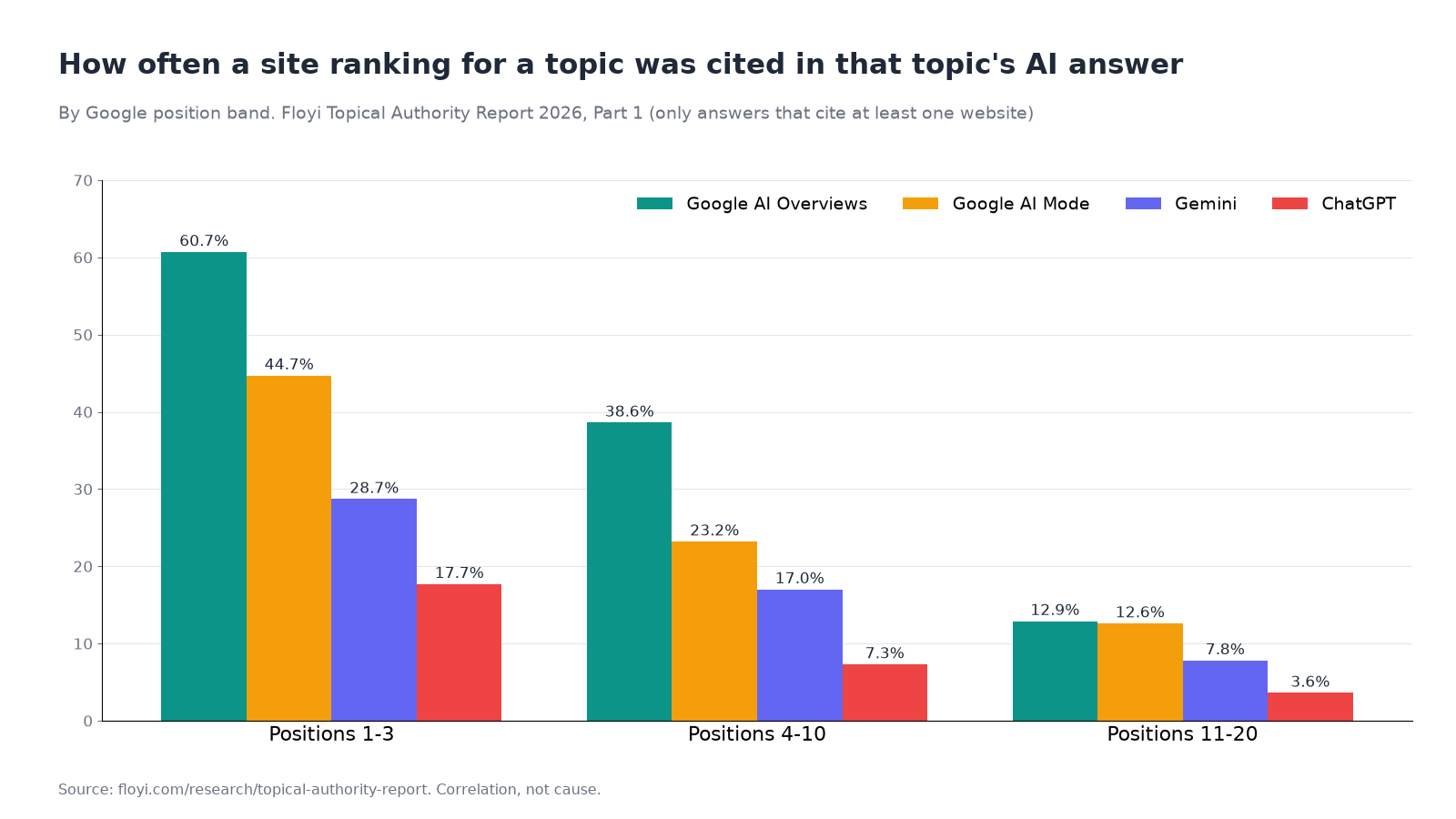
- In Floyi's data, a site ranking in positions 1 to 3 for a topic was cited in that topic's AI Overview 60.7% of the time. That fell to 38.6% at positions 4 to 10 and 12.9% at 11 to 20.
- Laurelin Labs ran a pre-registered test, meaning the analysis was fixed before the data came in. Among pages competing for the same query, a better organic rank was the strongest predictor of being cited, with page length second. Covering more of the "fan-out" sub-questions added nothing once rank and length were known.
- Serplify found that 60% of AI Overviews (227 of 380) cited at least one top-10 page, and 37% cited the number 1 result.
But ranking isn't the whole story, even on Google:
- Ahrefs found 37.9% of AI Overview-cited URLs also appeared in the top 10 for the same query. Another 31.2% sat in positions 11 to 100, and 31.0% were beyond the top 100. Ahrefs' July 2025 version of the study had put the top-10 share near 76%, but it changed its parser and sample since, so the two figures aren't a clean trend line.
- Serplify's smaller October sample found only 26% of cited links (776 of 2,931) were top-10 pages for that search. At the site level it was 51%.
- In Laurelin's sample, 54% of cited pages sat outside the query's top 10.
Google explains part of this itself: AI Overviews and AI Mode "may use a 'query fan-out' technique," issuing related searches across subtopics to build the answer (Google Search Central). So a page can be cited because it ranks for a related search, not the one you typed.
Google AI Mode: still tied to rankings, but looser
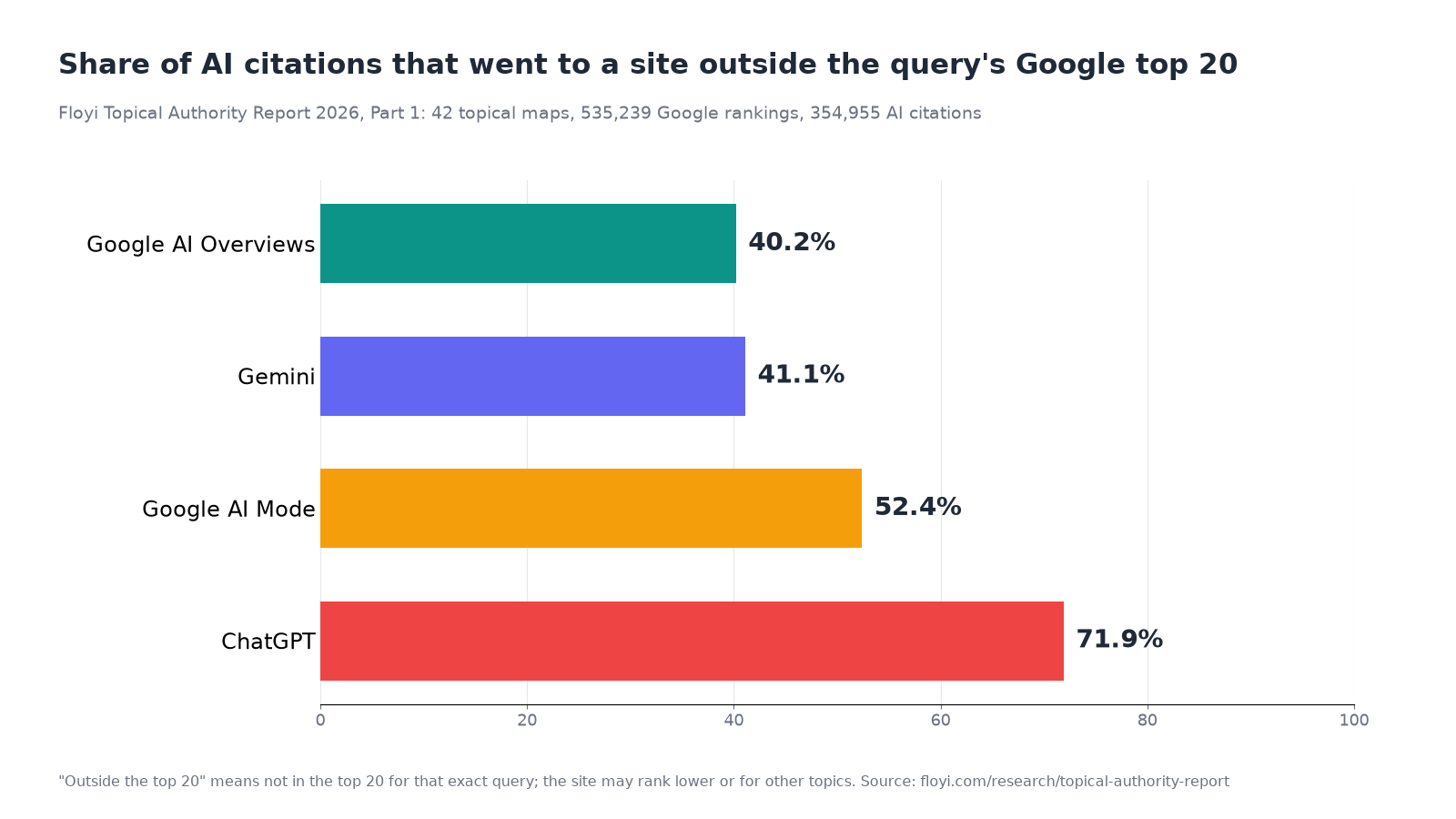
Floyi found 52.4% of AI Mode citations went to sites outside the query's top 20. A site in positions 1 to 3 was cited 44.7% of the time, against 60.7% for AI Overviews. For how the two Google features differ in practice, see our AI Mode vs AI Overviews comparison for local businesses.
Gemini: in between
Floyi found 41.1% of Gemini's citations came from outside the query's top 20, close to AI Overviews. But Gemini cites fewer sites, and a top-3 site was cited only 28.7% of the time. Gemini also often skips the web entirely. Floyi's Part 2 found Gemini cited nothing in 45.0% of its answers, and Laurelin saw the Gemini API run no search at all in 47% of answers.
ChatGPT: rankings matter least
ChatGPT is where Google SEO carries over least.
- 71.9% of ChatGPT's citations in Floyi's data went to sites outside the query's Google top 20.
- A site in positions 1 to 3 was cited only 17.7% of the time, 7.3% at positions 4 to 10 and 3.6% at 11 to 20.
- ChatGPT cited no website at all in 40.8% of its answers (Floyi Part 2). Those answers come from what the model already knows, so no ranking can get you into them directly.
Being named is a different game from being cited
Most research counts citations: the source links next to the answer. But a buyer reads the answer itself. If ChatGPT says "Try X or Y," that's the recommendation, whether or not X's website is linked. Floyi's Part 2 measured those mentions separately, and the gap is large.
- Most brands AI answers name don't rank for the query. Only 23.0% (ChatGPT) to 43.2% (AI Overviews) of the ranking websites mentioned in an answer were in that query's own top 20.
- Mentions and citations rarely overlap. 59.7% (AI Overviews) to 92.5% (Gemini) of the websites an answer named were not cited in that same answer.
- Small sites get most of their mentions on queries they don't rank for. Sites ranking for under 5% of a topic map got 65.4% to 80.8% of their mentions on queries where they weren't in the top 20.
- Commercial questions carry the mentions. Answers to buying and comparison questions named 2.0 to 2.6 times as many brands as informational answers.
- Ranking still helps where you do rank. A small site in a query's top 20 was mentioned in 2.37% to 4.48% of mentioning answers, against 0.10% or less where it didn't rank.
This is why checking only your ranking keywords undercounts your AI visibility. Most of your mentions, and most of your misses, sit in questions you've never tracked.
| Google AI Overviews | Google AI Mode | Gemini | ChatGPT | |
|---|---|---|---|---|
| Citations from outside the query's top 20 | 40.2% | 52.4% | 41.1% | 71.9% |
| Top-3 site cited in that topic's answer | 60.7% | 44.7% | 28.7% | 17.7% |
| Named brands that are in the query's top 20 | 43.2% | 34.7% | 26.0% | 23.0% |
| Answers that cite no website | 0.0% | 7.8% | 45.0% | 40.8% |
All figures from Floyi Part 1 and Part 2, "typical map" values where the report gives them. They describe one dataset of 42 curated topic maps.
What this means for your plan
1. Keep doing SEO, especially for Google's AI features
If your buyers use Google, rankings are still the main way into AI Overviews. The Laurelin test found rank for the main query, not sub-question coverage, predicted which top-ranking pages got cited. Don't trade proven SEO work for "AI hacks." Our SEO vs GEO vs AEO explainer covers where the work overlaps and where it doesn't.
2. Push commercial pages from page one into the top 3
Floyi's Part 2 found a site in a commercial query's top 3 was named in 10.1% to 18.0% of answers that mention a website, against 4.3% to 7.8% for positions 4 to 10. If you have money pages sitting at 4 to 10, that's the cheapest lift for both Google and AI answers.
3. Rank for more of your topic, not just your head terms
In Floyi's Part 1, ranking across more of a topic map tracked AI citations far better than Domain Rating did (0.51 against 0.09 on AI Overviews, 0.33 against 0.15 on ChatGPT). Sites that covered more of the topic also picked up more off-query citations, where a site is cited for a question it doesn't rank for.
4. Check the questions buyers ask, not only your keywords
Since most mentions come from queries you don't rank for, your keyword list is the wrong checklist for AI. Build a list of real buyer questions: "best X for Y," "X vs Y," "who should I hire for…," and price and trust questions. Our list of 67 questions customers ask AI before hiring a local business is a good starting set.
5. Track citations and mentions separately, on each engine
A citation in AI Overviews and a mention in ChatGPT are different results with different causes. Treat them as two numbers per engine. For the Google side, here's how to track what AI Overviews say about your business.
6. During the core update: baseline now, compare later
Google recommends waiting at least a full week after a core update finishes before analyzing changes, then comparing against a week before it started (Google Search Central). The November rollout can run until around November 24, so the fair comparison window opens around December 1. Record your AI answers now as well. If your rankings shift, you'll see whether your AI Overview citations moved with them, and whether ChatGPT barely noticed.
Where Beket AI fits
Beket AI checks the answers, not your rankings. The free audit runs 25 unbranded buyer questions across ChatGPT, Perplexity and Google AI Overview and shows which businesses each engine names, including whether it names you. Pro is $49/month and re-runs the audit daily, starting at 50 prompts across 3 engines. That gives you a baseline before the core update settles and a way to see change per engine afterward. Run a free audit.
AI answers change over time, and every figure in this post is a snapshot from the study dates listed above.
Related posts
Best Free AEO and GEO Tools in 2026 (Ranked and Checked)
9 free AEO and GEO tools, ranked and checked Nov 10, 2026: Beket AI's 25-prompt audit first, then /ai-check, Ahrefs, Semrush, Search Console, Bing and more.
How much does AI visibility tracking cost?
Published AI visibility prices as of November 2026: Beket AI Pro is $49 a month, Agency is $245 a month for 5 sites, and Otterly Lite starts at $29 a month.
Best AEO Courses and Communities in 2026 (Free and Paid, Checked)
9 AEO courses (Ahrefs, HubSpot, Semrush, Coursera, CXL) and 8 communities, checked Nov 10, 2026: length, price, certificate and which one to start with.