
GEO for Law Firms: How to Get Your Firm Recommended by ChatGPT (Data From 3 City Studies)

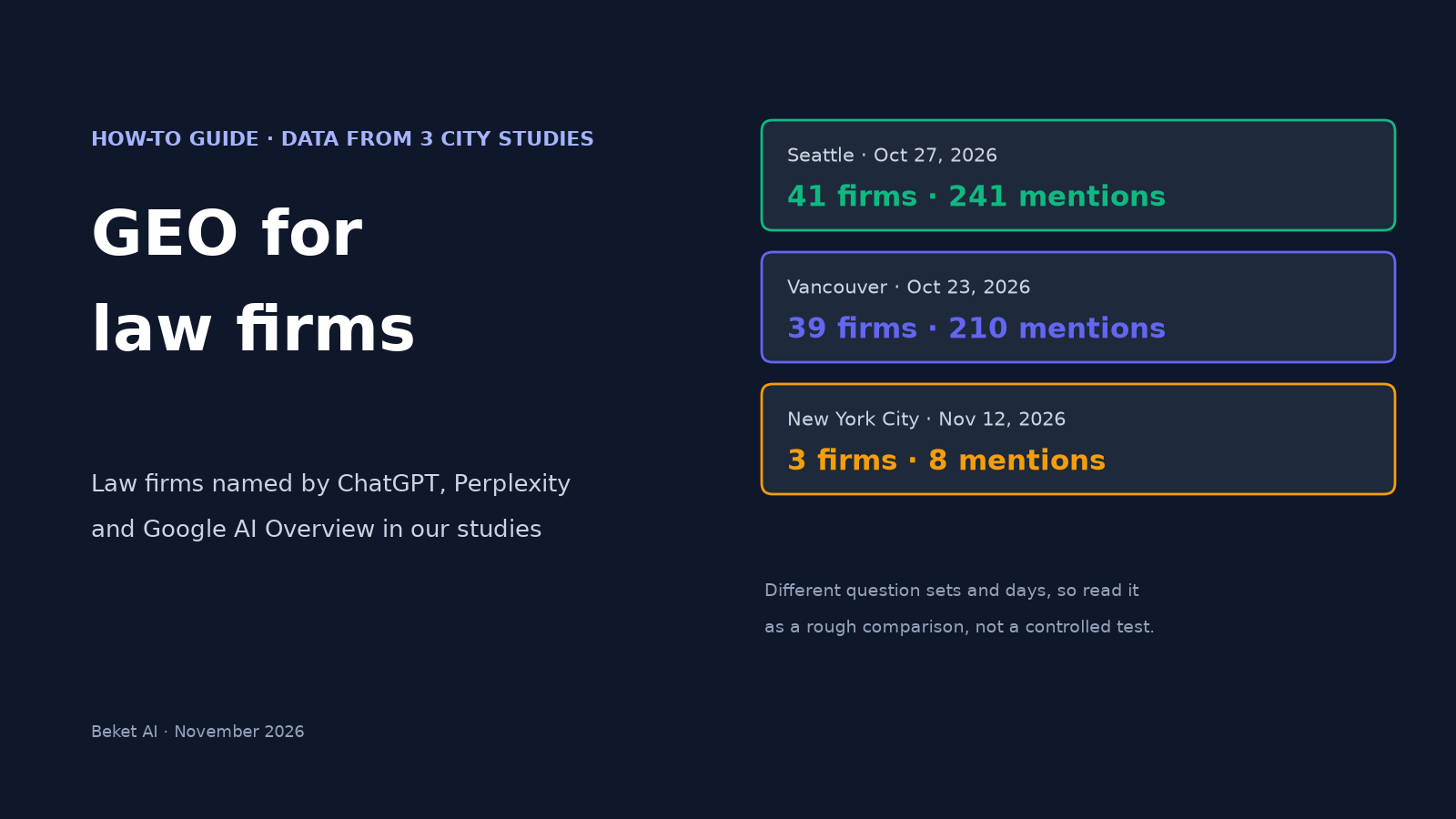
Ask ChatGPT, Perplexity and Google AI Overview for a lawyer in Seattle and you get a crowded list. In our October audit, the three engines named 41 Seattle law firms 241 times. Ask the same kind of questions about New York City and the list almost disappears: in November, 26 answers named just three firms, 8 times in total.
Same engines, same kind of unbranded questions, very different results. That gap is the most useful thing we know about GEO for law firms, because it shows that "get cited by AI" isn't one job. Who gets named depends on the city, the practice area and the engine, and in some markets the AI hands the decision to a bar referral service or a directory instead of naming anyone.
This guide turns the data from our three lawyer studies (Seattle, Vancouver and New York City) into seven steps a firm can actually work through. GEO here means generative engine optimization: making your firm easy for AI answer engines to find, understand and name.
What three city studies show
Each study was one Beket AI audit on one day, with unbranded questions such as "divorce lawyers in Seattle" or "how much does a lawyer cost in New York City". None of the questions named a firm.
| Seattle | Vancouver | New York City | |
|---|---|---|---|
| Study date | Oct 27, 2026 | Oct 23, 2026 | Nov 12, 2026 |
| Questions | 25 + 4 discovery prompts | 25 + 4 discovery prompts | 10 |
| Answers recorded | 69 | 61 | 26 |
| Law firms named | 41 | 39 | 3 |
| Law firm mentions | 241 | 210 | 8 |
| Named on all three engines | 7 | 1 | 0 |
| Named on only one engine | 13 | 11 | 2 |
| Google AI Overview answers | 11 of 29 prompts | 3 of 29 prompts | 6 of 10 questions |
The question sets and dates differ, so treat this as a rough comparison rather than a controlled test. Three patterns still hold across all three cities.
ChatGPT did most of the naming. It accounted for 132 of 241 firm mentions in Seattle, 132 of 210 in Vancouver and 7 of 8 in New York City.
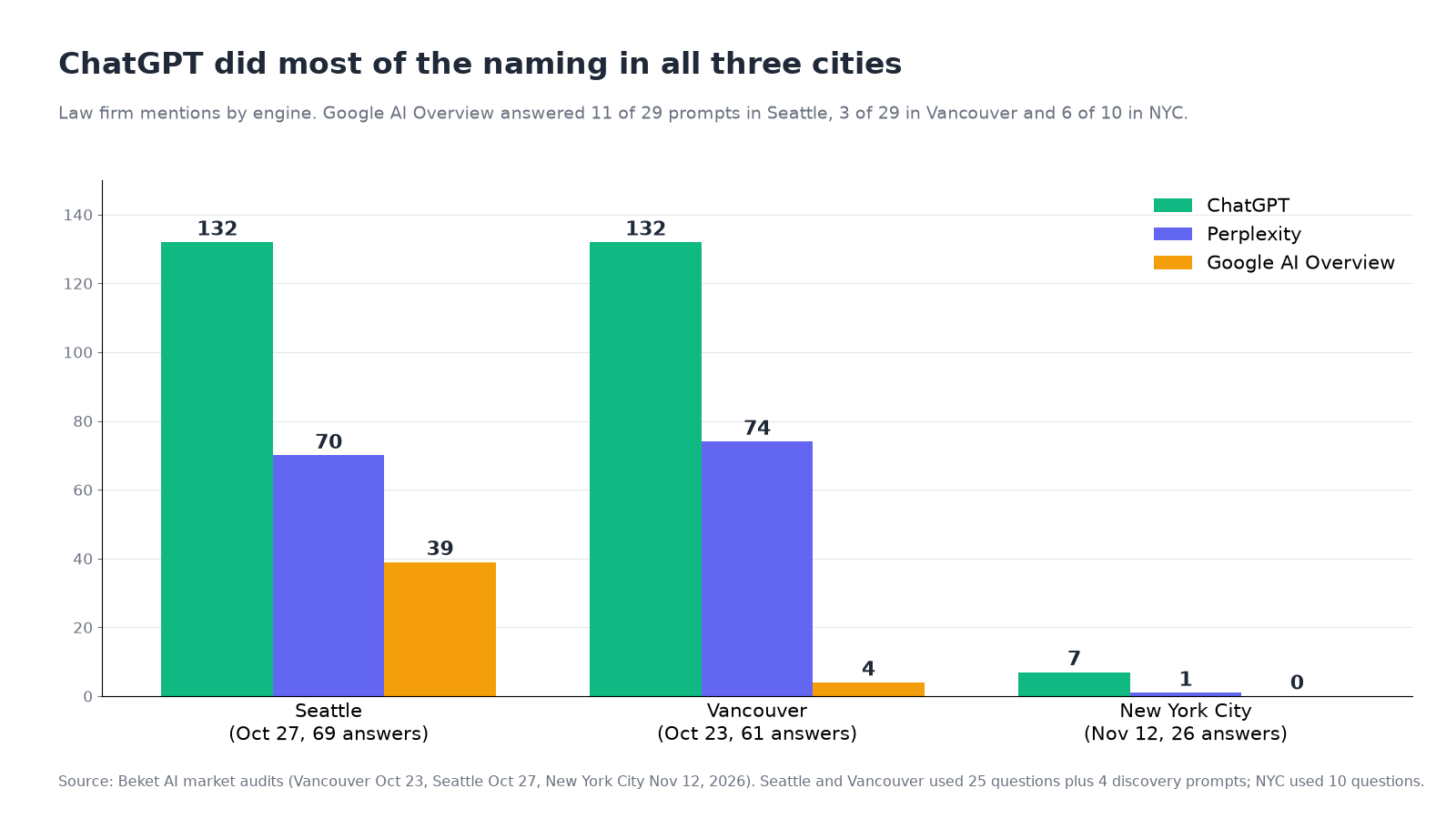
Each engine had its own favorites. In Vancouver, ChatGPT named Blakes most (13), Perplexity named Watson Goepel LLP most (8) and Google AI Overview named YLaw most (3). Fasken led the combined count without leading any single engine. In Seattle, ChatGPT's top firm was Wilson Sonsini (16), Perplexity's was Davis Wright Tremaine (10) and AI Overview's was K&L Gates (6).
Google AI Overview often didn't answer at all. It returned an answer for only 3 of 29 prompts in Vancouver and 11 of 29 in Seattle. In New York City it answered 6 of 10 questions and named no law firm in any of them.
Why it's worth the effort now
People do use AI to pick a lawyer, though not instead of Google. In iLawyer Marketing's July 2025 study of 1,052 US adults, 28.1% said they would use ChatGPT to research a lawyer for an important legal issue, up from 9% in 2023. Google was still first at 86.7%, and more than 94% of the people who would use ChatGPT said they would also use Google.
So the realistic goal isn't to replace your SEO. It's to make sure that when someone asks an AI first, your firm is in the short list they then go and check. Google itself says there are no extra requirements or special optimizations for AI Overviews and AI Mode beyond normal SEO best practices, which is good news: most of the work below also helps your regular search results.
Step 1: Write the questions your clients actually ask
Start with a list of unbranded questions, not your firm's name. A branded check ("is Smith Law good?") tells you how AI describes you once someone already knows you. The unbranded question is the one that decides whether they ever hear of you.
Our studies used four kinds of questions, and they make a good template:
| Question type | Example from our studies |
|---|---|
| Practice area plus city | "employment lawyers in Seattle", "immigration lawyers in New York City" |
| Cost | "how much does a lawyer cost in Vancouver BC" |
| How to choose | "how to choose a lawyer in New York City" |
| Nearby towns | "lawyers in Kirkland WA", "lawyers in Burnaby" |
Use your clients' wording, not legal terms of art. Our Seattle list said "wrongful termination" where Vancouver said "wrongful dismissal", because that's how people in each place talk. The New York list asked about "lawyers for buying a co-op" instead of a generic real estate question.
Ten to twenty-five questions per office is plenty to start. If you want more, your intake notes and the questions people ask in first consultations are a good place to find them.
Step 2: Check every engine on its own
Run each question on ChatGPT, Perplexity and Google, and record the results per engine. In Seattle, only 7 of the 41 firms were named by all three engines, and 13 appeared on just one. A firm that checks only ChatGPT could think it's doing well while Perplexity never mentions it.
For each answer, write down four things:
- Was your firm named, and in what position?
- Which other firms were named?
- Which sources were cited?
- Is anything about your firm wrong (practice areas, office location, jurisdiction)?
Our guide to checking whether ChatGPT recommends your business walks through doing this by hand. Keep the results in a spreadsheet with the date, because the next step depends on comparing runs.
Step 3: Find out who the AI trusts instead of you
The cited sources tell you what the engines leaned on, and for lawyers it's often not a law firm website.
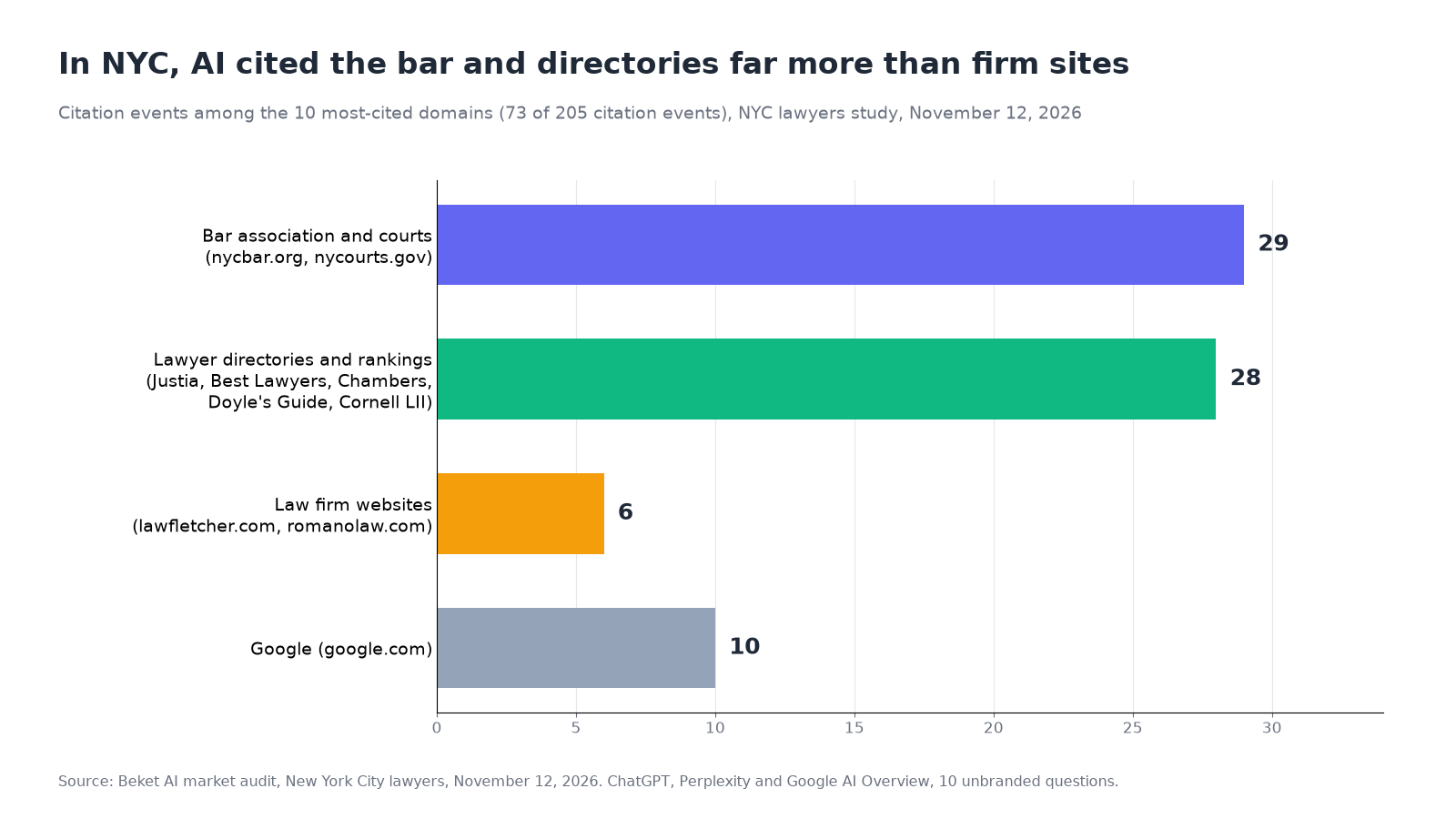
In New York City, the most-cited domain was nycbar.org, the New York City Bar Association, with 23 of 205 citation events. Among the 10 most-cited domains, the bar association and the courts had 29 citation events, lawyer directories and rankings had 28, and law firm websites had 6.
Directories also showed up as named "answers" in their own right. In Seattle, two lawyer directories and a review site were named 29 times, and Justia alone had 19 mentions, mostly on Perplexity. In New York City, Justia was named 4 times. We left these out of the firm counts in the studies, but they matter for your plan: if the engines send people to a directory, your profile there is part of your AI visibility.
What to do with this:
- List the directories, ranking guides and bar pages that appear in your answers.
- Check that your profile on each one is complete and matches your website: firm name, lawyers, practice areas, offices and phone number.
- Note any ranking guide that keeps getting cited. It may be worth the effort to get listed there, through whatever process that publisher uses.
Step 4: Make each practice-area page answer one real question
When AI does cite a firm website, it needs a page that answers the question directly. In New York City, romanolaw.com was one of only two firm sites in the top ten cited domains, and one of its cited URLs was the firm's small-business law page, a page about exactly the kind of matter one of our questions asked about.
For each practice area you want to be named for:
- Put the direct answer first. If the question is "how much does a divorce lawyer cost in Seattle", the first paragraph should give a real answer: how you bill, typical ranges if you're willing to publish them, and what changes the cost.
- Name the place and the jurisdiction. "We handle wrongful dismissal claims under BC law for employees in Vancouver, Burnaby and Surrey" is easy for an engine to match to a local question. A page that never names a city is not.
- Date and update it. Say when the page was last reviewed, and actually review it when the law or your fees change.
- Stay within your advertising rules. Superlatives like "best divorce lawyer in New York" can run into lawyer advertising rules, so check with your state bar or law society before publishing comparative claims. Plain facts (years in practice, bar admissions, the kinds of matters you handle) are both safer and easier for AI to quote.
Step 5: Keep your firm's name consistent everywhere
AI answers often use a short name. To count mentions correctly in our studies, we had to merge spellings: "DWT", "Davis Wright Tremaine" and "Davis Wright Tremaine LLP" in Seattle, and "Blakes" and "Blake, Cassels & Graydon LLP" in Vancouver.
If people and engines call your firm two different things, make the link between them obvious:
- Use your full legal name and your common short name together on your About page.
- Use the same name format on Google Business Profile, Bing Places, directories and bar listings.
- In your structured data, use the schema.org LegalService type, with
alternateNamefor the short name andsameAslinks to your official profiles. Note that schema.org now marks the older Attorney type as deprecated in favor of LegalService.
Google's guidance is that structured data should match the visible text on the page, and that you don't need any special schema to appear in AI features. So treat markup as a way to describe what's already on the page, not as a ranking trick.
Step 6: Make sure the AI crawlers can read your site
None of the above helps if the engines can't fetch your pages. Check your robots.txt and any firewall or CDN bot settings for these three:
| Engine | What to allow | Official docs |
|---|---|---|
| ChatGPT search | OAI-SearchBot | OpenAI crawlers |
| Perplexity | PerplexityBot | Perplexity crawlers |
| Google AI Overviews and AI Mode | Googlebot | Google: AI features and your website |
One common mix-up: blocking Google-Extended doesn't remove you from AI Overviews. Google says Googlebot's robots.txt rules are the control for Search, including its AI features, while Google-Extended covers training and grounding in some of Google's other systems. Similarly, OpenAI says sites that block OAI-SearchBot won't be shown in ChatGPT search answers, and that setting is separate from GPTBot, its training crawler.
Step 7: Re-check on a schedule and track what you can
One run is a snapshot. Answers change from day to day and from engine to engine, and which is why a single check can't tell you where you stand for good. Re-run the same question list monthly, or after you change your site or a major directory profile, and compare.
Alongside the answers, track the things that tell you whether AI visibility is turning into clients:
- Intake source. Add "an AI assistant like ChatGPT" as an option when you ask new clients how they found you.
- Branded searches. If AI answers start naming you, people may search for your firm by name afterward, so watch that number in Search Console.
- Accuracy. Keep a log of anything an engine gets wrong about your firm and what you changed to correct it.
If you'd rather not do the checks by hand, the free Beket AI audit runs 25 prompts across ChatGPT, Perplexity and Google AI Overview. Beket AI Pro is $49 a month with daily re-audits, starting at 50 prompts across the same three engines.
A one-page checklist
- [ ] 10 to 25 unbranded questions per office, in your clients' words, covering practice areas, cost, how to choose and nearby towns
- [ ] Each question checked on ChatGPT, Perplexity and Google, with results recorded per engine and dated
- [ ] A list of the directories, rankings and bar pages the engines cite for your questions
- [ ] Complete, consistent profiles on each of those sources
- [ ] One practice-area page per key question, with a direct answer first, the city and jurisdiction named, and a review date
- [ ] Comparative claims checked against your bar's or law society's advertising rules
- [ ] Full name and short name linked on your site and in LegalService structured data
- [ ] OAI-SearchBot, PerplexityBot and Googlebot allowed in robots.txt and your CDN
- [ ] A monthly re-check, plus an "AI assistant" option in your intake form
About the data
The figures in this guide come from three Beket AI market audits: lawyers in Vancouver (October 23, 2026), Seattle (October 27, 2026) and New York City (November 12, 2026). Each was a single run on ChatGPT, Perplexity and Google AI Overview with unbranded questions. Seattle and Vancouver used 25 questions plus 4 discovery prompts the audit added; New York City used 10 questions. Counts are mention events, not recommendation rates, and directories were left out of the firm counts. A mention says nothing about a firm's quality, fees or results, and nothing here is legal advice.
This is the data the engines returned on those days, and AI answers change over time. Full question lists, per-engine tables and method notes are in each study. If your firm appears in one of them, or you'd like a study re-run, you can ask Beket AI for another run.
Related posts
AI Search This Week: Gemini 4 Hydrogen Takes Over Google Search (Nov 13, 2026)
Gemini 4 Hydrogen now powers Google Search, the November core update is rolling out, and ChatGPT opened business profiles. The week in AEO, GEO and SEO.
How to Use a ChatGPT Business Profile for GEO and AEO (And What It's Missing)
How to claim a ChatGPT business profile, use it for GEO and AEO, and what official Insights leave out: no prompts, citations, competitors or sentiment.
Prompt Research From Support Tickets: How to Find the Questions Buyers Ask ChatGPT (2026)
Keyword tools miss most AI prompts. How to turn support tickets into real buyer questions, check what ChatGPT, Perplexity and AI Overviews say, and answer them.