
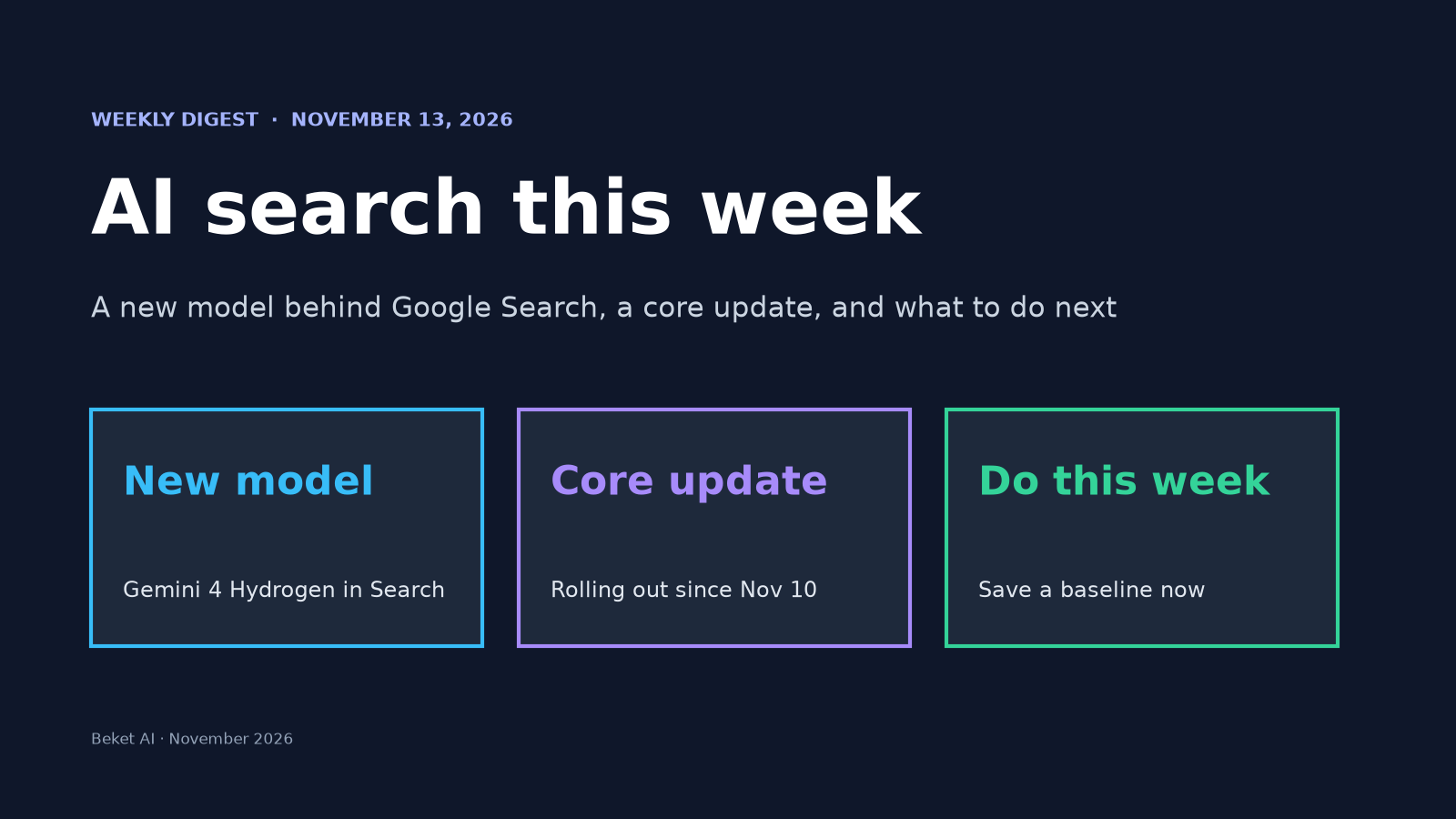
AI Search This Week: Gemini 4 Hydrogen Takes Over Google Search (Nov 13, 2026)

Two big Google changes landed on top of each other this week: a new model behind Search on November 12 and a core update that started two days earlier. OpenAI also opened a business listing inside ChatGPT, and ads kept spreading through AI Mode.
Our take: Most of what you'll read about this week is about where AI search is heading. Hardly any of it is measured yet. Google gave no figures for its new model, the core update is still rolling out, and some of the loudest stories come from one person or one screenshot. So this isn't the week to rewrite your site. It's the week to write down what AI engines say about you today, so you have something to compare against in two weeks. The community stories below point the same way: the people who got burned were the ones who trusted a single number, whether that was a ranking, a mention count or an AI-made "top agencies" list.
1. Top news
Gemini 4 Hydrogen now powers Google Search for everyone
On November 12, Google put Gemini 4 Hydrogen into Search for all users worldwide and called it "the biggest model upgrade to Search yet." Google says the new model handles long, multi-part and typo-filled questions better. It also says the improved query fan-out, where Search runs many related searches at once for each subtopic of a question, connects people "to a broader range of helpful links than before." Answers will show more images, comparison tables and custom tools. Hydrogen replaces Gemini 3.8 Flash (Ars Technica). Google's post talks about Search and AI Mode but doesn't mention AI Overviews by name (PPC Land). It gives no figures, so nobody outside Google has measured the effect yet.
Our take: Treat November 12 as a dividing line. Any AI Mode or AI Overview results you collected before it are now a "before" snapshot. "A broader range of links" could mean more businesses get named, or the same few get named next to more sources. Nobody knows which yet, so check your own questions before you change anything.
Source: Google
Google's November 2026 core update is rolling out
It started November 10, applies globally to all languages and may take up to two weeks, which puts the finish close to Black Friday. Google shared no new guidance.
Our take: With a new model and a core update overlapping, you can't pin a change in traffic or AI mentions on either one. Wait for the rollout to finish before you react.
Source: Search Engine Land
Businesses in ChatGPT launched in beta
Any eligible business, in countries where ChatGPT is available, can claim its profile in Business Hub, update its details and product feeds, and see aggregated mentions, website clicks and "discovery topics." US ecommerce and online-service businesses can also launch a Business Agent, which can be sponsored as an ad destination. It doesn't show prompts or conversations, and insights only appear above privacy thresholds.
Our take: This is the first time OpenAI has given businesses any first-party numbers about how ChatGPT talks about them, so claim it. But it shows totals, not the questions people asked, so you still need to check which questions name you and which name a competitor. Our Business Hub guide walks through claiming it.
Source: OpenAI
More ads inside AI Mode shopping answers
Screenshots shared on November 12 show a "Sponsored" pack of products "available from local retailers" under an AI Mode answer, plus "Sponsored stores" inside the product panel. One analyst counted four sponsored placements in a single response. This is screenshot-only, with no data on how often it shows, and Google hadn't commented.
Our take: Expect Black Friday shopping answers in AI Mode to carry more paid placements. The part you can influence without paying is whether your store is named in the answer text itself.
Source: PPC Land (screenshot-based, single report)
ChatGPT may be leaning on its own index instead of live page fetches
One practitioner reports a big, sustained drop in ChatGPT-User visits while OAI-SearchBot crawling rises across the sites he monitors. This is single-source and not confirmed by OpenAI.
Our take: One person's data isn't a trend. But checking it costs nothing, and if it holds, a page ChatGPT hasn't recrawled can keep feeding old facts into answers. Here's how to check both bots in your logs.
Source: Masters of Search (single source)
Bing re-explained how searchers can turn off AI answers
There's a preview browser extension and a "-ai" query operator.
Our take: This is a setting for searchers, not a control for publishers, and few people will switch it on. Plan as if most of your customers will see the AI answer first.
Source: Bing Search Blog
Google is testing AI Overview source icons at the bottom of the answer
So far, one SEO has seen this test.
Our take: If it ships, citations get even harder to see, and being named in the answer text matters more than being one of the links.
Source: Search Engine Roundtable (a test, not a rollout)
2. From the community
These are the most useful success and failure stories we saw on X, LinkedIn and Reddit this week. They're self-reported, so we've noted what each one does and doesn't prove.
1. An AI "study" ranked a parked domain as Estonia's #2 SEO agency (X, @MeelisVill). An AI study that ranked "Estonia's SEO agencies" put a parked domain in second place. The post says it was recommended in 273 of 1,080 AI answers, 181 times as the top pick, and that the domain is for sale for $10,000. Outcome: failure. The second-place "agency" doesn't exist. Our take: AI-made rankings are only as good as what the engines happened to find, and vendors are now writing their own. Open the names before you trust a list, and expect engines to keep marking self-serving rankings, as ChatGPT has started to do (our explainer). Single-source. We haven't seen the underlying study. Read the post
2. "Position 4.3" with 0 clicks, and the page wasn't in the organic results at all (X, @iraiansar). Search Console showed his post at an average position of 4.3 for "website monitoring for agencies," with 157 impressions and 0 clicks from October 3 to 30. When he pulled the live US results 20 deep on November 1, the post wasn't in any of the 19 organic results. It was in the AI Overview at the top, as a cited source. He saw the same pattern on a second query. Outcome: a reporting trap. An AI Overview citation looked like a top-5 ranking. Our take: This is the clearest example this week of why AI Overview citations and rankings have to be reported separately. If you report to clients, here's how agencies report AI search visibility. Read the post
3. Already in ChatGPT without doing anything "for AI" (X, @ConnorGillivan). He writes that when he first checked, EcomBalance was already showing up in ChatGPT answers, and the team hadn't done anything specifically for AI. He credits years of plain SEO and brand building, and says every AI search tactic he has tried since works better on a brand the model already knows. Outcome: success, by his account. Our take: We agree with the order of operations. Be a brand the web talks about first, then tune for engines. How much rankings matter depends on the engine, though. We pulled the data together in Does SEO Still Matter for AI Search? Read the post
4. 2.7 billion AI appearances, and Google traffic still fell 37% (X, @ai_seo_geo). The post says Ziff Davis appeared 2.7 billion times in Google's AI answers while its Google traffic fell 37%, and cites the company's latest earnings call for both numbers. The author points out that this doesn't prove AI caused the whole drop, and that the two numbers aren't a clean comparison. Outcome: a warning about counting visibility as a win. Our take: Mentions are an early signal, not the result you're after. Track them next to clicks, leads and orders, and if mentions rise while orders fall, ask why. The figures are as the post relays them from the earnings call. We haven't checked the call ourselves. Read the post
5. Merging a second website brought the biggest AI search jump of the year (LinkedIn, Matthew Proctor). He describes a large staffing company that moved content from a second domain into its main site around March. After the merge, he reports, AI Overview appearances rose from 96 in January to 855 in August, the content hub's clicks went from 434 in February to 6,220 in August, and average position on the main domain improved from about 19 to 8.5. Outcome: success, self-reported. It's a before-and-after comparison, not a controlled test. He posted it in October, and it reached our queue this week. Our take: Consolidating domains is an underrated lever. A brand split across several sites gives engines several weaker signals instead of one strong one. If your brand lives on more domains than it needs, look at that before you buy another AI search tool. Read the post
6. A local specialist squeezed by map proximity (Reddit, u/mediamuesli in r/localseo). A product photographer says he used to show up in the local pack across 10 or sometimes 20 miles. After Google's latest proximity update, he can barely rank within 2 miles, behind closer businesses from other niches. He's asking whether reviews are still worth the effort, and he's left looking at ads and AI visibility. Outcome: failure, and an open question. Our take: AI answers to specific questions are a separate place to show up, and they're worth checking. In our Seattle audits, 22 of 67 unbranded questions named a neighborhood and 17 asked for a specific job (what customers ask AI before hiring). Pages that clearly say what you do and where you serve give engines something to quote. Read the thread
3. Number of the week: 4% to 10%
In Victorious' Q3 2026 Search Report, any two AI platforms shared only 4% to 10% of their cited sources when they answered the same question. The report collected about 16,500 AI answers across nine platforms on September 29. Even the same platform, asked the same question twice, reused only about a quarter to three quarters of its sources. The brands named held steadier than the sources, and how many other sites mentioned and linked to a brand was the strongest signal (Victorious press release). It's one agency's single data collection, so treat it as directional.
Our take: Our own audits point the same way. In the NYC mortgage brokers study below, only 4 of the 15 brokers and lenders named showed up on all three engines. Being visible on one engine tells you little about the others.
4. Our studies this week
We ran 9 studies and audit write-ups this week. Each one is a snapshot of what ChatGPT, Perplexity and Google AI Overview returned on one day, not our ranking of anyone.
- Which NYC Mortgage Brokers Does AI Recommend? GuardHill Financial was named most, with 16 mentions. In all, 28 answers named 15 brokers and lenders 92 times, only 4 appeared on all three engines, and the most-cited source was the state regulator, dfs.ny.gov (21 citation events).
- Which NYC Lawyers Does AI Recommend? Across 26 answers to 10 questions, the engines named just 3 law firms, 8 times in total. They pointed people to nycbar.org instead, the most-cited source with 23 of 205 citation events.
- Which NYC Realtors Does AI Recommend? Compass, Corcoran, Brown Harris Stevens and Douglas Elliman took 145 of 287 brokerage mentions (50.5%), and Compass alone had 63.
- Which Online Learning Platforms Does AI Recommend? Coursera took 177 of 425 mentions (41.6%), and Coursera, Udemy and edX together took 73.2%.
- Which LA Marketing Agencies Does AI Recommend? SmartSites led with 15 mentions, and only 3 of 30 agencies showed up on all three engines.
- Which SaaS Tools Does AI Recommend? Out of 645 citation events, 8 of the top 10 cited domains were vendors' own sites, not review sites.
- Which Legal AI Tools Does AI Recommend? Spellbook had 113 mention events and Harvey had 100, but the engines disagreed on a leader. ChatGPT and Google AI Overview named Harvey most, while Perplexity named Spellbook most.
- Which SF Marketing Agencies Does AI Recommend? Jives Media led with 34 of 242 agency mentions (14.0%).
- What Questions Do Customers Ask AI Before Hiring a Local Business? Only 9 of 67 unbranded questions from our Seattle dentist, plumber and cleaner audits asked for the "best" or "most trusted." The biggest group, 22, named a neighborhood.
Our take: For lawyers and mortgages, where the stakes are high and the industries are regulated, the engines leaned on bar associations and regulators. They named almost no law firms, and the mortgage answers named businesses but cited the regulator most. In crowded consumer and software categories, a few big names took most of the mentions. If you're a smaller business in either kind of market, your shot is the specific question (a neighborhood, a service, a price), not the generic "best" one.
5. Do this week
- Save a baseline now, and compare after the core update finishes. Run the unbranded questions your customers actually ask on Google AI Mode, AI Overviews and ChatGPT, and write down who gets named and which pages get cited. Here's how to track what AI Overviews say about your business. The free Beket AI audit runs 25 unbranded prompts if you want a starting point.
- Claim your business in ChatGPT. Open Business Hub (OpenAI's announcement), verify, and fix your details and product feed. Then check which questions actually name you, since the hub won't show prompts. Step-by-step: our Business Hub guide.
- Report AI Overview citations separately from rankings. As @iraiansar found, a citation can show up in Search Console as a top-5 position. Use Google's guidance on identifying Google Search traffic in analytics and server logs for the click side, and keep a separate list of the questions where you're cited (agency reporting guide).
- Check ChatGPT-User and OAI-SearchBot in your logs. If live fetches are dropping on your site too, make sure your key pages are easy to crawl so ChatGPT's own index has your current facts (log check guide).
- If you sell online or locally, check your shopping answers before Black Friday (November 27). Make sure your Merchant Center feed is accurate. Then search your main products in AI Mode and see whether your store is named in the answer text, not only in the sponsored units. If you want to go further, here's how to make your store buyable in AI Mode.
6. More from the Beket AI blog this week
- Are Google AI Overviews Accurate? What a Northwestern Health Study Found
- How to Write a SaaS FAQ Page for AI Search
- Best Free AEO and GEO Tools in 2026
- What Is Agentic Commerce? OpenAI's ACP vs Google's UCP, Explained
- ChatGPT API vs ChatGPT: Why AI Visibility Checks Don't Match What Users See
Want to see how AI engines talk about your business? Start with the free Beket AI audit, which checks 25 unbranded prompts. For ongoing tracking, Pro is $49/mo, and the Agency plan is $245/mo for 5 sites.
Related posts
Prompt Research From Support Tickets: How to Find the Questions Buyers Ask ChatGPT (2026)
Keyword tools miss most AI prompts. How to turn support tickets into real buyer questions, check what ChatGPT, Perplexity and AI Overviews say, and answer them.
GEO for Law Firms: How to Get Your Firm Recommended by ChatGPT (Data From 3 City Studies)
GEO for law firms, built on our Seattle, Vancouver and NYC lawyer studies: which engines name firms, what they cite instead, and 7 steps to get recommended.
Which NYC Mortgage Brokers Does AI Recommend? 2026
We asked ChatGPT, Perplexity and Google AI Overview 10 NYC mortgage questions. GuardHill Financial was named most. See the full results by engine.