
How to Rank in Perplexity: 6 Steps to Get Your Business Cited (2026)

Ask Perplexity "who's the best emergency plumber in Seattle?" and you won't get ten blue links. You get a written answer with numbered sources under it. Ranking in Perplexity means being one of those sources, or being the business the answer names because of them.
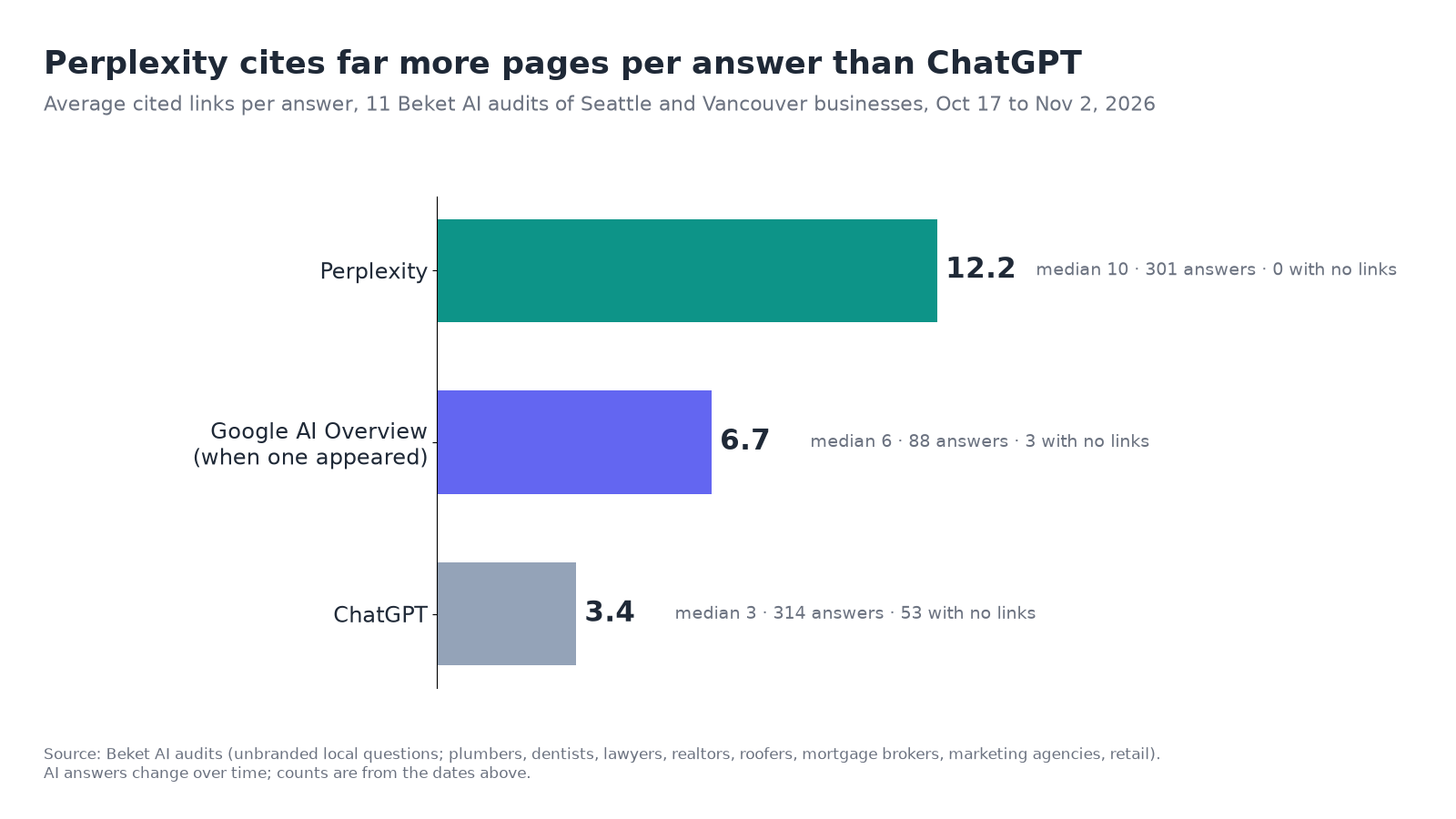
The good news: Perplexity cites a lot of pages. In 11 Beket AI audits of Seattle and Vancouver businesses run between October 17 and November 2, 2026, every one of Perplexity's 301 answers cited at least one source, and the average answer cited 12.2 links. ChatGPT, asked the same questions in the same audits, averaged 3.4 links, and 53 of its 314 answers cited nothing at all.
More seats at the table makes Perplexity one of the easier AI engines to get into, if it can reach your pages and they answer the question. This guide covers how Perplexity picks sources and six steps to become one.
How Perplexity picks the pages it cites
Perplexity's help center says it searches the internet in real time for each question and puts numbered citations in the answer so you can check where each claim came from. That makes it closer to a search engine with a writer on top than to a chatbot answering from memory.
Perplexity has described the search half in its engineering posts. Its search API write-up says the index tracks more than 200 billion unique URLs, that retrieval mixes keyword matching with semantic (meaning-based) matching, and that machine learning decides what gets crawled and refreshed, favoring authoritative domains and fresh content. In September 2026 it described Photon, its in-house retrieval and ranking engine.
The process has two stages, and you need to win both:
- Retrieval. Perplexity's search finds candidate pages and ranks them.
- Citation. The language model writes the answer and picks which candidates to cite.
The first stage matters a lot. Tenpoint Labs, a GEO agency, studied 1,282 answers from Perplexity's Sonar API between September 16 and October 15, 2026. Perplexity cited 89% of the sources it retrieved first and 29% of those it retrieved tenth. Page features like wording and freshness had only small effects once position was accounted for. So the practical goal is to be retrieved near the top for the questions your customers ask.
Step 1: Let PerplexityBot in
Perplexity documents two agents, and its crawler documentation explains both:
- PerplexityBot crawls pages "to surface and link websites in search results on Perplexity." Perplexity says it isn't used to train AI foundation models, and it recommends allowing it in robots.txt and through your firewall if you want to appear in results.
- Perplexity-User fetches a page when a user's question needs it. Because a person asked, Perplexity says it generally ignores robots.txt.
If your robots.txt blocks PerplexityBot, or blocks every bot by default, Perplexity's own index can't keep your pages fresh. The safe setup looks like this:
User-agent: PerplexityBot
Allow: /
Robots.txt isn't the only gate. Firewalls and bot-protection tools at your host or CDN often block crawlers before robots.txt is read. Perplexity publishes the IP ranges for PerplexityBot and Perplexity-User, so you can allow those exact addresses. Our guide on checking whether a crawler is really PerplexityBot or a fake walks through that check. If you're unsure which AI bots to allow at all, start with which AI crawlers to allow in robots.txt, since blocking a training bot and blocking a search bot have very different effects.
Step 2: Build a page for each service and area you want to be named for
Perplexity cites pages, not businesses. If the question is "plumber in Ballard," a page about plumbing in Ballard has a better shot than a homepage that lists 40 neighborhoods in the footer.
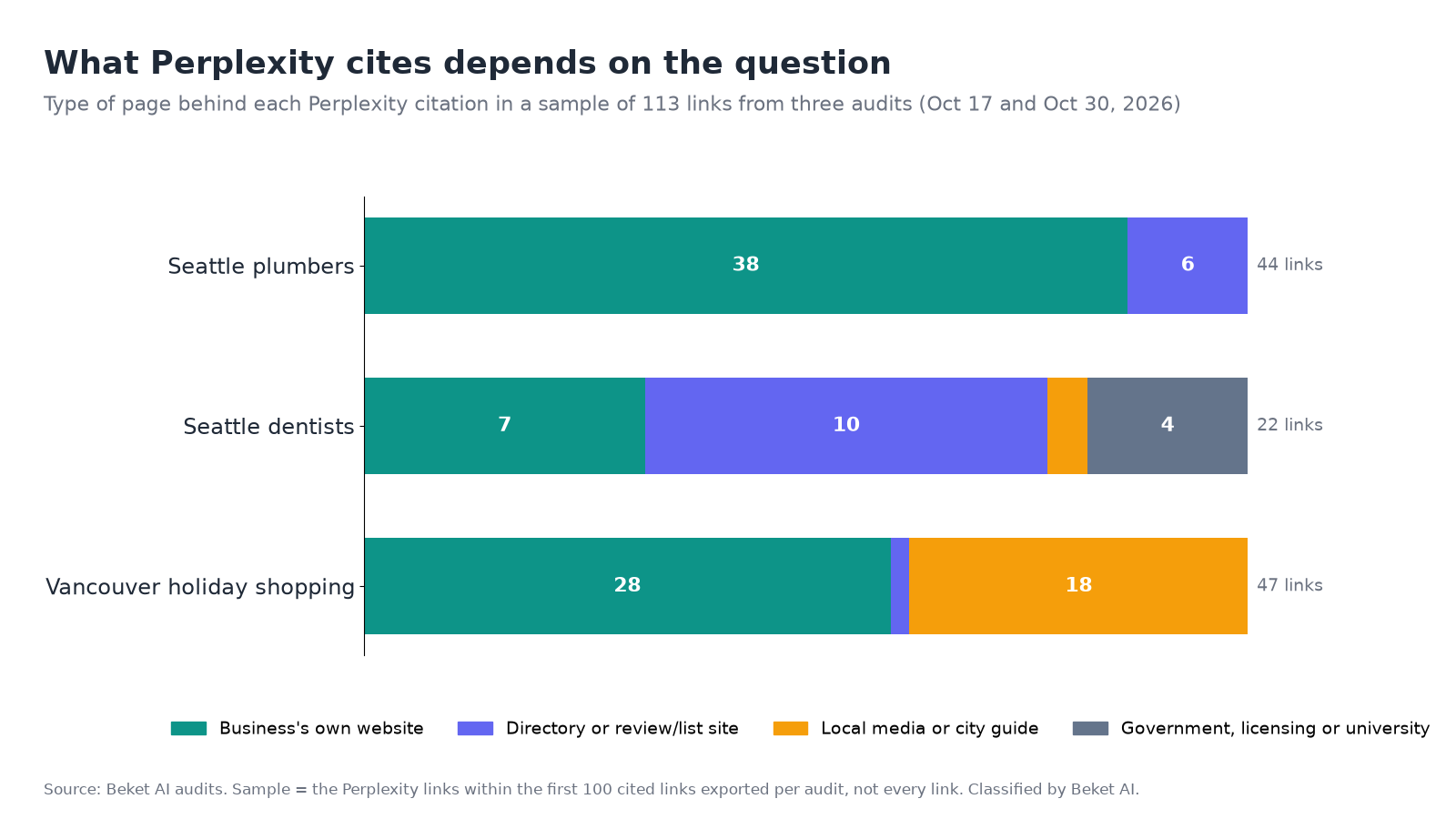
Our audit exports show this clearly for service businesses. In a sample of 44 Perplexity citations from our Seattle plumbers audit (October 17, 2026), 38 went to plumbing companies' own websites and 6 to directories such as BBB, Yellow Pages and Thumbtack. Half of the 44 links (22) pointed to a specific service-area or neighborhood page: University District, Ballard, West Seattle, Queen Anne and Northgate pages from several plumbing companies.
What a good area page has:
- The service and the place in the title and main heading, such as "Emergency Plumber in West Seattle."
- Real local detail: which streets or neighborhoods you cover, typical response times, the kinds of buildings you work on. A copy of another city page with the name swapped gives Perplexity nothing new to cite.
- Your name, address and phone matching your listings, plus LocalBusiness schema markup so the page states who you are and where you work in a structured way.
Step 3: Answer the question in the first few lines
Perplexity matches both the words in a question and its meaning, so a page that uses your customers' wording and answers right away is easier to retrieve and to quote. Tenpoint's study found pages that covered more of the question's terms tended to appear higher, though the effect was small.
Compare two example openings for the same page (the details are made up for illustration):
| Weak opening | Strong opening |
|---|---|
| "Welcome to our family-owned business, proudly serving the community since 1998." | "We fix burst pipes in West Seattle 24 hours a day. Most calls get a licensed plumber on site within 90 minutes, and emergency visits start at a flat call-out fee listed below." |
The second one answers who, what, where and how fast in two sentences. Only state numbers you can stand behind, since Perplexity may repeat them word for word. Prices, hours, licensing and service areas belong on the page in plain text, not only in images or PDFs.
Step 4: Get onto the third-party pages Perplexity reads for your category
Your own site isn't always the main source. What Perplexity cites depends heavily on the kind of question:
- Dentists. In our Seattle dentists sample (22 links, October 17, 2026), 10 citations went to directories and review lists, and 4 went to the Washington Department of Health's dentist licensing pages and the University of Washington's dental urgent care clinic. Only 7 went to practice websites. ChatGPT draws on these pages too: across 58 dentist questions we asked in Seattle and Vancouver on November 2, 2026, 32 of the 148 ChatGPT citations we exported went to directories, 17 to licensing bodies, dental associations and universities, and 9 to review sites. Of the 80 that went to practice websites, 45 pointed to a service, location or other inner page rather than the homepage.
- Holiday shopping. In our Vancouver Black Friday and gift-shopping sample (47 links, October 30, 2026), 18 citations went to local media and city guides such as BC Living, Destination Vancouver, Daily Hive and Curiocity. The other 28 went to store websites.
- Plumbers. Directories were a minority, at 6 of 44.
To find the sources for your category, ask Perplexity 10 to 20 questions your customers would ask and write down which sites appear under the answers more than once. Those are your targets: a profile you should claim, a "best of" list you could be considered for, a local guide worth pitching, or an official record whose details should match your site. Our study of local AI recommendations across nine audits shows how much the mix changes between industries.
Step 5: Keep your Yelp and Tripadvisor listings accurate
Perplexity licenses some local data directly. In 2024 it started pulling Yelp's maps, reviews, photos and business details into answers about places, through Yelp's data licensing program. In January 2025, Tripadvisor announced a partnership with Perplexity that brings its hotel listings, ratings and review summaries into travel answers.
Yelp pages showed up only once among the 113 Perplexity links in our sample, so this data may appear in place cards and summaries rather than as numbered citations. Either way, a wrong address, old hours or a thin profile on those platforms can end up in an answer. Claim the listings, fix the details and keep the photos current.
Step 6: Keep important pages fresh, then check what Perplexity says
Perplexity says machine learning decides when pages get re-crawled, and its Photon post describes getting new documents into the index within minutes for topics that need fresh information. Freshness alone isn't a reliable ranking boost, though: Tenpoint found newer pages appeared higher on one Perplexity model and showed almost no relationship on another. Update a page when something real changes, such as prices, hours, services or a new location, and show a visible "last updated" date.
Then measure. Perplexity's answers change from week to week, so a single check tells you little. Track a fixed set of questions over time and note three things for each one: whether your business is named, whether one of your pages is cited, and which other sites are cited instead. You can do that by hand in Perplexity, or run a free Beket AI visibility check, which asks 25 questions across 3 AI engines and shows where you're named and which sources the engines cite.
What doesn't decide whether Perplexity cites you
Source labels. Perplexity tags some sources as Government, Academic or Trusted. Its help article on source labels says the labels are assessed per site, that partnerships and payments don't affect them, and that having no label isn't a negative judgment. Most local businesses won't get one, and that's fine. Plenty of unlabeled business sites are cited in our audits.
Long, everything-in-one pages. Perplexity quotes passages. A focused page that answers one question well is easier to retrieve and cite than a 5,000-word page that covers everything.
Heavy traffic expectations. Perplexity is still small next to Google. CEO Aravind Srinivas said it handled about 780 million queries in May 2025, and he has said openly that AI answers send fewer referral clicks than classic search. The value is in being the business the answer names when someone is ready to choose.
A quick checklist
- robots.txt allows PerplexityBot, and your firewall or CDN isn't blocking Perplexity's published IP ranges
- One page per main service, and one per area you want to be named in, with real local detail
- Each page answers the main question in its first two sentences, in your customers' words
- Prices, hours, licensing and service areas in plain text, with LocalBusiness schema
- Claimed, accurate profiles on the directories, lists and guides Perplexity cites for your category
- Yelp (and Tripadvisor, if you're in travel or dining) listings checked and up to date
- A fixed list of customer questions checked in Perplexity every few weeks
About the data
The citation counts come from 11 Beket AI audits of local businesses in Seattle and Vancouver, BC (plumbers, dentists, lawyers, realtors, roofers, mortgage brokers, marketing agencies and holiday retail), run between October 17 and November 2, 2026, using unbranded questions such as "best plumber in Seattle." Google AI Overview figures cover only the 88 questions where an AI Overview appeared. The page-type breakdown uses a smaller sample: our citation export lists the first 100 cited links per audit, which included 113 Perplexity links across three audits, classified by hand by Beket AI. It is a sample, not every link Perplexity cited. The ChatGPT dentist figures in Step 4 come from two more Beket AI audits (Seattle and Vancouver, November 2, 2026). Our export captured 148 of the 165 links those answers cited, and we classified them by hand. AI answers change often, so treat these numbers as a snapshot from those dates.
Related posts
What Is GEO? A Practical Guide to Generative Engine Optimization
GEO is how brands get named, cited and described accurately in ChatGPT, Perplexity and Google AI answers. Where it came from, what to measure and how to do it.
What Is Parametric Knowledge Optimization (PKO)? How to Influence What AI Knows Without Search
PKO shapes what AI models learn about your brand in training, not what they find in search. How it differs from GEO and AEO, tactics, and how to measure it.
Profound Alternatives: 5 AI Visibility Tools With Public Pricing (2026)
Five Profound alternatives with published prices, compared on prompts, engines, seats and fit: Beket AI, Otterly, Semrush, Ahrefs Brand Radar and Scrunch.