
What Is Parametric Knowledge Optimization (PKO)? How to Influence What AI Knows Without Search

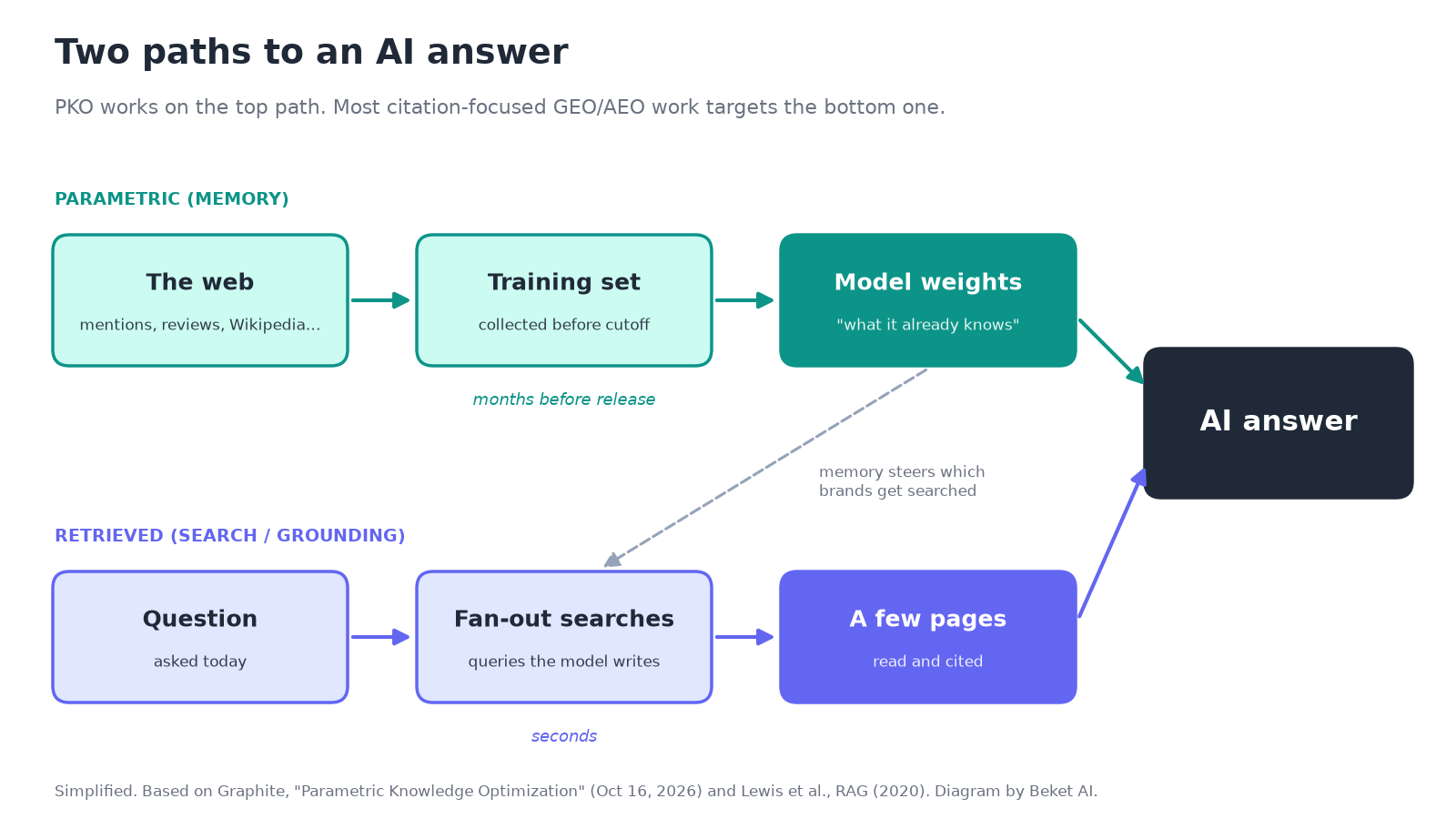
Ask ChatGPT "what's a good accounting firm for small restaurants?" and one of two things happens. Either it searches the web, reads a handful of pages and cites them, or it answers straight from memory, from what it learned when it was trained. Most AI visibility work focuses on the first path. Parametric knowledge optimization (PKO) is about the second.
PKO, in one sentence: the work of shaping what an AI model already "knows" about your brand from its training data, so it describes and recommends you accurately even when it doesn't search.
The term was named by Graphite researchers Gregory Druck, Ethan Smith and Bevin Benson in an October 16, 2026 paper. They define PKO as work that "aims to improve how models describe and recommend a brand by influencing the training set," and they're clear that it is harder and slower than optimizing for citations. This guide explains what PKO is, how it fits next to SEO, GEO and AEO, what you can realistically do about it, and how to tell whether any of it is working.
Parametric knowledge vs retrieved knowledge
"Parametric" comes from machine learning research. The 2020 paper that introduced retrieval-augmented generation (RAG) described large language models as storing factual knowledge "in their parameters," and split an AI system's knowledge into two kinds:
- Parametric memory: what the model absorbed during training and now holds in its weights. Graphite calls it "the model's fuzzy recollection of the internet." It doesn't keep copies of the pages it read, and it can't tell you which pages taught it something.
- Non-parametric (retrieved) memory: documents fetched at answer time and placed in front of the model. In today's assistants, that usually means a web search. Google and Microsoft call this grounding.
| Parametric knowledge | Retrieved knowledge (search, RAG, grounding) | |
|---|---|---|
| Where it lives | Inside the model's weights | On web pages fetched for each question |
| When it's set | At training, before the model's knowledge cutoff | At the moment the question is asked |
| How fast your changes show up | Months at the earliest, and only in a newer model | As soon as your page is crawled and retrieved |
| Can you see the source? | No. Models generally can't name the training documents behind an answer | Usually. Cited links show which pages were used |
| How much one page matters | Very little. It's one document among trillions of tokens | A lot. An answer typically cites a handful of pages |
| Which crawlers matter | Training crawlers (GPTBot, ClaudeBot, Google-Extended, CCBot) | Search crawlers (OAI-SearchBot, Claude-SearchBot, Googlebot, PerplexityBot) |
| Main discipline | PKO | GEO / AEO citation work, plus classic SEO |
Where PKO fits next to SEO, GEO and AEO
PKO isn't a replacement for anything. It's a layer underneath the others.
- SEO gets your pages ranked in search engines. Since many AI assistants search the web before answering, it's still the base of everything else.
- GEO and AEO aim to get your brand named and your pages cited in AI-generated answers. In practice, most of that work targets the retrieval path: be crawlable, be on the pages the engines cite, answer questions clearly. Our practical guide to generative engine optimization and the SEO vs GEO vs AEO breakdown cover these in more depth.
- PKO targets the model itself: the impression it formed of your brand and your category before anyone asked a question.
Graphite's argument is that AEO should include PKO, not that PKO is a separate industry. That framing is worth keeping. The tactics overlap heavily, and the main things PKO adds are a longer time horizon and a different way of measuring.
Why what the model "already knows" matters
1. Not every answer uses search
When an assistant doesn't search, its answer comes from parametric knowledge alone, and citation work has no direct effect on it. How often that happens depends on the question and changes over time:
- Graphite reports that, in a fixed set of entity-comparison prompts ("which X is best for Y"), the share of logged-out ChatGPT responses with a citation rose from 56.6% in the week of August 3, 2026 to 88.5% in the week of September 28, 2026. Over the same period, logged-out Gemini rose from 79.0% to 81.2%.
- Across all kinds of prompts, a Similarweb study cited in the same paper found only 7% of U.S. ChatGPT responses had citations. The datasets differ, but together they suggest comparison questions trigger search far more often than general ones.
- In 11 Beket AI audits of Seattle and Vancouver businesses (October 17 to November 2, 2026), 53 of 314 ChatGPT answers (17%) cited no links at all. Treat that as a rough signal, not proof: a missing link doesn't strictly mean no search happened. But those answers named businesses without showing any source.
2. Memory steers the search
Even when a model searches, it decides what to search for. Graphite looked at about 957,000 ChatGPT fan-out queries (the searches the model runs behind the scenes) generated for 22,953 non-branded comparison prompts. 59.6% contained a brand name and 22.7% used a "site:" operator. A model that already associates your brand with a category is more likely to search for you by name, and pages about you are then more likely to be retrieved.
3. Memory shapes how search results are used
Graphite compared the same prompts with and without search. Brands the model mentioned often without search also did better with search, at every level of how often they appeared on cited pages. Even brands mentioned on at least 15% of cited pages reached only 11% median visibility with search when their no-search visibility was in the lowest band. Graphite reports similar patterns in two replications, though this is correlation, not proof that one causes the other. Academic work on knowledge conflicts also shows models can lean on what they learned in training even when the supplied context says something different.
In plain terms: being on the right pages helps, but a model that has never "heard of" you may still pass you over.
How PKO works in practice: six tactics
None of these can force a model to learn something. They improve the odds that accurate information about you is in the data future models train on, and that it appears often and consistently enough to stick.
Make your core facts identical everywhere
Write down the handful of facts you want every model to get right: your exact name, what you do, who it's for, where you operate, and your main products and prices. Then make sure your own site, your profiles and directory listings, and your press pages all say the same thing. Graphite points out that if a brand is described inaccurately online, for example with outdated pricing, the model may learn and repeat it. They also suggest, as a hypothesis, that inconsistent descriptions make models less confident, so less likely to mention you. Put dates on facts that change, like pricing, so it's clear when they applied.
This is the same discipline as entity SEO: making it easy for machines to recognize one clear "thing" that is your business.
Earn mentions on many different sites
For a search-grounded answer, one well-placed page can matter. For training, one page is a drop in the ocean. Epoch AI estimates GPT-5 was trained on at least 30 trillion tokens. Graphite also notes that training pipelines remove near-duplicate pages and may limit how many pages come from one domain. So PKO favors many distinct mentions across many independent sites: industry publications, local news, partner pages, podcasts with transcripts, community threads. Copying the same press release to 200 sites probably doesn't count for much. Our piece on why brand mentions are the new backlinks for AI search goes deeper on earning them.
Show up where there's evidence of training use
Labs rarely publish their training sets, but there are clues:
- Wikipedia. OpenAI's GPT-3 paper listed English Wikipedia as one of its five training datasets. It was only 3% of the training mix, but the model went over it about 3.4 times during training, compared with 0.44 times for the filtered Common Crawl data. You can't write your own article, though. Wikipedia's conflict of interest guideline strongly discourages editing about your own company, and articles need independent coverage to exist at all. The practical route is to earn that coverage first.
- Wikidata. Wikidata is the structured database behind many Wikipedia facts, and it has its own notability rules. We haven't seen a lab confirm it as a training source, so treat an accurate entry as good entity hygiene rather than a proven PKO lever.
- Reddit. Reddit's expanded partnership with Google (February 2024) explicitly mentions "providing more efficient ways to train models." Graphite notes Reddit has a data partnership with OpenAI too. Genuine customer discussion there is worth more than any post you write yourself, and astroturfing tends to get removed.
- Publishers with AI licensing deals. Some publishers have agreements covering model training. Graphite cites the Axel Springer partnership with OpenAI, which covers outlets such as Business Insider.
- Common Crawl. Its public archive is likely used in training. You can look up whether your pages were collected in the Common Crawl index.
Publish original data people will cite
A statistic only you have tends to get repeated across many independent pages, which is exactly the spread PKO needs. Google's own guidance on generative AI search pushes in the same direction for its products: create "non-commodity" content with unique, expert-led insight rather than common knowledge. A yearly survey of your customers, a price index for your market, or a dataset from your own operations gives writers a reason to mention you.
Encourage detailed, honest reviews
Reviews and customer discussions are third-party descriptions of what you do and who you serve, in many different words, on many different sites. Ask for them consistently, reply to them, and keep the facts in your profiles current. We don't know how much review text any specific model trained on, so this is a sensible bet, not a measured effect.
Let training crawlers in, if that's your choice
If your robots.txt or firewall blocks training crawlers such as GPTBot, ClaudeBot, Google-Extended (Google's control token for Gemini training) or CCBot, your new pages can't enter those training sets. OpenAI's crawler documentation describes GPTBot as crawling content that "may be used in training our generative AI foundation models," separately from OAI-SearchBot, which powers ChatGPT search. This is a real trade-off, and plenty of publishers block training on purpose. Our explainer on the AI training opt-out vs AI grounding and the guide to which AI crawlers to allow in robots.txt cover how to allow one without the other. Graphite also notes that allowing a bot in robots.txt isn't enough if your CDN blocks it, and that key content should be in server-rendered HTML, since training crawlers may not run JavaScript.
Timing: why PKO runs on a slower clock
A page you publish today can't be in a model whose training data was collected last spring. Graphite tracked the gap between each model's knowledge cutoff and its release date. For text models released since July 2026, the average gap was 4.6 months for OpenAI, 2.4 months for Anthropic and 4.4 months for Google. Earlier in 2026, some models shipped with gaps of more than a year.
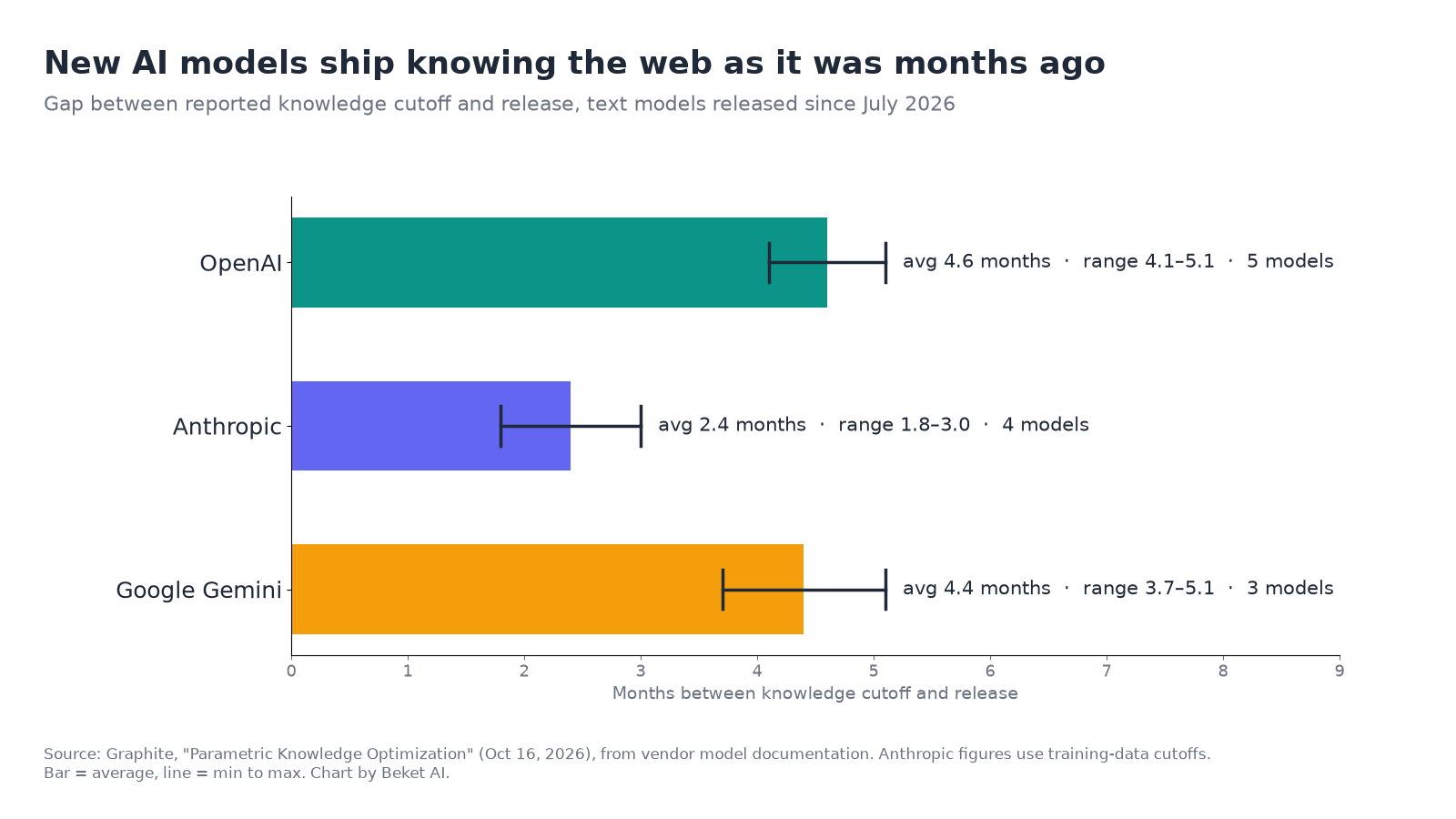
That gap is the minimum delay. Your page also has to be crawled, survive filtering, and be in the data for the next model you care about, and none of that is guaranteed or visible. Plan PKO in quarters and model releases, not weeks. Two practical consequences:
- Old, wrong information lingers. If you rebranded, changed prices or moved, current models may keep repeating the old version until a newer model is trained on the updated web. Fixing it everywhere now is how you get it right in the next generation.
- Retrieval covers the gap. For anything time-sensitive, citation-focused work is still the faster path, because search-grounded answers can pick up a new page within days.
How to measure parametric knowledge
You can't inspect a model's weights, but you can compare what it says with search off and with search on.
- Pick a fixed set of questions. Mix unbranded category questions ("best payroll software for restaurants") with direct ones ("what does [your brand] do and who is it for?").
- Ask with search off. Use a model's API with no web search tool enabled, so the answer can only come from memory. Graphite recommends collecting at least 50 responses per prompt, because answers vary from run to run.
- Record two things: how often you're mentioned (visibility), and whether the description is accurate. A model that knows you but rarely mentions you needs a different fix from one that has your facts wrong.
- Ask with search on, or let the model decide. Compare. If you appear with search but not without, your citation work is carrying you and the model's memory isn't. If you're absent both ways, start with the basics above.
- Repeat when a new model ships. Graphite notes that for a pinned model version with fixed prompts and settings, the no-search answers won't change, so one large sample per model version is enough.
A caveat for step 4: Graphite's earlier research argues against forcing search in prompt tracking, because forced-search answers can differ from what users actually see. For prompts that never triggered search on their own, forcing it shifted brand visibility by 20 points on average. It also notes ChatGPT can now insert inline links without a visible search, so "no links" isn't a perfect test for "no search" in the consumer app.
What Beket AI measures
Beket AI doesn't edit training data, and no tool can. What it does is ask AI engines the questions your customers ask and record what they say. A free audit runs 25 prompts across 3 AI engines and shows which businesses get named and which links get cited. Pro ($49/month) re-runs audits daily from 50 prompts across 3 engines, so you can see shifts over time, including when a new model rolls out.
Those answers are collected the way users get them, so many include search. Treat them as the with-search side of the comparison, and for a clean parametric-only read, run the search-off API test above as well. To fold PKO into a repeatable process, the AEO workflow guide has a six-step loop you can extend with a "check the model's memory" step at each model release.
The limits of PKO
PKO is a useful idea, and also a young one. Before you put budget behind it, keep these in mind:
- It's a proposal, not a proven method. Graphite calls its tactics "early strategies." Its own data shows a correlation between no-search and with-search visibility, not that any tactic causes a model to recommend you.
- You can't attribute results. Training sets aren't public, and models can't identify the documents behind an answer. If your visibility improves in a new model, you won't know which mention did it.
- Feedback takes months. Each test cycle waits on a model release. That makes PKO a poor fit for anyone who needs results this quarter.
- Big brands have a head start. Familiarity reflects years of coverage, customers and distribution. PKO won't close that gap quickly for a small business, though accurate facts and steady third-party mentions still help.
- Manipulation backfires. Fake reviews, planted Reddit threads and self-written Wikipedia articles break platform rules, tend to get removed, and can make your brand look worse in exactly the data you're trying to influence.
The short version
Search-grounded answers are where you can move fastest. The model's memory is where your brand's long-term reputation in AI is set, and it also steers what the model searches for. PKO is the name for working on that memory deliberately.
The good news is that most PKO tactics are things you should be doing anyway: consistent facts, real third-party coverage, original data, honest reviews, and not accidentally blocking the crawlers you want. What PKO adds is patience and a better test. Check what models say about you with search off, every time a new one ships.
To see what AI engines say about your business today, run a free Beket AI audit.
Sources and figures are dated as of November 2, 2026. AI answers and model behavior change often; Graphite's figures come from its own datasets, mostly logged-out ChatGPT responses to comparison prompts.
Related posts
How to Rank in Perplexity: 6 Steps to Get Your Business Cited (2026)
How Perplexity picks the pages it cites, plus six steps to get your business cited, with data from 301 Perplexity answers in Seattle and Vancouver audits.
Bing AI Mode vs Google AI Mode: Same Name, Different Engine (2026)
Bing renamed Copilot Search to AI Mode and AI Overview. How Bing AI Mode differs from Google's in listings, controls, reporting and reach, with a checklist.
What Is GEO? A Practical Guide to Generative Engine Optimization
GEO is how brands get named, cited and described accurately in ChatGPT, Perplexity and Google AI answers. Where it came from, what to measure and how to do it.