
What Is GEO? A Practical Guide to Generative Engine Optimization

In March 2025, Pew Research Center looked at the browsing data of 900 U.S. adults. When a Google search showed an AI summary, people clicked a regular result on 8% of visits. When it didn’t, they clicked on 15%. They clicked a link inside the summary itself on just 1% of visits (Pew Research Center, July 2025).
That gap is the reason generative engine optimization exists. More and more of the answer gets written before anyone reaches your website. You can show up inside that answer or not at all, and the work of showing up has a name: GEO.
This guide covers what GEO is, where the term comes from, how AI engines choose which brands to mention, what to measure, and a step-by-step way to do it. If you only want the short definition, our GEO glossary entry has it in a few paragraphs. This page is the long version.
What GEO means, in one paragraph
Generative engine optimization (GEO) is the practice of making your brand, products and pages more likely to be mentioned, cited and described accurately in answers written by AI systems such as ChatGPT, Perplexity, Gemini, Microsoft Copilot and Google’s AI Overviews and AI Mode. SEO aims to rank a page in a list of links. GEO aims to get your business into the paragraph the AI writes, and to make sure that paragraph is correct.
A few terms come up again and again:
- Generative engine: any system that writes an answer from retrieved sources instead of only listing links. ChatGPT search, Perplexity and Google AI Overviews all qualify.
- Mention: your brand is named in the answer.
- Citation: the answer links to your page as a source. You can be mentioned without being cited, and cited without being mentioned.
- Grounding: the step where the model pulls live sources to support its answer. See our grounding glossary entry.
- Query fan-out: the engine splits one question into several sub-searches before it answers. See query fan-out.
Where the term came from
“GEO” wasn’t invented by a marketing team. It comes from a research paper, GEO: Generative Engine Optimization, by researchers at Princeton University, IIT Delhi and independent collaborators. It was first posted in November 2023 and published at KDD 2024.
The authors built a benchmark called GEO-bench, with 10,000 queries across many domains. They rewrote source pages in different ways and measured how much more visible each source became in the AI-generated answer. Their headline result was that the right edits could raise a source’s visibility by up to 40%. Adding citations, quotations and statistics did best. Keyword stuffing, the oldest SEO trick there is, gave “little to no improvement.”
We broke down the method-by-method results in SEO vs GEO vs AEO, so we won’t repeat that here. One finding from the paper gets much less attention, though, and it matters for smaller brands.
The finding most people skip: lower-ranked pages gained the most
The researchers also split results by where each source ranked in the underlying search results. The same edits that barely moved the top-ranked source produced huge gains for the source ranked fifth.
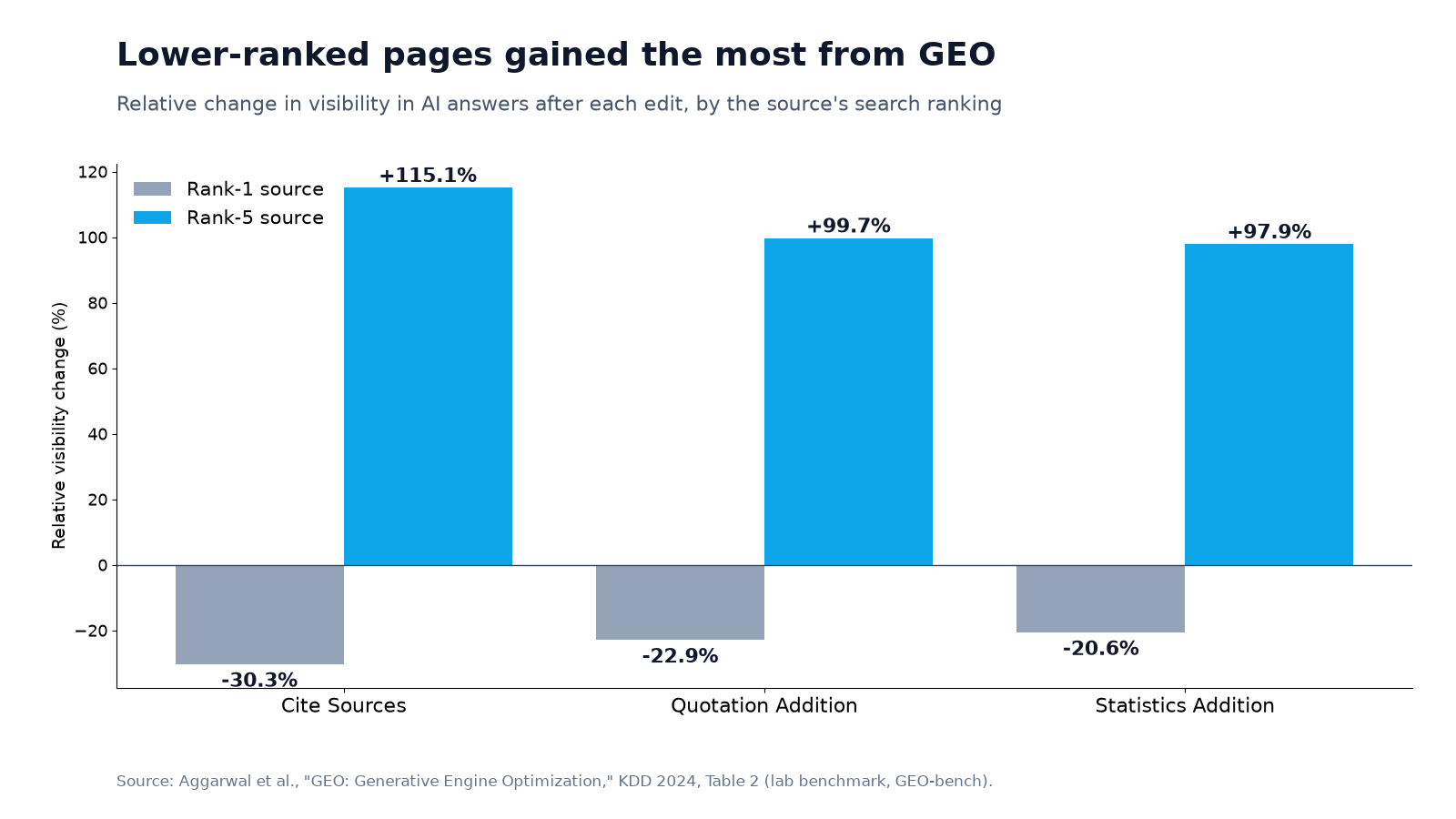
Source: Aggarwal et al., “GEO: Generative Engine Optimization,” KDD 2024, Table 2.
| GEO method | Rank-1 source | Rank-5 source |
|---|---|---|
| Cite Sources | −30.3% | +115.1% |
| Quotation Addition | −22.9% | +99.7% |
| Statistics Addition | −20.6% | +97.9% |
The authors’ take is that GEO could help “democratize the digital space,” because smaller sites that can’t win the top organic spot can still earn a place in the answer by being more useful to cite. Treat the exact numbers with care. This was a lab benchmark run on 2023-era models, not a live audit of ChatGPT in 2026. The direction still holds up in practice: an engine that’s assembling an answer wants specific, checkable material, and it will take that material from page five if page one doesn’t have it.
Why GEO matters now
Three public data points show the scale of the shift.
- AI summaries are common, and they cut clicks. In Pew’s March 2025 data, 18% of Google searches produced an AI summary. Searches that ended on the results page, with no click anywhere, rose from 16% to 26% when a summary appeared (Pew).
- Longer, question-style searches trigger them most. Pew found that 53% of searches with 10 or more words produced an AI summary, and so did 60% of searches that started with a question word. Those are the high-intent, “which one should I pick” queries.
- Consumers already lean on them. Bain & Company’s survey found that 80% of consumers rely on AI-written results for at least 40% of their searches. Bain estimates this cuts organic web traffic by 15% to 25% (Bain & Company, February 2025).
There’s a second problem besides lost clicks. AI engines can describe your business wrongly: an old price, a discontinued product, a competitor’s feature credited to you. Nobody sees that error in Search Console. You only find it by asking the engines. That’s why accuracy is part of GEO and not just visibility. (For the zero-click side of this, see what zero-click search means for your traffic.)
How generative engines decide what to say
You can’t optimize a system you don’t understand. The details differ by engine, but most of them run a similar loop for questions that need current information:
- Interpret the prompt. The engine decides whether it needs fresh sources at all. Many questions get answered from the model’s training data alone.
- Fan out. If it does search, it often rewrites the question into several narrower searches, such as “best GEO tools for agencies” or “GEO tool pricing 2026”.
- Retrieve. It pulls candidate pages from a search index. That might be its own index, a partner index, or Google’s.
- Select and synthesize. It picks the passages that answer the sub-questions most directly and writes them into one response.
- Attribute. It attaches citations to some of the sources it used. Not all of them get credit.
Each stage is somewhere you can be dropped. If a crawler can’t reach your page, you fail at retrieval. If your page answers the question vaguely, you fail at selection. If third-party sites describe you differently from your own site, the engine may pick their version. Our explainer on how ChatGPT search finds, indexes and cites websites walks through one engine in detail.
Two more realities shape GEO work:
- Engines disagree. ChatGPT, Perplexity and Google AI Overview often name different brands for the same prompt. Checking one engine and assuming it speaks for the rest is a mistake (why one engine is not enough).
- Answers move. The same prompt can return different brands a week later, or a minute later. One-off spot checks give you a snapshot, not a trend (why AI answers move more than you think).
What GEO measures
SEO has rankings, clicks and impressions. GEO needs its own measures, because “position 3” means nothing inside a paragraph. These are the ones that matter in practice:
| Metric | What it tells you | How it’s usually calculated |
|---|---|---|
| Mention rate | How often you’re named at all | Prompts where you’re mentioned ÷ prompts checked |
| AI share of voice | Your slice of the conversation vs competitors | Your mentions ÷ all brand mentions in the answer set |
| Citation rate | How often your own pages are used as sources | Responses that cite your domain ÷ responses checked |
| Accuracy | Whether what the AI says about you is true | Correct claims ÷ claims checked against your real facts |
| Position / prominence | Whether you’re the first recommendation or a footnote | Order of mention, or weighted by placement |
| Citation gaps | Sources engines trust that don’t mention you | Domains cited for your prompts where you’re absent |
We go deeper on the most-used of these in what AI share of voice is and how it’s measured, and on why these replaced classic rank tracking in the metrics that replaced keyword rankings.
A note on sampling: because answers vary, measure each prompt on each engine more than once, over time. A single run tells you what happened, not what usually happens.
GEO vs SEO vs AEO
People use these terms loosely, so here is the short version:
- SEO gets pages to rank and earn clicks in search results.
- AEO (answer engine optimization) gets your content chosen as the answer, in featured snippets, voice assistants and AI answers. See what is answer engine optimization.
- GEO focuses on generative systems specifically: being named, cited and described correctly when an AI writes the response.
In practice the overlap is large. Google’s own AI optimization guide says that, from Google Search’s point of view, optimizing for generative AI is still SEO. That’s true as far as it goes: crawlable pages, clear content and a good reputation still matter. What changes is how you measure and where you look. Rankings and clicks won’t tell you whether ChatGPT recommends you. The full comparison lives in SEO vs GEO vs AEO.
A practical GEO playbook
This is the process we’d follow for a brand starting from zero. It is deliberately ordered. Skipping straight to “write more content” is the most common way GEO budgets get wasted.
1. Choose the prompts that matter
Start with the questions buyers actually ask an AI, not your keyword list. Mix three kinds:
- Category prompts: “best GEO tools for small agencies”
- Comparison prompts: “[your brand] vs [competitor]” and “[competitor] alternatives”
- Problem prompts: “how do I know if ChatGPT recommends my business”
Include prompts where you expect to lose. If you only track the questions where you already appear, your numbers will look great and teach you nothing. Our guide to building a prompt library covers how many prompts you need and how to group them.
2. Get a baseline across engines
Run the prompt set across at least ChatGPT, Perplexity and Google AI Overview, and record who gets mentioned, who gets cited, and what’s said about you. This baseline is what every later change gets measured against. Without it, you can’t tell a GEO win from normal answer volatility.
3. Make sure the engines can reach you
Check robots.txt and your CDN or firewall rules. Many sites block AI search crawlers by accident, often while trying to block training crawlers. Blocking a training bot and blocking a search bot are different decisions with different results. Our guide to which AI crawlers to allow in robots.txt separates them bot by bot, and the Cloudflare AI Crawl Control guide shows how to see which bots actually visit.
4. Make your facts unambiguous
Engines get confused when your name, category, location, prices or product list differ across your site, directories and review platforms. Pick one version of each fact and make it consistent everywhere. Structured data helps engines connect the dots. This is the core of entity SEO, and it’s also the fastest way to fix accuracy errors.
5. Write pages that are easy to cite
This is where the research findings pay off. Pages that get used in AI answers tend to:
- answer one question directly, near the top
- include specific numbers, with the source named
- quote people with real credentials where it adds something
- use tables for comparisons and clear headings for each sub-question
- say when they were last updated
Compare a vague sentence like “We offer affordable plans” with a citable one: “Plans start at $49 per month, billed monthly.” The second gives an engine something to repeat.
6. Earn mentions where engines look
Engines don’t only read your site. They read reviews, forums, news, directories, comparison articles and documentation, and they often trust those more than your own claims. Look at which domains get cited for your target prompts and work out how to get your brand onto them honestly: product listings, expert quotes, partner pages, case studies. See why third-party signals drive AI mentions.
7. Re-measure on a schedule
Re-run the same prompts on the same engines regularly. Daily or weekly is ideal, and monthly is the bare minimum. Compare against your baseline. Keep a change log so you can tie movements to what you shipped. Then pick the next gap and repeat. Our six-step AEO workflow turns this loop into a routine.
Common GEO mistakes
- Treating one answer as the truth. A screenshot of one ChatGPT reply is an anecdote. Sample across engines and over time.
- Tracking only branded prompts. Of course ChatGPT knows your brand when you name it. The question is whether it names you when the buyer doesn’t.
- Rewriting for keywords. The GEO paper found keyword stuffing gave little to no benefit. Specific, sourced facts did far better.
- Blocking the wrong crawlers. A blanket AI bot block can quietly remove you from AI search results.
- Ignoring accuracy. Being mentioned with the wrong price or a feature you don’t offer can be worse than not being mentioned.
- Expecting referral traffic to tell the whole story. Pew found people clicked a link inside the AI summary on just 1% of visits. Much of GEO’s value shows up in being considered and recommended, not in sessions. Still track what you can: see how to track AI Overview traffic in Search Console and GA4 and Bing’s AI Performance report.
Tools for GEO
You can do a basic version of GEO by hand: a spreadsheet of prompts, a few engines, and a regular calendar slot. It gets impractical quickly. Ten prompts across three engines, checked weekly, is already 120 answers a month to read and record.
Dedicated tools automate the sampling and the scoring. They differ a lot in engines covered, how prompts are counted, how often they re-check, and whether they help with accuracy or only visibility. We compared the main options, with sourced pricing as of November 2026, in the best GEO tools for 2026. If you run GEO for clients, see the best AI visibility platforms for agencies.
Where Beket AI fits
Beket AI measures the parts of GEO that are hard to do by hand. That means whether ChatGPT, Perplexity and Google AI Overview mention you, which competitors they name instead, which sources they cite, and whether what they say about you is accurate. Every audit ends with a prioritized roadmap of what to fix. Your team does the fixing.
A free audit runs 25 prompts across 3 engines (ChatGPT, Perplexity and Google AI Overview), with no card required. Pro is $49/month and re-audits daily, starting at 50 prompts across the same 3 engines, with alerts when your visibility changes. It connects to Webflow, Google Analytics and Cloudflare. See Beket AI pricing for plan details, or start with the free audit to get your GEO baseline.
Related posts
Profound Alternatives: 5 AI Visibility Tools With Public Pricing (2026)
Five Profound alternatives with published prices, compared on prompts, engines, seats and fit: Beket AI, Otterly, Semrush, Ahrefs Brand Radar and Scrunch.
How to Rank in Perplexity: 6 Steps to Get Your Business Cited (2026)
How Perplexity picks the pages it cites, plus six steps to get your business cited, with data from 301 Perplexity answers in Seattle and Vancouver audits.
AI Search Optimization: What It Actually Means in 2026
AEO, GEO, and AI SEO get used interchangeably online. Here's what actually distinguishes them, and which one describes what most businesses need to do.