Is AI Sending Your Customers to the Wrong Website? How to Check for Lookalike and Lapsed Domains (2026)
Ask an AI assistant "what's the official site for [your brand]?" or "where do I log in to [your brand]?" and you'd expect your own domain back. Usually you get it. But not always, and the times you don't are the ones that cost you: a customer who follows the link to a fake store, a dead domain you let lapse years ago, or a regional site you never had.
This guide covers what the research shows, what we found in Beket AI's own audit data, and a step-by-step way to check which domains AI engines send your customers to, plus what to do when one is wrong.
What the studies found
Two independent tests asked AI engines the kind of navigation questions customers ask every day.
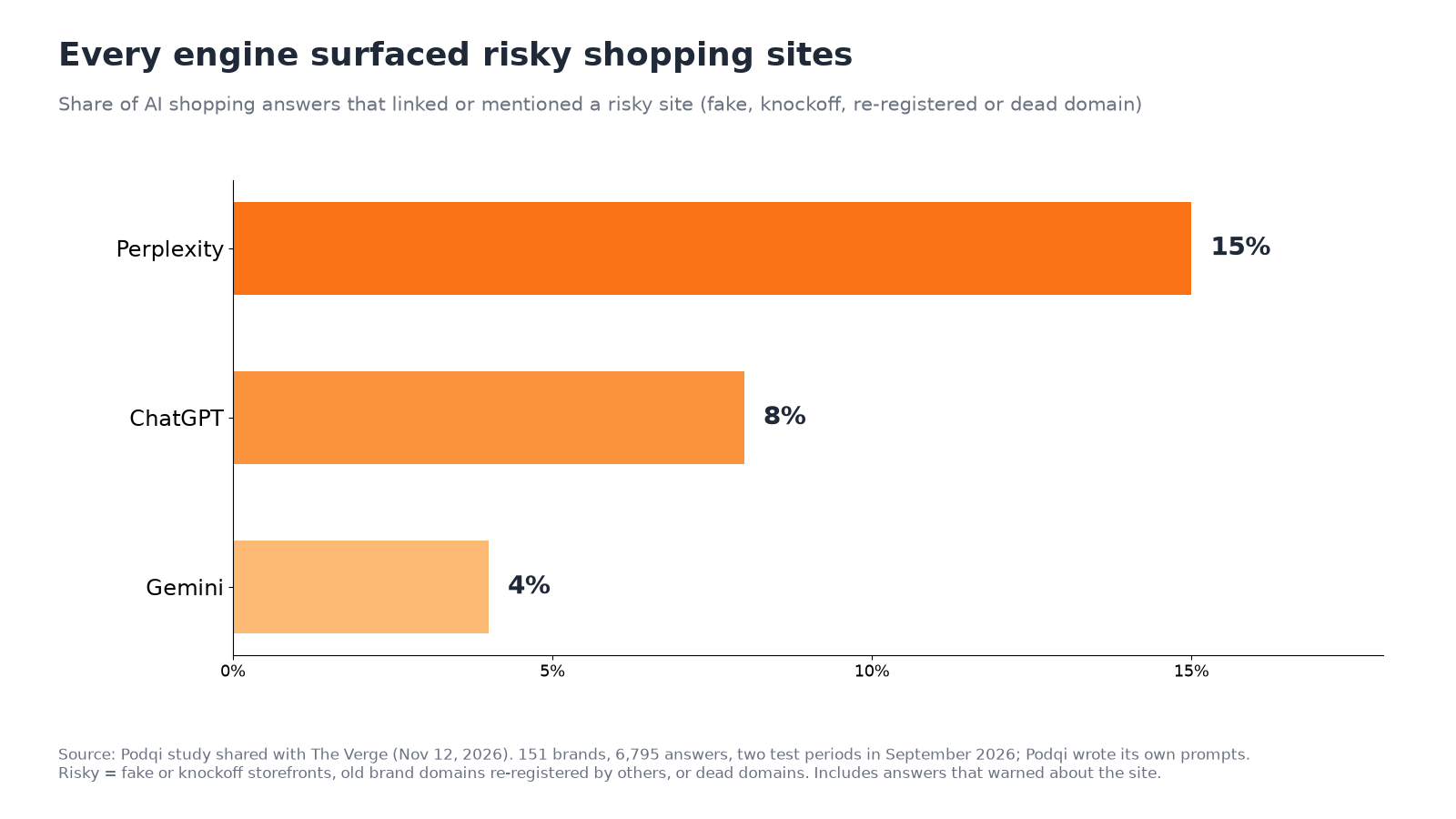
Podqi (shopping, September 2026). The IP protection firm shared its study with The Verge on November 12, 2026. It asked ChatGPT, Gemini and Perplexity questions like "Where can I find [brand] online?" and "Does [brand] ship internationally? What are their regional websites?" about 151 brands, across 6,795 answers. Risky sites meant fake stores impersonating the brand or selling knockoffs, old brand domains re-registered by someone else, and dead domains anyone could buy.
| Engine | Answers that linked or mentioned a risky site |
|---|---|
| Perplexity | 15% |
| ChatGPT | 8% |
| Gemini | 4% |
According to AI Weekly's write-up of the report, Podqi flagged 718 risky domains (351 fake, 367 dead). When an answer included a risky site, the chatbot actively suggested it as a place to shop 57% of the time, and risky sites were recommended 6.3 times as often as they were warned against. ChatGPT warned about the risky sites it surfaced 24% of the time, the best of the three. Questions about smaller brands surfaced risky sites about twice as often as questions about large ones, and questions about regional storefronts were the worst, partly because engines listed regional sites that don't exist.
Podqi sells brand protection and wrote its own prompts, so read the rates as a signal, not a census.
Netcraft (logins, July 2025). Netcraft asked a GPT-4.1 model where to log in to 50 brands. Of the 97 domains it returned, 66% belonged to the brand, 29% were unregistered, parked or inactive (open for anyone to claim), and 5% belonged to unrelated businesses. Netcraft also documented Perplexity putting a fake Google Sites page above a bank's real login page.
What Beket AI's audit data shows
We checked Beket AI's audit data for the same pattern. We took 101 non-demo audits where the business's domain name was at least five characters, used the latest completed answer for each question and engine, and looked at every domain the answers linked. Then we flagged domains that carried the business's name but weren't its main domain or a subdomain of it: the same name on another ending (.ca instead of .com, for example), the name as a subdomain of another host, or the name inside a longer domain.
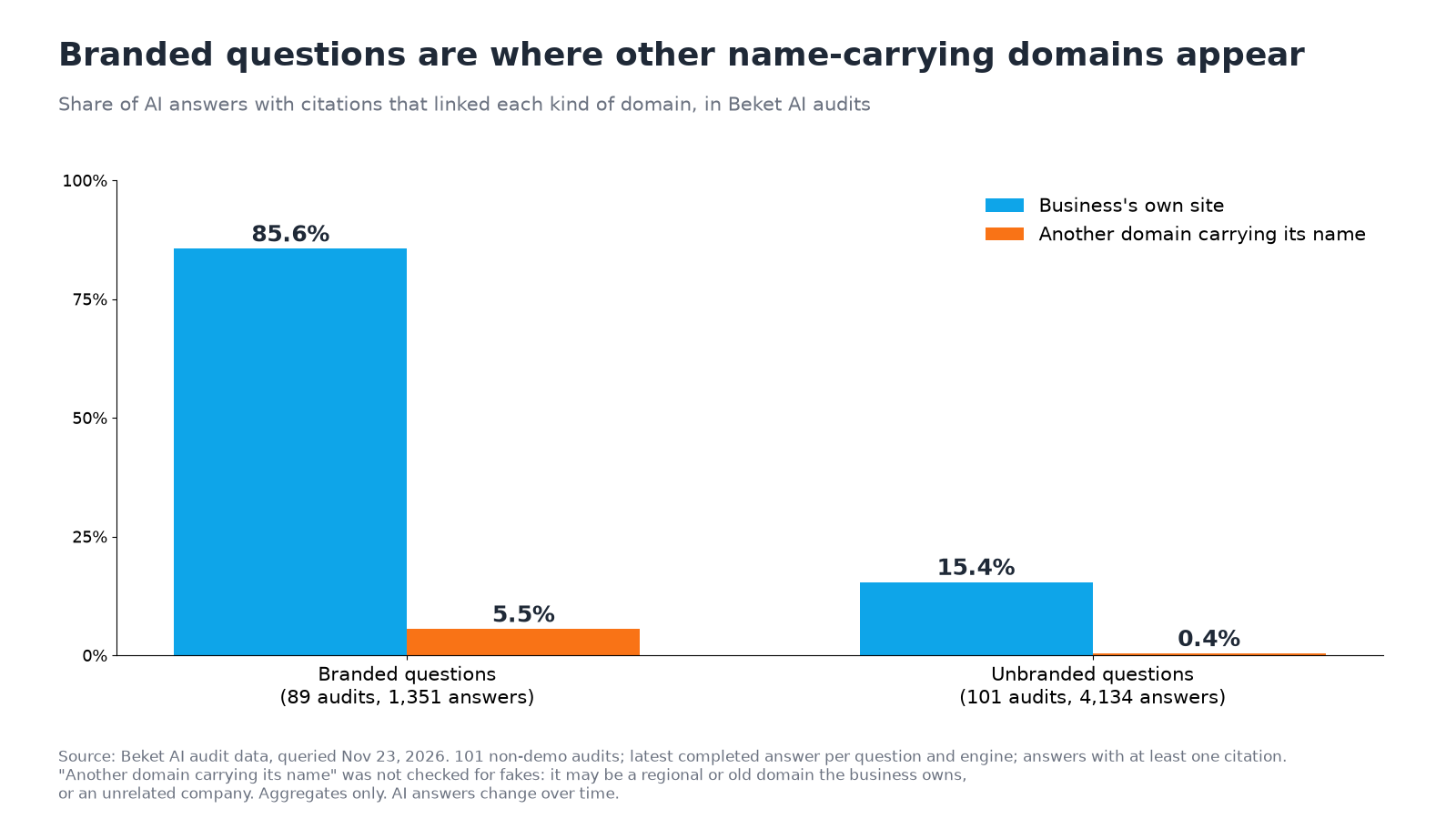
| Question type | Audits | Answers with citations | Linked the business's own site | Linked another domain carrying its name |
|---|---|---|---|---|
| Branded (the question names the business) | 89 | 1,351 | 1,156 (85.6%) | 74 (5.5%) in 24 audits |
| Unbranded (category questions) | 101 | 4,134 | 635 (15.4%) | 17 (0.4%) in 5 audits |
Two takeaways:
- The risk sits in branded questions. About 1 in 4 audits (24 of 89) had at least one branded answer that linked a domain carrying the business's name that wasn't its main site. On unbranded questions it almost never happened.
- One in seven branded answers didn't link the business at all. 14.4% of branded answers with citations named sources but not the business's own site, which leaves room for whatever else ranks for the name.
What this data doesn't show: we didn't check whether those 74 answers pointed to fakes. Some of those domains will be a business's own regional site or an old domain it still owns, and some will be an unrelated company with a similar name. That's the point of the check below: only you can tell which name-carrying domains are yours. These are the answers the engines returned for these audits at the time; AI answers change over time.
How to check which domains AI sends your customers to
Set aside an hour. You'll need a spreadsheet and a list of every domain you own or used to own.
1. List your real domains first
Write down every domain you control: the main site, regional sites, old brand names, campaign domains, shop and help subdomains, and the third-party hosts you use for checkout or support. Mark any you've let expire. This list is your answer key.
2. Write the navigation questions customers actually ask
Podqi's and Netcraft's results point to the same question types. For each, use your brand name:
- "What is the official website for [brand]?"
- "Where do I log in to my [brand] account?"
- "How do I get a refund from [brand]?" and "How do I contact [brand] support?"
- "Where can I buy [brand] online?" and "Is [store] a legit [brand] seller?"
- "Does [brand] have a [Canada/UK/EU] website?" (even if you don't, since that's where engines invented sites)
3. Ask each engine and log every linked domain
Run the questions in ChatGPT, Perplexity, Gemini, Microsoft Copilot and Google (AI Overviews and AI Mode). For each answer, record every domain it links or names, not just the first. Tick it off against your answer key.
4. Sort anything that isn't on your list
| What you found | What it likely is | What to do |
|---|---|---|
| A domain you own but don't promote | Old or regional site | Redirect it to the right page, keep it renewed |
| A domain you used to own | Lapsed, possibly re-registered | Look it up (step 5) and buy it back if you can |
| Your name plus "shop", "outlet", "login" or a different ending | Possible impersonation | Check it in a private window, then report it (step 6) |
| A real reseller or partner | Legitimate third party | Make sure it links back to your official site |
| An unrelated business with a similar name | Name collision | Make your own identity clearer (step 7) |
5. Look up suspicious and lapsed domains
ICANN's lookup tool shows a domain's registrar and registration dates. A domain registered recently, after you let it go, or through a privacy service with a copy of your logo on it is a red flag. Don't enter any login or payment details on a site you're checking.
6. Report impostors where it counts
- Report phishing or fake stores to Google Safe Browsing, which feeds warnings in Chrome and other browsers.
- Report it to Netcraft and to the domain's registrar (the ICANN lookup shows an abuse contact).
- In ChatGPT, Gemini, Perplexity and Copilot, use the thumbs-down or feedback button on the bad answer and say which link is wrong. It isn't a guaranteed fix, but it's the channel the engines offer.
7. Make your official domain hard to miss
AI engines pick links from what they find, so give them fewer chances to guess:
- Add Organization structured data on your home page with your
urlandsameAslinks to your real profiles. - Publish a short "official websites" page listing your real domains, regional sites and login URL, and link it from your footer and help center.
- Use the same official URL everywhere you control: Google Business Profile, social bios, directories and app store listings.
- Renew old domains and redirect them instead of letting them lapse. A dropped domain with your name on it is exactly what Podqi found being reused.
8. Re-check every month, and after any launch
Answers change. Re-run the same questions monthly, and again after you rebrand, launch a regional store or retire a domain. Our weekly AI brand monitoring routine shows how to fit this into a lightweight schedule, and how to fix wrong information in ChatGPT covers the wider set of corrections, from hours to prices. For retailers, our check of 881 store links before Black Friday shows where AI engines sent shoppers.
Automate the check with Beket AI
Doing this by hand across six engines gets old fast. Beket AI asks your questions, branded and unbranded, in ChatGPT, Gemini, Perplexity, Microsoft Copilot, Google AI Overviews and Google AI Mode, and lists every domain each answer cites, so a domain that isn't yours stands out. Start with the free audit on the Beket AI homepage: 25 questions on any 3 of the 6 engines. Pro ($49/month per site) re-runs your questions daily and sends change detection alerts when the answers move.
How we got our numbers
Beket AI data: queried November 23, 2026 from Beket AI's audit database, read-only. Non-demo, non-archived audits whose business domain label had at least five characters (101 audits). Latest completed answer per question and engine, answers with at least one cited source, each domain counted once per answer. "Own site" means the business's registered domain or any subdomain of it. "Another domain carrying its name" means the same name on a different domain ending, the name as a subdomain of a different host, or the name inside a longer domain; we didn't check whether these sites are fake, owned by the business, or unrelated. Branded and unbranded are the question types set in each audit. These are aggregates; we don't show customer names, brands, domains or questions. This is the data the engines returned at the time; AI answers change, and businesses can request a fresh run of their own audit. Podqi and Netcraft figures come from the sources linked above.
Related posts
GPT-6.2 Is ChatGPT's New Default for Paid Users: What to Check for Your Brand (2026)
OpenAI made GPT-6.2 the Chat tab model for paid ChatGPT plans. What it announced, why model launches matter for brands, and what to check this week.
Best SEO Conferences 2026–27: Dates, Prices, AI Sessions
Remaining 2026 SEO conferences and 2027 dates (SMX Munich, brightonSEO, SMX Advanced) with official prices, venues, AI search sessions and networking tips.
Personalized AI Overviews: Why Customers See Different Answers About Your Business (and How to Measure Visibility Anyway, 2026)
Google now tailors AI Overviews and AI Mode to recent searches. Why customers see different answers, and how to measure AI visibility with a clean baseline.