
Where Do ChatGPT, Perplexity and AI Overviews Send Shoppers? We Checked 881 Store Links Before Black Friday (2026 Study)

When someone asks an AI assistant where to buy a TV or a winter jacket this week, being named is only half of it. The other half is the link. Does the answer send the shopper to your website, to a Google listing, to a directory page or to a page that no longer exists?
We checked. On November 20, 2026, a week before Black Friday, Beket AI ran 25 unbranded shopping questions in Vancouver and Seattle on ChatGPT, Perplexity and Google AI Overviews. For every store an answer named, we recorded the links that came with it and loaded each one. That covered 128 answers, 724 store mentions and 881 links matched to a named store.
The short version
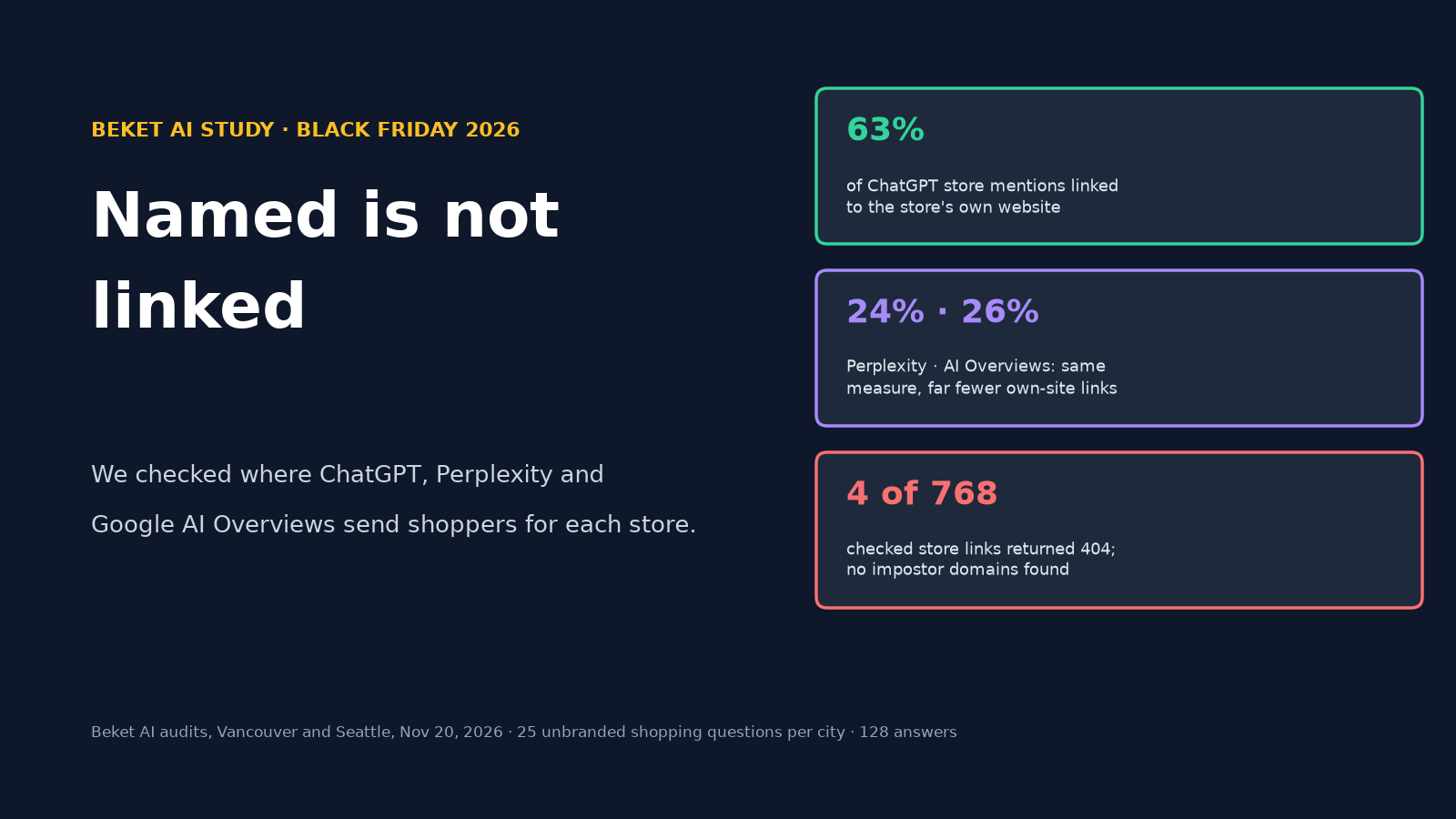
- ChatGPT sends shoppers to the store. 63% of the stores ChatGPT named came with a link to that store's own website. On Perplexity it was 24%, and on Google AI Overviews 26%.
- Google AI Overviews keep shoppers on Google. 45% of the AI Overview links tied to a named store went to maps, review or social pages rather than the store's site, and 49 of those 128 links (38%) were Google-owned pages. Perplexity leaned on MapQuest, Yelp, Apple Maps and Tripadvisor instead.
- Broken links were rare. Of 768 store links we could test, 4 returned a 404 (3 distinct pages), and none were on Google AI Overviews. If you've run into ChatGPT broken links elsewhere, store links weren't the problem here: ChatGPT gave just 1 dead store link in our whole check.
- No impostor shops turned up. We found no lookalike or fake store domains, and no links to the wrong country's site. Some links did go to scraped directory pages or to a different shop that stocks the brand.
- Blocking AI training bots didn't keep stores out. 11 store sites the engines linked block at least one AI crawler in robots.txt (10 block GPTBot), and they were still named and linked. None block OAI-SearchBot, the crawler ChatGPT uses for search.
What we asked, and where
The questions are the same 25 we used in our Black Friday AI shopping study in October, with the city name swapped in. None of them name a store or brand:
- best electronics store in [city] for Black Friday deals
- where to buy a TV on Black Friday in [city]
- best place to buy a laptop in [city]
- where to buy a winter jacket in [city]
- best outdoor gear store in [city]
- where to buy hiking boots in [city]
- best ski and snowboard shop in [city]
- best gift shops in [city]
- unique local gift shops in [city] for Christmas shopping
- where to buy Christmas gifts in [city]
- best toy store in [city]
- where to buy kids toys for the holidays in [city]
- best furniture store in [city]
- where to buy a sofa on sale in [city]
- affordable furniture stores in [city]
- best home decor stores in [city]
- best kitchenware store in [city]
- best bookstore in [city] for gifts
- best clothing boutiques in [city]
- where to buy shoes in [city]
- best shopping mall in [city] for Black Friday
- best jewelry store in [city] for holiday gifts
- where to buy video games and consoles in [city]
- best bike shop in [city]
- best sporting goods store in [city]
The audits ran from about 9:10 to 9:20 AM PT on November 20, 2026, with Vancouver, British Columbia and Seattle, Washington as the locations. ChatGPT and Perplexity answered all 50 questions. Google showed an AI Overview for 15 of the Vancouver questions and 13 of the Seattle ones, so the AI Overview numbers cover 28 answers, not 50. Our Google AI Mode and Microsoft Copilot runs didn't finish in time for this check, so they aren't included.
Across the three engines and two cities, the answers named 434 different stores, malls and markets. The names that came up most were MEC and Best Buy in Vancouver (9 answers each), and Pike Place Market (12), Best Buy (10) and REI (9) in Seattle. For the rest, we report counts only.
Finding 1: ChatGPT links to the store, the others link around it
We counted a store mention as "linked to its own site" when the same answer included a link whose domain matched the store's name. That match is automatic, so it misses some stores with short or unusual domains, which means these numbers lean low. The gap between engines is still large:
| Engine | Store mentions | With any matching link | With a link to the store's own site |
|---|---|---|---|
| ChatGPT | 349 | 246 (70%) | 219 (63%) |
| Perplexity | 216 | 90 (42%) | 51 (24%) |
| Google AI Overviews | 159 | 61 (38%) | 42 (26%) |
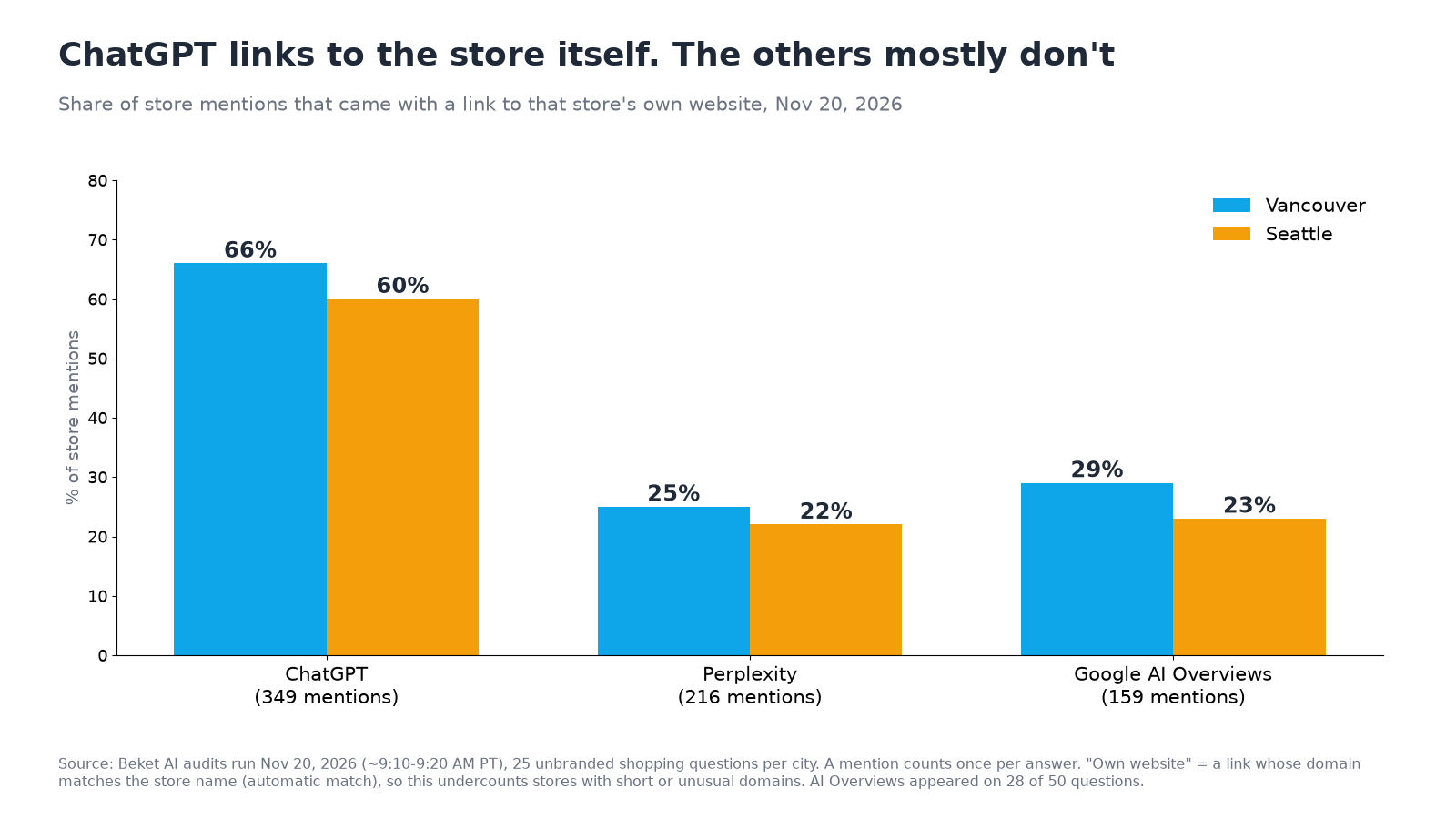
Both cities show the same pattern. ChatGPT linked the store's own site for 66% of mentions in Vancouver and 60% in Seattle, compared with 25% and 22% on Perplexity and 29% and 23% on AI Overviews.
It shows up in the links overall too. Of the 410 links in ChatGPT's answers, 76% pointed to the website of a store named in the same answer. For Perplexity it was 21% of 742 links, and for AI Overviews 19% of 288. Perplexity cites a lot of pages, but most of them are guides, lists and local media rather than the stores themselves. That matches what we saw in our comparison of AI Overviews and ChatGPT for local shops.
Update, November 23, 2026: OpenAI has edited its Shopping with ChatGPT Search help page. It used to say product results were "selected independently by ChatGPT and are not ads, nor influenced by any OpenAI partnerships." It now says "Product results are not ads; how products and merchants are selected is described below." The page lists what ChatGPT considers when it picks products and ranks merchants, including "availability, price, quality, and whether they are the maker or primary seller." Nothing on it says partnerships affect results, and the link counts in this study don't test that. We cover what changed and what it doesn't prove in What Changed on ChatGPT's Shopping Help Page, and What It Doesn't Prove.
Finding 2: AI Overviews send shoppers to Google, Perplexity to directories
When a store link didn't go to the store's site, where did it go?
| Engine | Store links | To maps, review or social sites | Top destinations |
|---|---|---|---|
| ChatGPT | 406 | 2 (0.5%) | (almost none) |
| Perplexity | 347 | 54 (16%) | MapQuest 19, Yelp 14, Apple Maps 8, Tripadvisor 6, Reddit 5 |
| Google AI Overviews | 128 | 57 (45%) | Google-owned pages 49, Instagram 3, Facebook 3, YouTube 2 |
For a local store, that means the listing Google shows for you, along with your MapQuest, Yelp and Apple Maps pages, can be what a shopper clicks from an AI answer instead of your own site. If your hours, holiday opening times or address are wrong on one of those listings, the AI answer passes that on.
Finding 3: Dead links were rare, and none of them were fakes
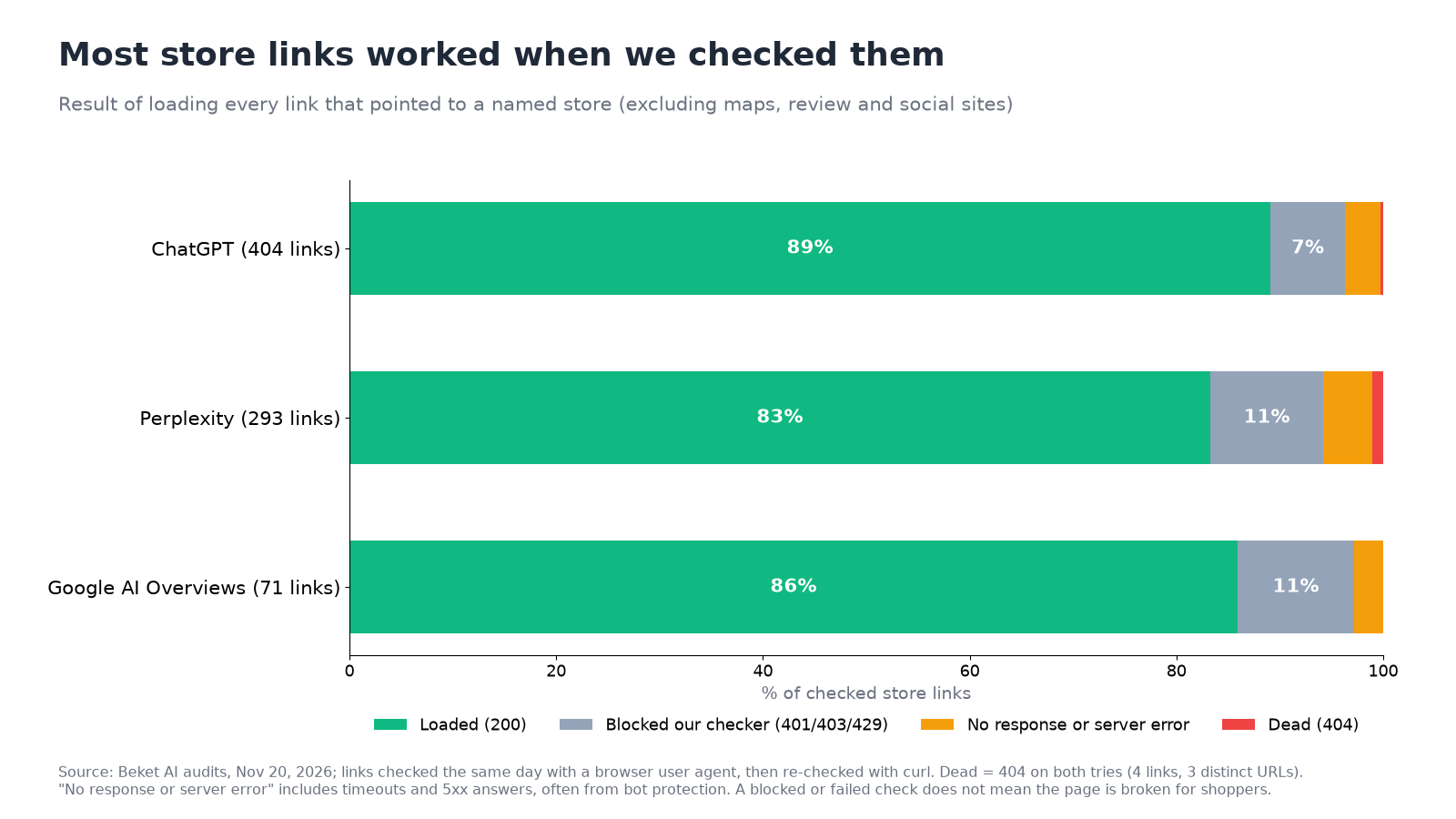
Not counting maps, review and social links, we loaded every store link on November 20 with a normal browser user agent and re-checked anything that failed with a second tool.
| Engine | Links checked | Loaded | Blocked our checker | No response or server error | Dead (404) |
|---|---|---|---|---|---|
| ChatGPT | 404 | 360 | 29 | 14 | 1 |
| Perplexity | 293 | 244 | 32 | 14 | 3 |
| Google AI Overviews | 71 | 61 | 8 | 2 | 0 |
The four dead links went to three pages: an outlet mall's location page, a brand's flagship store page and a mall's Black Friday event page that had already come down. All three are on the businesses' real domains and returned a 404 on both checks. The pages had most likely moved or expired, but the AI answers still pointed to the old address. A "blocked" or "no response" result usually means bot protection turned away our checker, not that a shopper would hit a broken page.
We also looked for the problem The Verge reported this month: a study by Podqi, a brand protection company, found that 9% of 6,795 ChatGPT, Gemini and Perplexity answers about where to buy 151 brands showed a risky site, such as an impostor shop or a dead brand domain, in September 2026. Perplexity was highest at 15%, then ChatGPT at 8% and Gemini at 4% (The Verge's coverage).
In our local questions, we didn't find that. We reviewed by hand the 90 linked domains that didn't match a store's name and found no lookalike or fake shop domains. They were local media, gift guides, malls, directories and stockists. A rule-based check also found no links to the wrong country's site, meaning US pages in Vancouver answers or Canadian pages in Seattle answers. Our questions are local and don't name a brand, while Podqi asked where to buy specific brands, so the two results don't contradict each other. They measure different things.
The smaller problems were still there:
- Scraped directories. Some links labeled with a store's name went to auto-generated locator or directory sites rather than the store.
- A different shop. A few links for a brand went to a store that sells that brand, not the brand's own shop. That's fine for the shopper, but not for the brand if it has its own store in town.
- The wrong layer of a site. A link for a store sometimes went to the mall's page or a parent company's page instead.
Finding 4: Blocking AI training bots didn't keep stores out of the answers
We fetched robots.txt for the 245 domains the engines linked for a named store, and 212 returned a readable file. 13 domains block at least one AI crawler, and 11 of those are store sites (the other 2 are local guide sites).
| Crawler | Domains blocking it |
|---|---|
| Amazonbot | 11 |
| Bytespider | 11 |
| GPTBot | 10 |
| ClaudeBot | 10 |
| CCBot | 10 |
| meta-externalagent | 9 |
| Google-Extended | 8 |
| Applebot-Extended | 6 |
| PerplexityBot | 2 |
| ChatGPT-User, Perplexity-User, Claude-SearchBot | 1 each |
| OAI-SearchBot | 0 |
All of these stores were still named and linked. That's what the crawler documentation says should happen. OpenAI says GPTBot and OAI-SearchBot are independent, so a site can block training and still appear in ChatGPT search. Google says Google-Extended doesn't affect inclusion in Google Search. Perplexity says PerplexityBot is what surfaces and links sites in its results, so the two domains blocking it are the ones to watch. We explain the difference in more detail in our guide to which AI crawlers to allow in robots.txt.
How to check where AI sends your shoppers before Black Friday
You can do this in under an hour:
- Ask your real buyer questions, without your name in them. Use five to ten questions like the ones above, with your city and category in each. Ask in ChatGPT, Perplexity and Google, signed out where you can.
- For each answer that names you, click every link next to your name. Write down where it goes: your site, a Google listing, Yelp, MapQuest, Apple Maps, a directory or a guide.
- Fix the destinations you control. Check the hours, holiday hours, address, phone number and website link on Google Business Profile, Apple Business Connect, Yelp and Bing Places. These are the pages AI Overviews and Perplexity often send people to.
- Redirect old URLs. If you've moved a store page, a location page or last year's Black Friday page, put a 301 redirect on the old address. AI answers can keep linking to it after the page is gone.
- Make the right page easy to pick. Give each physical store a clear page on your domain with its name, address and hours in plain text. Our guide to getting a Black Friday offer into Google AI Overviews covers what to put on it.
- Check robots.txt for the search crawlers. Blocking GPTBot or Google-Extended is a training decision. Blocking OAI-SearchBot or PerplexityBot can remove you from those engines' search results.
- Check again. AI answers change from day to day, so check the same questions again on Black Friday week.
Where Beket AI fits
Beket AI runs your buyer questions on ChatGPT, Gemini, Perplexity, Microsoft Copilot, Google AI Overviews and Google AI Mode, and shows for each engine whether you're named, how you're described and which competitors appear. The free audit covers 25 questions on any 3 of those 6 engines. Pro is $49 a month per website and adds daily re-runs and change detection alerts. The link and robots.txt checks in this post were a one-off analysis we ran on top of our audit data. They aren't a product feature.
About this study: the data comes from Beket AI audits run on November 20, 2026 (about 9:10 to 9:20 AM PT) in Vancouver and Seattle on ChatGPT, Perplexity and Google AI Overviews, using 25 unbranded questions per city. It shows what those engines returned at that time. Links and robots.txt files were checked the same day. AI answers change over time, so treat these numbers as a snapshot, and any business can request another run. Store-to-link matching is automatic, and the domain review was done by hand from hostnames. It wasn't a security scan. Podqi's figures come from its own report and are a vendor study with its own method.
Related posts
AI Mentions vs Citations vs Recommendations: What's the Difference and Which to Track (2026)
AI mentions vs citations vs recommendations: what each means, how often they split (Semrush, Snezzi and Beket AI data), and which one to track for your goal.
Help Center SEO for AI Search: How to Make Your Knowledge Base the Page ChatGPT Cites (2026)
Help center SEO for AI search: how often ChatGPT and other engines cite help and docs pages, plus 8 steps to make your knowledge base the page they quote.
ChatGPT, Perplexity and AI Mode Cite the Same Page on 4% of Buyer Questions: How to Get Cited in AI Answers on Each (2026)
A new study of 857 buyer questions finds ChatGPT, Perplexity and Google AI Mode rarely cite the same page. What our audits show, and how to get cited on each.