
What Changed on ChatGPT's Shopping Help Page, and What It Doesn't Prove

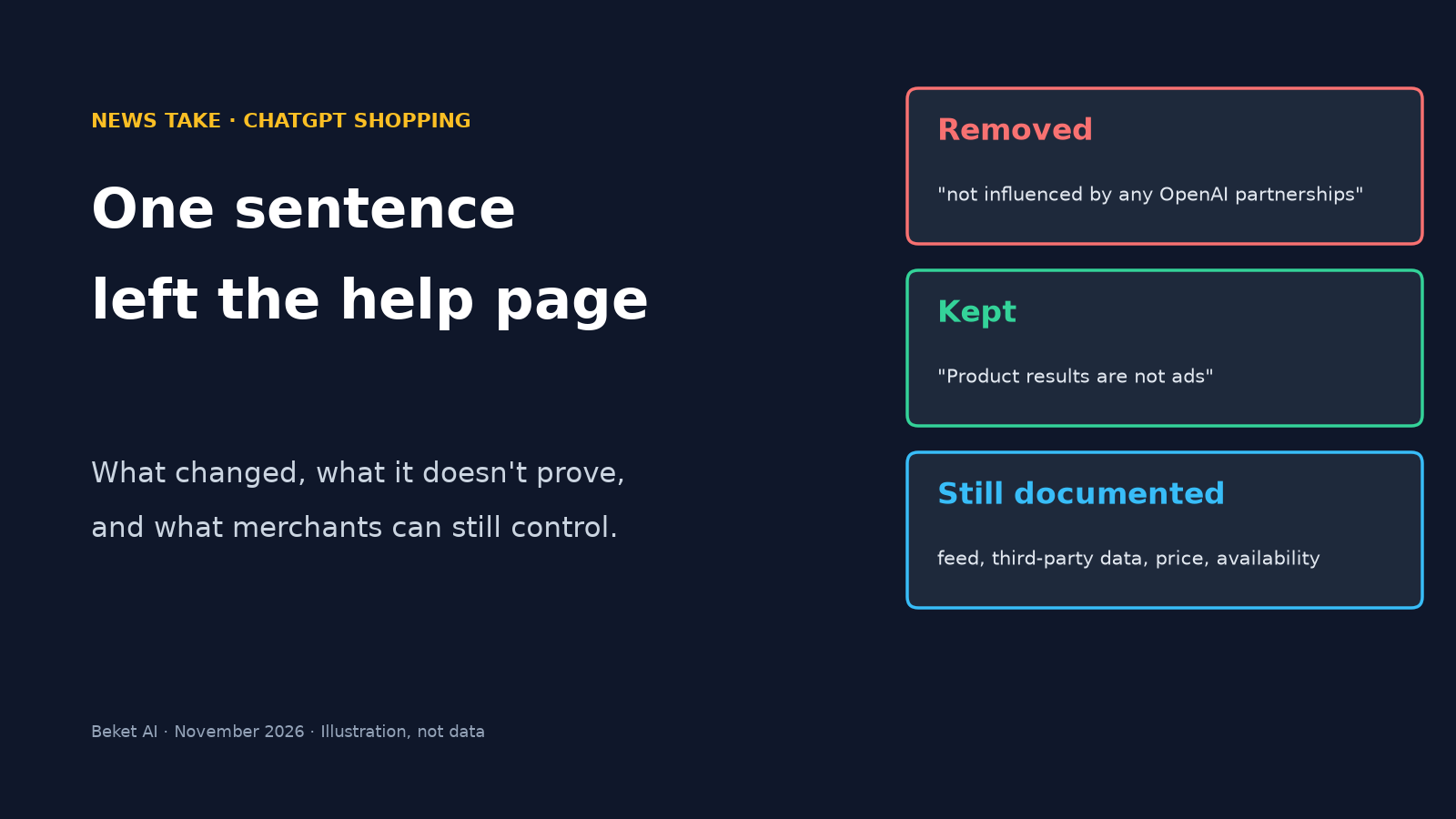
OpenAI has edited the help page that explains how ChatGPT picks shopping results. The old page said product results were "selected independently by ChatGPT and are not ads, nor influenced by any OpenAI partnerships." The current page keeps the "not ads" part and drops the rest. Search Engine Roundtable reported the change on November 23, 2026.
It's a fair thing to notice. It's also easy to read too much into. This post goes through what the page says now, what the edit does and doesn't show, and what a merchant can still act on.
What changed on the page
| Wording on Shopping with ChatGPT Search | |
|---|---|
| Before (as quoted by Search Engine Roundtable) | "Product results are selected independently by ChatGPT and are not ads, nor influenced by any OpenAI partnerships." |
| Now (checked November 23, 2026) | "Product results are not ads; how products and merchants are selected is described below. Ads are separate from product results, and you can learn more about ads in ChatGPT." |
Search Engine Roundtable compared the live page with an archived copy to show the difference. We didn't find an OpenAI statement announcing or explaining the edit.
What the page says now about how results are chosen
The help page describes two stages. For products, it says ChatGPT considers:
- structured metadata from first-party and third-party providers (for example price and product description), plus other third-party content
- model responses ChatGPT generated before it looks at any new search results
- OpenAI safety standards and product policies
It adds that some factors matter more than others depending on the question: with a $30 budget, ChatGPT "will focus more on price."
For the list of stores shown after you pick a product, the page says merchants "are ranked based on factors like availability, price, quality, and whether they are the maker or primary seller of that item." It also says merchant data comes from third-party providers or directly from merchants, that Shopify merchants are already integrated through Shopify Catalog with "no additional work" required, and that merchants can apply for direct product feed access. For how that works in practice, see our guide to how ChatGPT shopping works.
What this edit does and doesn't prove
It does show that OpenAI no longer makes a blanket promise on its help page that partnerships have no influence on product results. Anyone who quoted the old line as a guarantee can't point to the current page for it.
It doesn't show that partnerships do influence results. Nothing on the current page says they do, and nothing on it describes a paid or preferred slot. The page says results are not ads, and that ads are separate. Removing a denial is not the same as disclosing an influence. There are several possible reasons for dropping a sweeping sentence, and we don't know OpenAI's.
It doesn't change what we measured. Our own data doesn't test whether any partnership affects which stores ChatGPT names. In our store links study, we looked at where the links in answers go, not why a store was chosen.
So the safe reading is narrow: the page now makes fewer promises, and it still explains what ChatGPT looks at.
What merchants can still act on
The levers the page documents haven't gone away. Three matter most:
- Feed quality. The page puts structured product data from providers and merchants first. Fill in every required field and keep titles, descriptions and identifiers accurate. Our ChatGPT product feed guide walks through the fields and common mistakes.
- Third-party coverage. The page says ChatGPT also draws on third-party providers and other third-party content, and that its review summaries come from reviews on public websites. Make sure your product and store details match across the marketplaces, review sites and listings that feed those sources.
- Price and availability. Merchants are ranked on availability and price, among other things. The page also warns there may be a delay before price or shipping changes show up. Keep stock status and prices current wherever you publish them, and don't leave old offers live.
If you're the maker or primary seller of what you sell, make that clear on your own product pages, since the page lists it as a ranking factor.
A 20-minute check
- Pick five to ten shopping questions a buyer would ask, with no brand names in them.
- Ask each in ChatGPT, signed out if you can.
- For every product shown, note the merchants listed, the order, and the price shown.
- Compare what you see with your own feed and product pages. Fix the mismatches first.
- Repeat the same questions in a week, because answers change.
What we can't tell you yet
- Why OpenAI edited the page. There's no stated reason.
- What else changed. We compared the page against Search Engine Roundtable's report, not a full change history, so we can't list every edit.
- How merchant ranking works inside ChatGPT. The page names factors. It doesn't give weights.
- Whether the wording will change again. Help pages get updated, so check the page itself before you quote it.
Where Beket AI fits
Beket AI runs your buyer questions on ChatGPT, Gemini, Perplexity, Microsoft Copilot, Google AI Overviews and Google AI Mode, and shows for each engine whether you're named, how you're described and which competitors appear. The free audit covers 25 unbranded questions on any 3 of those 6 engines.
Note: quotes are from OpenAI's help page as it read on November 23, 2026, and from Search Engine Roundtable's report of the same date. The help page can change at any time. This post reports a wording change and doesn't present any Beket AI data.
Related posts
Angi vs Thumbtack in 2026: Which One Gets Contractors Into ChatGPT, Gemini and Google AI Mode
Angi vs Thumbtack for pros in 2026: how each plugs into Google AI Mode, Gemini and ChatGPT, how fees work, and which one AI answers cited in 173 audits.
Google Search Is Adding Angi and Thumbtack Account Linking: What Home Service Businesses Should Do Now
Google says Angi and Thumbtack account linking is coming to Search. A to-do list for home service businesses: profiles, budgets, billing and what's unknown.
Help Center SEO for AI Search: How to Make Your Knowledge Base the Page ChatGPT Cites (2026)
Help center SEO for AI search: how often ChatGPT and other engines cite help and docs pages, plus 8 steps to make your knowledge base the page they quote.