
Help Center SEO for AI Search: How to Make Your Knowledge Base the Page ChatGPT Cites (2026)

A customer types "how do I export my data from [your product]" into ChatGPT. The answer arrives as five neat steps with a source link. If that link points to your help center, the steps are probably right. If it points to a forum thread from 2023 or to a competitor's "switch to us" guide, they might not be.
That is the case for help center SEO in 2026. Your support articles are no longer read only by customers who already found your help site. AI engines read them too, and they repeat what they find to people who never open your site. This guide shows what the public data says about how often AI engines cite help pages, what our own audit data adds, and eight steps to make your knowledge base the page they quote.
What the data says about help pages in AI answers
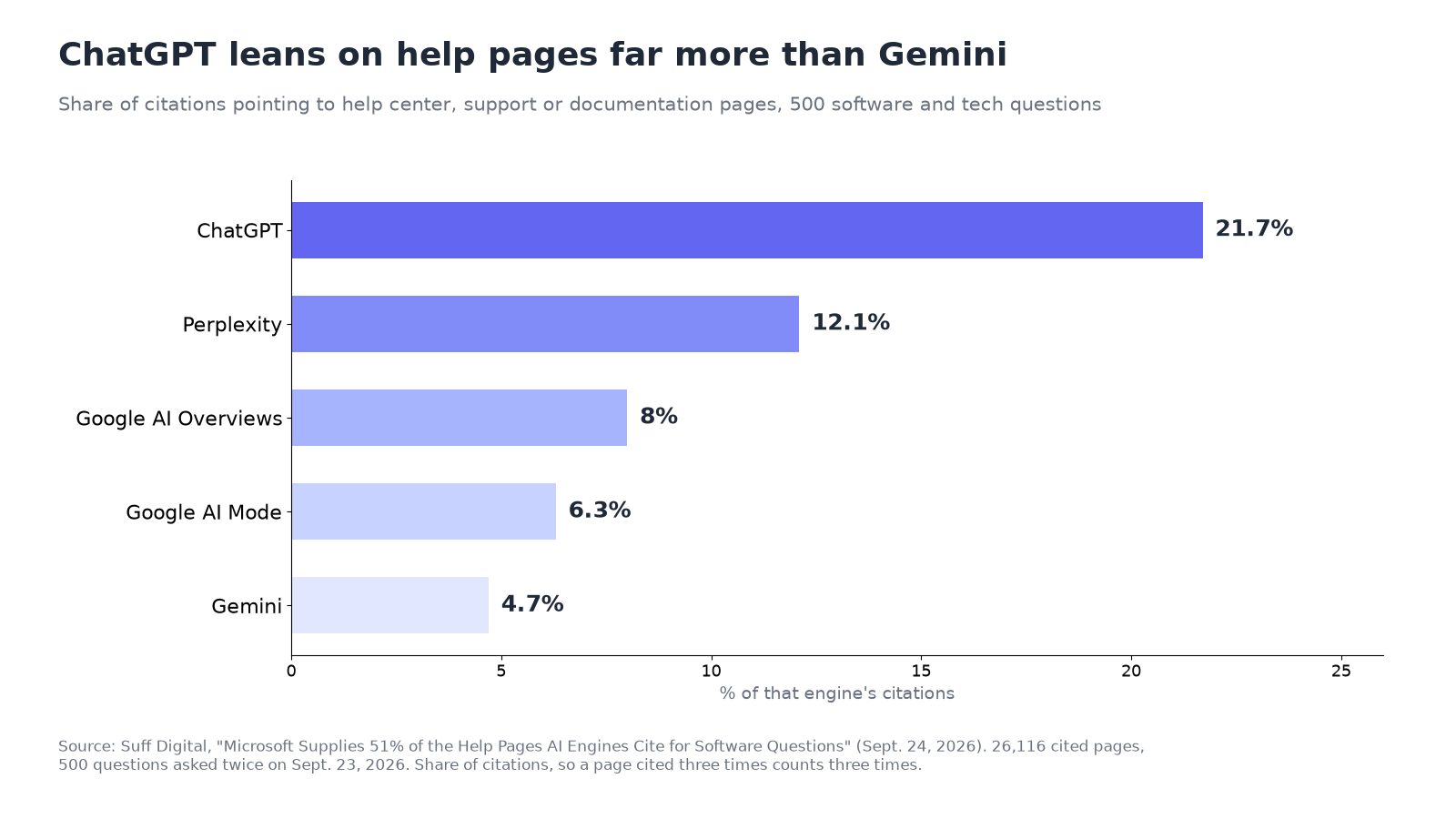
The clearest public number comes from Suff Digital. On September 23, 2026 the agency asked 500 software and tech questions (from "best software" questions to device and app how-tos) twice each on ChatGPT, Gemini, Perplexity, Google AI Overviews and Google AI Mode. The answers cited 26,116 pages. In its write-up, 10% of all citations (2,634 pages) were help center, support, knowledge base or developer documentation pages. On ChatGPT it was 21.7%.
Two other details from that study matter for smaller companies:
- Citations are concentrated. Microsoft supplied 51% of the help pages cited (1,344 of 2,634), mostly from support.microsoft.com and learn.microsoft.com. Apple's support site was next with 193 citations, then Dell (128) and OpenAI's help center (98).
- Gemini cited more pages but fewer help pages. Gemini cited 4,669 pages against ChatGPT's 3,429, yet only 4.7% were help pages. Suff Digital's reading: the same how-to question can be answered from the vendor's own instructions on ChatGPT and from third-party articles on Gemini.
A second, vendor-run dataset points the same way. Promptwatch's October 2026 software report (ChatGPT prompts from September 28 to October 4, 2026) grouped the 23 most-cited software domains by type. The documentation and help center domains among them earned 2.64% of all software citations, more than the vendor sites (2.01%) or the review sites and analysts (1.57%). Learn.microsoft.com was the second most-cited software domain after GitHub.
What Beket AI's own audits add
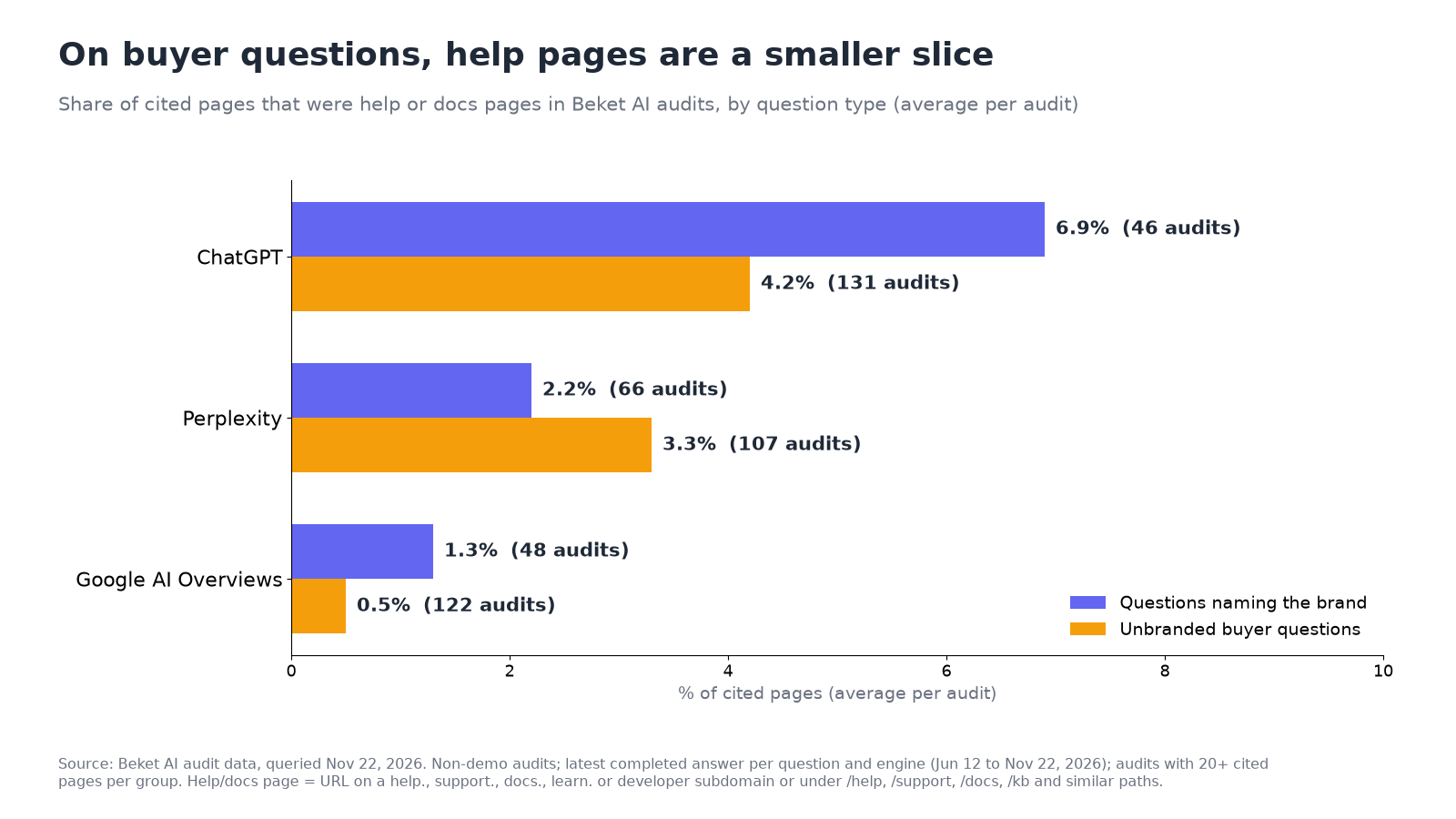
Beket AI audits ask a different kind of question: the ones buyers ask when they compare and choose a business, not how to fix a setting. So we checked how often help and docs pages show up there. Across 162 audits and 76,421 cited pages (latest answer per question and engine, June 12 to November 22, 2026), help and docs pages made up 3.0% of cited pages on average per audit. At least one was cited in 64.8% of audits.
| Engine | Audits | Help/docs share of cited pages | Answers citing at least one help/docs page |
|---|---|---|---|
| ChatGPT | 136 | 4.6% | 11.8% |
| Perplexity | 107 | 3.2% | 14.7% |
| Google AI Overviews | 125 | 0.7% | 4.5% |
Averages per audit, audits with 20+ cited pages. A help/docs page is any URL on a help., support., docs., learn. or developer subdomain, or under /help, /support, /docs, /kb and similar paths. Copilot, AI Mode and Gemini had too few audits to report.
Read together, the two sources say something useful:
- The engine order holds. ChatGPT leans on help pages the most and Google AI Overviews the least, in both Suff Digital's how-to-heavy set and our buyer-question set.
- The question type matters most. On software how-to questions, help pages are one ChatGPT citation in five. On buyer questions they are closer to one in twenty, and more common when the question names the brand (6.9% on ChatGPT) than when it doesn't (4.2%).
- Help pages still reach buyers. About one ChatGPT answer in eight and one Perplexity answer in seven to buyer questions in our audits cited at least one help or docs page. Those are the "can it do X" and "how does it work" answers people read before they sign up.
So your help center is not a replacement for product and comparison pages. It is the source AI engines use to explain how your product works, and that explanation lands in front of customers and prospects alike.
How to make your help center citable: 8 steps
1. Start with the questions people actually ask
Pull the 30 to 50 most common questions from support tickets, chat logs and sales calls, and group them by task (set up, connect, export, troubleshoot, cancel, compare). Our guide to turning support tickets into AI prompt research walks through the process. The aim is one help article for every question that comes up again and again, worded the way customers word it.
2. Make the help center public
An article behind a login can't be crawled, so an AI engine answers from whatever it can read instead. Suff Digital makes the same point: when a help article is missing, gated or out of date, the engine takes its instructions from someone else. Keep the articles that explain features, limits, setup and integrations public. Keep only account-specific content behind the login.
3. Let the search crawlers in
This is the one step where a mistake removes you completely. OpenAI's crawler documentation says OAI-SearchBot is the bot that surfaces sites in ChatGPT search, and that robots.txt changes take about 24 hours to take effect. Its help article on ChatGPT search also asks site owners to confirm their host or CDN allows OpenAI's published search bot IP addresses. Perplexity's bot guide likewise recommends allowing PerplexityBot to appear in its results.
Many help centers run on a separate platform or subdomain with its own robots.txt and firewall rules, so check help.yourdomain.com on its own, not just your main site. Blocking GPTBot (training) is a separate choice from blocking OAI-SearchBot (search). Our GPTBot vs OAI-SearchBot guide explains which rule does what.
4. Make each article indexable with a snippet
For Google, the rule is short. Google's AI features documentation says a page must be indexed and eligible to be shown with a snippet to appear as a supporting link in AI Overviews or AI Mode, and that there are no additional technical requirements. Check that help articles don't carry a noindex or nosnippet tag left over from the platform's defaults, and that each article has its own URL rather than loading inside a widget.
5. Write one task per article, answer first
AI engines need a precise instruction, and a help article written for one narrow task already has that shape. Make it easy to lift:
- Title the article with the task, in the customer's words: "How to export invoices to CSV", not "Data management".
- Put the answer in the first two lines: what the feature does, who can use it and on which plan.
- Number the steps and use the exact button and menu labels from your current interface.
- State the conditions and limits next to the steps: plan, role, file size, region, version.
- End with what can go wrong and the fix.
6. Keep facts current and dated
A cited help article that describes last year's interface or an old plan limit gets repeated as fact. Add a visible "last updated" date, update articles in the same release cycle as product changes, and redirect retired articles to their replacements instead of letting them linger. Pay most attention to pages that state prices, limits and plan names, since those are the details buyers act on.
7. Answer the "can it do X" questions in the open
Buyers ask AI engines whether a product integrates with their stack, supports their country or handles a specific use case. If the only answer lives in a sales deck, the engine fills the gap from reviews and competitors. Publish plain articles for each integration, each supported region or language, and each known limitation. Link them from your product and pricing pages so they are easy to find. In our study of which SaaS tools AI recommends, 8 of the 10 most-cited domains on unbranded buyer questions were vendors' own sites, so your own pages are where these answers can come from.
8. Check what the engines cite every month
Pick 10 questions and ask them on ChatGPT, Perplexity and Google, then write down which page each answer cites and whether the steps are right. A starting set:
- How do I set up [product] for a team of five?
- How do I connect [product] to [the integration your customers use most]?
- How do I export my data from [product]?
- Why is [common error] happening in [product]?
- Does [product] work in [country or language]?
- What's the difference between [product]'s plans?
- Can [product] do [a feature buyers often ask about]?
- How do I cancel or downgrade [product]?
- How do I migrate from [category alternative] to [product]?
- What are the limits of [product]'s free plan?
If an answer cites someone else's page, or your own outdated one, that article goes to the top of the rewrite list. It's the same pattern we saw when we looked at which pages ChatGPT cites for local businesses: the links tended to go to pages written for that exact question, not to homepages.
Help center SEO checklist
| Check | Why it matters for AI answers | How to verify |
|---|---|---|
| Feature, setup and limit articles are public | Gated pages can't be crawled or cited | Open the article in a private window |
| OAI-SearchBot and PerplexityBot allowed on the help subdomain | Opting out of OAI-SearchBot keeps a site out of ChatGPT search answers | Read help.yourdomain.com/robots.txt and your CDN bot rules |
| Indexable, with a snippet | Google's requirement for AI Overviews and AI Mode links | Search Console URL Inspection; check for noindex and nosnippet |
| One task per article, answer in the first lines | Gives the engine a precise instruction to quote | Read the first two lines alone: do they answer the title? |
| Exact UI labels, plans and limits | Engines repeat what they read | Compare against the current product |
| Visible last-updated date | Stale steps get repeated as fact | Audit the 20 most-viewed articles each quarter |
| Integration, region and limitation articles | Buyers ask "can it do X" before they sign up | Ask the engines and see what they cite |
What you can skip
Google's documentation says you don't need new machine-readable files, AI text files or special schema.org markup to appear in AI Overviews or AI Mode. Spend the time on the articles themselves and on crawler access, which both decide whether a page can be cited at all.
Track it without doing it by hand
Running the monthly check in step 8 by hand works for 10 questions on two engines. It gets slow past that, and AI answers change from day to day. Beket AI's free audit runs 25 questions on any 3 of 6 engines (ChatGPT, Gemini, Perplexity, Microsoft Copilot, Google AI Overviews and Google AI Mode). Pro, at $49 a month per website, re-checks your questions daily and adds change detection alerts and a citation gaps and content roadmap, so you can see which questions your help center isn't winning yet.
About the data: Suff Digital's figures come from its own question set, collected September 23, 2026. Promptwatch's are vendor data for ChatGPT software prompts, September 28 to October 4, 2026. Beket AI's figures come from our audit data, queried November 22, 2026, and averaged per audit so frequently re-run audits don't dominate. They show what the engines returned at the time; AI answers change over time, and any business can request a fresh run of its own questions.
Related posts
Where Do ChatGPT, Perplexity and AI Overviews Send Shoppers? We Checked 881 Store Links Before Black Friday (2026 Study)
We checked every store link ChatGPT, Perplexity and Google AI Overviews gave for 50 Black Friday shopping questions in Vancouver and Seattle. What we found.
Angi vs Thumbtack in 2026: Which One Gets Contractors Into ChatGPT, Gemini and Google AI Mode
Angi vs Thumbtack for pros in 2026: how each plugs into Google AI Mode, Gemini and ChatGPT, how fees work, and which one AI answers cited in 173 audits.
AI Mentions vs Citations vs Recommendations: What's the Difference and Which to Track (2026)
AI mentions vs citations vs recommendations: what each means, how often they split (Semrush, Snezzi and Beket AI data), and which one to track for your goal.