
AI Mentions vs Citations vs Recommendations: What's the Difference and Which to Track (2026)

Say one tool tells you ChatGPT cited your site 40 times last month. Then you ask ChatGPT for "the best options" in your category and your name isn't in the answer. Both things can be true. A citation means one of your pages was a source behind the answer. A mention means the answer says your name. A recommendation means the answer puts you forward as a pick. These are three different outcomes, and AI engines hand them out separately.
This post covers what each one means, how often they come apart (in public studies and in Beket AI's own audit data), and which one to track for which goal.
The short answer
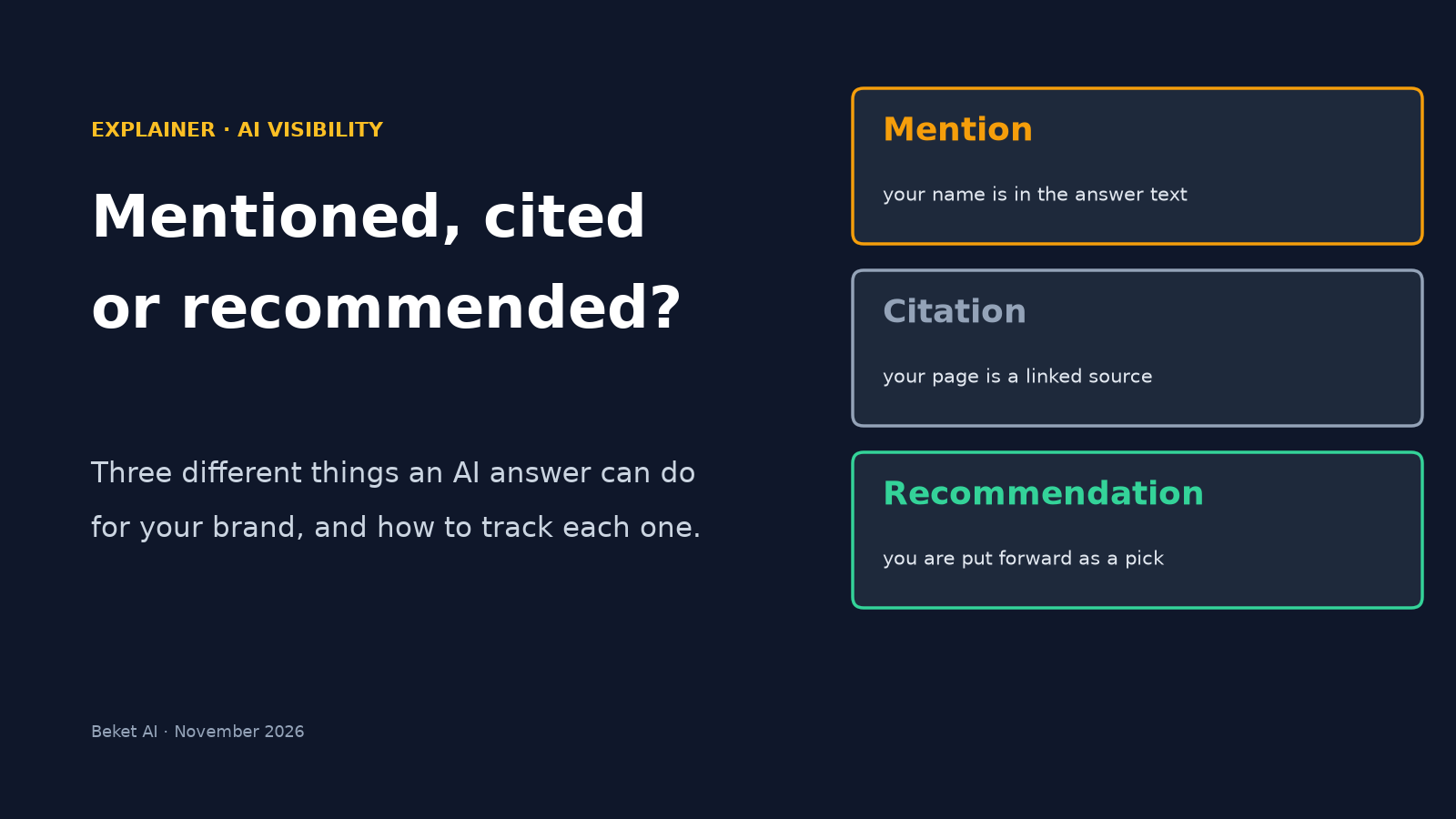
- AI mention: your brand name appears in the answer text. It can be positive, neutral, negative or just part of a list.
- AI citation: a page from your site is shown as a source link, either beside the answer or inside it. Your name doesn't have to appear in the text.
- AI recommendation: the answer names you and suggests you as a choice, usually near the top of a shortlist or with clear "best for" wording.
A citation can come without a mention, and a mention can come without a citation. You can't be recommended unless you're mentioned, but plenty of mentions aren't recommendations.
AI mentions vs citations vs recommendations, side by side
| Mention | Citation | Recommendation | |
|---|---|---|---|
| What it is | Your name in the answer text | Your page listed or linked as a source | You're named as a pick for the buyer's need |
| Where you see it | The written answer | Source list, link cards or inline links | The top of a shortlist, or "best for..." wording |
| What it does for you | Gets you onto the reader's shortlist, even with no click | Can send a click, and shows the engine trusts your page | The closest thing to winning the question |
| What it doesn't prove | That you were endorsed (it may be neutral or critical) | That the reader ever saw your name | That the description is accurate |
| How to check | Read the answer: are you named, and in what words? | Open the sources: which of your URLs show up? | Note your position and the wording around your name |
| Best for tracking | Awareness and share of voice | Referral traffic and which content gets used | Buyer-intent questions that drive sales |
How often mentions and citations come apart
Several 2026 studies measured the gap. They use different definitions, so the numbers aren't directly comparable, but they all point the same way.
| Study | What it counted | Finding |
|---|---|---|
| Semrush with Kevin Indig and Growth Memo (June 2026) | 3,981 domain appearances, 115 prompts, 14 countries; ChatGPT, AI Overviews, Gemini, AI Mode | 61.7% were "ghost citations" (cited, never named), 13.2% were cited and named, and 25.1% were named without a citation |
| Same Semrush study, by engine | Share of appearances cited vs named | Gemini named brands in 83.7% of appearances but cited them in 21.4%; ChatGPT cited in 87% and named in 20.7% |
| Snezzi (updated Nov 19, 2026) | 9,974 brand-prompt-engine combinations from 182,789 unbranded answers, Nov 2025 to Sep 2026 | 46% of combinations with an own-site citation never named the brand; 74% of combinations that named the brand never recorded a citation to its site |
| Stacker (Aug 2026) | 456 distributed stories, 30 prompts each, six AI platforms | Brand content was cited in 13.6% of responses; the brand was named in 3.8% |
Snezzi also points out that being named doesn't mean being recommended. In its tracker, 61.7% of mentions were labeled neutral, 29.3% positive and 0.9% negative.
Semrush's split by query type is also useful. Informational questions ("what is", "how does") had an 89.3% citation rate but only an 18% mention rate. Comparative questions ("best", "vs", "recommend") had a 43.3% mention rate. Semrush reads this as engines using reference content as raw material and saving brand names for questions where the reader is choosing.
What Beket AI's audit data shows
We ran the same kind of check on audits run through Beket AI, using aggregate numbers only. We kept unbranded questions (ones that don't name a brand), used the latest completed answer for each question on each engine, excluded demo audits, and only looked at answers that cited at least one source. We counted a business when it has a known website and was named somewhere in that audit, so publishers, directories and Wikipedia aren't counted. Then we averaged per audit, so a few large audits can't skew the result. The answers are dated July 27 to November 22, 2026.
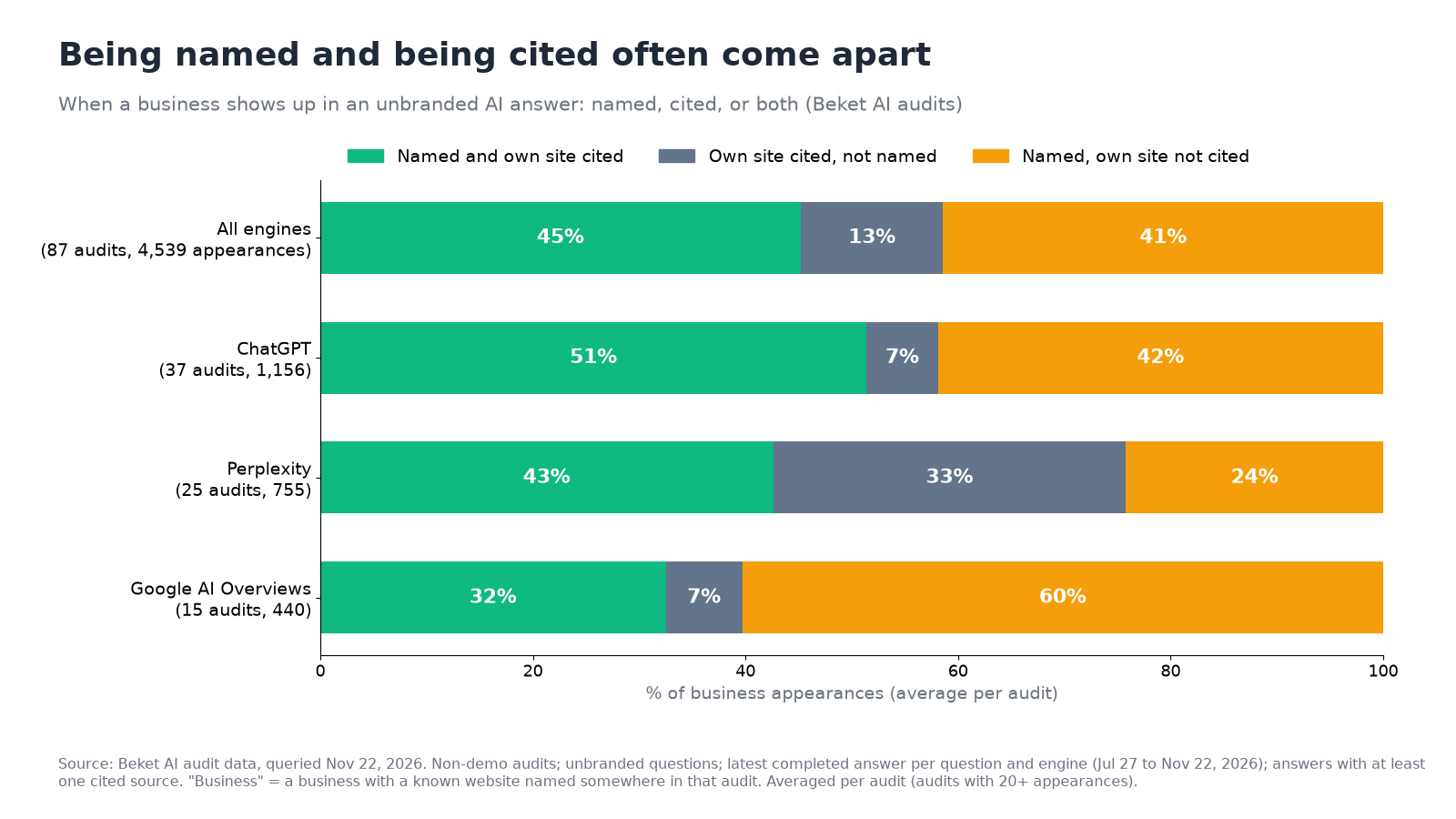
| Engine | Audits | Business appearances | Named and cited | Cited, not named | Named, not cited |
|---|---|---|---|---|---|
| All engines | 87 | 4,539 | 45.2% | 13.4% | 41.4% |
| ChatGPT | 37 | 1,156 | 51.4% | 6.7% | 41.9% |
| Perplexity | 25 | 755 | 42.6% | 33.2% | 24.2% |
| Google AI Overviews | 15 | 440 | 32.5% | 7.2% | 60.3% |
Three things stand out:
- Our "ghost citation" share is much lower than Semrush's 61.7%, and that's expected. We only counted businesses, not every cited domain. Broad studies count every cited domain, including reference sites, publishers and directories that an answer can use as a source with no reason to name. In our data, when a business's own site was cited, the business was usually named too.
- Perplexity is the exception. A third of business appearances on Perplexity were cited-only: the business's site was in the sources, but the answer didn't name it. Perplexity cites a lot of pages per answer (15.8 URLs per unbranded answer in our audits, vs 5.9 on ChatGPT, as we found when comparing ChatGPT, Perplexity and AI Mode citations), so being a source there is easier than being named.
- Google AI Overviews names businesses without linking to them. In 60.3% of business appearances, the overview named the business but cited other pages, not the business's own site. If you only count citations, you'll miss most of your AI Overview presence.
None of this is a ranking of engines. It shows that a mention report and a citation report tell you different things, and how far apart they are depends on the engine.
Recommendations: the third signal
A mention in seventh place and a mention as the first pick are not the same result. So we also looked at the order in which businesses were named, as a rough proxy for "recommended."
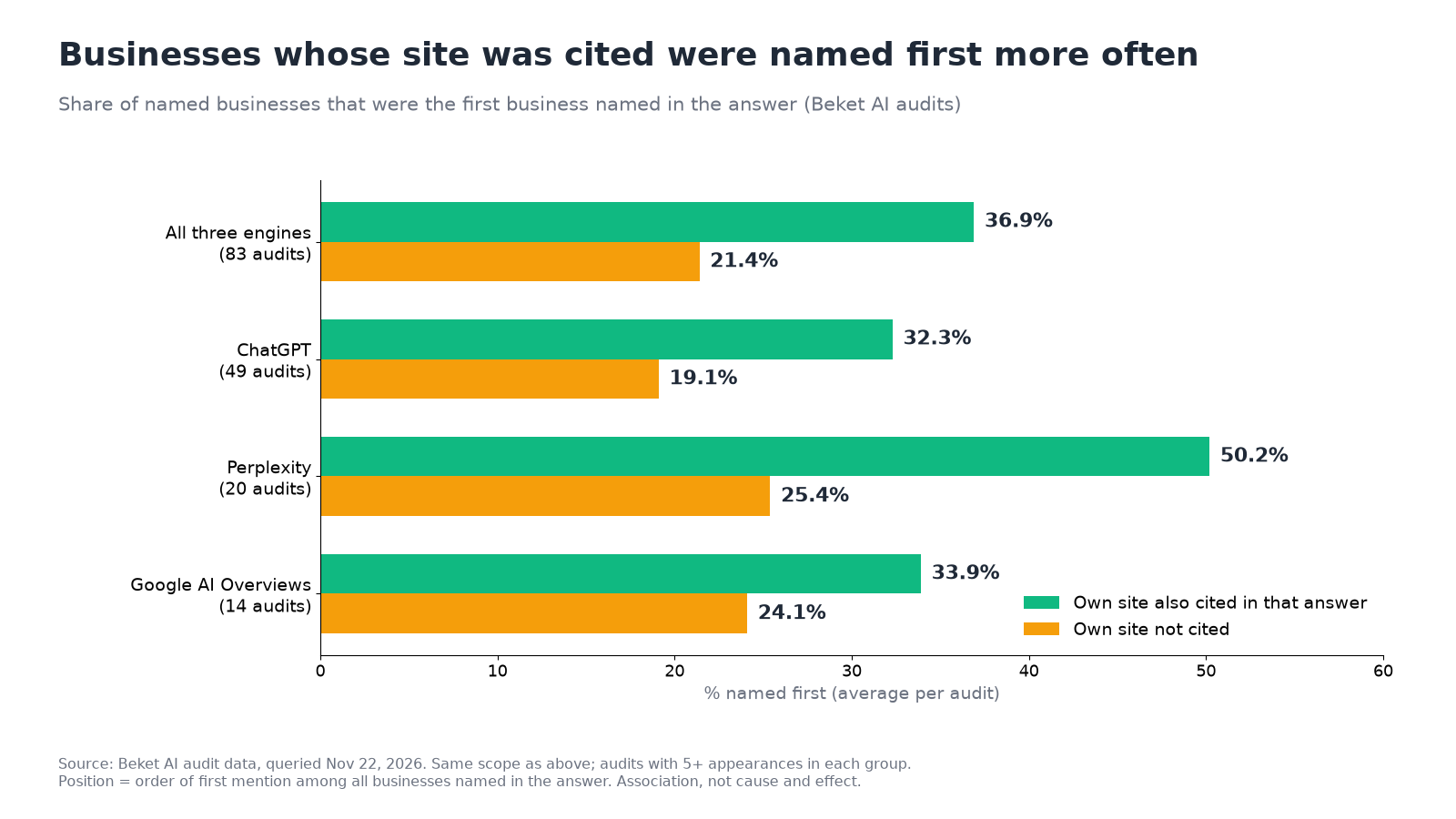
Across 83 audits, a named business whose own site was also cited in that answer was named first 36.9% of the time. A named business whose site wasn't cited was named first 21.4% of the time. Its average position was 2.6 versus 3.8. The pattern held on all three engines and was strongest on Perplexity (50.2% vs 25.4%).
This is an association, not proof that getting cited moves you up. Engines may simply cite the businesses they already rate highly. Still, it suggests that your best results tend to come when the answer both names you and uses your own page to back that up. For context, an unbranded answer in these audits named 6.5 businesses on average on ChatGPT, 5.7 on AI Overviews and 4.1 on Perplexity, so first place is a small target.
Which one should you track?
All three, but give each one its own job.
| If your goal is... | Watch this most | Why |
|---|---|---|
| Getting onto buyers' shortlists | Mentions on unbranded buying questions | Readers see the names in the text without clicking anything; those names are the shortlist |
| Traffic from AI answers | Citations, and which of your URLs get them | Only a cited link can send a visit |
| Winning sales against named competitors | Recommendations: position and wording | Being named seventh, or with a caveat, rarely wins the deal |
| Accuracy | What mentions say about you | A mention with the wrong price or service area can do harm |
Our AI share of voice explainer covers how to turn mentions into a competitive metric.
How to track all three in one weekly check
- Write unbranded questions a buyer would ask. Use "best X for Y", "X vs Y" and "who should I hire for Z" in your own category and cities. Don't put your brand name in them, or you're testing recall, not recommendation.
- Run them on each engine separately. As the data above shows, ChatGPT, Perplexity and AI Overviews split mentions and citations very differently, so a blended score hides the gaps.
- Log four things per answer: were you named, at what position, in what words, and which (if any) of your URLs were cited. Also note which third-party pages were cited next to your name.
- Sort each question into a bucket:
- Cited, not named: the engine uses your page but doesn't credit you. Check whether that page states clearly who you are and what you offer, rather than reading as generic reference text.
- Named, not cited: the engine knows you from other sources. Find those sources (reviews, lists, directories) and make sure they're accurate. Then make sure your own site confirms the same facts.
- Named but low or hedged: compare your position and wording with the businesses named above you, and look at what their cited pages cover that yours doesn't.
- Neither: start with the third-party lists and reviews the engine already cites for that question.
- Repeat it every week. AI answers change from run to run, so a single check is a snapshot. Our weekly AI brand monitoring routine walks through the cadence, and our guide on how to get cited by ChatGPT covers the citation side in more depth.
Doing this by hand works for 10 to 20 questions. Beyond that, a tracker saves time. Beket AI checks your unbranded questions on ChatGPT, Gemini, Perplexity, Microsoft Copilot, Google AI Overviews and Google AI Mode. It tracks whether you're named and where, engine by engine. Pro ($49/month per website) re-runs them daily with change detection alerts and a citation gaps and content roadmap. The free audit covers 25 questions on any 3 of the 6 engines.
The bottom line
Mentions, citations and recommendations are three separate scoreboards. Citations show the engine trusts your page. Mentions show it puts your name in front of the reader. Recommendations show it actually picks you. Track all three, on each engine, on the unbranded questions your buyers ask.
About this post: Semrush, Snezzi and Stacker figures are from their published study pages (dated June 9, November 19 and August 19, 2026). Snezzi and Stacker are vendor-published studies, and we haven't re-run any of them. Beket AI figures were queried on November 22, 2026 from non-demo audits. They're aggregates only, with no business names, brands or questions read, and they show what the engines returned when those audits ran. "Own site cited" means the business's domain or a subdomain was among the answer's cited sources. Position is the order of first mention among all businesses named in the answer. Audits skew toward software, services, local and B2B businesses, and the AI Overviews and Perplexity samples are smaller than ChatGPT's. AI answers change, so these numbers are a snapshot, and any business can request another run of its own audit.
Related posts
ChatGPT, Perplexity and AI Mode Cite the Same Page on 4% of Buyer Questions: How to Get Cited in AI Answers on Each (2026)
A new study of 857 buyer questions finds ChatGPT, Perplexity and Google AI Mode rarely cite the same page. What our audits show, and how to get cited on each.
Where Do ChatGPT, Perplexity and AI Overviews Send Shoppers? We Checked 881 Store Links Before Black Friday (2026 Study)
We checked every store link ChatGPT, Perplexity and Google AI Overviews gave for 50 Black Friday shopping questions in Vancouver and Seattle. What we found.
AI Holiday Shopping: Chains Were 1 in 9 Store Names in 150 ChatGPT and Google Answers (2026 Study)
We asked ChatGPT and Google 25 holiday shopping questions in Vancouver and Seattle. Chains were about 11% of store names, and 65% of stores were named once.