
ChatGPT, Perplexity and AI Mode Cite the Same Page on 4% of Buyer Questions: How to Get Cited in AI Answers on Each (2026)

Picture a buyer asking the same question in three places on the same afternoon: ChatGPT, Perplexity and Google's AI Mode. All three come back with a shortlist of about seven brands. But if you open the sources behind those answers, you'll find that the three engines almost never point to the same web page.
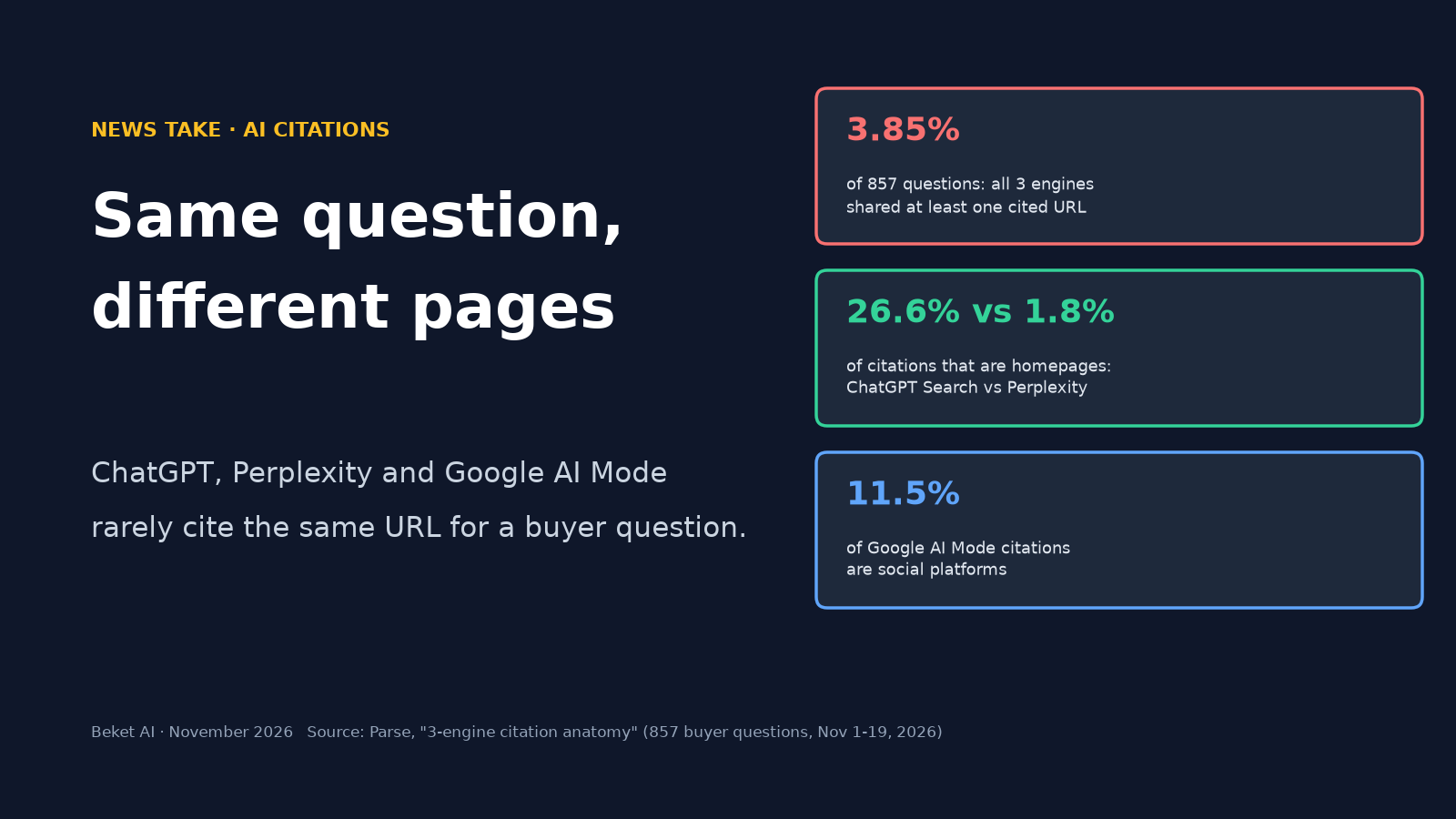
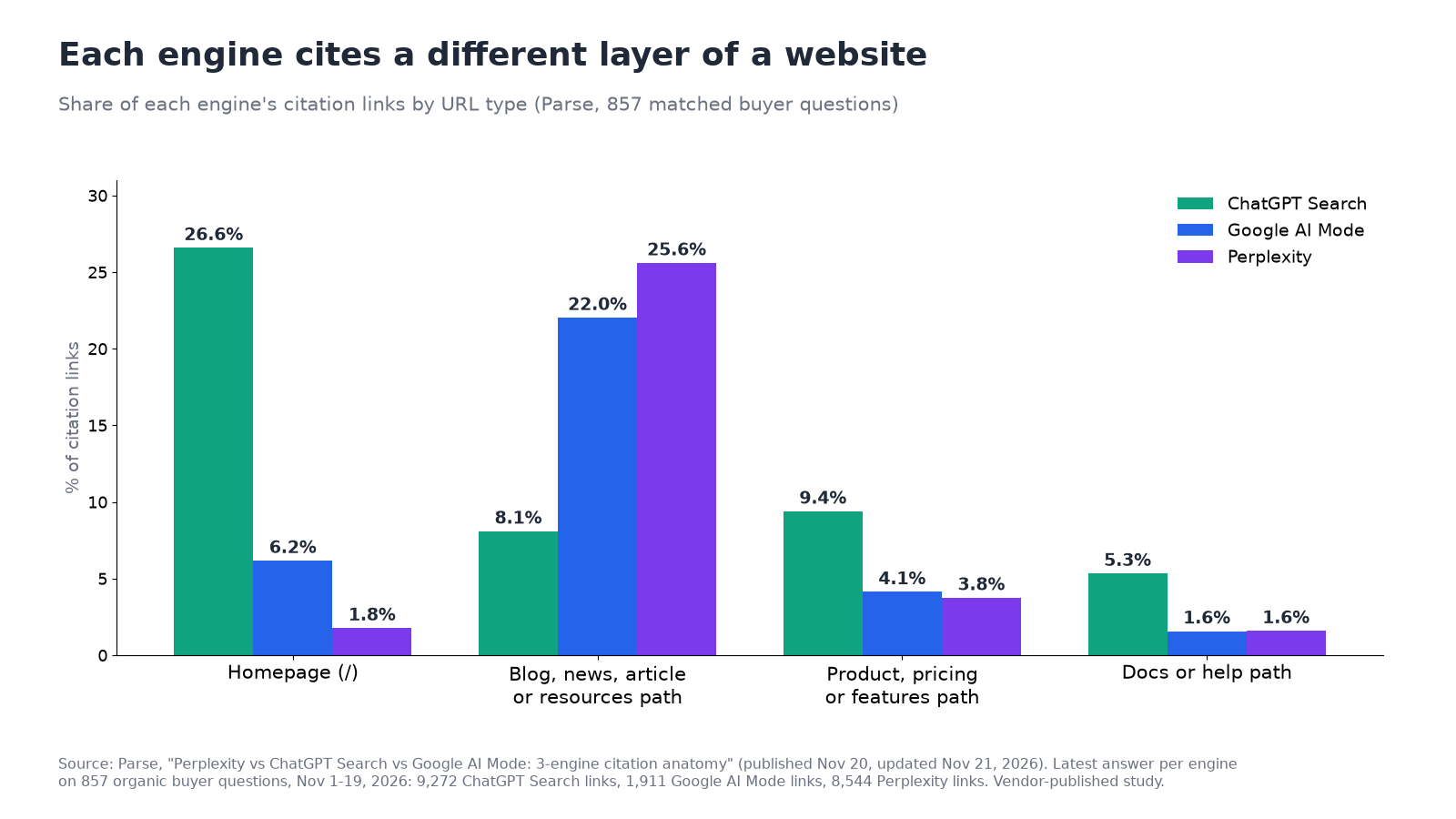
That's the main finding of a new study from Parse, an AI visibility vendor, published on November 20, 2026. Across 857 buyer questions answered by all three engines, all three cited at least one of the same URLs on only 3.85% of questions. Each engine also leaned on a different kind of page: homepages for ChatGPT, deep articles for Perplexity, and social platforms for AI Mode.
If you're trying to work out how to get cited in AI answers, this matters more than any single tactic. Below we cover what the study found, what we'd discount, what Beket AI's own audit data shows, and what to change on each engine.
What the Parse study found
Parse matched 857 organic buyer questions that Perplexity, ChatGPT Search and Google AI Mode all answered between November 1 and 19, 2026. It kept the latest answer from each engine, which came to 2,571 answers and 19,727 citation links. Every number in this table comes from the Parse write-up:
| Measure | ChatGPT Search | Perplexity | Google AI Mode |
|---|---|---|---|
| Brands named per answer | 7.42 | 7.19 | 7.46 |
| Cited URLs per answer | 10.82 | 9.97 | 2.23 |
| Answers with no prose citation | 1.05% | 0% | 10.5% |
| Average answer length (characters) | 7,739 | 2,294 | 3,444 |
| Citations that are a homepage | 26.59% | 1.77% | 6.17% |
| Citations to blog, news, article or resources paths | 8.09% | 25.60% | 22.03% |
| Citations to social platforms | 0.85% | 1.51% | 11.46% |
| Citations to editorial and news sites | 7.89% | 18.78% | 13.19%* |
*AI Mode's figure adds Parse's separate editorial (6.96%) and news (6.23%) shares.
The overlap numbers are even starker:
- All three engines shared at least one URL on 3.85% of questions and at least one root domain on 14.59%.
- Two engines at a time shared few pages. Averaged over all 857 questions, URL overlap (shared URLs divided by all distinct URLs) was 2.54% for Perplexity and ChatGPT, 1.87% for Perplexity and AI Mode, and 1.68% for ChatGPT and AI Mode.
- They agreed on the winner more often. When both engines ranked a top brand, Perplexity and ChatGPT picked the same #1 brand 30.78% of the time, ChatGPT and AI Mode 28.94%, and Perplexity and AI Mode 26.85%.
- Each engine's most-cited domains looked different. Only microsoft.com and amazon.com made all three top-10 lists. AI Mode's top two were reddit.com and youtube.com.
Our take: the overlap finding is solid, the page-type split needs a caveat
The headline matches what other research keeps finding. In its Q3 2026 Search Report, the agency Victorious collected about 16,500 AI answers on September 29 and found that any two AI platforms answering the same question share between 4% and 10% of the sources they cite. Different methods, different months, same conclusion: being cited on one engine tells you very little about the others.
Before you rebuild your content plan around Parse's page-type split, though, keep three things in mind:
- The question set leans toward software and tech. ChatGPT's top cited domains included splunk.com, cloudflare.com, clickup.com, elastic.co, atlassian.com and asana.com. A dentist or a furniture store will see a different mix.
- It's a vendor study, and the vendor shows up in its own data. Parse notes that its own domain was Perplexity's second most-cited domain (110 links), because some matched questions were about AI visibility tools. It left those in.
- "No citation" doesn't always mean no sources. The 10.5% figure for AI Mode counts answers with no prose citation, so it's best read as "AI Mode shows far fewer links," not "AI Mode makes things up."
Still, the direction is clear. And our own data, collected a different way, points the same way.
What Beket AI's audits show
We looked at the audits run through Beket AI, using aggregate numbers only. We excluded demo audits, kept the latest completed answer for each question on each engine, and counted distinct audits rather than raw answers so that daily-scheduled audits don't skew the totals. We also stuck to unbranded questions (ones that don't name a brand), which is how buyers usually start. The answers are dated June 12 to November 22, 2026, and about half are from November.
| Engines compared | Questions | Audits | Average URL overlap | Shared at least one URL | Shared at least one domain |
|---|---|---|---|---|---|
| ChatGPT and Perplexity | 1,850 | 103 | 3.55% | 45.7% | 70.4% |
| ChatGPT and Google AI Overviews | 1,301 | 112 | 2.34% | 21.2% | 43.7% |
| Google AI Overviews and Perplexity | 1,168 | 86 | 1.79% | 27.7% | 58.0% |
| ChatGPT and Google AI Mode | 111 | 13 | 3.68% | 25.2% | 39.6% |
| Google AI Mode and Google AI Overviews | 78 | 14 | 10.35% | 47.4% | 67.9% |
Four things stand out:
- Average overlap is in the low single digits, as Parse found. Most of each engine's sources are its own. The two Google surfaces overlap the most with each other (10.35%), but even they share only about a tenth of their URLs. The AI Mode rows come from a small sample (13 to 14 audits).
- "At least one shared URL" is more common in our data. ChatGPT and Perplexity shared at least one page on 45.7% of questions. That's mostly because Perplexity cites many links: 15.83 URLs per answer in our audits, compared with 5.85 for ChatGPT. More links means more chances for a single match.
- All three engines rarely cite the same page. On 1,041 unbranded questions answered by ChatGPT, Perplexity and AI Overviews (85 audits), all three cited at least one of the same URLs only 8.0% of the time, and at least one of the same domains 26.2% of the time.
- The homepage gap shows up here too. Homepages made up 31.9% of ChatGPT's citations but only 5.8% of Perplexity's. Social, forum and video sites made up 12.0% of AI Overview citations, compared with 1.9% for Perplexity and 0.4% for ChatGPT. That matches what we found when we looked at why AI Overviews cite YouTube far more often than ChatGPT.
The most useful finding is about brands. When two engines answered the same unbranded question, they named the same brands far more often than they cited the same pages:
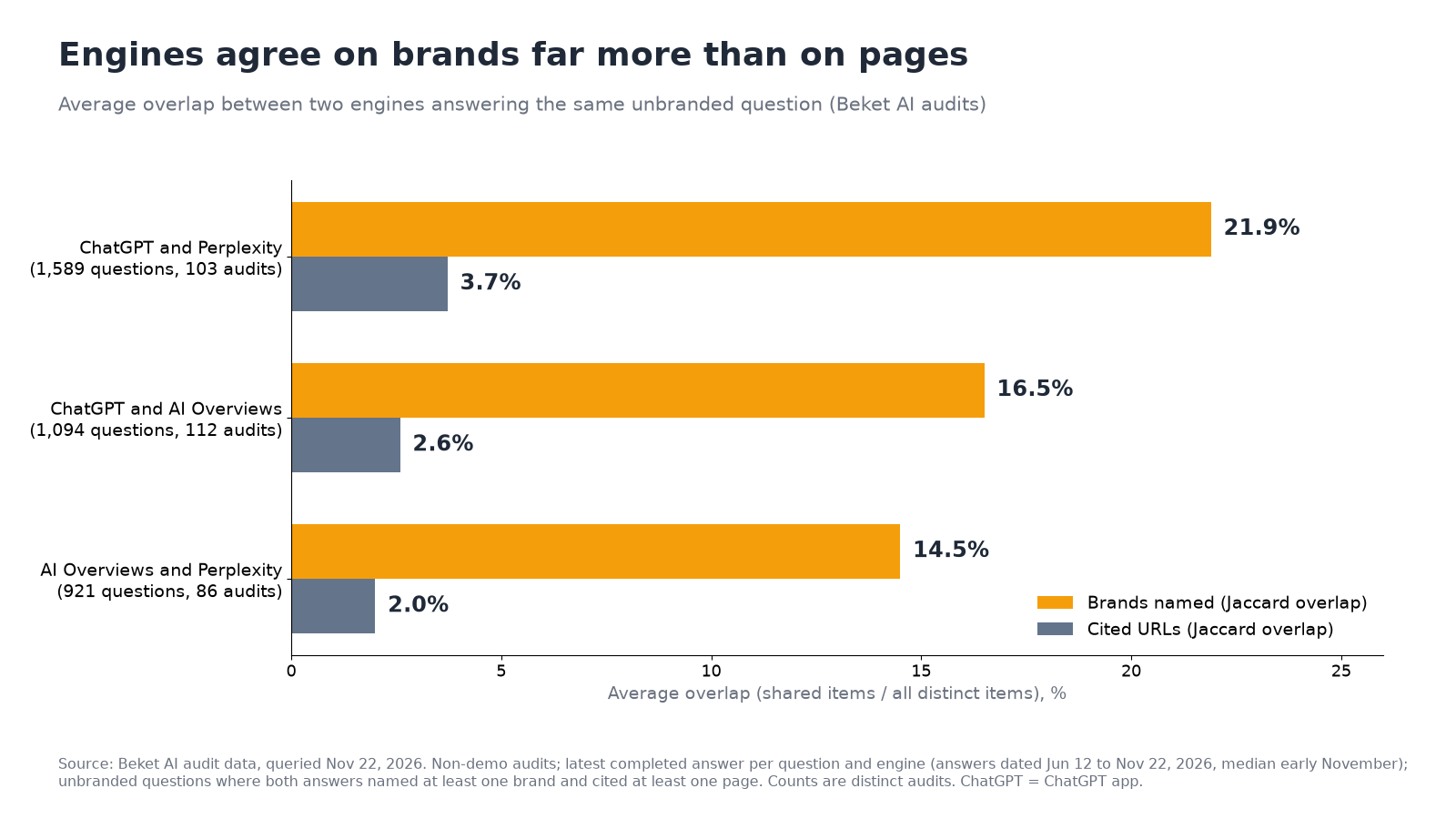
This chart counts only answers that named at least one brand and cited at least one page, so its URL overlap figures run slightly higher than the table above.
Brand overlap was about six to seven times higher than URL overlap for every pair. Parse saw the same thing from a different angle: the engines agreed on the #1 brand roughly three to four times as often as they shared URLs. The engines often land on similar brands, but each one gets there through different pages. A brand that's well covered across the web can show up on every engine. A brand that counts on one page getting cited is betting on one engine.
How to get cited in AI answers when each engine picks different pages
This doesn't mean you need three separate content strategies. It means you need to check each engine separately and close the gaps each one shows. Here's what we'd do this week:
- Run the same buyer questions on every engine you care about. A single "AI visibility" number that blends engines hides the gaps above. Check ChatGPT, Perplexity, Google AI Overviews and Google AI Mode one at a time, and keep a note of which pages each engine cites for you and for your competitors.
- For ChatGPT, make your core pages easy to quote. ChatGPT cites homepages, product and pricing pages, and docs more than the other engines do. Say what you sell, who it's for, where you operate and what it costs in plain text on those pages, not inside images or scripts. Our guide on how to get cited by ChatGPT covers the details.
- For Perplexity, earn coverage in deep articles. A quarter of Perplexity's citations went to blog, news and article URLs, and editorial and news sites got 2.4 times ChatGPT's share. Original research on your own blog and mentions in trade publications do more here than polishing your homepage. Our guide to ranking in Perplexity goes step by step.
- For Google AI Mode and AI Overviews, show up where people talk. Reddit and YouTube were AI Mode's top two cited domains in the Parse study, and social, forum and video sites were 12.0% of AI Overview citations in our audits. Useful answers in the right subreddits and short videos that answer real buyer questions count here. In the Parse study, AI Mode showed only about two links per answer, so being named in the text matters more than being linked.
- Track brand mentions as well as citations. Since engines agree on brands more than pages, the question "are we named?" is often more stable than "which of our pages got cited?" Watch both, and look into it when a competitor gets named on an engine where you don't.
- Check again before you react. AI answers change from day to day, so one check is a snapshot. Our post on how often AI answers change shows how much a repeat run can differ. Re-run the same questions on a schedule before deciding a page "lost" an engine.
Where Beket AI fits
Beket AI runs your buyer questions on ChatGPT, Gemini, Perplexity, Microsoft Copilot, Google AI Overviews and Google AI Mode, and shows for each engine whether you're named, how you're described, and which competitors appear, plus the citation gaps where competitors get cited and you don't. The free audit covers 25 questions on any 3 of those 6 engines. Pro is $49 a month per website and adds daily re-runs and change detection alerts, so you can see when one engine moves and the others don't.
About this post: Parse figures are from its study page (published November 20 and updated November 21, 2026; questions answered November 1 to 19, 2026). It's vendor-published research, and we haven't re-run it. Beket AI figures were queried on November 22, 2026 from non-demo audits. They're aggregates only, with no business names, brands or questions read, and they show what the engines returned when those audits ran. "URL overlap" is the average Jaccard overlap: shared items divided by all distinct items for each pair of answers to the same question. Audits skew toward software, services, local and B2B businesses. AI answers change, so these numbers are a snapshot, and any business can request another run of its own audit.
Related posts
AI Holiday Shopping: Chains Were 1 in 9 Store Names in 150 ChatGPT and Google Answers (2026 Study)
We asked ChatGPT and Google 25 holiday shopping questions in Vancouver and Seattle. Chains were about 11% of store names, and 65% of stores were named once.
AI Mentions vs Citations vs Recommendations: What's the Difference and Which to Track (2026)
AI mentions vs citations vs recommendations: what each means, how often they split (Semrush, Snezzi and Beket AI data), and which one to track for your goal.
AI Search Market Share in 2026: Why ChatGPT Is 20% of Google, or 1.4%, or 0.09%
AI search market share in 2026: six estimates put ChatGPT at 20% to 0.09% of Google. What each one divides, and which number to use for which decision.