
AI Search Market Share in 2026: Why ChatGPT Is 20% of Google, or 1.4%, or 0.09%

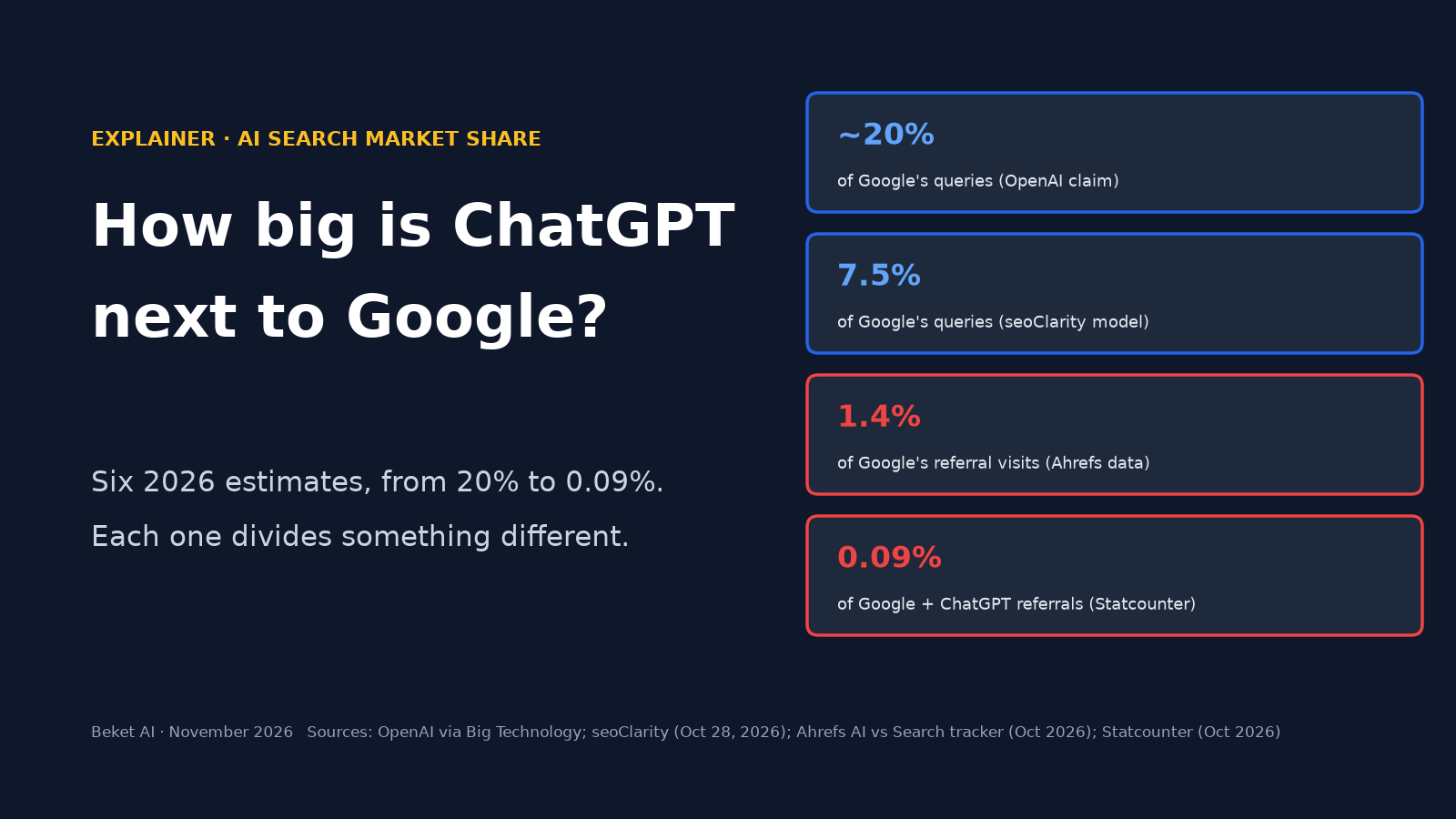
How big is AI search next to Google? This month you can find a confident answer for almost any size you like. OpenAI says ChatGPT handles about a fifth as many search-like queries as Google. Ahrefs estimated 12%. seoClarity models 7.5%. Ahrefs' own traffic tracker puts ChatGPT's referral visits at about 1.4% of Google's, and Statcounter's referral panel gives ChatGPT 0.09% of a Google-plus-ChatGPT total.
None of these numbers is fake. They divide different things by different things, and two of the six aren't even counting searches. Once you see what each one measures, the range stops being confusing and starts being useful, because each number answers a different business question.
Six estimates, side by side
| Estimate | Source and date | What is counted (top) | What it is divided by (bottom) | Kind of number |
|---|---|---|---|---|
| About 20% ("roughly one-fifth") | OpenAI's Adam Fry, Nov 2026 (Big Technology) | ChatGPT questions that trigger a web search | Google's query volume (figure not disclosed) | Company claim |
| About 12% | Ahrefs, Feb 11, 2026 (Ahrefs) | 65% of 2.5 billion daily ChatGPT prompts (July 2025) | Google's 13.7 billion daily searches (5 trillion a year) | Modeled estimate |
| About 7.5% | seoClarity, Oct 28, 2026 (seoClarity) | 1.24 billion "search-equivalent" ChatGPT messages a day | A modeled 16.44 billion Google queries a day | Modeled estimate |
| About 6.8% | Our calculation from Similarweb, Oct 2026 (Similarweb) | 6.05 billion web visits to chatgpt.com, for any purpose | 88.44 billion web visits to google.com | Site visits, web only |
| About 1.4% | Our calculation from Ahrefs' tracker, Oct 2026 (Ahrefs) | 4.3 million visits ChatGPT sent to 118,671 websites | 297.8 million visits Google sent to the same sites | Referral clicks |
| 0.09% | Statcounter, Oct 2026 (Statcounter) | Page views referred by ChatGPT across its member sites | Page views referred by Google plus ChatGPT | Referral share |
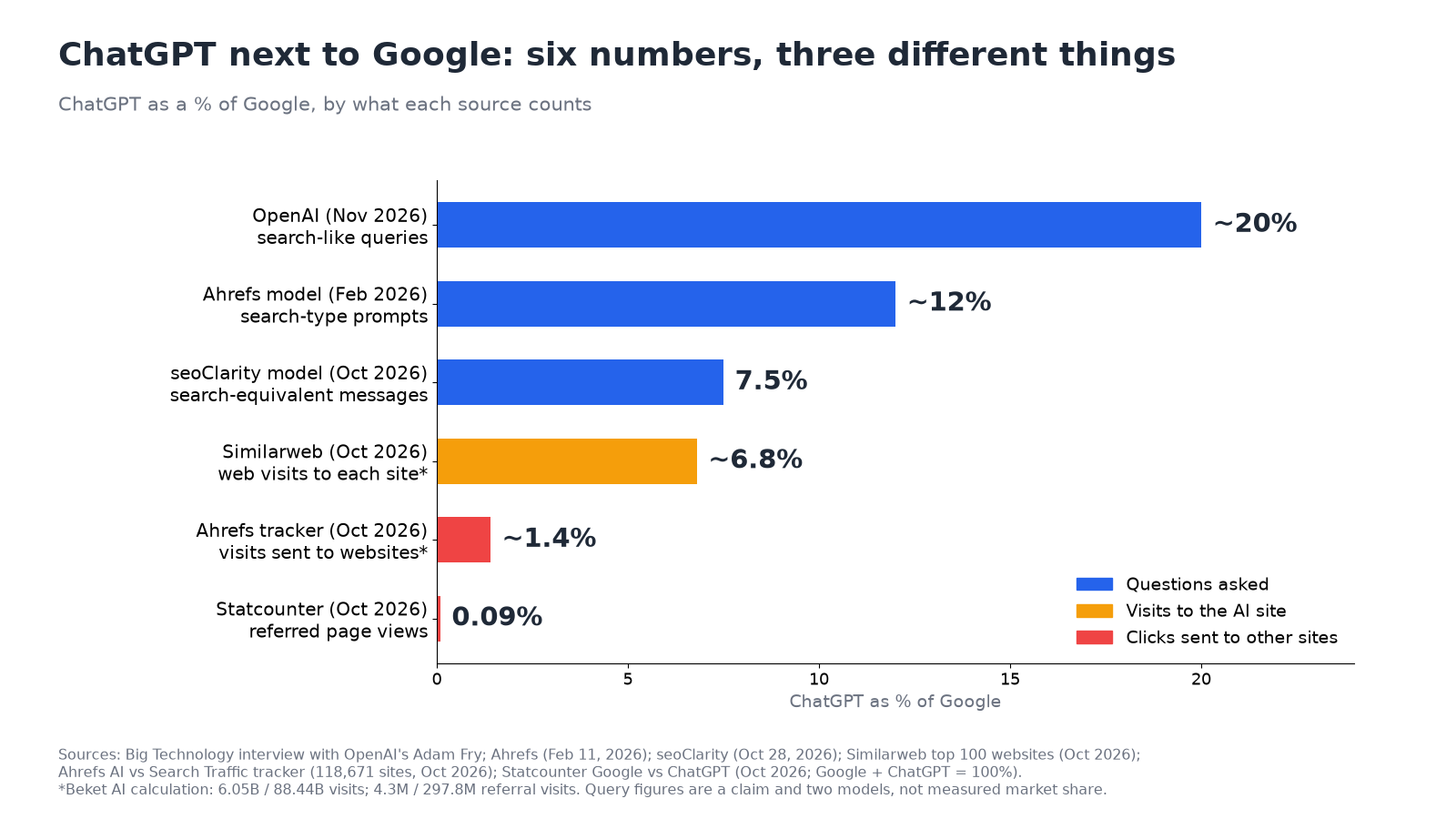
The rows fall into three groups. The top three try to count questions asked. The Similarweb row counts visits to the AI product itself. The bottom two count clicks the AI sends to other websites. The gap between the first group and the last is the main story, and it isn't a measurement error.
The query estimates: 20%, 12% and 7.5%
These three try to answer "how many searches happen in ChatGPT compared with Google?" They differ mostly in what they treat as a search.
OpenAI's one-fifth is the broadest. Adam Fry, ChatGPT's consumer product lead, told Big Technology's Alex Kantrowitz that "ChatGPT's volume of search-like queries is now roughly one-fifth the volume of queries of Google." Asked how searches are counted, he said: "Every time you ask a question and go search the web, that's a search." So several follow-up questions in one chat can count several times. As Search Engine Journal noted, Fry did not say which Google figure he compared against, over what period, or for which regions. OpenAI also hasn't published a total, so nobody outside the company can check the ratio.
Ahrefs' 12% came from a desk calculation in February. Patrick Stox took the 2.5 billion daily prompts ChatGPT reported in July 2025, which is 18% of Google's 13.7 billion daily searches if every prompt counts. He then judged that 65% of ChatGPT use is the kind of thing people used to search Google for, which gives 11.86%. Using the narrower "pure search" share from the OpenAI and Harvard study he cites (24% of usage), the same math gives 4.38%. The inputs are also older than OpenAI's claim: July 2025 ChatGPT volume against Google's January 2025 announcement.
seoClarity's 7.5% uses newer inputs. It took OpenAI's Signals data for July to September 2026, counted all "Seeking Information" messages plus an assumed 25% of "Practical Guidance" (about 27.5% of messages), and applied that to an estimated 4.5 billion daily messages. On the Google side it assumed 20% growth on the 5 trillion figure because no current count was available. seoClarity is upfront that "this is a modeled comparison, not a measured market-share figure."
So the 20% and 7.5% are less contradictory than they look. One counts every web lookup ChatGPT runs. The other counts a subset of messages by topic and makes assumptions on both sides of the fraction. Neither is a measured share of the search market.
The visit estimate: about 6.8%
Similarweb's October 2026 ranking gives google.com 88.44 billion visits and chatgpt.com 6.05 billion. Dividing one by the other gives about 6.8%, close to seoClarity's model. But that agreement is a coincidence.
A visit to chatgpt.com can be a coding session, a cover letter or a homework question, not just a search. A visit to google.com can be Search, Maps or a sign-in page. Similarweb also says its ranking counts desktop and mobile web visits only, so activity inside the ChatGPT and Google apps isn't included. This number tells you how much people use the two websites. It doesn't tell you how much search moved.
The referral estimates: about 1.4% and 0.09%
This is where ChatGPT looks small. These numbers don't count questions at all. They count the visits each platform sends to other websites.
- Ahrefs' tracker (updated Nov 20, 2026) follows the same 118,671 sites that use Ahrefs Web Analytics. In October 2026 Google sent 297.8 million visits (24.74% of their traffic) and ChatGPT sent 4.3 million (0.36%). That works out to about 1.4 ChatGPT visits for every 100 from Google. All AI assistants together sent 5.4 million visits, 0.46% of the total.
- Statcounter measures page views referred to its 1 million+ member sites. Its October 2026 Google vs ChatGPT split is 99.91% to 0.09%, and its search vs social vs AI chatbot split gives AI chatbots 0.14% of referrals.
Why are the two referral numbers so far apart? They track different sets of websites. Ahrefs' sample is sites that installed its analytics, and Statcounter's is sites that use its counter, so the two samples can look very different. Both also miss AI visits that arrive without a referrer. Similarweb warns that these visits "land in direct traffic, so referrer-based counts understate true volume." We covered the same counting problem in our post on why AI search traffic looks small but still matters.
Why query share and click share are supposed to differ
Put the groups together and you get the pattern Ahrefs put in its headline back in February: ChatGPT had about 12% of Google's search volume by its estimate, but Google sent 190 times more traffic to websites. Even on OpenAI's one-fifth, the referral data says ChatGPT sends only a small fraction of the clicks Google does.
That gap is the product working as designed. ChatGPT answers the question in the chat and offers a few links, and most people don't click. It's the same reason zero-click numbers vary so much, which we unpacked in what zero-click search measures and why studies disagree. For a business, it means that if you judge AI search by referral traffic alone, you're measuring the part of the conversation that leaves the chat, not the part where a buyer hears which companies to consider.
There's one more blind spot. All six estimates treat Google as "traditional" search, but Google now answers many queries with its own AI. seoClarity notes that "Google AI Mode also contributes to Google's query volume," so an AI Overview or AI Mode answer shows up on the Google side of every fraction above. If the real question is "how much search is now answered by AI?", ChatGPT versus Google understates it. Our post on what share of Google searches show AI Overviews covers that side.
Within AI: which assistants have the most share
The other common reading of "AI search market share" is the split between AI assistants. Here the sources broadly agree on the order at the top, and the differences again come from what they count.
| Assistant | Statcounter, share of AI chatbot referrals (Oct 2026) | Similarweb, share of generative AI web visits (May 2026) | Ahrefs tracker, visits sent to tracked sites (Oct 2026) |
|---|---|---|---|
| ChatGPT | 51.58% | about 53% | 4.3 million |
| Google Gemini | 28.86% | about 27–28% | 183,300 |
| Perplexity | 15.04% | not reported | 61,300 |
| Claude | 2.3% | close to 9% | 164,600 |
| Microsoft Copilot | 2.18% | not reported | not listed |
| Meta AI | not listed | not reported | 757,400 |
Sources: Statcounter AI chatbot market share; Similarweb AI search stats (June 2025 to May 2026 trend; ChatGPT fell from about 76%); Ahrefs AI vs search traffic. Different samples and units, so compare the order, not the decimals.
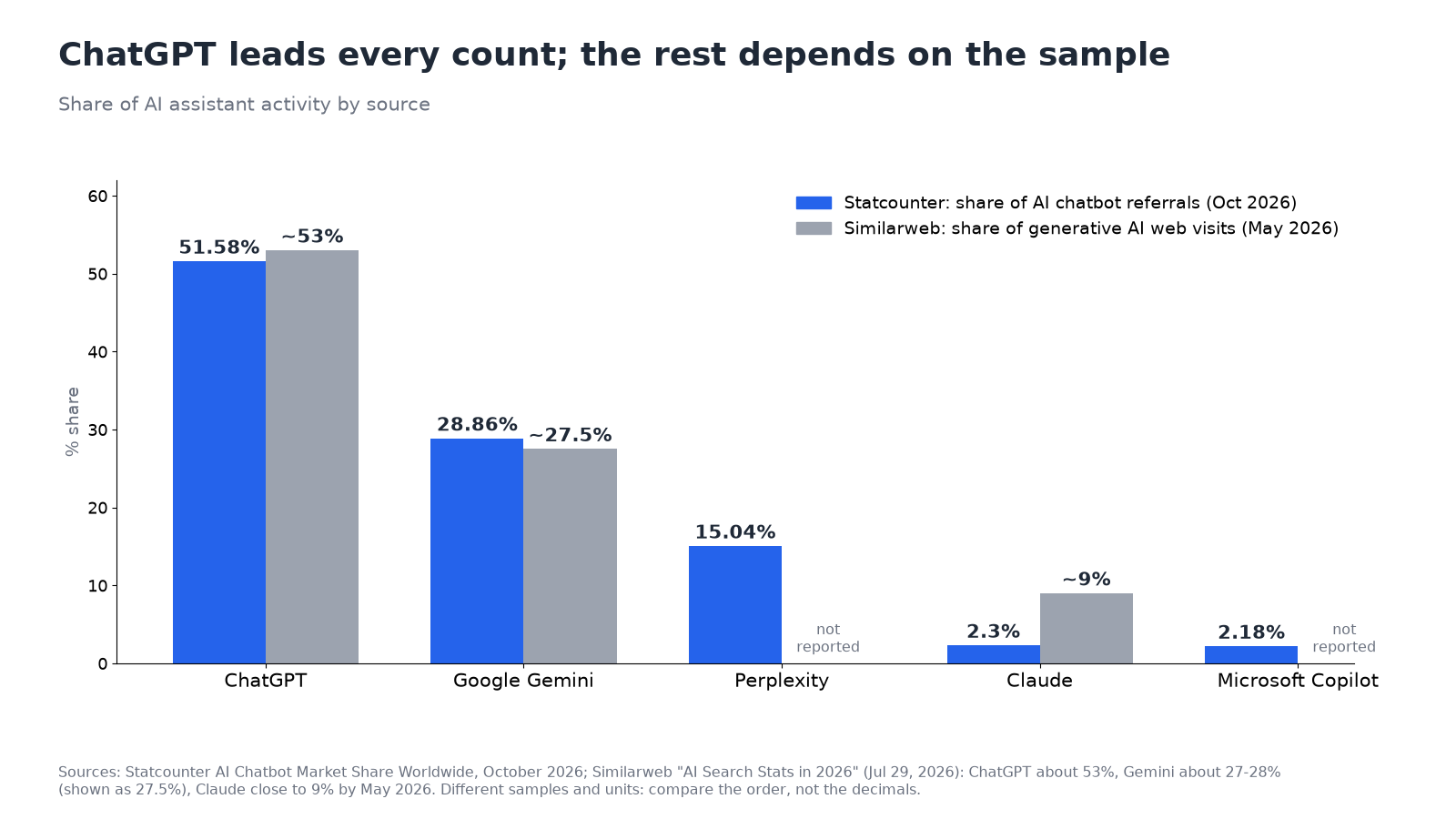
ChatGPT leads in every source, and Gemini is second in both share-based sources. After that the order depends on the sample. Perplexity has 15% of AI chatbot referrals in Statcounter's panel but sends fewer visits than Gemini or Claude across Ahrefs' sites. Claude is close to 9% of AI web visits in Similarweb but 2.3% of referrals in Statcounter, which suggests more of its use stays inside the chat instead of clicking out to websites. In Ahrefs' tracker, Meta AI sends more visits than Gemini, Claude and Perplexity combined.
Which number to use for which decision
| Your question | Number to use | Why |
|---|---|---|
| How many of my customers' questions now go to AI instead of Google? | The query estimates (7.5% to 20% for ChatGPT alone), plus Google's own AI features | They're the only ones that try to count questions. Treat them as a range, not a fact. |
| How much traffic should I plan to get from AI? | Your own analytics first, then public referral benchmarks (0.09% to 1.4% of Google's referrals for ChatGPT) | Clicks are what referral data measures, and it varies a lot by site and sample. |
| Which AI assistants should I check first? | The within-AI shares | ChatGPT and Gemini lead in every source. Perplexity, Claude and Copilot depend on the audience. |
| Do buyers hear my name when they ask? | None of the six | Market share says how many people ask. It says nothing about what the answer says about you. |
That last row is the one most market share debates skip. A brand with a small AI referral line can still be named, or left out, in thousands of answers that never produce a click. Of the US ChatGPT conversations in one opt-in panel, only 6.9% showed purchase intent, as we covered in how many ChatGPT chats are about buying. But those are the conversations where a shortlist gets made.
A simple way to put this in a report
When someone on your team brings one of these numbers to a meeting, ask three questions before using it:
- What's on top of the fraction? Questions, visits to the AI site, or clicks it sent?
- What's on the bottom? A disclosed Google figure, a modeled one, or one nobody has published?
- Whose sample is it? One company's own data, a vendor's model, or a panel of sites that may not look like yours?
Then report two numbers next to each other, not one: what AI sends you (from your analytics) and what AI says about you (from checking the answers themselves). The first tells you about traffic. The second tells you whether you're on the shortlist.
To see the second number for your business, run a free Beket AI audit. It asks 25 prompts on any 3 of 6 engines (ChatGPT, Gemini, Perplexity, Microsoft Copilot, Google AI Overviews and Google AI Mode) and shows whether you're named, how you're described and which competitors appear. Pro ($49 a month per website) re-runs the checks daily with change detection alerts. AI answers change from day to day, so treat any single check as a snapshot of what the engines returned that day.
Figures in this post were checked on November 21, 2026. The 6.8% and 1.4% ratios are our own calculations from the Similarweb and Ahrefs figures linked above; every other number is quoted from its source.
Related posts
A Third of Shoppers Now Use AI: Why Specialists Beat Big Retailers in AI Answers (2026)
Bain says 33% of US and 36% of European shoppers use AI to shop and that AI favors specialists. Our Nov 20 Vancouver and Seattle re-run, and what to do.
AI Holiday Shopping: Chains Were 1 in 9 Store Names in 150 ChatGPT and Google Answers (2026 Study)
We asked ChatGPT and Google 25 holiday shopping questions in Vancouver and Seattle. Chains were about 11% of store names, and 65% of stores were named once.
We Checked 40 Local Searches in Vancouver and Seattle: The Google Local Pack Is Still There (Mostly)
An AI Overview showed on 40 of 40 local searches we checked in Vancouver and Seattle, and a separate map pack on about 35. What we saw vs Semrush's 79 of 80.