
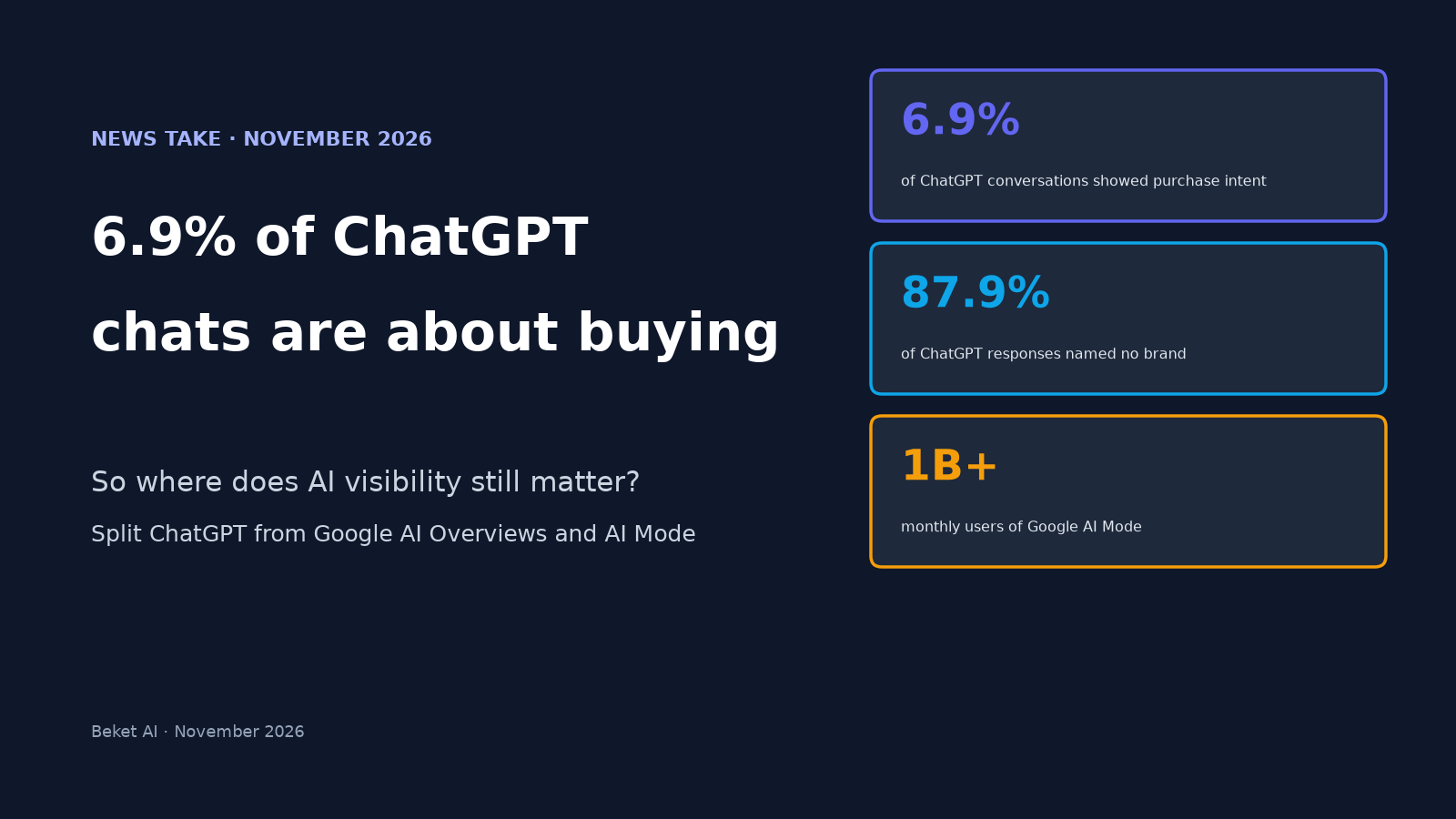
Only 6.9% of ChatGPT Chats Are About Buying. Here's Where AI Visibility Still Matters

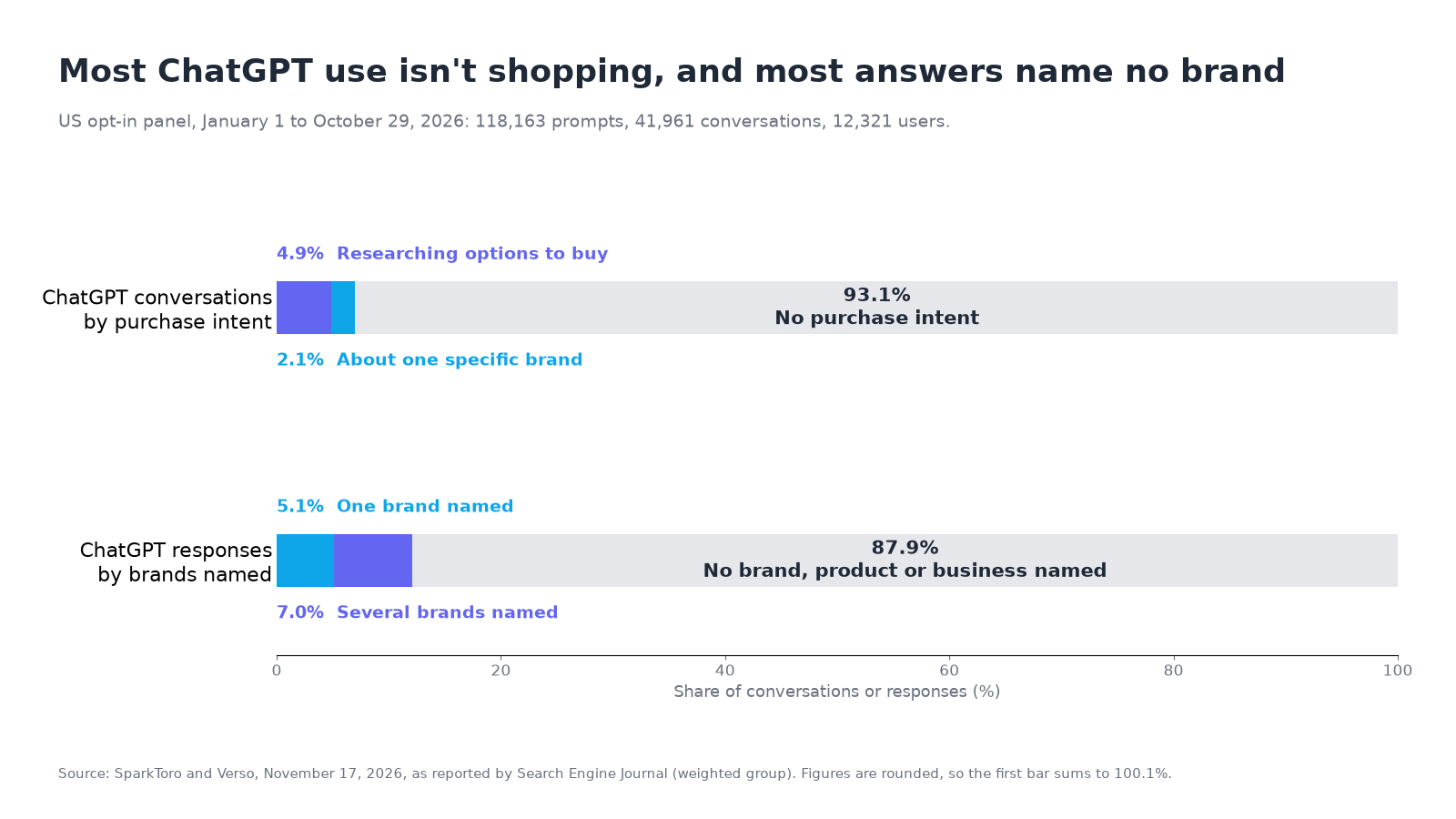
How much of what people ask ChatGPT is about buying something? A new data set puts a number on it, and the number is small. In a US opt-in panel analyzed by SparkToro and Verso, only 6.9% of ChatGPT conversations showed purchase intent, and 87.9% of ChatGPT's responses named no brand, product or business (Search Engine Journal).
Does that mean AI visibility is overrated? No, but it does mean the question needs splitting. ChatGPT and Google's AI features are different surfaces with different amounts of buying behavior behind them, and a brand should measure them separately.
What the SparkToro and Verso data says
SparkToro, the audience research company run by Rand Fishkin, published the analysis on November 17, 2026. The data came from Verso, which collects opt-in, anonymized ChatGPT histories: 118,163 prompts across 41,961 conversations from 12,321 US panel users, between January 1 and October 29, 2026 (SparkToro). The 131 heaviest users were removed because they were about 1% of panelists but sent 21% of prompts.
The figures that matter for marketers:
- Purchase intent was 6.9%. Search Engine Journal reads the chart as 4.9% of conversations where the person was researching options to buy, 2.1% asking about one specific brand, product or service, and 93.1% with no purchase intent. The pieces are rounded.
- Most responses named nobody. 87.9% of responses did not name a single brand, product or business. 12.1% named at least one (7.0% named several and 5.1% named one) (Search Engine Journal).
- Shopping wasn't a top use. The "shopping, brands and local services" category was 5.7% of conversations in SparkToro's text, well behind images and visual design (16.1%) and information and entertainment (14.0%). Search Engine Journal's chart reading puts shopping at 5.3% (SparkToro).
Fishkin's own conclusion is blunt. ChatGPT is mostly a consumer assistant, not a search engine, and the "competition with Google has been massively overblown." He also writes that AI visibility "matters a huge amount," but "NOT BECAUSE OF CHATGPT": it's Google AI Overviews and AI Mode that make it important (SparkToro).
Why 6.9% is not the end of the story
It is a panel, not all of ChatGPT. The panel skews younger, female and lower income. Most users were recorded on phones, so desktop and work-account use is probably under-counted, and API requests are missing. SparkToro says the data shows what people ask ChatGPT much better than how much they use it. Search Engine Journal also notes that SparkToro sells audience research software.
The 6.9% isn't comparable to Google's number. Fishkin compares it with an earlier SparkToro analysis of about 332 million Google searches, where he says 15% or more fit his definition. Search Engine Journal points out that the two sets of categories don't match, so the percentages can't be compared directly. Use the Google figure as direction, not as a ratio.
Other estimates count a wider net. Bain & Company estimated on November 21, 2026 that 15% to 20% of ChatGPT prompts are shopping-related, up from 9% in 2025 (Bain). That doesn't contradict the 6.9%. Bain counts shopping-related prompts, which includes any prompt about shopping. SparkToro's 6.9% counts conversations that showed purchase intent. Bain's figure is also an estimate for ChatGPT's whole user base, while SparkToro's comes from a panel of 12,321 US users, so the two shouldn't be set side by side as a ratio.
The post doesn't agree with itself on the headline. Fishkin's takeaways say 12% of ChatGPT usage is part of the buyer journey, while the purchase-intent chart says 6.9%. Search Engine Journal flagged this too. We use 6.9% because it is the chart figure, and we don't mix it with the 12.1% share of responses that named a brand. They are different measures.
A small slice can still be the valuable one. The buying prompts are the ones that ask for a shortlist, like SparkToro's example "best running shoe options for 50 year old men with plantar fasciitis." That is where a business gets named or doesn't. Adobe reported that visits to US retail sites from AI answers converted 90% better than other traffic in September 2026 (Adobe). Our own post on why AI search sends little traffic but still matters goes through three studies on how few clicks AI search sends, and why influence is a different question from clicks.
Split ChatGPT from Google's AI features
The panel only covers ChatGPT. It says nothing about Google AI Overviews or AI Mode, so it can't rank them. What it does is remove the assumption that ChatGPT alone represents "AI search."
| Surface | What the data says | What it means for tracking |
|---|---|---|
| ChatGPT | 6.9% of panel conversations showed purchase intent; 87.9% of responses named no brand | Track the buying-intent prompts only, not every topic. Expect a modest share of demand |
| Google AI Overviews | Fishkin names it, with AI Mode, as the reason AI visibility matters. Google CEO Sundar Pichai said at I/O it has 2.5 billion monthly users, as reported by LaPresse | Treat it as a core surface, not an extra |
| Google AI Mode | Google says it has passed a billion monthly active users (Google). Alphabet said on its Q3 2026 earnings call that "many of these queries are upper-funnel queries, allowing us to capture new high-value commercial intent" (Alphabet) | Track it separately: Google says the average AI Mode search is three times as long as a traditional Search query |
| Bing | Fishkin says ChatGPT tracking only makes sense if you also track Bing rankings and AI visibility | Don't skip Microsoft's side because the ChatGPT numbers look small |
Here is a rule that follows from this. If you report one blended "AI visibility" number, a small ChatGPT share and a large Google share cancel each other out. Report each engine on its own, and report them for the questions your buyers actually ask. We cover how the two Google surfaces differ in AI Mode vs AI Overviews.
What to do with this
- Don't drop ChatGPT. Be named in the 6.9%, because those are shortlist moments. But don't build the whole plan on it.
- Start with buying-intent prompts. Use questions that end in a shortlist ("best X for Y," "X vs Y," "who should I hire"), not every question about your topic. Most ChatGPT conversations will never be about buying.
- Add Google AI Overviews and AI Mode to the same prompt set. Compare the three side by side, so you can see where you're named and where you aren't.
- Keep the SEO basics. Fishkin's advice is to track keyword rankings and Bing alongside AI visibility.
- Pair this with your own data. Search Engine Journal suggests checking panel figures like this against your own ChatGPT referral and ad data before changing a budget.
- For stores: shopping answers use product feeds and structured data more than pages alone. Our GEO checklist for ecommerce lists 20 checks, and how ChatGPT shopping works explains how ChatGPT picks products.
Beket AI runs unbranded buyer questions across the six engines we track (ChatGPT, Gemini, Perplexity, Microsoft Copilot, Google AI Overviews and Google AI Mode) and shows how often your business is named, which sources are cited and how you compare with competitors. A free audit covers 25 prompts on any 3 of the 6 engines. Pro is $49 a month per site with daily re-runs. Beket AI shows the answers and citation gaps; changes to your site and listings are up to you.
Caveats
- One panel, one analysis, read on November 19, 2026. SparkToro says it hopes to do more research with Verso.
- Categories were assigned to each conversation by a classifier and a written codebook. The two coders agreed 90% of the time on categories, according to Search Engine Journal, which says the post reports no separate agreement figure for purchase intent.
- The figures here are the weighted group as reported by Search Engine Journal. SparkToro's text and chart differ by less than two percentage points per category.
- The Google user counts are Google's own and a news report of its CEO's statement. They count users, not buying conversations, so they say how large the surfaces are, not how much of that use is shopping.
Related posts
How Often Do AI Answers Change? What Beket AI's Daily Audits Show
75% of AI answers changed overnight in a new study. Beket AI's daily audits show brands, cited domains and pages move too. Here's what to track instead.
Service Area Pages vs Doorway Pages: What Google Allows and What AI Engines Cite (2026)
Service area pages vs doorway pages: what Google's spam policy says, which city pages AI engines cited in 33 Beket AI local audits, and when to build one.
How to track what Google AI Overviews say about your business
A monthly method to record what Google AI Overviews say about your business, check it for errors and read it alongside clicks.