
Service Area Pages vs Doorway Pages: What Google Allows and What AI Engines Cite (2026)

Google's spam policy is blunt about city pages. Under "doorway abuse" it lists "having multiple domain names or pages targeted at specific regions or cities that funnel users to one page." So a lot of service businesses have stopped building location pages at all.
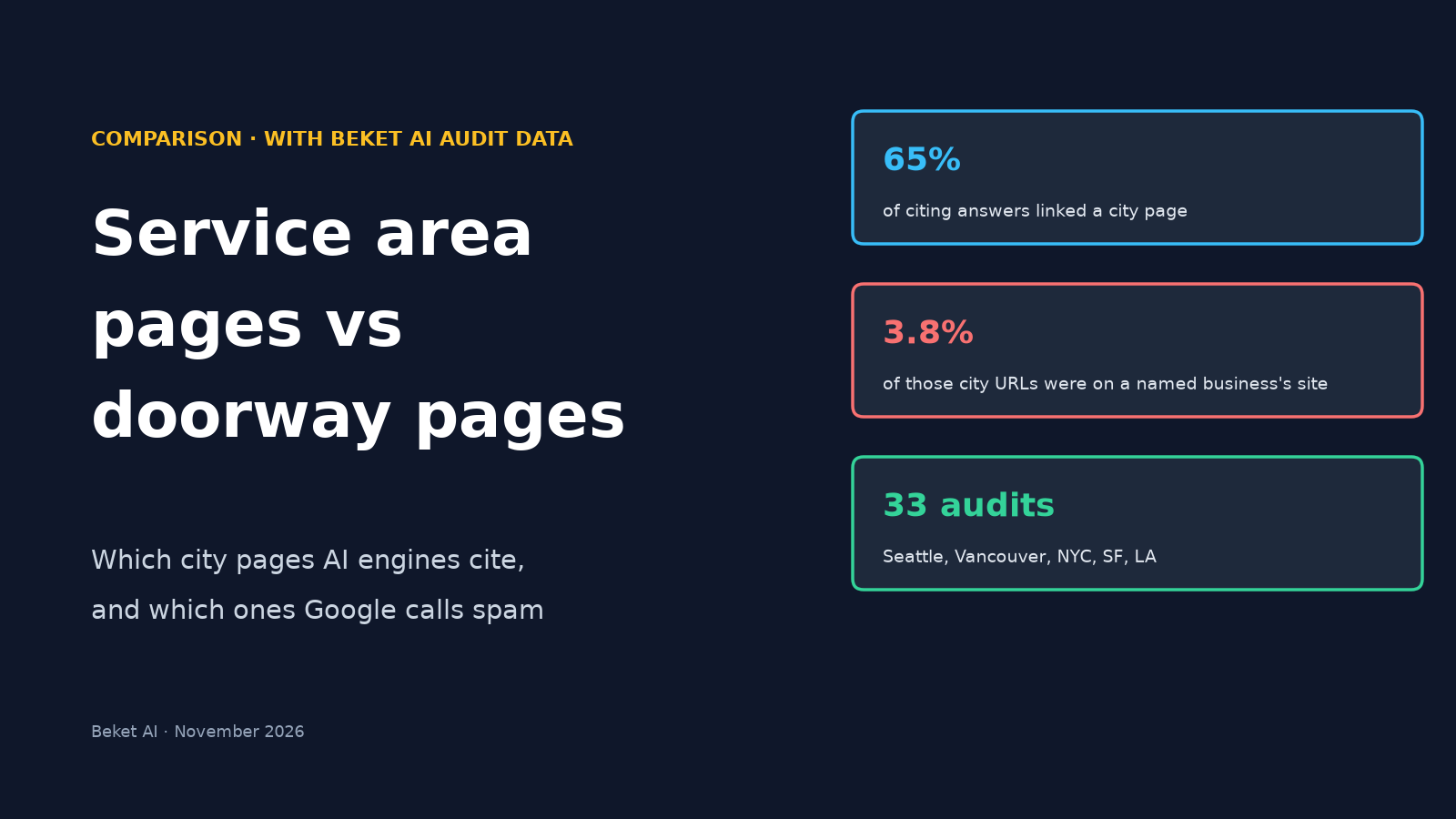
Then you look at what AI engines actually cite for local questions, and city pages are everywhere. In Beket AI's local market audits, 65% of the answers that cited any source (926 of 1,419) linked to at least one page with the city in its URL. Most of those pages were not on the businesses' own websites, though. They belonged to directories, review sites and Reddit.
So the question isn't whether city pages work. It's what separates a service area page that earns a citation from a doorway page that gets ignored or penalized. This post compares the two, shows what our audits found, and gives you a simple test for deciding which city pages to build, merge or delete.
The short version
- A service area page tells someone in one area something true and specific to that area: jobs done there, travel fees, response times, local rules, reviews from local customers.
- A doorway page is the same page with the city name swapped. Google names this pattern as spam.
- AI engines cite city-specific pages often (65% of citing answers in our audits), but only 120 of the 3,192 city URLs they cited (3.8%) sat on a named business's own site.
- The city pages that got cited most, from directories and review sites, carry information that changes from city to city. That's the bar.
- Build a separate page only where you have local proof. Otherwise, list your areas honestly on one page and keep it consistent with your Google Business Profile.
Service area pages vs doorway pages, side by side
The two can look identical in a site map: /plumber-ballard/, /plumber-fremont/, /plumber-queen-anne/. The difference is what's on them and why they exist.
| Service area page | Doorway page | |
|---|---|---|
| Why it exists | To answer a real question from people in that area | To rank for "[service] + [city]" and pass visitors on |
| What changes between cities | Facts: jobs, prices or travel fees, response times, permits, crew base, local reviews | The city name, maybe a stock photo |
| Could a customer act on it alone? | Yes: they learn whether you serve them, how fast, at what cost, and can book | No: the useful part is on another page |
| How many there are | As many as you have real local proof for | As many as there are towns on a map |
| Site structure | Part of a clear hierarchy (service area hub, then area pages) | A flat batch of near-identical pages, often unlinked from the menu |
| What Google says | Fine, as long as it's helpful, people-first content | Listed under doorway abuse in Google's spam policies |
| What an AI engine gets from it | A citable fact for that city ("serves Ballard, same-day, $X call-out fee") | Nothing it couldn't get from your service page |
Google's doorway examples also include "creating substantially similar pages that are closer to search results than a clearly defined, browseable hierarchy." That last phrase is useful. If your city pages read like a search results page with the town swapped in, they're on the wrong side of the table.
For AI answers specifically, Google says there are "no additional requirements to appear in AI Overviews or AI Mode, nor other special optimizations necessary," and that both may use "query fan-out," running several related searches to build one response. A city page doesn't need anything special for that. It needs to be the best answer to one of those sub-searches, such as "emergency plumber Ballard same day."
What our audits show about city pages in AI answers
We looked at Beket AI's own local market audits: 33 audits that asked unbranded buyer questions about businesses in Seattle, Vancouver, New York, San Francisco and Los Angeles, run between October 16 and November 17, 2026. Data was pulled on November 19, 2026. To stop repeat runs from inflating the numbers, we kept only the latest completed answer for each question and engine, and counted answers and distinct URLs rather than raw citation events. A URL counted as a "city page" if the city's name (or a common short form like nyc) appeared in its path.
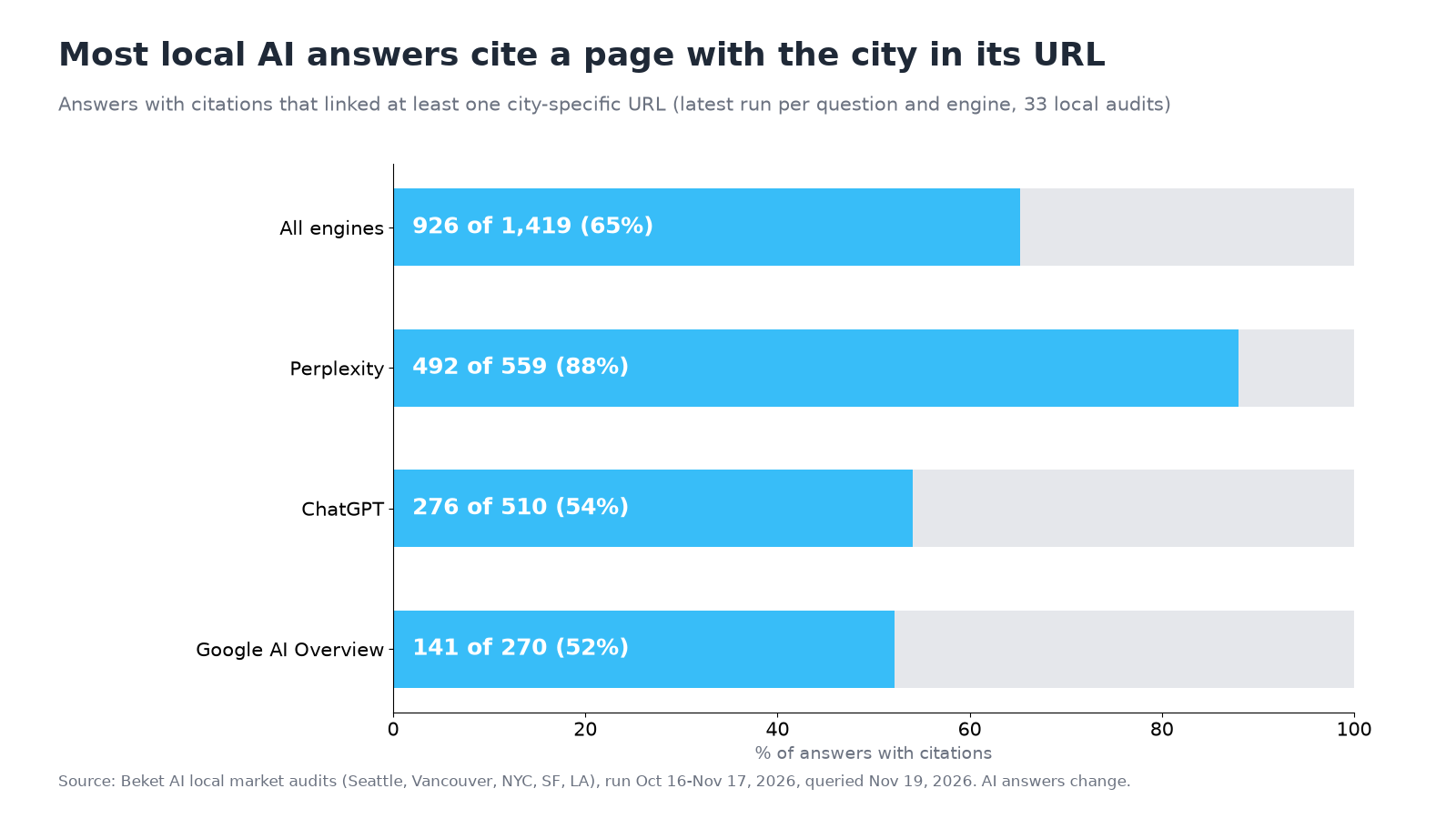
| Engine | Answers with citations | Cited at least one city URL | Share |
|---|---|---|---|
| Perplexity | 559 | 492 | 88% |
| ChatGPT | 510 | 276 | 54% |
| Google AI Overview | 270 | 141 | 52% |
| All engines (incl. smaller samples) | 1,419 | 926 | 65% |
Google AI Mode (70 answers in 4 audits) and Gemini (10 answers in 1 audit) were too small to break out, so they're only in the total. Across all engines, 3,192 of the 9,575 distinct URLs cited (33%) had the city in the path.
Now the part that matters for your own site. We matched each cited city URL against the websites of the businesses the engines actually named in that audit. Only 120 of the 3,192 city URLs (3.8%) were on a named business's own site, and that happened in 21 of the 33 audits. Looked at the other way, 120 of the 460 own-site URLs the engines cited (26%) had the city in the path, so when a business's site did get cited, a city-specific page was one of the pages doing it about a quarter of the time.
The rest came from third parties. These are the domains whose city pages turned up in the most audits:
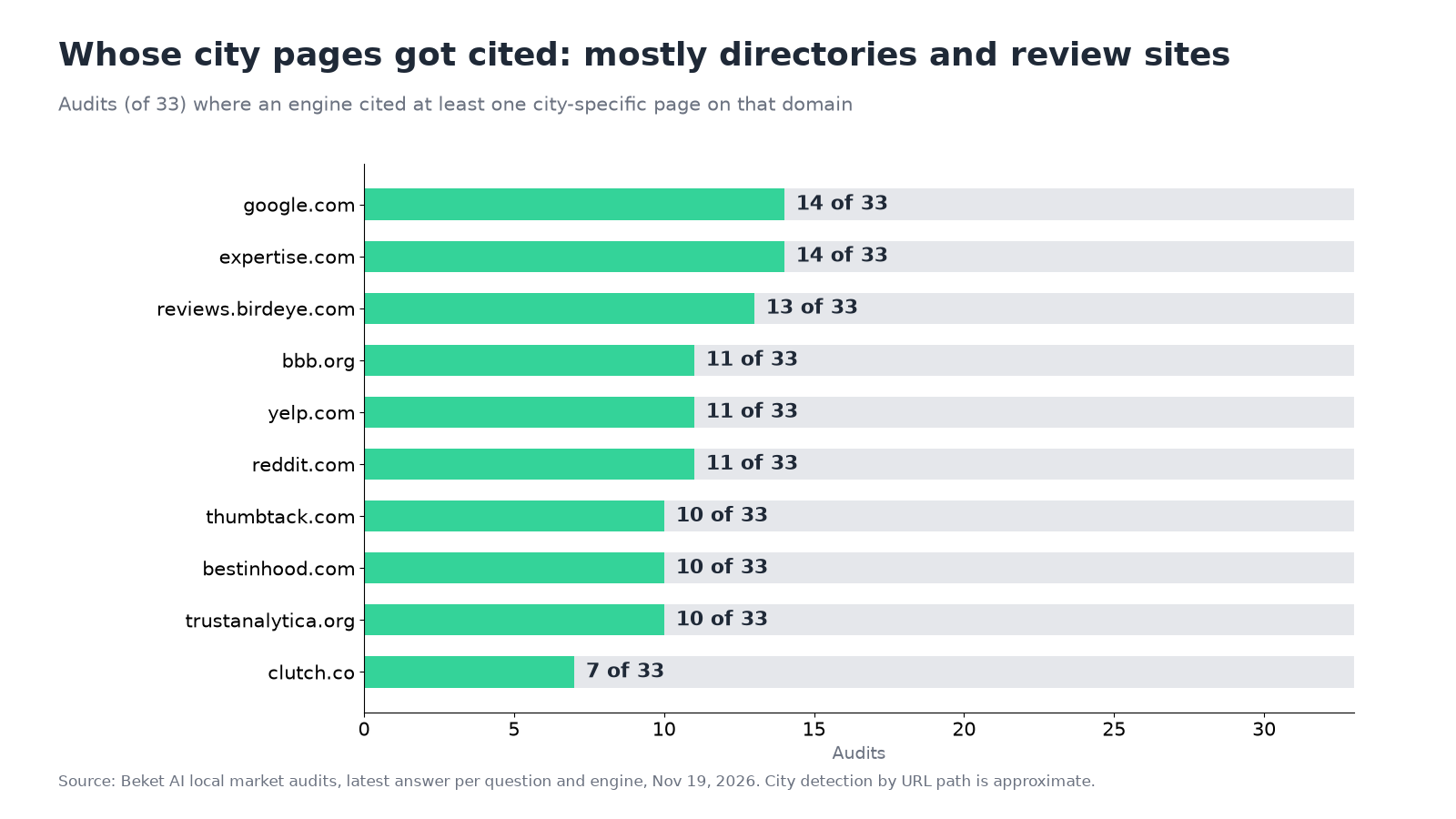
| Domain | Audits (of 33) | Distinct city URLs cited |
|---|---|---|
| google.com | 14 | 92 |
| expertise.com | 14 | 35 |
| reviews.birdeye.com | 13 | 20 |
| bbb.org | 11 | 45 |
| yelp.com | 11 | 28 |
| reddit.com | 11 | 25 |
| thumbtack.com | 10 | 28 |
| bestinhood.com | 10 | 16 |
| trustanalytica.org | 10 | 13 |
| clutch.co | 7 | 160 |
Look at what these pages have in common. A Yelp, Thumbtack or Clutch city page is a list of real businesses in that city with reviews, ratings and prices from customers there. A Reddit city thread is locals answering a local question. None of them is the same page with the town swapped. That's also a reason to keep your directory profiles complete: in these audits, directory and review pages were where engines most often picked up city-level detail.
Our numbers line up with a point we made in our service page template post: across Beket AI audits, standalone location pages on a business's own site were among the least-cited page types. Thin city pages don't seem to be what engines reach for.
Same questions, different city, different winner
City pages matter because AI engines build a separate shortlist for each place. We ran the same set of buyer questions, with only the city and neighborhood names swapped, for marketing agencies in three cities. Each city got a different top name. (The New York run also included some extra discovery questions, so the samples aren't identical.)
| City | Study date | Top-named agency (mentions) | Most-cited domain |
|---|---|---|---|
| New York | Nov 5, 2026 | NoGood (26) | clutch.co |
| San Francisco | Nov 7, 2026 | Jives Media (34) | clutch.co |
| Los Angeles | Nov 11, 2026 | SmartSites (15) | clutch.co |
The full breakdown, with the question list and per-engine counts, is in our Los Angeles marketing agencies study. Two things carry over to any service-area business. Being recommended in one city says little about the next one. And the directory city page (Clutch's, in this case) was the source the engines leaned on in all three places.
Outside research points the same way. BrightLocal's Local AI Visibility Study of about 200,000 non-branded local prompts found that ChatGPT shared only 19% to 20% of named businesses with Google's AI Overviews or AI Mode on average. Different engines, different cities, different lists.
The test: should this area get its own page?
Before you build or keep a city page, ask whether you can fill it with facts that are true for that area and not for the others. Here's a quick way to decide.
| Question | If yes | If no |
|---|---|---|
| Have you done real jobs there, and can you describe some (with dates, job types, photos you own)? | Point toward a page | Leave it on the area list |
| Do price, travel fee, minimum or response time differ there? | Point toward a page | Leave it on the area list |
| Are there local rules, permits, building types or conditions that change the work? | Point toward a page | Leave it on the area list |
| Do you have reviews from customers in that area you can quote and link? | Point toward a page | Leave it on the area list |
| Is there a crew, office or partner based there? | Point toward a page | Leave it on the area list |
| Would the page still be useful with the city name deleted? | It's probably generic. Rewrite or merge | Good sign: the content is local |
Three or more "points toward a page" answers usually means you have enough for a page that can stand on its own. One or none means the area belongs on a single, honest service area page.
What goes on a service area page that earns citations
Your service page explains the service. A service area page answers the questions that change by location. Keep it in plain HTML text, linked from a "Service areas" hub that's reachable from your main menu.
- A two-sentence local answer. "We provide [service] in [area], usually within [time]. Call-outs in [area] cost [price or how it's quoted]." That sentence is what an engine can quote.
- Exact coverage. Neighborhoods, postal codes or boundaries, and what's out of range. Keep it consistent with your Google Business Profile.
- Recent local work. Three to five short job notes: what, where (neighborhood level), when, outcome. Real ones only.
- Local pricing and timing. Travel fees, minimums, typical arrival windows, after-hours rules for that area.
- Local conditions. Permit requirements, common building types, weather or terrain issues, HOA or strata rules. Link to the official source when you cite a rule.
- Local proof. Reviews from customers in that area (quoted with a link to the review), licenses that apply there, local memberships.
- One next step. Book, call or request a quote, with the area pre-filled if your form allows it.
If you add structured data, mark up only what's visible on the page. Schema.org's areaServed property lets a LocalBusiness or Service say where it operates; our local business schema guide covers the setup. Markup won't rescue a thin page, though. The text has to carry the facts.
Keep your service area pages consistent with your Business Profile
For Google, your Business Profile is where service areas are formally set. According to Google's service area help page, you can list up to 20 service areas by city, postal code or other area, and the overall boundary "shouldn't be more than about 2 hours of driving time from where your business is based." Google's Business Profile guidelines also say service-area businesses should hide a home address and generally get one profile for the whole area they serve.
That gives you a practical rule. Your service area hub should list the same areas as your profile. The areas with real local proof get their own pages. The rest stay as named entries on the hub. If your site claims 60 cities and your profile lists 12, the mismatch doesn't help anyone, human or engine. Just don't expect the profile alone to carry you: in our Google Maps vs AI study of Vancouver realtors, the AI engines named only 7 of the 50 businesses in the Maps top 3.
What to do with the city pages you already have
Most sites that built city pages years ago have a mix. Sort them into three piles.
| Pile | What it looks like | What to do |
|---|---|---|
| Keep and improve | Some real local content already, gets some traffic, area has proof | Add the local blocks above, link it from the hub |
| Merge | Same template, city swapped, no traffic, but the area is genuinely served | Move the area name onto the hub page, redirect the old URL to it |
| Remove | Areas you don't actually serve, or pages built only for search | Delete or redirect, and take the area off any lists |
Do this in batches and check Search Console after each one, so you can see what changed.
How to check whether AI engines cite your city pages
Ask the questions a customer in each area would ask, without your business name: "who does same-day drain cleaning in Ballard," "best roofer for an older house in Burnaby." Ask them on more than one engine, since the lists differ, and note which pages get cited: yours, a directory's, or a competitor's. Repeat the check over a few weeks, because AI answers change from run to run.
Beket AI runs that check for you. The free audit runs 25 prompts on any 3 of 6 engines (ChatGPT, Gemini, Perplexity, Microsoft Copilot, Google AI Overviews and Google AI Mode). Pro, at $49 a month per site, re-runs your prompts daily, so you can see whether a rebuilt area page starts showing up. Details are on the pricing page. The fixes themselves, like writing the local content and merging pages, stay with you or your web team.
Method and caveats
- Data: 33 of Beket AI's own local market audits (study audits, not customer audits) asking unbranded buyer questions about businesses in Seattle (15), Vancouver (13), New York (4), San Francisco (1) and Los Angeles (1), run October 16 to November 17, 2026, and queried November 19, 2026. These numbers show what the engines returned on those runs. AI answers change, and a business can ask us for another run.
- De-duplication: latest completed answer per question and engine. We counted distinct answers, distinct URLs and distinct audits, not raw citation events.
- City pages: detected by the city name in the URL path. That's approximate. It misses area pages named only by neighborhood (for example
/areas/ballard/) and catches some blog posts with the city in the slug. - Own sites: a city URL counted as a business's own page when its domain matched the website of a business the engines named in that audit. Businesses without a matched website aren't counted, so the 3.8% is a floor, not an exact share.
- Engines: most audits ran ChatGPT, Perplexity and Google AI Overview. Google AI Mode and Gemini appear in only a few audits.
- No customer names, prompts or personal data were used. Agency names come from our published studies.
The bottom line
City pages aren't the problem. Copies are. The city pages AI engines cited most in our audits were full of facts that only apply to that city: who works there, what they charge, what locals said. If your service area page can say something true about Ballard that it can't say about Fremont, build it. If it can't, put Ballard on your service area list and spend the time on the pages that can.
Related posts
Only 6.9% of ChatGPT Chats Are About Buying. Here's Where AI Visibility Still Matters
SparkToro's panel found 6.9% of ChatGPT conversations show buying intent. Here's what it means for AI visibility, and why Google's AI features matter more.
Ads Now Sit Next to Bing's AI Overviews: What Changes for Organic Citations
Microsoft confirmed ads next to Bing's AI Overviews on Nov 19. What it said, what it left out, and what to check before Black Friday.
How Often Do AI Answers Change? What Beket AI's Daily Audits Show
75% of AI answers changed overnight in a new study. Beket AI's daily audits show brands, cited domains and pages move too. Here's what to track instead.