
How Often Do AI Answers Change? What Beket AI's Daily Audits Show

A brand shows up in ChatGPT today. Will it show up tomorrow? Two days of data from a new study, and months of data from our own daily audits, give the same answer: often not.
Supercite, which builds an AI visibility tracker, asked 210 buying questions on four engines on November 17 and again on November 18. For 75% of the 839 answers it could compare, the list of brands was different the next day (Supercite). Our daily audits show the same pattern. Between two consecutive daily runs of the same prompt on the same engine, the list of brands named was identical only 30.1% of the time, and the list of cited domains only 14.8% of the time.
What the Supercite study found
Supercite asked 210 buying questions across 21 categories, such as "best CRM for small business," on ChatGPT, Gemini, Google AI Overviews and Google AI Mode. It ran them as a US user in English on November 17 and 18, 2026, and compared each answer with the one from the day before (Supercite). The post is labeled preliminary: it covers days 1 and 2 of a 7-day run, and Supercite says it will update every number with the full week. On November 19, Supercite revised its headline figure from 84% to 75% of answers changing (with 68% brand overlap) after recounting with the study's published brand list.
Here is what it reported for those two days:
- 75% of answers changed. Supercite first reported 84% (701 of 839 answers), then recounted with its published brand list and got 75%. "Changed" means the set of brands was not exactly the same.
- 27% of the brands named on day one were gone on day two.
- The top spot is fairly safe, but not safe. A brand ranked #1 was still named the next day 90% of the time, yet it was #1 again only 63% of the time.
- Lower positions are close to a coin flip. A brand ranked sixth or lower was named again 61% of the time.
- The sources move faster than the brands. Only 42% of the cited pages were the same from one day to the next.
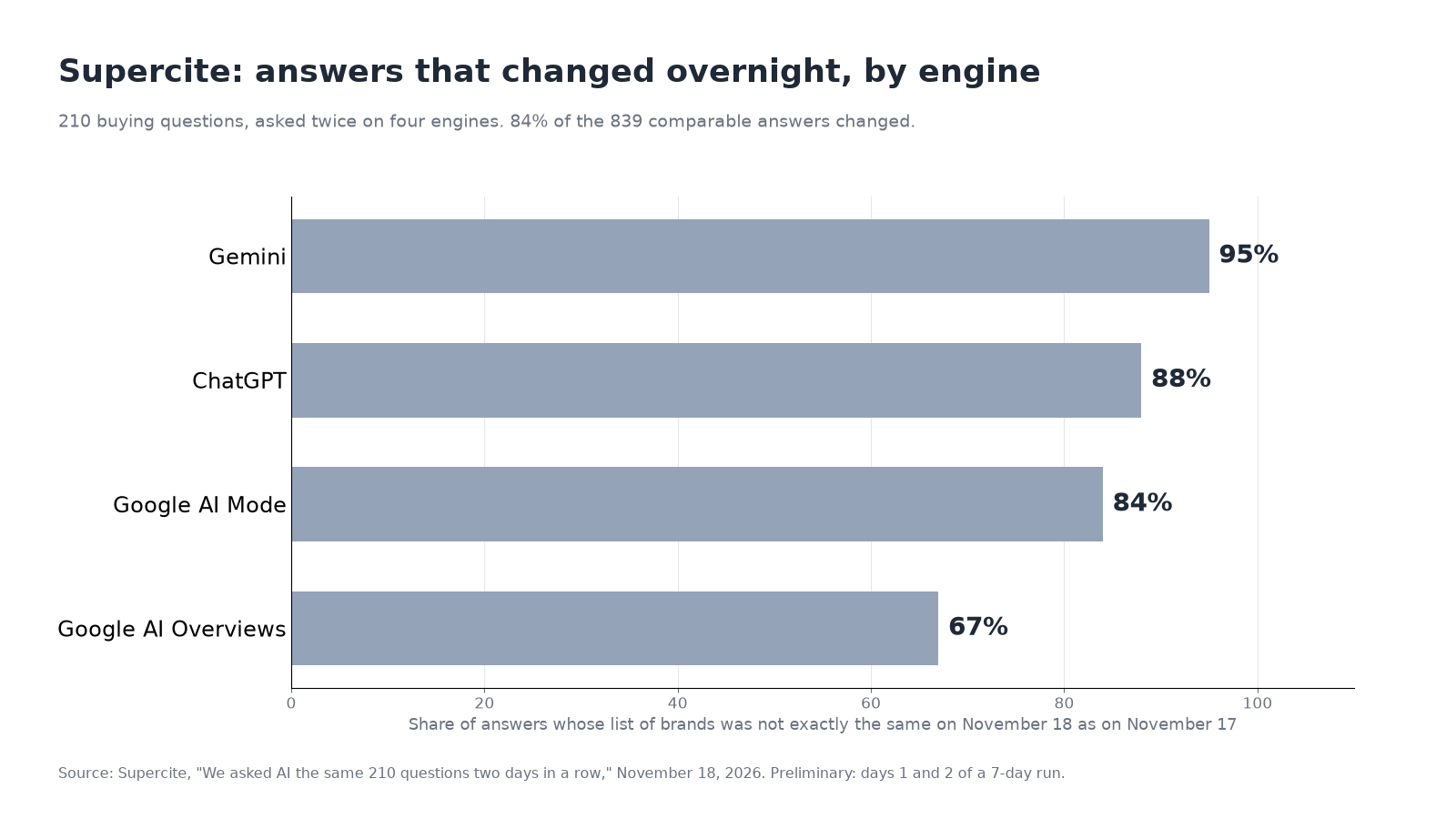
Engines differed. Gemini changed the most, and Google AI Overviews changed the least, though two out of three AI Overviews answers still moved:
Supercite's explanation is that an AI answer is a summary of a few pages picked fresh each time. Swap the pages and you swap the answer. We covered the same idea earlier in why an AI answer is a weather report, not a fact.
What Beket AI's daily audits show
A fair question is whether this is a quirk of one study. We checked it against our own data, using the audits on Beket AI that re-run on a daily schedule.
Method. Of the audits on a daily schedule, 21 had at least one prompt answered by the same engine on consecutive days. That gave 2,138 next-day answer pairs across 461 prompts, from June 26 to November 19, 2026. Each pair is two completed answers to the same prompt on the same engine, 20 to 28 hours apart, so a prompt asked for many days contributes many pairs. Answers that failed or weren't generated are left out. Citations are counted as distinct domains or pages per answer, not as raw citation rows, and we report how many distinct audits each figure comes from. All figures are aggregates. No customer, brand or prompt is named here.
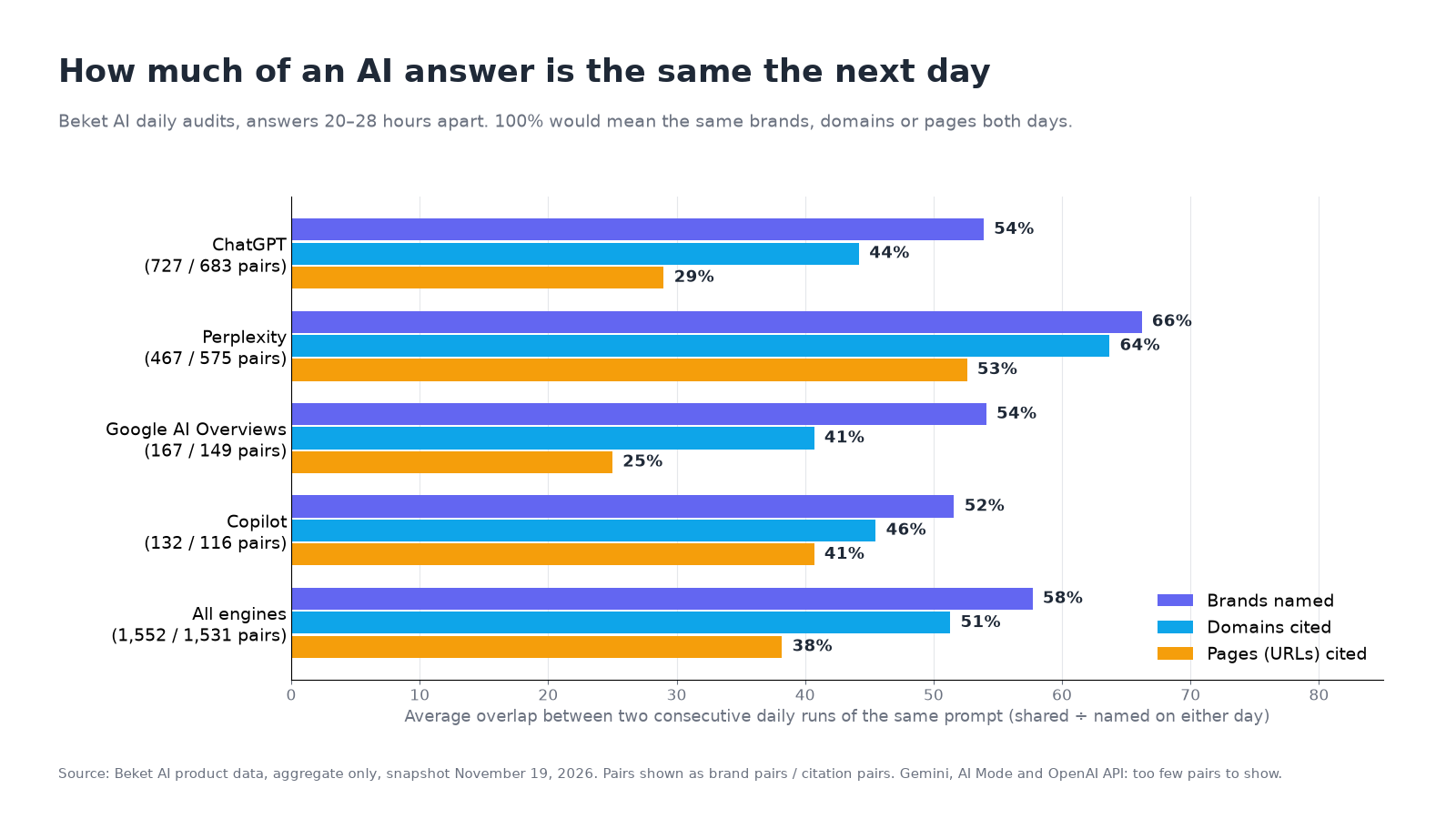
We measured three things for each pair: which brands were named, which domains were cited and which pages (URLs) were cited. The overlap figure is the number of items present on both days divided by the number present on either day, so 100% means nothing changed.
| Engine | Brand pairs | Brand list identical next day | Brand overlap | Citation pairs | Cited-domain overlap | Cited-page overlap |
|---|---|---|---|---|---|---|
| ChatGPT | 727 | 25.2% | 53.9% | 683 | 44.2% | 29.0% |
| Perplexity | 467 | 38.5% | 66.2% | 575 | 63.7% | 52.6% |
| Google AI Overviews | 167 | 29.3% | 54.1% | 149 | 40.7% | 25.0% |
| Microsoft Copilot | 132 | 25.8% | 51.6% | 116 | 45.5% | 40.7% |
| All engines | 1,552 | 30.1% | 57.7% | 1,531 | 51.3% | 38.2% |
Source: Beket AI product data, aggregate only, November 19, 2026. "All engines" also includes Gemini, Google AI Mode and the OpenAI API, which had too few pairs (under 40 each) to show on their own. Brand pairs and citation pairs differ because not every answer has both named brands and cited sources.
Across all engines:
- Brand lists: the list of brands named was exactly the same in 30.1% of next-day pairs, so it changed in about 70%. Of the brands named on day one, 30.3% were not named on day two. Supercite found 75% of answers changed and 27% of brands gone on days 1 and 2.
- Cited domains: the list of cited domains was identical in 14.8% of pairs, and 35.6% of the domains cited on day one were not cited on day two.
- Cited pages: the list of cited pages was identical in 4.9% of pairs, and 48.6% of the pages cited on day one were not cited again. Page overlap averaged 38.2%, against Supercite's 42% of cited pages that were the same.
The methods differ, so don't read these as the same measurement. Supercite used 210 open buying questions on four engines and counted every brand in the answer. We used the prompts of each audit, and our brand lists cover the businesses recorded as the audited brand or as a competitor in each answer. Even so, the shape is the same: brands move, domains move more, and individual pages move most.
It doesn't depend on one big audit. Pooled figures can be dominated by the audits with the most prompts. When we gave each audit equal weight, brand lists were identical on 26.5% of days and cited-domain lists on 13.0%. In no audit with next-day citation pairs was the cited-domain list identical more than 24.4% of the time. For brand lists, the highest audit was 52.6%.
Limits. This is not a random sample of the web. The audits cover different industries and prompt styles. An exact match is a strict test, because one extra brand makes two lists "different," so the overlap columns are the fairer read. Perplexity and Copilot show more stable cited pages than ChatGPT or AI Overviews, but each engine's figures come from between 7 and 18 audits, so we wouldn't rank engines on this alone.
What this means for tracking your brand
A single check is one sample out of a moving distribution. A screenshot of ChatGPT recommending you, or leaving you out, tells you what happened on one run. Supercite makes the same point: ask the same questions many times and look at how often you come up.
- Run the same prompts repeatedly. One answer named about 6 brands in Supercite's data, but across eight answers to the same question (four engines, two days) 14 different brands came up, and 30% of them were named only once (Supercite). The set of brands in play is bigger than any one answer shows.
- Report a share, not a yes or no. Count how many of your answers name you, out of all the answers you collected. That's the idea behind AI share of voice, and it is a number you can compare from week to week.
- Judge trends over a week or two. If a new page gets you named tomorrow, that is a good sign, not proof. Supercite suggests watching the trend over a week or two before judging a change.
- Watch the sources, not only the answer. Both datasets show cited pages rotating faster than brand names. The pages being read are where the next answer comes from.
- Test the way a buyer asks. Who is asking also changes answers, which we cover in are ChatGPT answers the same for everyone.
Smaller brands have more to lose. Supercite found brands that show up in many answers in their category kept 73% of their spots the next day, against 51% for brands that show up less. Its advice is to be on more of the pages the engines read, so that it matters less which of them gets picked.
Beket AI runs unbranded buyer questions across the engines we track (ChatGPT, Gemini, Perplexity, Microsoft Copilot, Google AI Overviews and Google AI Mode) and shows how often your business is named, which sources are cited and how you compare with competitors. A free audit covers 25 prompts on any 3 of the 6 engines. Pro is $49 a month per site with daily re-runs. Beket AI shows you the answers and citation gaps; what to change on your site and elsewhere is up to you.
What we're checking next
We re-ran our Black Friday shopping study on November 20 and added a same-day churn check. We asked ChatGPT the same 25 Vancouver shopping questions twice, nearly three hours apart (around 9:15 AM and noon PT). All 25 answers changed. In the 22 where both answers named stores, every list was different. Of the 141 stores named in the morning, 42 (30%) were gone by noon, and 60 new ones showed up. The store named first stayed first in 13 of the 22. The other 3 answers switched between giving a list and asking whether we meant Vancouver, BC or Vancouver, Washington. This covers one engine, one city and one day, so treat it as a snapshot, not a rate. Supercite also plans to update its numbers with the full 7-day run.
Caveats
- Supercite's figures are preliminary, from two days, and Supercite builds an AI visibility tracker. We have not repeated its study; we only read its published numbers on November 19, 2026.
- The Beket AI figures are from our own audits, with next-day pairs from June 26 to November 19, 2026, and they are aggregates only. They describe how those audits behaved, not every business or every prompt.
- Day-to-day change includes real change and normal randomness in how engines answer. Neither study separates the two.
Related posts
GEO Checklist for Ecommerce: 20 Checks Before AI Shopping Answers Pick Your Products (2026)
GEO for ecommerce in 20 checks: feeds, crawler access, product pages, reviews and tracking, each tied to what Google, OpenAI and Microsoft publish.
Only 6.9% of ChatGPT Chats Are About Buying. Here's Where AI Visibility Still Matters
SparkToro's panel found 6.9% of ChatGPT conversations show buying intent. Here's what it means for AI visibility, and why Google's AI features matter more.
Publishing Is the Start, Not the Finish
Hitting publish feels like the end of the work. For AI visibility it is barely the beginning: discovery, extraction and citation come after.