
Ads Now Sit Next to Bing's AI Overviews: What Changes for Organic Citations

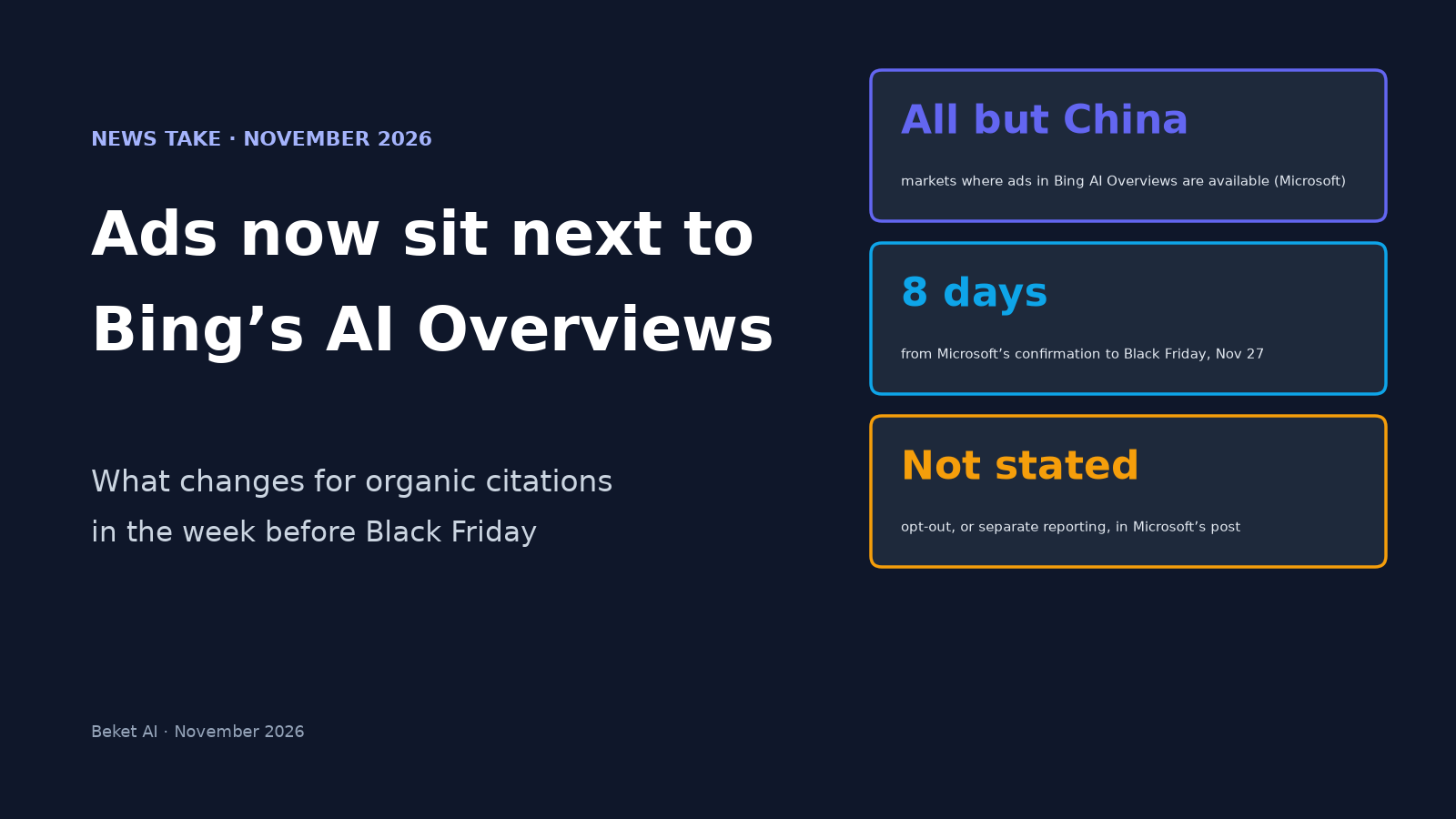
On November 19, 2026, Microsoft said what searchers had been spotting for weeks: ads now run next to AI answers in Bing's AI Overviews. They are available in every market except China, and they run through campaigns advertisers already have. Bing now sits beside Google AI Mode and ChatGPT as an AI answer surface with ads, and it happens eight days before Black Friday.
For brands that rely on being named or cited in those answers, the question is what a paid unit next to the answer does to the organic citations. Microsoft's post doesn't say. This is what it does say, what it leaves open, and what to check this week.
What Microsoft announced
The announcement is in Microsoft Advertising's November product update, published November 19, 2026. Search Engine Roundtable and Search Engine Watch reported the same points. We read Microsoft's post directly. It says:
- Ads can now show next to AI Overviews on Bing. In Microsoft's words: "Your ads can now show up next to AI-powered answers on Bing when your offers are relevant."
- It builds on ads in Copilot. Microsoft calls it "the latest step in bringing ads to AI experiences, building on ads in Copilot."
- There is no separate setup. The ads "run through the campaigns you already use, including Performance Max and AI Max."
- Availability is wide. "Now available in all markets except China."
- Its example is a travel query. Someone asks Bing about a trip to Snowdonia National Park, the AI Overview shows a sample itinerary and travel tips, and a hotel's ad "can appear right next to that answer."
The ads are not entirely new. Search Engine Roundtable reported a first sighting on October 30, and its November 19 story says it started seeing them about three weeks earlier. Microsoft's November update also adds URL inclusions for AI Max, so advertisers can name the pages AI Max may use as landing pages and as a source for ad text.
What Microsoft didn't say
Several things that matter for organic visibility are not in the post:
- Labeling rules. The text doesn't describe how the ads are labeled. Microsoft's example screenshot shows a unit headed "Sponsored," sitting below the answer text and above a row of source cards. That is one mock-up for one query, not a rule.
- An opt-out. The post doesn't say whether an advertiser can exclude AI Overviews. Microsoft's separate help page on ads in Copilot says eligible campaigns are opted in automatically and advertisers cannot opt out of Copilot, but it covers Copilot, not the new AI Overviews placement.
- Reporting. The same help page says Microsoft Advertising doesn't currently support specific metrics for ads served in Copilot. The new post doesn't say whether AI Overview placements are reported separately.
- Position relative to cited sources. Beyond the one example, there is nothing on where the ad sits compared with the pages the answer cites, or whether paid units change which sources are shown.
- Proof the ads work. The only number is that Microsoft data shows "a 21% increase in purchases after a Copilot interaction." Its footnote says that figure comes from Microsoft internal data on global Edge users from December 21 to 31, 2024. It measures purchases after a Copilot interaction, not ads in AI Overviews.
Bing joins Google AI Mode and ChatGPT
All three big AI answer surfaces now carry ads, with different disclosures:
| Bing AI Overviews | Google AI Mode | ChatGPT | |
|---|---|---|---|
| Where | All markets except China (Microsoft, Nov 19) | Expanded to 10 more countries on Oct 28, including Canada; Brazil, Mexico and the UK planned for Q4 (Google) | 89 countries as of Oct 21 (OpenAI) |
| Labeled how | Not described in the text; example image shows "Sponsored" | "Clearly labeled as 'Sponsored'" (Google) | "Clearly labeled and separate from ChatGPT's answers" (OpenAI) |
| Do ads affect the answer? | Not stated | Not stated | "Advertising does not influence the answers ChatGPT provides" (OpenAI) |
Sources: Microsoft Advertising, Google, October 28, 2026, OpenAI, October 21, 2026. Cells marked "not stated" mean we found nothing in that company's announcement, not that the answer is no.
We covered the other two when they launched: ads in Google AI Mode reaching Canada and ChatGPT ads in Canada. Bing is the one where the company hasn't said whether the ad affects the answer.
Why this matters for organic citations
This section is our read, not Microsoft's.
Paid and organic now share one screen. An AI answer used to be a block of text with a few cited links. Now a paid unit can sit in the same view. Google offers a useful signal on how that plays out in its own product: it says click-through rates are "already similar between sponsored and organic product list items within AI Mode" (Google internal data, US, August 20 to September 3, 2026). Google's number is about product items in AI Mode, not Bing, but it shows a sponsored item inside an AI answer can draw clicks much like an organic one.
The timing is shopping season. Black Friday is November 27. Microsoft's own post says most holiday shoppers plan to use conversational AI to help find gift ideas, "including 76% in the US." Its footnote cites Microsoft consumer research with a US sample of 1,024 from July 2026, so treat it as Microsoft's own direction-setting number, not a forecast. Still, if shoppers ask AI Overviews for gift ideas and a retailer's ad can sit next to the answer, the retailers that are cited and the retailers that pay may not be the same.
Bing is tied to Copilot. Search Engine Watch reports that Microsoft's own FAQ describes Bing's AI Overview and AI Mode as both powered by Copilot technology, and the new ads build on Microsoft's ads in Copilot. So Bing is one place where your brand may be named or cited and where a competitor may also be sponsored.
What to check this week
- Look at Bing yourself. Open Bing in a clean browser window and ask your ten most commercial questions the way a buyer would. Note whether an AI Overview appears, whether there is a sponsored unit, where it sits, and which pages are cited. Save a dated screenshot.
- Repeat it on other days. One look is a sample. In our own daily audits, the list of brands named was identical on consecutive days only 30.1% of the time (how often AI answers change). Expect a sponsored unit to come and go too.
- If you advertise on Microsoft, review Performance Max and AI Max now. Microsoft says these campaigns can serve in AI Overviews with no extra setup. Check the final URLs, the ad text and any URL inclusions before November 27, because an AI answer may now sit next to that ad. The Copilot help page says negative keywords apply in Copilot. The new post doesn't say whether the same holds for AI Overviews, so check before relying on it.
- If you don't advertise, there is nothing to switch on. The levers for organic presence stay the same: pages Bing can crawl, and for local businesses an accurate Bing Places listing. Our Bing AI Mode vs Google AI Mode guide covers both.
- Log paid and organic separately. A competitor's ad beside an answer that names you is a different problem from an answer that leaves you out. Record "named in the answer," "cited as a source" and "sponsored" as three columns.
- Don't assume the ad changes the answer. OpenAI says ChatGPT ads don't influence its answers. Microsoft hasn't said either way for Bing. Until it does, treat that as an open question and test it rather than assume.
Beket AI runs unbranded buyer questions across the engines we track (ChatGPT, Gemini, Perplexity, Microsoft Copilot, Google AI Overviews and Google AI Mode) and shows how often your business is named, which sources are cited and how you compare with competitors. A free audit covers 25 prompts on any 3 of the 6 engines. Pro is $49 a month per site with daily re-runs.
What we're checking next
We re-ran our Black Friday shopping study on November 20 and planned to count Bing AI Overview ads against the retailers cited in the same answers. That check couldn't run: Beket AI doesn't have a Bing AI Overview engine, and the Microsoft Copilot run we tried as a stand-in returned no answers. As a substitute, here is what Google AI Mode showed, which we could capture. In 6 of 25 Vancouver shopping answers on November 20, the answer ended with a "Sponsored" block. Those blocks held 12 ads from 10 advertisers. 4 of those advertisers were also named in the answer itself, and 6 appeared only as ads. In Seattle, none of 24 answers had a Sponsored block. That's Google, not Bing, and a single day, so read it as a snapshot.
Caveats
- This post rests on Microsoft's announcement, Microsoft's help documentation, and the Google and OpenAI announcements, all read on November 19, 2026. We have not run our own measurement of ads in Bing AI Overviews, and we haven't reproduced the placement ourselves.
- Microsoft's example is a single travel query. Ads for shopping queries may look or sit differently.
- Microsoft's help page on ads in Copilot is about Copilot. We cite it to show how Microsoft has described its other AI ad placements, not to say the same rules apply to AI Overviews.
- Google's click-through figure is Google's own internal data for AI Mode in the US. The 21% purchase figure and the 76% survey figure are Microsoft's own data, and Microsoft's post gives only brief footnotes on how they were measured.
Related posts
Service Area Pages vs Doorway Pages: What Google Allows and What AI Engines Cite (2026)
Service area pages vs doorway pages: what Google's spam policy says, which city pages AI engines cited in 33 Beket AI local audits, and when to build one.
AI Brand Monitoring: A Weekly Routine to Track What AI Says About Your Brand (2026)
AI brand monitoring as a weekly routine: which prompts to run, which engines to check, what to log, how to triage wrong answers, and the tools that help.
Only 6.9% of ChatGPT Chats Are About Buying. Here's Where AI Visibility Still Matters
SparkToro's panel found 6.9% of ChatGPT conversations show buying intent. Here's what it means for AI visibility, and why Google's AI features matter more.