
ChatGPT Ads in Canada Can Now Rewrite Themselves. They Still Can't Buy You the Answer

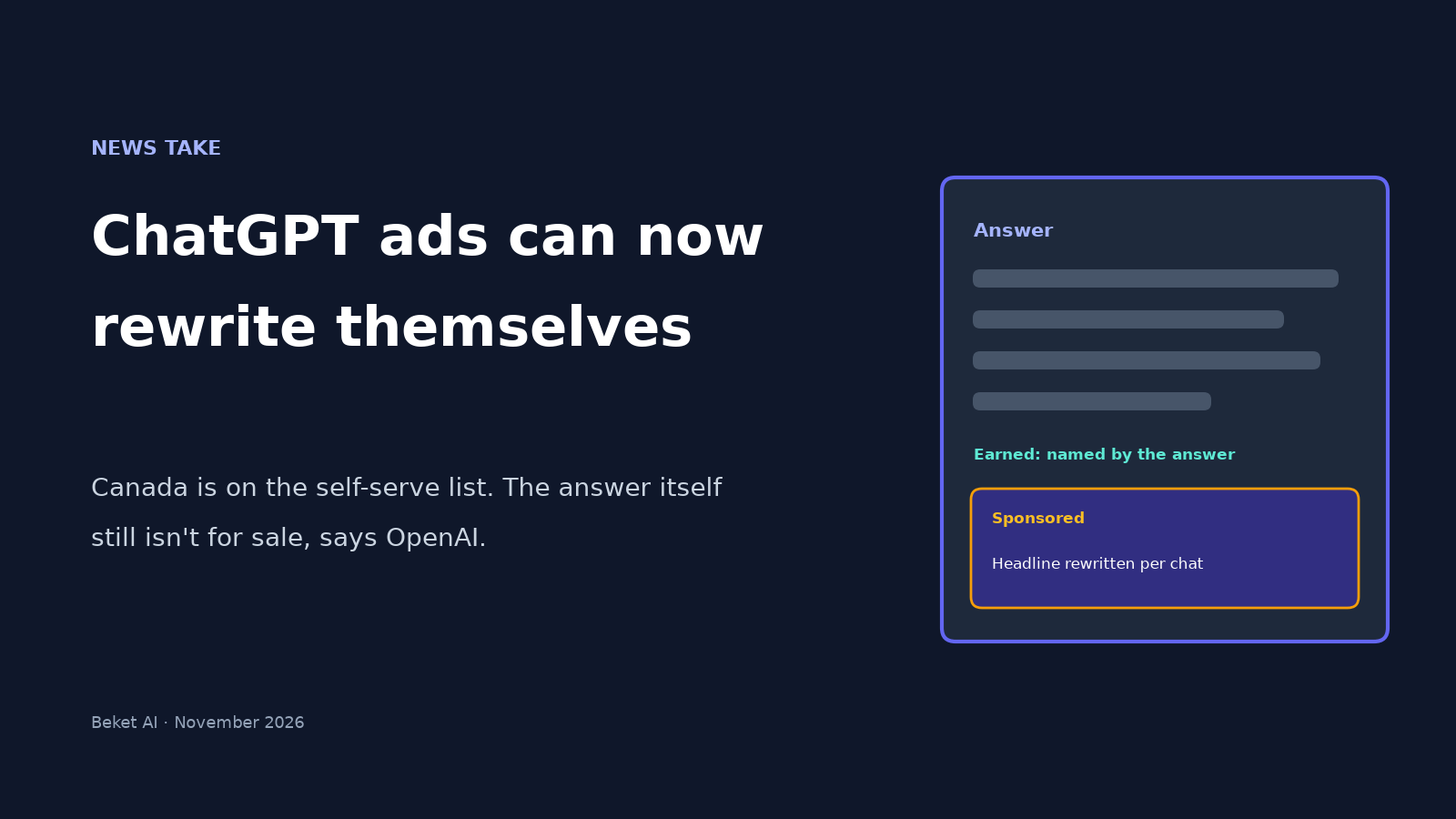
Picture someone in Vancouver asking ChatGPT where to buy a winter jacket before the holidays. The answer names a few stores. Under it, if they’re on a Free or Go plan, there may now be a sponsored card for a store the answer didn’t name, with a headline OpenAI’s system wrote for that exact conversation.
That last part is new. On Friday, October 30, 2026, OpenAI switched on “creative enhancements” by default for every ChatGPT Ads campaign, new and existing, unless the advertiser opted out. The system can now rewrite an ad’s headline and description, translate it, resize its images and send the click to a different page on the advertiser’s site, without the advertiser approving each version.
Canadian businesses can buy these ads themselves. Here is what changed, what OpenAI says it doesn’t change, and what our own audit data says about the part of the answer no one can buy.
What changed on October 30
OpenAI’s help page on creative enhancements for ChatGPT Ads says the feature uses three inputs: the context of the conversation or the user’s interests, the advertiser’s existing ad, and content from the ad’s landing page. From those, the system “may adjust your headlines and descriptions, resize images, optimize destination URLs, or translate ad text.”
Variations “may be prepared in advance or created in real time based on the conversation,” and when the feature is on they “can run automatically without requiring you to review or approve each version.” OpenAI also says the experience “does not provide a preview of every variation.”
| Part of the ad | What OpenAI says can change | Advertiser control |
|---|---|---|
| Headline and description | New or updated text that ties the offer to the conversation | Opt out at account or campaign level in Ads Manager |
| Language | Ad text translated into another language | Same setting |
| Images | Resized to fit the ad format | Same setting |
| Destination URL | Pointed to “a relevant page on your website” | Same setting |
| ChatGPT’s answer | Nothing: “Ads do not influence ChatGPT’s answers” | Not for sale |
Existing opt-outs carry over, and a campaign-level setting overrides the account default, according to the same page.
Two format changes landed the same week. OpenAI’s weekly advertiser email, published by Search Engine Roundtable on October 30, announced a wider standard ad card that uses more of the conversation width on desktop, applied to existing campaigns with no advertiser action needed. And since October 26, a multi-image ad format has been in open beta: 4 to 6 square images, one destination URL, and “Learn more” as the only button.
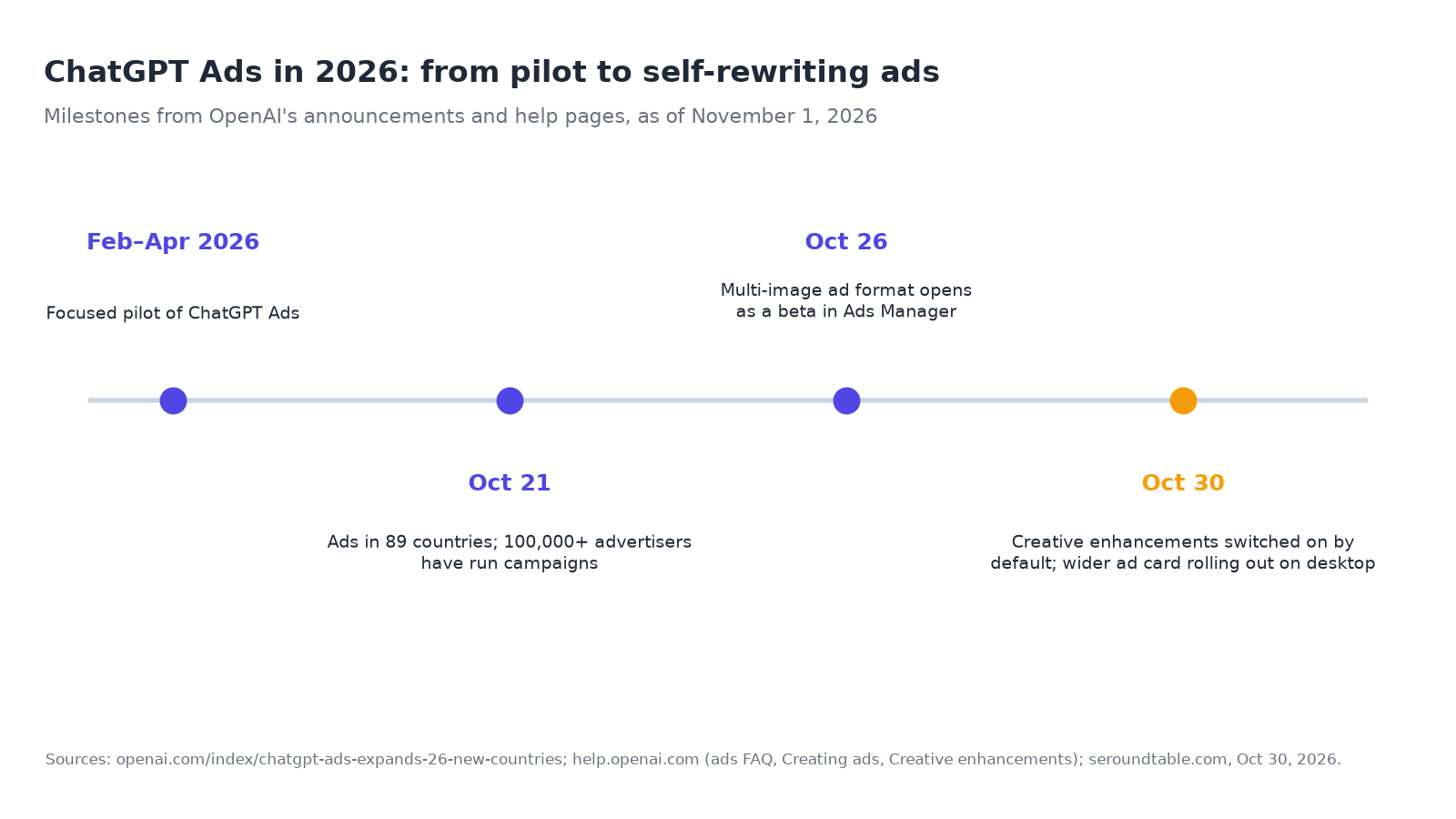
The bigger picture: OpenAI said on October 21 that ChatGPT Ads now runs in 89 countries, that more than 100,000 advertisers have run campaigns since ads launched “just over eight months ago,” and that more than 1.2 billion people use ChatGPT each week. Its ads FAQ still calls the product a beta “in the early stages of scaling,” after a focused pilot from February through April.
Are ChatGPT ads available in Canada?
Yes. Canada is listed as “Available” on OpenAI’s Ads Manager availability page, which means a business can sign up and buy ads itself rather than going through OpenAI’s sales team. The legal entity that advertises and gets billed has to be based in a listed country. Here is what OpenAI’s help pages say about running a campaign from Canada, as of November 1, 2026:
| Question | What OpenAI’s help pages say |
|---|---|
| Minimum budget | 25 CAD per day for accounts billed in Canadian dollars (campaign guide) |
| How you pay | Per 1,000 impressions (Views), per click (Clicks), or a Conversions objective billed per click or per 1,000 impressions; never per conversion |
| Can you target just Vancouver? | For most campaigns, yes: cities, regions and postal codes where available. New product-feed campaigns are country-level only |
| Can a new account target the U.S. too? | Not always. Some new self-serve accounts can only advertise in their home country until identity verification is approved and they reach a required spend there |
| Who sees the ads? | People on the Free and Go plans. Plus, Pro and Enterprise stay ad-free, per OpenAI’s October 21 post |
| Does advertising help you appear in the answer? | No. OpenAI says ads are “clearly labeled and separate from ChatGPT’s answers” |
One more line in OpenAI’s ad guidelines is worth knowing even if you never advertise: landing pages “must not block OpenAI user agents (OAI-AdsBot and OAI-SearchBot).” OAI-SearchBot is also the crawler that lets ChatGPT search find your pages in the first place. If you’ve been tightening robots.txt or firewall rules, our guide to which AI crawlers to allow in robots.txt covers which bots to keep open.
The free slot: what ChatGPT already names in Vancouver
OpenAI is drawing a hard line between the sponsored card and the answer above it. So what does the unpaid part look like for local shopping questions?
On October 29, 2026, Beket AI ran unbranded market audits in Vancouver and Seattle for our Black Friday shopping study: 25 shopping questions per city, such as “where to buy a winter jacket in Vancouver” and “best toy store in Vancouver,” plus 4 discovery questions the audit added on its own. Looking only at ChatGPT’s answers from those runs:
- Vancouver: ChatGPT answered all 29 questions and named 30 businesses at least twice, for 128 mentions. Local independents and national chains took 42 mentions each (33%), and markets and fairs took 38 (30%). The most-named were Circle Craft (16), Best Buy (14), Portobello West (13), MEC (9), Vancouver Christmas Market (7) and Valhalla Pure Outfitters (6).
- Seattle: ChatGPT named 72 businesses at least twice, for 367 mentions. Local independents had the largest share, 133 mentions (36%), ahead of national chains at 122 (33%).
- Links were optional. ChatGPT answered 10 of the 29 Vancouver questions and 7 of the 29 Seattle questions with no source links at all.
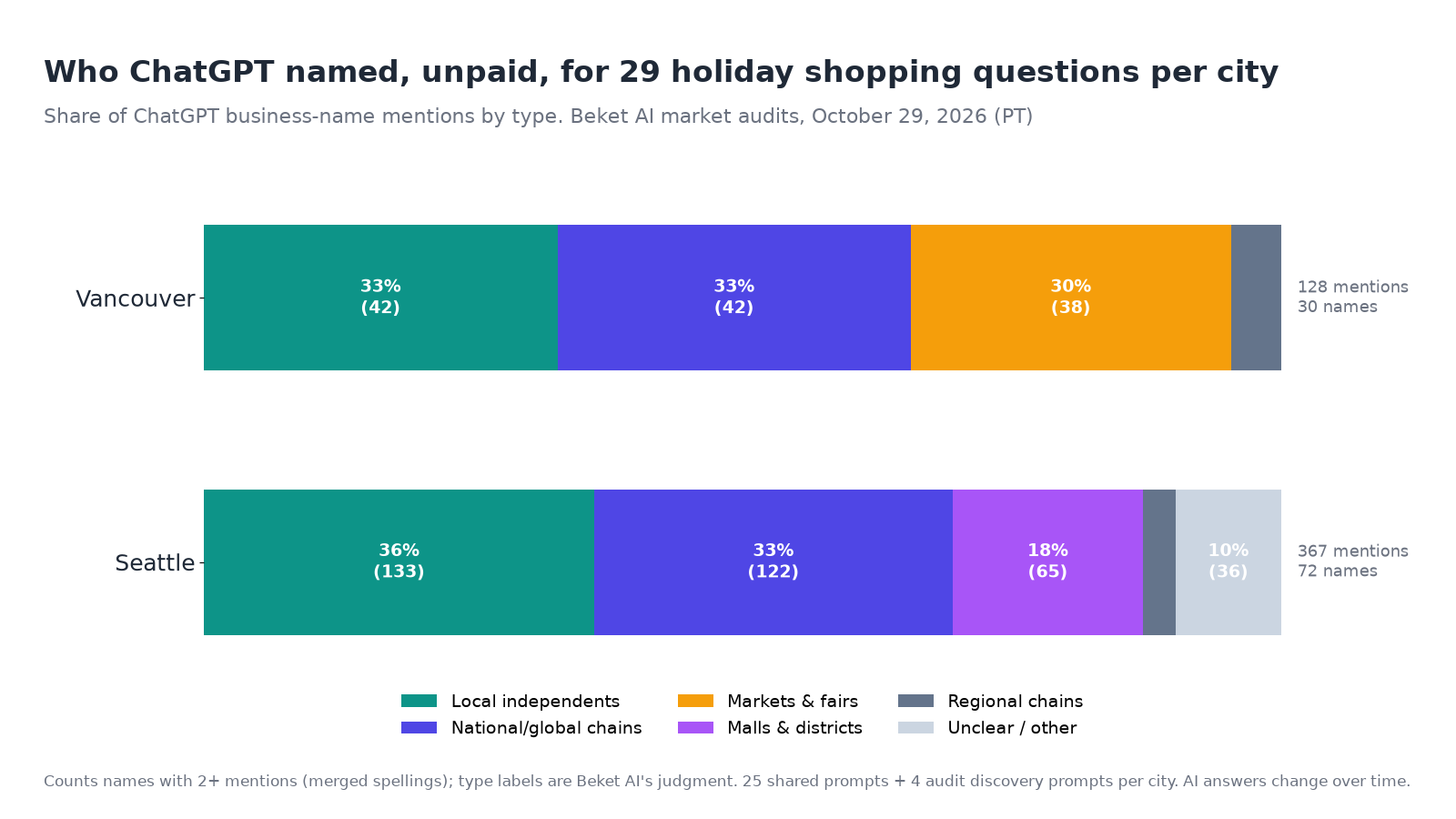
About a third of ChatGPT’s mentions in both cities went to local independents. By OpenAI’s own rules, that placement isn’t something an ad budget can buy. The flip side: any store in those categories can now pay to sit directly under an answer that named its competitors.
A few limits on this data. It’s one run per city on one evening, in the shopping categories we picked. The counts only include businesses named twice or more, and the type labels are our judgment. Beket AI’s audits record the answer text, not any ad that may appear next to it, so this tells you who was named, not who advertised. AI answers change over time; this is what ChatGPT returned on October 29.
What an early study says the paid slot is worth
The first independent numbers on ChatGPT ads aren’t flattering for advertisers. A working paper published in October by researchers at WU Vienna and Frankfurt School of Finance & Management, reported by Search Engine Land on November 2, analyzed nearly 10 billion sessions across 1,898 websites from June 2025 through August 2026. In U.S. traffic, paid ChatGPT visits were worth well under half of a Google Search ad visit:
| Paid ChatGPT visits | Google Search ads | |
|---|---|---|
| Revenue per session | $0.89 | $2.45 |
| Conversion rate | 0.37% | 1.17% |
- Most advertisers saw the gap. Of 87 advertisers using both channels, 97% earned less revenue per ChatGPT visit.
- The price would have to fall a lot. The researchers estimated ChatGPT clicks would need to cost about $0.26 to match Google Search’s return on ad spend. One publicly disclosed ChatGPT advertiser reported paying $1.72 per click.
- Unpaid referrals may have dipped. Unpaid ChatGPT referrals fell an estimated 5.9% in the first 13 weeks after ads launched, compared with markets without ads, but that drop wasn’t statistically significant. After the researchers adjusted for assumed differences in regional ChatGPT growth, the estimate rose to 7.2% to 8.4%, which was significant under the study’s assumptions.
Read it as an early signal, not a verdict. The study is observational, the paid comparison used a smaller sample, the revenue figures are for U.S. traffic, and revenue attributed to a visit can miss purchases made later. It also covers a product OpenAI still calls a beta, before the October 30 changes.
For a Canadian business, the direction is still useful. Being named in ChatGPT’s answer is likely worth more than the sponsored card under it, and ads may take a share of the organic clicks that answer used to send. If you test ads anyway, compare revenue per click with what you pay per click, not just click volume. And even when no one clicks, being named counts, which we explain in what zero-click search is.
ChatGPT isn’t the only answer with a paid slot
In the same week, all three big AI search platforms made news for paid placements in or beside their answers:
- Google AI Mode is bringing ads to Canada and nine other countries, announced October 28. We covered what that means locally in ads in Google AI Mode coming to Canada.
- Bing was seen showing sponsored results inside its Copilot-powered AI Overviews in a screenshot shared on X, reported by Search Engine Roundtable on October 30. Treat that one as a limited sighting: the reporter said he couldn’t trigger the ads himself.
- ChatGPT now runs ads in 89 countries, and as of October 30 can reword them for each conversation.
The common thread: the answer is becoming a two-part page, with an earned part and a paid part. Measuring only one of them gives you half the picture. One way to track the earned part over time is AI share of voice: how often you’re named compared with competitors.
What to do this week
If you run ChatGPT ads:
- Open Ads Manager and decide on creative enhancements at the campaign level, not just the account default. OpenAI says campaign settings win.
- Audit your landing pages. Enhancements draw on landing-page content, so an old price, a finished promotion or a discontinued product can end up in an ad you never saw. OpenAI’s own advice is to keep prices, promotions, product details and availability current.
- Watch performance by ad and campaign in Ads Manager reporting. OpenAI notes that changes over time don’t, on their own, prove what creative enhancements did, and the FAQ says there are no performance benchmarks across advertisers yet.
If you don’t run ads (or do and also care about the answer):
- Make sure OAI-SearchBot isn’t blocked by robots.txt, a firewall or bot protection.
- Ask ChatGPT the questions your customers ask, without your business name, and note who gets named. Run it more than once, and on more than one engine.
- Treat being named as its own channel. You can’t buy your way into the answer, and a competitor’s ad now sits under it either way.
Step 2 is what Beket AI does at scale. A free Beket AI audit runs 25 prompts across 3 AI engines and shows whether your business is named and which competitors appear in the same answers. Beket AI Pro is $49 a month, re-audits daily and starts at 50 prompts across 3 engines, so you can see whether the earned part of the answer holds up as ads roll in around it. If you’re a business that appeared in our audit data and want another run, get in touch.
Related posts
How to Verify Googlebot, GPTBot and Other AI Crawlers (and Catch the Fakes)
Anyone can call their bot Googlebot or GPTBot. How to verify real AI crawlers with official IP lists and reverse DNS, block fakes, and keep real ones in.
Reddit Says Google's AI Mode Doesn't Send Traffic. What That Means for a Local Business That Gets Cited
Reddit says Google's AI Mode doesn't drive traffic and will test a login wall. What that means for local businesses named in AI answers, and what to measure.
Should Nonprofits Optimize Reports and White Papers for AI Citations?
Yes, with nuance. What a 25-question audit of ChatGPT, Perplexity and Google AI shows about which reports get cited, and how to make yours easier to cite.